
Verwandte Artikel zu Interpretation Radical but Not Unruly: The New Puzzle...
Inhaltsangabe
With this challenging work, Joseph Margolis continues the project begun in The Flux of History and the Flux of Science (California, 1993). Tackling one of philosophy's master themes, he develops the controversial thesis that the world is a flux. Here he applies this doctrine to Western theories of history and the interpretation of cultural phenomena--offering the first sustained analysis of the logic, methodology, and metaphysics of interpretation committed to a thoroughgoing relativism and the historicized structure of cultural phenomena. Versed in Anglo-American and Continental philosophy, Margolis draws on the best views of Western philosophy to investigate a topic regularly ignored in that tradition. The result is the surprising synthesis of two historically antipathetic approaches to philosophy.
Die Inhaltsangabe kann sich auf eine andere Ausgabe dieses Titels beziehen.
Über die Autorin bzw. den Autor
Joseph Margolis, Laura H. Carnell Professor of Philosophy at Temple University, is the author of more than thirty books.
Von der hinteren Coverseite
"The wide ranging investigation presented in Margolis's books provide a comprehensive and unequalled view of intellectual and artistic pursuits. . . . Some readers will be convinced by the author's arguments, others will be prompted to provide a better defense of their own views; all will gain by arguing with these books."—Laurent Stern, Rutgers University
Aus dem Klappentext
"The wide ranging investigation presented in Margolis's books provide a comprehensive and unequalled view of intellectual and artistic pursuits. . . . Some readers will be convinced by the author's arguments, others will be prompted to provide a better defense of their own views; all will gain by arguing with these books." Laurent Stern, Rutgers University
Auszug. © Genehmigter Nachdruck. Alle Rechte vorbehalten.
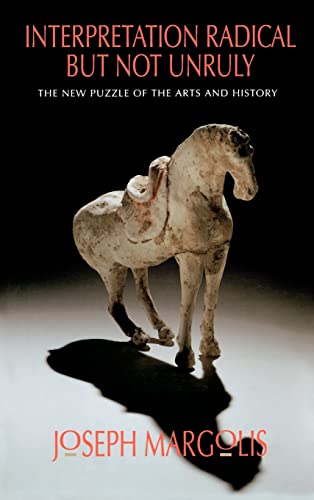
Interpretation Radical but Not Unruly: The New Puzzle of the Arts and History
By Joseph MargolisUniversity of California Press
Copyright © 1995 Joseph MargolisAll right reserved.
ISBN: 0520087690
Chapter 1
Reinterpreting Interpretation
I
Give or take a little in the way of precision, there are at least three bits of advice that ought not be ignored in constructing a theory of interpretation of any size. First, it is impossible to disjoin the account of the nature or logic of interpretation from one's theory of the nature of what it is that may or must be submitted to interpretation. Second, there are only two sorts of pertinent theories of interpretation. One holds that interpretation is practiced on relatively stable, antecedently specifiable referents of some sort, and that the requisite account identifies the practice by which distributed claims about them are responsibly assigned truth-like values of some sort; the other holds that interpretation is a productive practice by which an entire "world" or what may be distributively referred to in that world is or are actually and aptly first constituted (not ex nihilo or by pure fancy but by Intentional technologies, by painting and sculpture, for instance) for certain further claims or use, possibly for interpretation in the first sense—but in ways that may be affected by referential puzzles due to the ongoing interpretation or reinterpretation of what has already been "constituted." These are not yet theories in their own right, I admit, but they are remarkably economical directives about what to explore. (They are no more than promises, of course.) The first sort of theory identifies the traditional genus of interpretation; the second is notably, even peculiarly, fashionable in our own time and is sometimes thought to disallow theories of the first sort.
The second option, separated from the first or some analogue of the first, cannot possibly be right, for the simple reason that there is no socially sustained discourse that does not provide for orderly reference and predication. Since that is so, the extreme contemporary worry that we may have to abandon altogether statement, assertion, judgment, claim, and the like on the grounds of the need to avoid any and all forms of cognitive privilege or transparency is a conceptually extravagant retreat that misses the point of the ineliminability of effective reference. One cannot do without reference, predication, description, interpretation, explanation, analysis, evaluation, although saying that disallows nothing in the way of arguable views about what may be described or interpreted or how description and interpretation actually proceed. The point would be entirely trivial except for the annoying fact that it is no longer unusual to hear it denied or implicitly rejected.
In any case, the first sort of theory is the classic one. It admits the complexity of what we interpret, but it does not extend the notion of interpretation to include the very constitution of that. It ranges over properties, but it does not extend to realism itself. In contemporary exchange, however, the cognitive intransparency of the world and the symbiosis of world and word oblige us to make room for theories of the second sort. (Bear in mind that I am using the terms "intransparency" and "symbiosis" in the sense marked in the Introduction. I do not deny that that sense may be challenged.) Characteristically, the work of such theories is inseparably linked to the viability of the work of theories of the first sort. You can appreciate, therefore, that the barest beginning of an account of interpretation plunges us at once into a conceptual swamp. For how can we interpret what has yet to be constituted and how can anything be constituted by way of interpretation? Still, there are no interesting theories of interpretation in our own time that do not—or will not—consider combining both senses of "interpret."
The third bit of advice reminds us that, whatever the slackness of linguistic usage, what are interpreted in either of the senses given are distinctly cultural (Intentional) phenomena of some sort, interpretable just in virtue of their having cultural features or because they are treated as having such features or because they have features sufficiently like cultural features to warrant being similarly treated.
These are all, of course, deliberately elusive but quite safe initial pronouncements that convey an air of imminent system and scope and a promise of detail that a streetwise audience is likely to be polite and
patient enough about while awaiting full delivery from the vendor. Also, it is not likely to be ignored that, regarding all three bits of advice taken together, the first sort of theory of interpretation identifies referents conceptually apt in some antecedent sense for interpretation, whereas the second sort of theory treats interpretation as a process of actually constituting things by interpretation, by a constructive activity by which certain phenomena or entities are first and merely posited. There need be no incompatibility or equivalence between these two sorts of theory. The kind of contribution the first might make can hardly be supposed to be entailed or precluded by the work of the second; and the point of the second would be entirely lost if it did not accommodate some form of the work of the first. Both are keyed to what would be distinctive of any plausibly realist account of the cultural world in a way that need yield nothing in favor of, or against, the reality of mere physical nature. The simple point is that to say that reality is "constituted" is to say at least that there is no principled distinction between the structure of the world and the structure of our conceptual schemes that must be in place prior to inquiry or that is reliably disclosed, within inquiry, to be such. It is entirely open to us (presumably that is the work of science) to propose (interpretively) what, within the terms of inquiry, we should treat as real or "independent" of inquiry. Hence, to admit that the world is in some sense artifactual is hardly to deny that its structures are real or to affirm that it is a mere fiction. (This is an accommodation of the supreme Kantian thesis. Of course it need not adopt what I construe to be Kant's undefended alternative to "symbiosis.")
I have moved rather quickly, here, into the neighborhood of the principal puzzles of interpretation that have taxed the most recent accounts in the arts and history, without much of a preamble. In that sense, what has so far been said is no more than a small clue, a warning of matters we must return to in good time. Still, there is an advantage in its being made at once clear that the question of the logic of interpretation is now very different from what it had been taken to be as recently as thirty or forty years ago. Also, this local change depends, we may anticipate, on larger conceptual changes that have affected the whole discourse of philosophy and science. In focusing on interpretation, then, I believe I am featuring the most strategically placed cognitive ingredient of the entire set of conceptual questions that confront us in a fresh way at the end of the century. What they are and how they are linked to the puzzle of interpretation have yet to be told. They
invite a certain patience and generosity of vision. For the idiom that favors the older account has not yet accommodated the new puzzle,...
„Über diesen Titel“ kann sich auf eine andere Ausgabe dieses Titels beziehen.
Suchergebnisse für Interpretation Radical but Not Unruly: The New Puzzle...

Beispielbild für diese ISBN
Interpretation Radical But Not Unruly: The New Puzzle of the Arts and History
Verlag:
University of California Press, 1995
ISBN 10: 0520087690
ISBN 13: 9780520087699
Gebraucht
Hardcover
Anbieter: ThriftBooks-Dallas, Dallas, TX, USA
Verkäuferbewertung 5 von 5 Sternen

Hardcover. Zustand: Very Good. No Jacket. Missing dust jacket; May have limited writing in cover pages. Pages are unmarked. ~ ThriftBooks: Read More, Spend Less. Artikel-Nr. G0520087690I4N01
Gebraucht kaufen
EUR 13,17
Versand gratis
Versand innerhalb von USA
Versand innerhalb von USA
Anzahl: 1 verfügbar
Beispielbild für diese ISBN
Interpretation Radical but Not Unruly: The New Puzzle of the Arts and History
Verlag:
University of California Press, 1995
ISBN 10: 0520087690
ISBN 13: 9780520087699
Gebraucht
Hardcover
Erstausgabe
Anbieter: Powell's Bookstores Chicago, ABAA, Chicago, IL, USA
Verkäuferbewertung 5 von 5 Sternen
hardcover. Zustand: Used-Very Good. First Edition. Cloth, no dj. Slight shelf-wear, else very sound. Artikel-Nr. 1977287
Gebraucht kaufen
EUR 9,28
EUR 6,44 Versand
Versand innerhalb von USA
Versand innerhalb von USA
Anzahl: 1 verfügbar
Beispielbild für diese ISBN
Interpretation Radical but not Unruly: The New Puzzle of the Arts and History.
Verlag:
University of California Press, 1995
ISBN 10: 0520087690
ISBN 13: 9780520087699
Gebraucht
Hardcover
Anbieter: G. & J. CHESTERS, TAMWORTH, Vereinigtes Königreich
Verkäuferbewertung 5 von 5 Sternen
Hardcover. Zustand: Fine. Dust Jacket Included. 312 pages, a Fine hardback in a fine dust-jacket [0520087690]. Artikel-Nr. 45443
Gebraucht kaufen
EUR 13,39
EUR 8,17 Versand
Versand von Vereinigtes Königreich nach USA
Versand von Vereinigtes Königreich nach USA
Anzahl: 1 verfügbar
Foto des Verkäufers
INTERPRETATION RADICAL BUT NOT UNRULY The New Puzzle of the Arts and HIstory
Verlag:
University of California Press, Berkeley etc., 1995
ISBN 10: 0520087690
ISBN 13: 9780520087699
Gebraucht
Hardcover
Anbieter: Douglas Books, Tunbridge Wells, Vereinigtes Königreich
Verkäuferbewertung 4 von 5 Sternen

Hardcover. Zustand: Fine. Zustand des Schutzumschlags: Fine. 1st ed. Black cloth. xiii+312; virtually pristine copy in similar jacket. Note: quoted non-UK shipping rates are calculated for 500-700 gram net weight, cost will be modified up or down as appropriate outside this range. Artikel-Nr. 007166
Gebraucht kaufen
EUR 14,42
EUR 25,67 Versand
Versand von Vereinigtes Königreich nach USA
Versand von Vereinigtes Königreich nach USA
Anzahl: 1 verfügbar
Foto des Verkäufers
Interpretation Radical but not Unruly: The new puzzle of the arts and history
Verlag:
University of California Press: Berkeley, 1995, 1995
ISBN 10: 0520087690
ISBN 13: 9780520087699
Gebraucht
Hardcover
Erstausgabe
Anbieter: Antiquariaat Fenix, Amsterdam, Niederlande
Verkäuferbewertung 5 von 5 Sternen
Zustand: Good. Bound with dustwrapper, 312pp. 1st printing. Notes. 15x23x2,3cm. Slight signs of use wrapper, in very good condition. Artikel-Nr. 45702
Gebraucht kaufen
EUR 18,00
EUR 31,50 Versand
Versand von Niederlande nach USA
Versand von Niederlande nach USA
Anzahl: 1 verfügbar
Beispielbild für diese ISBN
Interpretation Radical but Not Unruly
Verlag:
University of California Press, 1995
ISBN 10: 0520087690
ISBN 13: 9780520087699
Neu
Hardcover
Anbieter: PBShop.store UK, Fairford, GLOS, Vereinigtes Königreich
Verkäuferbewertung 5 von 5 Sternen
HRD. Zustand: New. New Book. Shipped from UK. Established seller since 2000. Artikel-Nr. WF-9780520087699
Neu kaufen
EUR 58,26
EUR 5,86 Versand
Versand von Vereinigtes Königreich nach USA
Versand von Vereinigtes Königreich nach USA
Anzahl: 1 verfügbar
Beispielbild für diese ISBN
Interpretation Radical but Not Unruly: The New Puzzle of the Arts and History
Verlag:
University of California Press, 1995
ISBN 10: 0520087690
ISBN 13: 9780520087699
Neu
Hardcover
Anbieter: Kennys Bookstore, Olney, MD, USA
Verkäuferbewertung 5 von 5 Sternen
Zustand: New. Tackling one of philosophy's key themes, this book develops the controversial thesis that the world is a flux. It applies this doctrine to Western theories of history and the interpretation of cultural phenomena, offering analysis of the logic, methodology and metaphysics of interpretation. Num Pages: 328 pages, black & white illustrations. BIC Classification: HPCF. Category: (P) Professional & Vocational. Dimension: 229 x 152 x 26. Weight in Grams: 481. . 1995. First Edition. Hardcover. . . . . Books ship from the US and Ireland. Artikel-Nr. V9780520087699
Neu kaufen
EUR 67,33
EUR 9,01 Versand
Versand innerhalb von USA
Versand innerhalb von USA
Anzahl: 1 verfügbar
Beispielbild für diese ISBN
Interpretation Radical but Not Unruly: The New Puzzle of the Arts and History
Verlag:
University of California Press, 1995
ISBN 10: 0520087690
ISBN 13: 9780520087699
Neu
Hardcover
Anbieter: Ria Christie Collections, Uxbridge, Vereinigtes Königreich
Verkäuferbewertung 5 von 5 Sternen
Zustand: New. In. Artikel-Nr. ria9780520087699_new
Neu kaufen
EUR 62,76
EUR 13,98 Versand
Versand von Vereinigtes Königreich nach USA
Versand von Vereinigtes Königreich nach USA
Anzahl: Mehr als 20 verfügbar
Beispielbild für diese ISBN
Interpretation Radical but Not Unruly: The New Puzzle of the Arts and History
Verlag:
Univ of California Pr on Demand, 1995
ISBN 10: 0520087690
ISBN 13: 9780520087699
Neu
Hardcover
Anbieter: Revaluation Books, Exeter, Vereinigtes Königreich
Verkäuferbewertung 5 von 5 Sternen
Hardcover. Zustand: Brand New. 328 pages. 9.25x6.50x1.00 inches. In Stock. Artikel-Nr. x-0520087690
Neu kaufen
EUR 101,45
EUR 14,58 Versand
Versand von Vereinigtes Königreich nach USA
Versand von Vereinigtes Königreich nach USA
Anzahl: 2 verfügbar
Beispielbild für diese ISBN
Interpretation Radical but Not Unruly : The New Puzzle of the Arts and History
Anbieter: Buchpark, Trebbin, Deutschland
Verkäuferbewertung 5 von 5 Sternen
Zustand: Gut. Zustand: Gut | Seiten: 328 | Sprache: Englisch | Produktart: Bücher | Keine Beschreibung verfügbar. Artikel-Nr. 1403386/3
Gebraucht kaufen
EUR 16,04
EUR 105,00 Versand
Versand von Deutschland nach USA
Versand von Deutschland nach USA
Anzahl: 1 verfügbar