
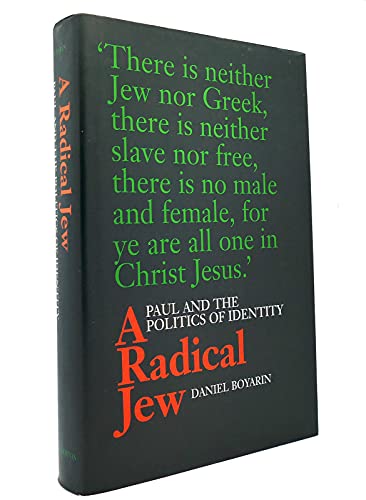
A Radical Jew: Paul and the Politics of Identity (Contraversions : Critical Studies in Jewish Literature, Culture, and Society, No 1, Band 1) - Hardcover
Inhaltsangabe
Daniel Boyarin turns to the Epistles of Paul as the spiritual autobiography of a first-century Jewish cultural critic. What led Paul—in his dramatic conversion to Christianity—to such a radical critique of Jewish culture?
Paul's famous formulation, "There is neither Jew nor Greek, no male and female in Christ," demonstrates the genius of Christianity: its concern for all people. The genius of Judaism is its validation of genealogy and cultural, ethnic difference. But the evils of these two thought systems are the obverse of their geniuses: Christianity has threatened to coerce universality, while ethnic difference is one of the most troubled issues in modern history.
Boyarin posits a "diaspora identity" as a way to negotiate the pitfalls inherent in either position. Jewishness disrupts categories of identity because it is not national, genealogical, or even religious, but all of these, in dialectical tension with one another. It is analogous with gender: gender identity makes us different in some ways but not in others.
An exploration of these tensions in the Pauline corpus, argues Boyarin, will lead us to a richer appreciation of our own cultural quandaries as male and female, gay and straight, Jew and Palestinian—and as human beings.
Paul's famous formulation, "There is neither Jew nor Greek, no male and female in Christ," demonstrates the genius of Christianity: its concern for all people. The genius of Judaism is its validation of genealogy and cultural, ethnic difference. But the evils of these two thought systems are the obverse of their geniuses: Christianity has threatened to coerce universality, while ethnic difference is one of the most troubled issues in modern history.
Boyarin posits a "diaspora identity" as a way to negotiate the pitfalls inherent in either position. Jewishness disrupts categories of identity because it is not national, genealogical, or even religious, but all of these, in dialectical tension with one another. It is analogous with gender: gender identity makes us different in some ways but not in others.
An exploration of these tensions in the Pauline corpus, argues Boyarin, will lead us to a richer appreciation of our own cultural quandaries as male and female, gay and straight, Jew and Palestinian—and as human beings.
Die Inhaltsangabe kann sich auf eine andere Ausgabe dieses Titels beziehen.
Über die Autorin bzw. den Autor
Daniel Boyarin is Taubman Professor of Talmudic Culture at the University of California, Berkeley. He is the author of Carnal Israel: Reading Sex in Talmudic Culture (California, 1993).
Von der hinteren Coverseite
"A splendid piece of work: learned, witty, wide-ranging in its understanding of religion as a cultural phenomenon, passionate in its concern for the ethical implications of our reading of ancient texts."—Richard B. Hays, author of Echoes of Scripture in the Letters of Paul
"Boyarin's bracing argument turns us into strangers to ourselves, as the first century comes uncannily close to the twenty-first century. The importance of this stimulating and controversial book lies in promoting an awareness of the possibilities of solidarity, justice, and liberation in the time of the culture wars."—Homi K. Bhabha, author of The Location of Culture
"Brilliant, thought-provoking and outrageous (a compliment in my lexicon). Demonstrates very clearly the merits of a Jewish look at Paul (that is, a Jew looking at Paul in his Jewishness)."—Adele Reinhartz, McMaster University
"Boyarin has mastered the literature of Paul in amazing detail and devastating understanding. His analytic skills are honed to perfection on the stone of critical theory. As a Jewish reader of a foundational Christian text, he has explained to Christians the power of Paul's thinking for Christians."—Burton L. Mack, author of Myth of Innocence: Mark and Christian Origins
"This book is a polemic for difference based on genealogical memory as a creative force in the broadest human solidarity. In that sense it is a moral or philosophical tractate, what Boyarin calls cultural criticism, as well as an analysis of Paul's position. I have been greatly informed by a reading of this study."—Antoinette Wire, author of The Corinthian Woman Prophets
"Boyarin weighs in with his usual éclat . . . reading the Epistles as if they were contributions to contemporary debates over the issues of feminism, multiculturalism, Zionism, identity politics, and deconstruction, and reading these as if they were germane to an understanding of the Epistles. The book is a tour de force of PoMo criticism, and required reading for anyone interested in the history of religion, Judaism, Christianity, Western culture, 'Orientalism,' identity politics, feminism—and the list could go on."—Hayden White, author of Metahistory
"Boyarin's bracing argument turns us into strangers to ourselves, as the first century comes uncannily close to the twenty-first century. The importance of this stimulating and controversial book lies in promoting an awareness of the possibilities of solidarity, justice, and liberation in the time of the culture wars."—Homi K. Bhabha, author of The Location of Culture
"Brilliant, thought-provoking and outrageous (a compliment in my lexicon). Demonstrates very clearly the merits of a Jewish look at Paul (that is, a Jew looking at Paul in his Jewishness)."—Adele Reinhartz, McMaster University
"Boyarin has mastered the literature of Paul in amazing detail and devastating understanding. His analytic skills are honed to perfection on the stone of critical theory. As a Jewish reader of a foundational Christian text, he has explained to Christians the power of Paul's thinking for Christians."—Burton L. Mack, author of Myth of Innocence: Mark and Christian Origins
"This book is a polemic for difference based on genealogical memory as a creative force in the broadest human solidarity. In that sense it is a moral or philosophical tractate, what Boyarin calls cultural criticism, as well as an analysis of Paul's position. I have been greatly informed by a reading of this study."—Antoinette Wire, author of The Corinthian Woman Prophets
"Boyarin weighs in with his usual éclat . . . reading the Epistles as if they were contributions to contemporary debates over the issues of feminism, multiculturalism, Zionism, identity politics, and deconstruction, and reading these as if they were germane to an understanding of the Epistles. The book is a tour de force of PoMo criticism, and required reading for anyone interested in the history of religion, Judaism, Christianity, Western culture, 'Orientalism,' identity politics, feminism—and the list could go on."—Hayden White, author of Metahistory
Aus dem Klappentext
"A splendid piece of work: learned, witty, wide-ranging in its understanding of religion as a cultural phenomenon, passionate in its concern for the ethical implications of our reading of ancient texts."Richard B. Hays, author ofEchoes of Scripture in the Letters of Paul
"Boyarin's bracing argument turns us into strangers to ourselves, as the first century comes uncannily close to the twenty-first century. The importance of this stimulating and controversial book lies in promoting an awareness of the possibilities of solidarity, justice, and liberation in the time of the culture wars."Homi K. Bhabha, author ofThe Location of Culture
"Brilliant, thought-provoking and outrageous (a compliment in my lexicon). Demonstrates very clearly the merits of a Jewish look at Paul (that is, a Jew looking at Paul in his Jewishness)."Adele Reinhartz, McMaster University
"Boyarin has mastered the literature of Paul in amazing detail and devastating understanding. His analytic skills are honed to perfection on the stone of critical theory. As a Jewish reader of a foundational Christian text, he has explained to Christians the power of Paul's thinking for Christians."Burton L. Mack, author of Myth of Innocence: Mark and Christian Origins
"This book is a polemic for difference based on genealogical memory as a creative force in the broadest human solidarity. In that sense it is a moral or philosophical tractate, what Boyarin calls cultural criticism, as well as an analysis of Paul's position. I have been greatly informed by a reading of this study."Antoinette Wire, author ofThe Corinthian Woman Prophets
"Boyarin weighs in with his usual éclat . . . reading the Epistles as if they were contributions to contemporary debates over the issues of feminism, multiculturalism, Zionism, identity politics, and deconstruction, and reading these as if they were germane to an understanding of the Epistles. The book is a tour de force of PoMo criticism, and required reading for anyone interested in the history of religion, Judaism, Christianity, Western culture, 'Orientalism,' identity politics, feminismand the list could go on."Hayden White, author of Metahistory
"Boyarin's bracing argument turns us into strangers to ourselves, as the first century comes uncannily close to the twenty-first century. The importance of this stimulating and controversial book lies in promoting an awareness of the possibilities of solidarity, justice, and liberation in the time of the culture wars."Homi K. Bhabha, author ofThe Location of Culture
"Brilliant, thought-provoking and outrageous (a compliment in my lexicon). Demonstrates very clearly the merits of a Jewish look at Paul (that is, a Jew looking at Paul in his Jewishness)."Adele Reinhartz, McMaster University
"Boyarin has mastered the literature of Paul in amazing detail and devastating understanding. His analytic skills are honed to perfection on the stone of critical theory. As a Jewish reader of a foundational Christian text, he has explained to Christians the power of Paul's thinking for Christians."Burton L. Mack, author of Myth of Innocence: Mark and Christian Origins
"This book is a polemic for difference based on genealogical memory as a creative force in the broadest human solidarity. In that sense it is a moral or philosophical tractate, what Boyarin calls cultural criticism, as well as an analysis of Paul's position. I have been greatly informed by a reading of this study."Antoinette Wire, author ofThe Corinthian Woman Prophets
"Boyarin weighs in with his usual éclat . . . reading the Epistles as if they were contributions to contemporary debates over the issues of feminism, multiculturalism, Zionism, identity politics, and deconstruction, and reading these as if they were germane to an understanding of the Epistles. The book is a tour de force of PoMo criticism, and required reading for anyone interested in the history of religion, Judaism, Christianity, Western culture, 'Orientalism,' identity politics, feminismand the list could go on."Hayden White, author of Metahistory
Auszug. © Genehmigter Nachdruck. Alle Rechte vorbehalten.
A Radical Jew: Paul and the Politics of Identity
By Daniel BoyarinUniversity of California Press
Copyright © 1994 Daniel BoyarinAll right reserved.
ISBN: 0520085922
Introduction Wrestling with Paul
You will surely not find it strange that this subject, so profound and difficult, should bear various interpretations, for it will not impair the face of the argument with which we are here concerned. Either explanation may be adopted.
This book is the record of an encounter with some of the most remarkable texts in the canon of western literature, the letters of Paul. If one measure of the greatness of a work of literature is its ability to support many interpretations, then certainly these texts must rank among the very greatest of literature, for they have spawned and continue to spawn—anew every morning—not only new interpretations of particular passages but entirely new constructions of their complete thought-world. Here, then, you have a talmudist and postmodern Jewish cultural critic reading Paul. I think that my particular perspective as a practicing Jewish, non-Christian, critical but sympathetic reader of Paul conduces me to ways of understanding his work that are necessarily different from the ways of readers of other cultural stances. This text fits into the tradition, then, of what has come to be called cultural readings of the Bible, readings that are openly informed by the cultural knowledge and subject-positions of their producers.
I am going to begin this introduction by asking a question that I fantasize will be asked by many of my readers: What motivated a scholar of Talmud, virtually untrained in New Testament scholarship, to produce an essay about Paul? What is my purpose in writing this book? What, indeed, beyond the sensual pleasure of learning, impelled me to learn Greek (of which I had only one year before this project) in order to read Paul and write about him? There are several answers to these closely related questions.
First of all, I would like to reclaim Pauline studies as an important, even an integral part of the study of Judaism in the Roman period and late antiquity. Paul has left us an extremely precious document for Jewish studies, the spiritual autobiography of a first-century Jew. There is hardly another document, save parts of Josephus and Philo, which even comes close to fitting such a description. Moreover, if we take Paul at his word—and I see no a priori reason not to—he was a member of the Pharisaic wing of first-century Judaism, with which Josephus may have also been connected but with which Philo certainly was not.1 In addition, Paul's activity and its consequences have had an enormous effect on the history of the Jews and Judaism in late antiquity (not to mention afterward). Much of that distinctive religious formation that we call rabbinic Judaism, which is the ancestor of virtually all Judaisms since late antiquity, was formed in the environment of a Pauline Christianity growing steadily in influence through the crucial formative centuries of this Judaism and culminating in the triumph of Christianity in the fourth century. I would like to make this absolutely clear. It is proper to speak of “rabbinic” Judaism only with regard to the second century and onward, because we have no direct evidence for such a movement prior to the Mishna formed in the late second century. The Rabbis see the first-century Pharisees as their spiritual ancestors, and there is no reason to doubt that sensibility, but, on the other hand, neither is there reason to assume that the later rabbinic reports about those Pharisees have not been substantially re-formed in the light of rabbinic Judaism itself. Accordingly, when we speak of rabbinic Judaism, we are speaking of a post-Pauline religious development. This means that Judaism formed itself for good and for ill in the context of Pauline (and other Christian) thought, sometimes undoubtedly reacting simply for the purpose of self-definition but also, more positively, answering in its own distinctive fashion theological and other challenges placed before it by Pauline Christianity.2
Second, I would like to reclaim Paul as an important Jewish thinker. On my reading of the Pauline corpus, Paul lived and died convinced that he was a Jew living out Judaism. He represents, then, one option which Judaism could take in the first century. Paul represents a challenge to Jews in the first century, and I will argue that he presents a challenge to Jews now as well. Assuming, as I do, that Paul was motivated not by an abnormal psychological state but by a set of problems and ideas generated by his cultural, religious situation, I read him as a Jewish cultural critic, and I ask what it was in Jewish culture that led him to produce a discourse of radical reform of that culture. I ask also in what ways his critique is important and valid for Jews today, and indeed in what ways the questions that Paul raises about culture are important and valid for everyone today. Further, I want to inquire into the limitations, inadequacies, contradictions, and disastrous effects of some of the Pauline solutions to those problems. Finally, I wish to interrogate our situation and ask whether we have better solutions to the cultural, social problems raised by the Pauline corpus.
In his very extremity and marginality, Paul is in a sense paradigmatic of “the Jew.” He represents the interface between Jew as a self-identical essence and Jew as a construction constantly being remade. The very tension in his discourse, indeed in his life, between powerful self-identification as a Jew—in Romans 9, he expresses willingness to sacrifice his own salvation for that of “his brothers according to the flesh”—and an equally powerful, or even more powerful, identification of self as everyman is emblematic of Jewish selfhood. Paul represents in his person and thematizes in his discourse, paradoxes not only of Jewish identity, but, as we have come to learn, of all identity as such. When the Galatians wish to take on Jewish cultural practice, Paul cries out to them with real pathos: Remain as I am, for I have become as you are. The paradoxes and oxymorons of that sentence are, I submit, those of identity itself, and exploring the Pauline corpus with this kind of quest in mind will lead us to a deeper and richer appreciation of our own cultural quandaries as male or female, Jew or Greek, and human.
I am indeed wrestling here with Paul—a metaphor that I think he would have appreciated—in two senses: I am wrestling alongside of him with the cultural issues with which he was wrestling, and I am also wrestling against him in protest against some of the answers he came up with. Paul's discourse is supremely pertinent even today, and not only because there are millions for whom his word is Scripture. When Paul says, There is no Jew or Greek, no male and female in Christ, he is raising an issue with which we still struggle. Are the specificities of human identity, the differences, of value, or are they only an obstacle in the striving for justice and liberation? What I want to know is what Paul is saying to me, a male Jew, and how I must respond to it. How must I accept what he says as an ethical challenge and in what ways do I wish to reject that challenge and its implications? Finally, how might Paul's challenge and my response be of interest and importance to other people of difference?
Rather than seeing Paul as a text and my task that of a philologist, I see us engaged across the...
„Über diesen Titel“ kann sich auf eine andere Ausgabe dieses Titels beziehen.
Weitere beliebte Ausgaben desselben Titels

Suchergebnisse für A Radical Jew: Paul and the Politics of Identity (Contravers...

Beispielbild für diese ISBN
A Radical Jew: Paul and the Politics of Identity (Contraversions: Critical Studies in Jewish Literature, Culture, and Society)
Verlag:
University of California Press, 1994
ISBN 10: 0520085922
ISBN 13: 9780520085923
Gebraucht
Hardcover
Anbieter: World of Books (was SecondSale), Montgomery, IL, USA
Verkäuferbewertung 5 von 5 Sternen

Zustand: Acceptable. Item in acceptable condition! Textbooks may not include supplemental items i.e. CDs, access codes etc. Artikel-Nr. 00103478312
Gebraucht kaufen
EUR 8,77
Versand gratis
Versand innerhalb von USA
Versand innerhalb von USA
Anzahl: 1 verfügbar
Foto des Verkäufers
A Radical Jew â" Paul & the Politics of Identity: 1 (Contraversions: Critical Studies in Jewish Literature, Culture, and Society)
Verlag:
University of California Press, 1994
ISBN 10: 0520085922
ISBN 13: 9780520085923
Gebraucht
Hardcover
Anbieter: WeBuyBooks, Rossendale, LANCS, Vereinigtes Königreich
Verkäuferbewertung 5 von 5 Sternen
Zustand: Good. Most items will be dispatched the same or the next working day. A copy that has been read but remains in clean condition. All of the pages are intact and the cover is intact and the spine may show signs of wear. The book may have minor markings which are not specifically mentioned. Artikel-Nr. rev6515547609
Gebraucht kaufen
EUR 26,17
EUR 9,95 Versand
Versand von Vereinigtes Königreich nach USA
Versand von Vereinigtes Königreich nach USA
Anzahl: 1 verfügbar
Foto des Verkäufers
A Radical Jew: Paul and the Politics of Identity.
Verlag:
Berkeley, Ca.: University of California Press., 1994
ISBN 10: 0520085922
ISBN 13: 9780520085923
Gebraucht
Hardcover
Anbieter: Wittenborn Art Books, San Francisco, CA, USA
Verkäuferbewertung 5 von 5 Sternen
Zustand: Good. 4to. 366 pp. Near fine in black cloth with very good dust jacket. Price sticker on dust jacket inside flap. Slight water damage to dust jacket front. Dust jacket creased at front and back along upper edge, with light fraying at spine top. Front cover faded in small strip along lower edge. Spine bottom very slightly bumped. Artikel-Nr. 66-0139
Gebraucht kaufen
EUR 45,27
EUR 8,79 Versand
Versand innerhalb von USA
Versand innerhalb von USA
Anzahl: 1 verfügbar
Beispielbild für diese ISBN
In the Beginning Was the Ghetto: Notebooks from Lodz.
Verlag:
Berkeley, Ca.: University of California Press., 1994
ISBN 10: 0520085922
ISBN 13: 9780520085923
Gebraucht
Hardcover
Anbieter: Wittenborn Art Books, San Francisco, CA, USA
Verkäuferbewertung 5 von 5 Sternen
Zustand: Good. 4to. 313 pp. Near fine in gray and tan boards with very good dust jacket. Dust jacket has small tear at front lower edge toward spine, foxing where long edge curves into inside flap, and is creased at top near spine. Front cover has one small stain, possibly pencil marking, at center of outer edge. Edited and with an introduction by Hanno Loewy. Translated from the German by Brigitte M. Goldstein. Artikel-Nr. 66-0140
Gebraucht kaufen
EUR 45,27
EUR 8,79 Versand
Versand innerhalb von USA
Versand innerhalb von USA
Anzahl: 1 verfügbar