
Verwandte Artikel zu History and Tropology: The Rise and Fall of Metaphor
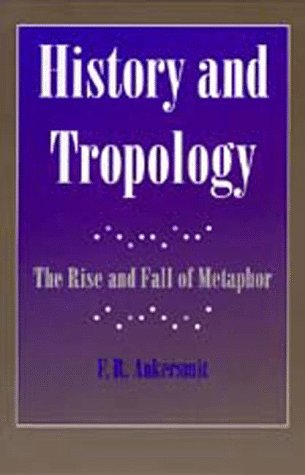
Inhaltsangabe
"The chief business of twentieth-century philosophy is to reckon with twentieth-century history," claimed Collingwood. In this remarkable collection of essays, many published for the first time, Frank Ankersmit demonstrates the prescience of that remark and goes a long way toward meeting its challenge. Responding to the work of Hayden White, Arthur Danto, and Hans-Georg Gadamer, he examines such issues as the difference between historical representation and artistic expression, the status of metaphor in historical description, and the relation of postmodernism to historicism. Ankersmit's fluent grasp of European thought and his ability to incorporate concepts from literary theory, art history, the philosophy of science, and political thought into his analyses assure that this collection will interest readers throughout the humanities.
Die Inhaltsangabe kann sich auf eine andere Ausgabe dieses Titels beziehen.
Über die Autorin bzw. den Autor
F. R. Ankersmit is Professor of Historical Theory and Intellectual History at the University of Groningen and the author of numerous books on the philosophy of history.
Auszug. © Genehmigter Nachdruck. Alle Rechte vorbehalten.
History and Tropology: The Rise and Fall of Metaphor
By F.R. AnkersmitUniversity of California Press
Copyright © 1994 F.R. AnkersmitAll right reserved.
ISBN: 0520080459
Introduction
Transcendentalism and the Rise and Fall of Metaphor
Twentieth-century philosophy is fascinated by the phenomenon of language. Russell and the logical positivists saw formalized language as the logical matrix for all our knowledge of the world. And they argued that it would be the philosopher's task to reduce language by formal analysis to its logical core and, furthermore, that a thorough analysis of that logical core would show us how all reliable (i.e., scientific) knowledge is built out of its elementary, atomistic constituents. Carnap gave the logical positivist's thesis a polemical edge when he added that metaphysics—and metaphysics embraced, in his view, the greater part of Western philosophy—originated in the philosopher's ignorance of the proper syntactic rules for the logical constitution of the world. Hence, logical analysis, as advocated and practiced by the logical positivists, would dispel most of the problems that had been discussed in the tradition of Western philosophy. Thanks to a logical analysis of the language that had been used for stating these problems, they would not be solved in the proper sense of the word but would be shown to be pseudoproblems.
At a later stage, the Wittgenstein of the Philosophical Investigations, Ryle, Austin, and many others would turn to the social dimension of language; for Wittgenstein, the many different languages we use on different occasions could best be compared to the playing of a game. Playing a game requires that all the players involved accept the rules of the game, and it would be no different with the speakers of a language. Language was no longer a logical calculus but a social practice. And natural language henceforward replaced formalized language as the proper focus of philosophical interest. Carnap's rejection of metaphysics now was abandoned in favor of Strawson's peculiarly Nietzschean thesis that the most general syntactical structures of natural languages determine the metaphysical struc-
ture of our world.1 Thanks to this sociological (or, as is ordinarily said, linguistic ) turn, philosophy now received the task of developing a descriptive metaphysics that would account for these metaphysical structures of the world.
But what all these philosophies of language had in common—despite their many diversities or even outright oppositions—was the assumption that language is the principal condition for the possibility of all knowledge and meaningful thinking, and that therefore an analysis of language is of as much importance to the contemporary philosopher as an analysis of the categories of the understanding was for the Kant of the first Critique. Precisely because of this obvious similarity it has often been pointed out that contemporary philosophy of language can best be seen as a new and more fruitful phase in the transcendentalist program that was inaugurated two centuries ago by Kant.
Two intimately related assumptions underlie contemporary philosophy of language. (I hasten to add that these two assumptions are of primary importance merely from the point of view of what I want to say in this introduction; it certainly is not my wish to make any general claims with regard to the practice of philosophy of language.) The first assumption is a methodological one that harks back to the so-called resoluto-compositional method that was adopted by early modernist philosophers like Descartes and Hobbes.2 This method requires us to divide complex problems into their simpler components. It is recommended that the philosopher start with the simpler problems and then slowly and carefully work his way up to the larger and more complex issues. The "assumption behind this assumption" is that nothing essential to the larger and more complex issues will be lost when this method is applied. The acceptance of the resoluto-compositional method in the practice of contemporary philosophy of language resulted in the almost universally shared conviction that philosophy of language ought to start with an investigation of the behavior of logical constants, proper names, et cetera, and of the meaning of words and propositions. Obviously this assumption must have an elective affinity with the logical atomism that was described at the beginning of this introduction. Hence, though logical atomism as a philosophical position has been discredited for over half a century, contemporary philosophy of language
P. F. Strawson, Individuals: An Essay in Descriptive Metaphysics , London, 1971.
Descartes proposed four rules for the discovery of truth. The second ran as follows: "de diviser chacune des difficultés que j'examinerais, en autant de parcelles qu'il se pourrait, et qu'il serait requis pour mieux les résoudre" (to divide each of the problems that I would investigate into as many parts as possible and as would be required for better solving them). (R. Descartes, Discours de la méthode, Paris: Flammarion, 1966, 47)
is still "atomist" as far as its method is concerned. We are confronted here once again with the peculiar paradox that philosophers, always so focused on methods used in other disciplines, are largely indifferent to their own methods and their implications.3 In short, with the help of an investigation of propositions (either singular or universal) and their constituent components, or of simple transparent conjunctions of propositions, philosophers of language hoped to discover the transcendental conditions for truth and meaning.
As soon as this method is accepted it will not be hard to appreciate the plausibility of a second assumption of twentieth century philosophy of language. According to this second assumption, the problem of how language might account for a complex reality in terms of texts rather than of individual propositions (the professional concern of the historian!) is regarded as a nonproblem; that is to say, one was unwilling to expect problems here that would not be reducible to the kind of problems encountered in the analysis of propositions and their parts. Most of the fortunes and misfortunes of contemporary philosophy of history can be explained from this perspective. With regard to the misfortunes, it must be pointed out that philosophers of history were often tempted to superimpose this assumption on philosophy of history. Thus in the fifties and sixties, philosophy of history preferred to focus on the elements of the historical text, like singular statements about historical states of affairs, statements expressing causal connections, or on the temporal perspective of statements about the past (Danto's "narrative sentences"). The historical text as a whole was rarely, if ever, the topic of philosophical investigation. This is all the more to be regretted since the fortunes of philosophy of history self-evidently lie with the historical text and not its parts. Only a philosophy of history concentrating on the historical text as a whole could contribute importantly to contemporary philosophy of history and go beyond a mere application of what had already been discovered elsewhere. History is the first discipline that comes to mind if we think of disciplines attempting to give a truthful representation of a complex reality by means of a complex text. Hence, what is so interesting about the historical discipline is that it so...
„Über diesen Titel“ kann sich auf eine andere Ausgabe dieses Titels beziehen.
Weitere beliebte Ausgaben desselben Titels

Suchergebnisse für History and Tropology: The Rise and Fall of Metaphor

Beispielbild für diese ISBN
History & Tropology - The Rise & Fall of Metaphor
Verlag:
University of California Press, 1994
ISBN 10: 0520080459
ISBN 13: 9780520080454
Gebraucht
Paperback
Anbieter: Optimon Books, Gravesend, KENT, Vereinigtes Königreich
Verkäuferbewertung 5 von 5 Sternen

Paperback. Zustand: Good. The chief business of twentieth-century philosophy is to reckon with twentieth-century history, claimed Collingwood. In this remarkable collection of essays, many published for the first time, Frank Ankersmit demonstrates the prescience of that remark and goes a long way toward meeting its challenge. Responding to the work of Hayden White, Arthur Danto, and Hans-Georg Gadamer, he examines such issues as the difference between historical representation and artistic expression, the status of metaphor in historical description, and the relation of postmodernism to historicism. Ankersmit's fluent grasp of European thought and his ability to incorporate concepts from literary theory, art histor. Artikel-Nr. 422529
Gebraucht kaufen
EUR 54,17
EUR 21,04 Versand
Versand von Vereinigtes Königreich nach USA
Versand von Vereinigtes Königreich nach USA
Anzahl: 1 verfügbar
Beispielbild für diese ISBN
History And Tropology: The Rise And Fall Of Metaphor
Verlag:
University of California Press. 1994., 1994
ISBN 10: 0520080459
ISBN 13: 9780520080454
Gebraucht
Hardcover
Anbieter: Antiquariaat Ovidius, Bredevoort, Niederlande
Verkäuferbewertung 4 von 5 Sternen

Zustand: Gebraucht / Used. Hardcover with dustjacket. Very good. Vii,244pp. Artikel-Nr. 106244
Gebraucht kaufen
EUR 80,00
EUR 22,00 Versand
Versand von Niederlande nach USA
Versand von Niederlande nach USA
Anzahl: 1 verfügbar
Beispielbild für diese ISBN
History and Tropology: The Rise and Fall of Metaphor
Verlag:
University of California Press, 1994
ISBN 10: 0520080459
ISBN 13: 9780520080454
Gebraucht
Hardcover
Anbieter: Buchpark, Trebbin, Deutschland
Verkäuferbewertung 5 von 5 Sternen
Zustand: Sehr gut. Zustand: Sehr gut | Seiten: 252 | Sprache: Englisch | Produktart: Bücher | Keine Beschreibung verfügbar. Artikel-Nr. 41565690/2
Gebraucht kaufen
EUR 57,16
EUR 105,00 Versand
Versand von Deutschland nach USA
Versand von Deutschland nach USA
Anzahl: 1 verfügbar