
Verwandte Artikel zu Protecting Motherhood: Women and the Family in the...
Inhaltsangabe
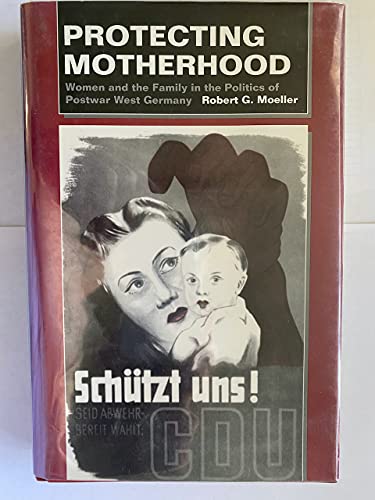
Robert G. Moeller is the first historian of modern German women to use social policy as a lens to focus on society's conceptions of gender difference and "woman's place." He investigates the social, economic, and political status of women in West Germany after World War II to reveal how the West Germans, emerging from the rubble of the Third Reich, viewed a reconsideration of gender relations as an essential part of social reconstruction.
The debate over "woman's place" in the fifties was part of West Germany's confrontation with the ideological legacy of National Socialism. At the same time, the presence of the Cold War influenced all debates about women and the family. In response to the "woman question," West Germans defined the boundaries not only between women and men, but also between East and West.
Moeller's study shows that public policy is a crucial arena where women's needs, capacities, and possibilities are discussed, identified, defined, and reinforced. Nowhere more explicitly than in the first decade of West Germany's history did, in Joan Scott's words, "politics construct gender and gender construct politics."
Die Inhaltsangabe kann sich auf eine andere Ausgabe dieses Titels beziehen.
Über die Autorin bzw. den Autor
Robert G. Moeller is Associate Professor of History at the University of California, Irvine, and the author of German Peasants and Agrarian Politics, 1914-1924: The Rhineland and Westphalia (1986).
Von der hinteren Coverseite
"Entirely original. . . . All future texts on modern Germany will have to take on board the findings of this major study."—Volker Berghahn, author of Modern Germany
Aus dem Klappentext
"Entirely original. . . . All future texts on modern Germany will have to take on board the findings of this major study."—Volker Berghahn, author of Modern Germany
Auszug. © Genehmigter Nachdruck. Alle Rechte vorbehalten.
Protecting Motherhood: Women and the Family in the Politics of Postwar West Germany
By Robert G. MoellerUniversity of California Press
Copyright © 1993 Robert G. MoellerAll right reserved.
ISBN: 0520079035
Introduction
Writing in 1946, Agnes von Zahn-Harnack observed:
Hardly any other question will be so important for the future shape of German domestic life, for German culture and morals, and for [Germany's] reintegration into world culture as the question of the relation of the sexes to each other. [This question] will be raised in the arena of politics as well as economics, and in the specifically sexual arena as well. Every war and postwar period brings serious devastation and crisis, but defeated peoples are doubly endangered. They must fear the internal dissolution of many bonds that the victor can more easily maintain. The defeated party runs the risk of self-hate that allows it to throw away even what might be maintained.1
Zahn-Harnack's credentials qualified her as a keen observer of sexual politics. Cofounder of the German Association of Women Academics, author of a major history of the German women's movement, and the last president of the League of German Women's Associations (Bund deutscher Frauenvereine), the national umbrella organization that had brought together various strands of the bourgeois women's movement before its dissolution in 1933, she was also active in the political organization of middle-class women in Berlin in the late forties.2 But no such qualifications were required to realize that a reassessment of gender relations would be a crucial part of rebuilding Germany after 1945.
Indeed, in many respects Zahn-Harnack expressed the obvious. Wars throw into disarray the domestic social order of the countries they involve. Particularly in the twentieth century, wars have been fought with
the massive mobilization of society by the state; the war at the front finds its counterpart in the war at home. While some men put on uniforms and try to kill those identified as the enemy, other men and even more women take on expanded responsibilities as workers, as single parents, and as sustainers of the domestic social and political order. Consequently, wars rupture boundaries that do not appear on maps—the boundaries between women and men. Unlike the boundaries between nations, these borders are never fixed; they are constantly challenged, questioned, and negotiated, though most people remain largely unaware of that process and live it without consciously participating in it. During wartime, however, state intervention into virtually all aspects of social and economic life alters the relations between women and men; the process is explicitly political, and its effects are immediately apparent. From the start, wartime changes are seen as temporary, extraordinary responses to extraordinary circumstances. At war's end, the social and political process of renegotiating boundaries commences, and again, the state's direct involvement makes explicit efforts to reestablish normalcy, to rebuild what has been destroyed, and to determine where the past can no longer provide direction. The politics of the family and women's status is essential to this general passage from war to peace.3
After 1945, the "political reconstruction of the family"4 took place in all countries that participated in the Second World War, but the salience of gender as a political category in postwar West Germany was particularly striking. On the most basic, immediately recognizable level, relations between the sexes commanded attention because postwar Germany was a society in which women far outnumbered men. As the journalist and political activist Gabriele Strecker observed, in purely visual terms the high rate of male casualties in the war and the large number of soldiers detained in prisoner-of-war camps meant that in 1945 Germany was a "country of women."5 This lasting demographic legacy of the Nazis' war of aggression combined in the late forties with the social dislocation and economic instability of the immediate postwar period to prompt widespread fears of a "crisis of the family." In a society where adult men were in short supply, this was a crisis of the status of women and gender relations.
Unlike the situation in Britain, France, and the United States, the problem for German women was not how to adjust to their postwar demobilization from nontraditional occupations; they faced challenges of a very different sort. Until the late forties under Allied controls, shortages of all necessities became worse than they had been before the war's
end, and the gradual release of men from prisoner-of-war camps, which continued into the fifties, delayed family reunions. War deaths meant that many families remained "incomplete" (unvollständig )—without adult males—and many marriages collapsed under the strains of long separations. The end of the war meant no end to the war at home.
Women's hardships and the perceived disequilibrium of gender relations caused by women's altered status in the war and postwar years became central concerns of politicians and public policy-makers. For women and men, from the Social Democratic Party (SPD) to the conservative Christian-Democratic/Christian-Social (CDU/CSU) coalition, there was a broad political consensus that the war had placed particularly great strains on the family, and that "more than any other societal institution, the family had fallen into the whirlpool created by the collapse." This made the family "the central problem of the postwar era."6 Everyone could agree that after the hard times of the war and its aftermath, the needs of women and the family deserved special attention.
This book explores how postwar West Germans approached these issues in the first decade of the Federal Republic's history. It focuses on public-policy debates over the definition of gender equality in the new West German constitution, family allowances, protective legislation and women's participation in the wage labor force, and family-law reform. Here, West Germans outlined blueprints for reconstructing gender in reconstruction Germany. Debates over these policies provide an exceptionally rich source for examining postwar Germans' attitudes toward gender relations because they engaged such a wide-ranging variety of witnesses and experts; employers, trade unionists, party politicians, ministers of religion, organized women's groups, lawyers and judges, medical practitioners, sociologists, and civil servants were all brought onto the stage, into newspapers and journals and before parliamentary commissions. In remarkably explicit terms, they voiced their opinions on women's work, family life, and motherhood. By exploring the extensive discussions and the implementation of specific measures, this book seeks to illuminate how established conceptions of gender difference influenced public policy and how state policy in turn shaped the conditions of women's social and economic status during West Germany's "economic miracle" (Wirtschaftswunder ).
It would be possible to pursue other thematic paths to the same end. The process of redefining "woman's place" in postwar West Germany occurred not only in social policies that expressed how families should be but in the lived experiences of families as they were; not only in the
sometimes arid debates of policy-makers but in novels, movies, and popular magazines;7 not only in the halls of parliament but...
„Über diesen Titel“ kann sich auf eine andere Ausgabe dieses Titels beziehen.
Suchergebnisse für Protecting Motherhood: Women and the Family in the...

Beispielbild für diese ISBN
Protecting Motherhood : Women and the Family in the Politics of Postwar West Germany
Verlag:
University of California Press, 1993
ISBN 10: 0520079035
ISBN 13: 9780520079038
Gebraucht
Hardcover
Anbieter: Better World Books, Mishawaka, IN, USA
Verkäuferbewertung 5 von 5 Sternen

Zustand: Very Good. 1 Edition. Pages intact with possible writing/highlighting. Binding strong with minor wear. Dust jackets/supplements may not be included. Stock photo provided. Product includes identifying sticker. Better World Books: Buy Books. Do Good. Artikel-Nr. 39274347-6
Gebraucht kaufen
EUR 10,69
Versand gratis
Versand innerhalb von USA
Versand innerhalb von USA
Anzahl: 2 verfügbar
Beispielbild für diese ISBN
Protecting Motherhood: Women and the Family in the Politics of Postwar West Germany
Verlag:
University of California Press, 1993
ISBN 10: 0520079035
ISBN 13: 9780520079038
Gebraucht
Hardcover
Anbieter: ThriftBooks-Atlanta, AUSTELL, GA, USA
Verkäuferbewertung 5 von 5 Sternen
Hardcover. Zustand: Very Good. No Jacket. May have limited writing in cover pages. Pages are unmarked. ~ ThriftBooks: Read More, Spend Less. Artikel-Nr. G0520079035I4N00
Gebraucht kaufen
EUR 10,74
Versand gratis
Versand innerhalb von USA
Versand innerhalb von USA
Anzahl: 1 verfügbar
Foto des Verkäufers
PROTECTING MOTHERHOOD: WOMEN AND THE FAMILY IN THE POLITICS OF POSTWAR WEST GERMANY.
Verlag:
University Of California Press, Berkeley, 1993
ISBN 10: 0520079035
ISBN 13: 9780520079038
Gebraucht
Hardcover
Erstausgabe
Anbieter: Any Amount of Books, London, Vereinigtes Königreich
Verkäuferbewertung 5 von 5 Sternen
Hardcover. 8vo. pp: xiv, 346. Original publisher's red boards with silver lettering at spine in original publisher's black, red, white and grey illustrated dust jacket. Illustrated in black and white. ISBN: 0520079035 Dust jacket shows signs of shelfwear. Flaps curled. Small crease to front flap. Otherwise tight and internally perfectly clean copy. Very good indeed in good dust jacket. Artikel-Nr. C68627
Gebraucht kaufen
EUR 30,76
EUR 22,10 Versand
Versand von Vereinigtes Königreich nach USA
Versand von Vereinigtes Königreich nach USA
Anzahl: 1 verfügbar