
Verwandte Artikel zu A Surplus of Memory: Chronicle of the Warsaw Ghetto...
Inhaltsangabe
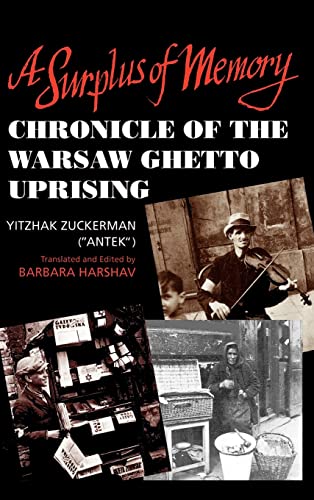
In 1943, against utterly hopeless odds, the Jews of the Warsaw Ghetto rose up to defy the Nazi horror machine that had set out to exterminate them. One of the leaders of the Jewish Fighting Organization, which led the uprisings, was Yitzhak Zuckerman, known by his underground pseudonym, Antek. Decades later, living in Israel, Antek dictated his memoirs. The Hebrew publication of Those Seven Years: 1939-1946 was a major event in the historiography of the Holocaust, and now Antek's memoirs are available in English.
Unlike Holocaust books that focus on the annihilation of European Jews, Antek's account is of the daily struggle to maintain human dignity under the most dreadful conditions. His passionate, involved testimony, which combines detail, authenticity, and gripping immediacy, has unique historical importance. The memoirs situate the ghetto and the resistance in the social and political context that preceded them, when prewar Zionist and Socialist youth movements were gradually forged into what became the first significant armed resistance against the Nazis in all of occupied Europe. Antek also describes the activities of the resistance after the destruction of the ghetto, when 20,000 Jews hid in "Aryan" Warsaw and then participated in illegal immigration to Palestine after the war.
The only extensive document by any Jewish resistance leader in Europe, Antek's book is central to understanding ghetto life and underground activities, Jewish resistance under the Nazis, and Polish-Jewish relations during and after the war. This extraordinary work is a fitting monument to the heroism of a people.
Unlike Holocaust books that focus on the annihilation of European Jews, Antek's account is of the daily struggle to maintain human dignity under the most dreadful conditions. His passionate, involved testimony, which combines detail, authenticity, and gripping immediacy, has unique historical importance. The memoirs situate the ghetto and the resistance in the social and political context that preceded them, when prewar Zionist and Socialist youth movements were gradually forged into what became the first significant armed resistance against the Nazis in all of occupied Europe. Antek also describes the activities of the resistance after the destruction of the ghetto, when 20,000 Jews hid in "Aryan" Warsaw and then participated in illegal immigration to Palestine after the war.
The only extensive document by any Jewish resistance leader in Europe, Antek's book is central to understanding ghetto life and underground activities, Jewish resistance under the Nazis, and Polish-Jewish relations during and after the war. This extraordinary work is a fitting monument to the heroism of a people.
Die Inhaltsangabe kann sich auf eine andere Ausgabe dieses Titels beziehen.
Über die Autorin bzw. den Autor
Yitzhak Zuckerman ("Antek"), 1915-1981, was the last commander of the Jewish Fighting Organization. After World War II he assisted the exodus of surviving Jews to Palestine, where he also emigrated. His memoirs were published in Israel in 1991. Barbara Harshav, who has taught history at various universities and at Yad Vashem in Jerusalem, is the translator of several books, including Jewish Memories (from French, California, 1990) and American Yiddish Poetry (from Yiddish, with Benjamin Harshav, California, 1986).
Von der hinteren Coverseite
In 1943, against utterly hopeless odds, the Jews of the Warsaw Ghetto rose up to defy the Nazi horror machine that had set out to exterminate them. One of the leaders of the Jewish Fighting Organization, which led the uprisings, was Yitzhak Zuckerman, known by his underground pseudonym, 'Antek.' Decades later, living in Israel, Antek dictated his memoirs, which were published in Hebrew as Those Seven Years: 1939-1946.
Auszug. © Genehmigter Nachdruck. Alle Rechte vorbehalten.
A Surplus of Memory: Chronicle of the Warsaw Ghetto Uprising
By Yitzhak ZuckermanUniversity of California Press
Copyright © 1993 Yitzhak ZuckermanAll right reserved.
ISBN: 0520078411
One
The War
[World War II broke out with the invasion of Poland by the German armies in the early morning hours of September 1, 1939. At the time, Zuckerman was a leader of the He-Halutz Ha-Tza'ir (Young Pioneer) Zionist socialist youth movement, which had recently united with Frayhayt (Freedom, later known as Dror), a youth movement with similar ideals. Both belonged to the He-Halutz (Pioneer), an umbrella organization of all pioneering Zionist youth movements, striving to realize their ideals on kibbutzim in Eretz Israel.]
On September 1, 1939, I was in Kleban*
, a small village in Wolyn* , near Rowno, where we were holding seminars of He-Halutz Ha-Tza'ir and later of the united movement of Frayhayt-He-Halutz Ha-Tza'ir. Why was I in Kleban* at that time? The twenty-first Zionist Congress was taking place in Geneva and most of the Shlikhim from Eretz Israel who worked with our Movement in Poland were in the delegation to the Congress, along with many from the local leadership cadre. There were very few of us left in Poland in this season of summer camps, symposia, and similar activities. A month-long seminar for the leaders of the united movement from Wolyn* and Polesie was going on in Kleban* , which began on August 11 with thirty-eight participants.I opened the seminar with lectures on literature and other subjects. Haim Shechter and Edek Golowner were with me.1 I stayed a week, delivered a course of lectures, and returned to Warsaw at the end of August. Arriving in Warsaw, before I had a chance to bask in the sun—the weather was very nice—I was informed that the English Consul in Warsaw had called on English citizens, including residents of Eretz Israel who had British Mandatory citizenship, to leave Poland immediately.
One of the first things I did when I heard this was to return to Kleban*
to replace Yudke Helman, a Shaliah from Eretz Israel who had succeeded me there.2 I did that to keep the seminar from dispersing, for Yudke hadYitzhak (Edek) Golowner: Born in Vienna in 1915, educator; one of the founders of the He-Halutz and Frayhayt (Dror) underground in the Soviet zone in December 1989. Imprisoned in Luck by the Soviets and murdered at the age of twenty-seven when the Germans captured that city. (Details of his death are unknown.)
Yudke Helman: Born in Pinsk. Immigrated to Israel as a Halutz. Sent to Poland in 1939 by Ha-Kibbutz Ha-Meuchad and the Histadrut; established the Dror underground in the Soviet zone and worked there until his return to Eretz Israel in February 1940. Currently a member of Kibbutz Gvat.
to rush to Warsaw with the other Shlikhim returning from the Congress until the issue of their return to Eretz Israel was clarified.
At that time, I was Secretary General of the united movement, Frayhayt-He-Halutz Ha-Tza'ir. Edek Golowner was in Kleban*
with me. As a result of the parity arrangement in the Movement, after unification, Moshe Novoprutzki, a member of Frayhayt, was supposed to be with me; but he was also a delegate to the Congress.3 He was supposed to "keep an eye on" me, in case I "went too far" in shifting the Movement onto the tracks of Halutziut,4 Hebrew, and such, so that Frayhayt wouldn't assimilate, God forbid, into He-Halutz Ha-Tza'ir. When He-Halutz had told me they didn't want to add Novoprutzki to the delegation to the Congress, I thought it was unfair to him; I discussed it with Abraham Gewelber of the He-Halutz Central Committee and Nowoprutski was ultimately added to the delegation.5 The Zionist Pioneer movement in Warsaw was almost bereft of its central activists and I remained practically alone.So, at the outbreak of the war, on September 1, I was back in Kleban*
. We assembled the students for a discussion and tried to prepare them for the future in terms of our naive understanding. First, we made sure everyone would return home. Edek and I stayed behind. The two of us belonged to the Polish "Patriot" branch—we overlooked the injustices and hatred of the Polish state against the Jews and reported to the local authorities to enlist in the army. But the authorities didn't know what to do with us. The next day, September 2, we decided to return to Warsaw, which we did by traveling a roundabout route, in a train and a taxi. The great turmoil had not yet reached eastern Poland. We even took a taxi, which was expensive. On the way, in Miedzyrzec, I think, we came upon an army unit commanded by a Polish officer. We reported to the officer, a pleasant young man, who told us he wished he knew what to do with his own soldiers, let alone civilians.I must say that I didn't serve in the Polish army. I was the youngest of four children in my family, two boys and two girls. The family did
Moshe Novoprutzki: A member of the Central Committee of Frayhayt-He-Halutz. Immigrated to Eretz Israel from Vilna in 1941.
I.e., "pioneering," striving to realize the ideals of the Movement by joining a kibbutz in Eretz Israel.
Abraham Gewelber: Secretary of He-Halutz Ha-Tza'ir in Poland from 1937 on. Active in the Soviet zone after the outbreak of the war. Moved to Vilna, where he represented He-Halutz Ha-Tza'ir in Jewish welfare organizations. Immigrated to Eretz Israel in 1941.
everything to keep my oldest brother, Abraham, from serving in the army. The night before he reported for the draft, he and his friends sat up all night drinking coffee. When my brother appeared the next day, his heart was pounding and the doctor sent him to rest. After an hour's rest, his strength was restored. But, finally, he was released with a bribe. I didn't allow my parents to do the same for me and reported on time for the military examination. He-Halutz was against shirking Polish army duty, and that was my personal position, too. But by law, high school graduates could not serve as simple soldiers and were sent to officer's school; yet, except for physicians, Jews weren't accepted to those schools. This dragged on for a year, two, three, and I wasn't called to the army. Finally, I was called in and informed that I wasn't accepted. So I was exempt from military service.
Now, when we got to Warsaw, I reported again for the draft, for the third time. They took Edek but not me. Since the Halutzim on Dzielna6 and Gesia*
7 considered me a "patriot," I tried to do something. Not everyone understood what war with the Germans meant. There was a certain apathy. I argued not only the anti-German aspect, but also the pro-Polish angle.On September 2, by the time I returned from Kleban*
, the Shlikhim who had returned from the Congress were in Warsaw, and everything was confused and in a turmoil. As we made our way to Warsaw, we saw bombing, and Warsaw itself had already been bombed. The war began on Friday, September 1; many cities were bombed that day, there were serious casualties, and everything was in an uproar.We gathered to discuss the situation. By then we knew from the radio about the German advance. We figured that our Movement would retreat eastward, but it didn't...
„Über diesen Titel“ kann sich auf eine andere Ausgabe dieses Titels beziehen.
Suchergebnisse für A Surplus of Memory: Chronicle of the Warsaw Ghetto...

Beispielbild für diese ISBN
A Surplus of Memory : Chronicle of the Warsaw Ghetto Uprising
Verlag:
University of California Press, 1993
ISBN 10: 0520078411
ISBN 13: 9780520078413
Gebraucht
Hardcover
Anbieter: Better World Books, Mishawaka, IN, USA
Verkäuferbewertung 5 von 5 Sternen

Zustand: Good. Former library copy. Pages intact with minimal writing/highlighting. The binding may be loose and creased. Dust jackets/supplements are not included. Includes library markings. Stock photo provided. Product includes identifying sticker. Better World Books: Buy Books. Do Good. Artikel-Nr. GRP17040977
Gebraucht kaufen
EUR 19,43
Versand gratis
Versand innerhalb von USA
Versand innerhalb von USA
Anzahl: 2 verfügbar
Beispielbild für diese ISBN
A Surplus of Memory : Chronicle of the Warsaw Ghetto Uprising
Verlag:
University of California Press, 1993
ISBN 10: 0520078411
ISBN 13: 9780520078413
Gebraucht
Hardcover
Anbieter: Better World Books, Mishawaka, IN, USA
Verkäuferbewertung 5 von 5 Sternen
Zustand: Good. Pages intact with minimal writing/highlighting. The binding may be loose and creased. Dust jackets/supplements are not included. Stock photo provided. Product includes identifying sticker. Better World Books: Buy Books. Do Good. Artikel-Nr. 5343928-6
Gebraucht kaufen
EUR 19,43
Versand gratis
Versand innerhalb von USA
Versand innerhalb von USA
Anzahl: 1 verfügbar
Beispielbild für diese ISBN
A Surplus of Memory: Chronicle of the Warsaw Ghetto Uprising (A Centennial Book)
Verlag:
University of California Press, 1993
ISBN 10: 0520078411
ISBN 13: 9780520078413
Gebraucht
Hardcover
Anbieter: Books From California, Simi Valley, CA, USA
Verkäuferbewertung 4 von 5 Sternen

Hardcover. Zustand: Good. Ex-library copy with the usual markings/stickers/stamping present, including stamping on the page edges and a slip insert attached to the preliminary pages. Missing dust jacket. Book shows some shelf & handling wear, including edge wear and light scuffing. Pages are slightly worn on their edges, but remain intact with unmarked text & pictures. A good reading copy. Artikel-Nr. mon0004168613
Gebraucht kaufen
EUR 24,88
EUR 4,45 Versand
Versand innerhalb von USA
Versand innerhalb von USA
Anzahl: 1 verfügbar
Beispielbild für diese ISBN
A Surplus of Memory: Chronicle of the Warsaw Ghetto Uprising
Verlag:
California University Press, 1993
ISBN 10: 0520078411
ISBN 13: 9780520078413
Gebraucht
Hardcover
Anbieter: Anybook.com, Lincoln, Vereinigtes Königreich
Verkäuferbewertung 5 von 5 Sternen
Zustand: Fair. This is an ex-library book and may have the usual library/used-book markings inside.This book has hardback covers. In fair condition, suitable as a study copy. Please note the Image in this listing is a stock photo and may not match the covers of the actual item,1250grams, ISBN:0520078411. Artikel-Nr. 5954334
Gebraucht kaufen
EUR 19,79
EUR 15,55 Versand
Versand von Vereinigtes Königreich nach USA
Versand von Vereinigtes Königreich nach USA
Anzahl: 1 verfügbar
Beispielbild für diese ISBN
A Centennial Book: A Surplus of Memory: Chronicle of the Warsaw Ghetto Uprising
Verlag:
California University Press, 1993
ISBN 10: 0520078411
ISBN 13: 9780520078413
Gebraucht
Hardcover
Anbieter: Anybook.com, Lincoln, Vereinigtes Königreich
Verkäuferbewertung 5 von 5 Sternen
Zustand: Poor. This is an ex-library book and may have the usual library/used-book markings inside.This book has hardback covers. Book contains pen markings. In poor condition, suitable as a reading copy. No dust jacket. Please note the Image in this listing is a stock photo and may not match the covers of the actual item,1250grams, ISBN:0520078411. Artikel-Nr. 4927607
Gebraucht kaufen
EUR 31,08
EUR 15,55 Versand
Versand von Vereinigtes Königreich nach USA
Versand von Vereinigtes Königreich nach USA
Anzahl: 1 verfügbar
Beispielbild für diese ISBN
A Surplus of Memory
Verlag:
University of California Press, 1993
ISBN 10: 0520078411
ISBN 13: 9780520078413
Neu
Hardcover
Anbieter: PBShop.store US, Wood Dale, IL, USA
Verkäuferbewertung 5 von 5 Sternen
HRD. Zustand: New. New Book. Shipped from UK. Established seller since 2000. Artikel-Nr. L2-9780520078413
Neu kaufen
EUR 83,41
Versand gratis
Versand innerhalb von USA
Versand innerhalb von USA
Anzahl: Mehr als 20 verfügbar
Beispielbild für diese ISBN
A Surplus of Memory: Chronicle of the Warsaw Ghetto Uprising (A Centennial Book)
Verlag:
University of California Press, 1993
ISBN 10: 0520078411
ISBN 13: 9780520078413
Neu
Hardcover
Anbieter: Ria Christie Collections, Uxbridge, Vereinigtes Königreich
Verkäuferbewertung 5 von 5 Sternen
Zustand: New. In English. Artikel-Nr. ria9780520078413_new
Neu kaufen
EUR 80,79
EUR 17,65 Versand
Versand von Vereinigtes Königreich nach USA
Versand von Vereinigtes Königreich nach USA
Anzahl: Mehr als 20 verfügbar
Beispielbild für diese ISBN
A Surplus of Memory
Verlag:
University of California Press, 1993
ISBN 10: 0520078411
ISBN 13: 9780520078413
Neu
Hardcover
Anbieter: Majestic Books, Hounslow, Vereinigtes Königreich
Verkäuferbewertung 4 von 5 Sternen
Zustand: New. pp. 720. Artikel-Nr. 4990211
Neu kaufen
EUR 120,39
EUR 7,68 Versand
Versand von Vereinigtes Königreich nach USA
Versand von Vereinigtes Königreich nach USA
Anzahl: 1 verfügbar
Foto des Verkäufers
Zuckerman, Y: A Surplus of Memory
Verlag:
University of California Press, 1993
ISBN 10: 0520078411
ISBN 13: 9780520078413
Neu
Hardcover
Anbieter: moluna, Greven, Deutschland
Verkäuferbewertung 5 von 5 Sternen
Zustand: New. A memoir that situates the ghetto and the resistance in the social and political context that preceded them, when prewar Zionist and Socialist youth movements were gradually forged into what became the first significant armed resistance against the Nazis in. Artikel-Nr. 594720361
Neu kaufen
EUR 93,00
EUR 48,99 Versand
Versand von Deutschland nach USA
Versand von Deutschland nach USA
Anzahl: Mehr als 20 verfügbar
Beispielbild für diese ISBN
A Surplus of Memory Chronicle of the Warsaw Ghetto Uprising
Verlag:
Univ of California Pr on Demand, 1993
ISBN 10: 0520078411
ISBN 13: 9780520078413
Neu
Hardcover
Anbieter: Revaluation Books, Exeter, Vereinigtes Königreich
Verkäuferbewertung 5 von 5 Sternen
Hardcover. Zustand: Brand New. 702 pages. 9.25x6.25x1.50 inches. In Stock. Artikel-Nr. x-0520078411
Neu kaufen
EUR 128,27
EUR 17,72 Versand
Versand von Vereinigtes Königreich nach USA
Versand von Vereinigtes Königreich nach USA
Anzahl: 2 verfügbar