
Verwandte Artikel zu Conversion to Christianity: Historical and Anthropological...
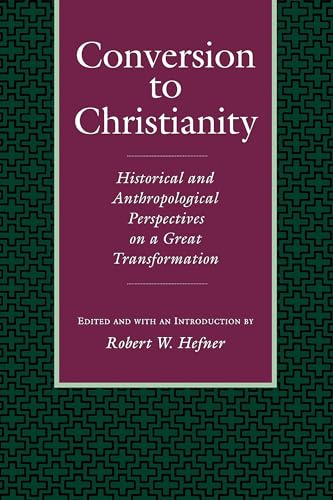
Conversion to Christianity: Historical and Anthropological Perspectives on a Great Transformation - Softcover
Inhaltsangabe
One of the most striking developments in the history of modern civilizations has been the conversion of tribal peoples to more expansively organized "world" religions. There is little scholarly consensus as to why these religions have endured and why conversion to them has been so widespread. These essays explore the phenomenon of Christian conversion from this world-building perspective. Combining rich case studies with original theoretical insights, this work challenges sociologists, anthropologists and historians of religion to reassess the varieties of religious experience and the convergent processes involved in religious change.
Die Inhaltsangabe kann sich auf eine andere Ausgabe dieses Titels beziehen.
Über die Autorin bzw. den Autor
Robert W. Hefner is Associate Professor of Anthropology and Associate Director of the Institute for the Study of Economic Culture at Boston University.
Von der hinteren Coverseite
"Contributes as much to advancing contemporary social theory as it does to understanding conversion."—Dale Eickelman, Dartmouth College
"These rich and rewarding essays problematize a process central to Western notions of the making of modernity—the reformation of peripheral worlds under the impact of global religions. [The authors] challenge established disciplinary boundaries, providing sensitive accounts of the interplay of world-transforming movements and accounts of specific cultures and histories. In doing so, they cause us to rethink the ethnocentric, developmentalist assumptions often built into the very notion of "conversion" itself as a concept in our own scholarly tradition."—Jean Comaroff, University of Chicago
"These rich and rewarding essays problematize a process central to Western notions of the making of modernity—the reformation of peripheral worlds under the impact of global religions. [The authors] challenge established disciplinary boundaries, providing sensitive accounts of the interplay of world-transforming movements and accounts of specific cultures and histories. In doing so, they cause us to rethink the ethnocentric, developmentalist assumptions often built into the very notion of "conversion" itself as a concept in our own scholarly tradition."—Jean Comaroff, University of Chicago
Aus dem Klappentext
"Contributes as much to advancing contemporary social theory as it does to understanding conversion." Dale Eickelman, Dartmouth College
"These rich and rewarding essays problematize a process central to Western notions of the making of modernity the reformation of peripheral worlds under the impact of global religions. [The authors] challenge established disciplinary boundaries, providing sensitive accounts of the interplay of world-transforming movements and accounts of specific cultures and histories. In doing so, they cause us to rethink the ethnocentric, developmentalist assumptions often built into the very notion of "conversion" itself as a concept in our own scholarly tradition." Jean Comaroff, University of Chicago
"These rich and rewarding essays problematize a process central to Western notions of the making of modernity the reformation of peripheral worlds under the impact of global religions. [The authors] challenge established disciplinary boundaries, providing sensitive accounts of the interplay of world-transforming movements and accounts of specific cultures and histories. In doing so, they cause us to rethink the ethnocentric, developmentalist assumptions often built into the very notion of "conversion" itself as a concept in our own scholarly tradition." Jean Comaroff, University of Chicago
Auszug. © Genehmigter Nachdruck. Alle Rechte vorbehalten.
Conversion to Christianity
Historical and Anthropological Perspectives on a Great Transformation By Robert W. HefnerUniversity of California Press
Copyright © 1993 Robert W. HefnerAll right reserved.
ISBN: 9780520078369
Chapter One—
Introduction:
World Building and the Rationality of Conversion
Robert W. Hefner
The conventional wisdom in the historiography of the ancient world is that the emergence of what we call civilization was marked by the rise of the state, government bureaucracy, writing, and a complex division of labor. Less widely noted, but of equal import, was the conversion of tribal and nonstate peoples to more socially expansive and doctrinally formalized religions, including those today identified as "historic" or "world" religions. For many peoples, it would appear, incorporation into a broader social order brought not just technological and political transformations of traditional lifeways but far-reaching adjustments in the canons of divinity, identity, and social ethics as well.1 Here is a development at the origins of the world we call civilized, but one about which there is surprisingly little intellectual consensus.
What makes this phenomenon all the more intriguing is that conversion to more inclusive or world religions is not just a distant event in an unknowable past but a process that continues in the backlands and barrios of the developing world today. Indeed, though empires and economic orders have come and gone, the world religions have survived. They are, we might say, the longest lasting of civilization's primary institutions. Just why this is so is an important question: it challenges our understanding of "traditional" and "world" religions, forces us to reflect on how people become converted from one form of religion to another, and shows how deeply religious reformation is implicated in the making of the modern world.
This world-building aspect of religious conversion is the focus of the essays in this volume. All examine the twin phenomena of Christian conversion and Christianization—the reformulation of social relations,cultural meanings, and personal experience in terms of putatively Christian ideals. Though studies of conversion have traditionally privileged its psychology (or, all too often, a reification of that psychology),2 the authors of these essays explore Christian conversion in its full complexity—sociological and historical, cultural and psychological. Rather than elevate the individual experience of conversion above the social world, they examine how social and individual processes interact over time. The studies reveal that conversion takes many forms. Not always an exclusivistic change of religious affiliation requiring the repudiation of previously held beliefs (Nock 1933), conversion assumes a variety of forms because it is influenced by a larger interplay of identity, politics, and morality.
A second characteristic of these studies is that they explore Christianity as a world religion rather than as a uniquely Eurocentric one.3 This cross-cultural focus speaks to the reality of Christianity in the premodern and modern eras and to how it has shaped our world. It highlights what is distinctive about Christian conversion and how it relates to the more general reformation of religion and moral authority that marks human history. Why do people convert? Why are some cultures so resistant to Christian appeals while others eagerly embrace the faith? Does the widespread incidence of conversion to Christianity and other world religions suggest convergence in the development of religion, ethics, and authority across cultures?
A comparative understanding of these questions promises to be of interest not only for anthropology and sociology but also for comparative politics, ethical history, and, indeed, our understanding of the civilized world. My intent in the present chapter is to outline something of this broader context. I will emphasize two points from the start. First, though most of the discussion in these essays centers on Christianity, my remarks here are necessarily broader. For the sake of comparison, I speak of Christianity as a species of world religion and seek to explore the differences between world religions and the other great family of religions referred to, much too generally, as traditional.
When used in too bipolar a fashion, the categories of traditional and world religion are simplistic and reinforce certain prejudices of the putative rationality of the modern world and the irrational traditionalism of the premodern. Most such modernist generalities are of little analytic value. But one distinction made between traditional and world religions points to something quite real: only a few religions have shown great success in propagating themselves over time and space. This seemingly obvious aspect of their sociohistorical distribution, we shall see, has had some not-so-obvious influences on the ideals and social organization of the faiths we call world religions.
Situating Christianity in history and in relation to other world religions, the discussion which follows departs somewhat from anthropological research on Christianity and indeed from the focus of some of the other essays in this volume. Recent anthropological work has emphasized that Christianity in a cross-cultural context is far less socially and ideologically monolithic than the "salvationist orthodoxy" (Schneider and Lindenbaum 1987:4) often attributed to it. Contrary to essentialist characterizations of its meaning, Christianity has demonstrated a remarkable ability to take on different cultural shadings in local settings (Badone 1990; Boutilier et al. 1978; Saunders 1988; Schneider and Lindenbaum 1987). The Christian message of individual salvation, for example, has often been marginalized or recast to meet communal needs; elsewhere, believers have been inclined to seek blessing not simply for otherworldly ends but also for "the fulfillment of needs and desires in the here and now" (French Smith 1988:42; cf. Schneider and Lindenbaum 1987:2).
Having refuted the myth of the Christian monolith, however, we must not fall into the converse error of extreme cultural particularism, so thoroughly deconstructing Christianity as to conclude that it is really no more than a congeries of local traditions. Though, in absolute terms, all religions and all cultures are unique, the faiths we know as world religions show striking continuities over time and space. This simple fact indicates their social and moral distinctiveness.
The second point I should stress is that my discussion of the social science commentary on conversion is inevitably selective, designed less to provide an exhaustive history of ideas than to highlight a few recurring themes. Central among these are the nature of the world religions and the source of their remarkable social power. Wherein originates the capacity of these religions to challenge the received lifeways and moral imagination of people incorporating into the civilized social order? Is it a function of the association of these religions with imperial or hegemonic powers? Is conversion, then, first and foremost a colonization of consciousness? Alternately, or in addition, do Christianity and the other world religions embody a cultural logic uniquely adapted to the challenge of the civilized macrocosm?
Whatever our answers to these questions, this much is clear: human history...
„Über diesen Titel“ kann sich auf eine andere Ausgabe dieses Titels beziehen.
Suchergebnisse für Conversion to Christianity: Historical and Anthropological...

Beispielbild für diese ISBN
Conversion to Christianity : Historical and Anthropological Perspectives on a Great Transformation
Verlag:
University of California Press, 1993
ISBN 10: 0520078365
ISBN 13: 9780520078369
Gebraucht
Softcover
Anbieter: Better World Books, Mishawaka, IN, USA
Verkäuferbewertung 5 von 5 Sternen

Zustand: Very Good. Former library copy. Pages intact with possible writing/highlighting. Binding strong with minor wear. Dust jackets/supplements may not be included. Includes library markings. Stock photo provided. Product includes identifying sticker. Better World Books: Buy Books. Do Good. Artikel-Nr. GRP98518392
Gebraucht kaufen
EUR 8,32
Versand gratis
Versand innerhalb von USA
Versand innerhalb von USA
Anzahl: 1 verfügbar
Beispielbild für diese ISBN
Conversion to Christianity : Historical and Anthropological Perspectives on a Great Transformation
Verlag:
University of California Press, 1993
ISBN 10: 0520078365
ISBN 13: 9780520078369
Gebraucht
Softcover
Anbieter: Better World Books, Mishawaka, IN, USA
Verkäuferbewertung 5 von 5 Sternen
Zustand: Good. Former library copy. Pages intact with minimal writing/highlighting. The binding may be loose and creased. Dust jackets/supplements are not included. Includes library markings. Stock photo provided. Product includes identifying sticker. Better World Books: Buy Books. Do Good. Artikel-Nr. 11084817-6
Gebraucht kaufen
EUR 8,32
Versand gratis
Versand innerhalb von USA
Versand innerhalb von USA
Anzahl: 1 verfügbar
Beispielbild für diese ISBN
Conversion to Christianity : Historical and Anthropological Perspectives on a Great Transformation
Verlag:
University of California Press, 1993
ISBN 10: 0520078365
ISBN 13: 9780520078369
Gebraucht
Softcover
Anbieter: Better World Books, Mishawaka, IN, USA
Verkäuferbewertung 5 von 5 Sternen
Zustand: Good. Pages intact with minimal writing/highlighting. The binding may be loose and creased. Dust jackets/supplements are not included. Stock photo provided. Product includes identifying sticker. Better World Books: Buy Books. Do Good. Artikel-Nr. 8662406-6
Gebraucht kaufen
EUR 8,32
Versand gratis
Versand innerhalb von USA
Versand innerhalb von USA
Anzahl: 1 verfügbar
Beispielbild für diese ISBN
Conversion to Christianity: Historical and Anthropological Perspectives on a Great Transformation
Verlag:
University of California Press, 1993
ISBN 10: 0520078365
ISBN 13: 9780520078369
Gebraucht
Paperback
Anbieter: ThriftBooks-Atlanta, AUSTELL, GA, USA
Verkäuferbewertung 5 von 5 Sternen
Paperback. Zustand: Very Good. No Jacket. May have limited writing in cover pages. Pages are unmarked. ~ ThriftBooks: Read More, Spend Less. Artikel-Nr. G0520078365I4N00
Gebraucht kaufen
EUR 8,44
Versand gratis
Versand innerhalb von USA
Versand innerhalb von USA
Anzahl: 1 verfügbar
Beispielbild für diese ISBN
Conversion to Christianity Historical and Anthropological Perspectives on a Great Transformation
Verlag:
University of California Press, Berkeley, 1993
ISBN 10: 0520078365
ISBN 13: 9780520078369
Gebraucht
PAPERBACK
Anbieter: COLLINS BOOKS, Seattle, WA, USA
Verkäuferbewertung 5 von 5 Sternen
PAPERBACK. Paper edition. 326pp, bw illustration, octavo paper. slight cover wear otherwise very good-. Artikel-Nr. 77188
Gebraucht kaufen
EUR 13,50
EUR 6,11 Versand
Versand innerhalb von USA
Versand innerhalb von USA
Anzahl: 1 verfügbar
Beispielbild für diese ISBN
Conversion to Christianity
Anbieter: PBShop.store US, Wood Dale, IL, USA
Verkäuferbewertung 5 von 5 Sternen
PAP. Zustand: New. New Book. Shipped from UK. Established seller since 2000. Artikel-Nr. WF-9780520078369
Beispielbild für diese ISBN
Conversion to Christianity
Anbieter: PBShop.store UK, Fairford, GLOS, Vereinigtes Königreich
Verkäuferbewertung 5 von 5 Sternen
PAP. Zustand: New. New Book. Shipped from UK. Established seller since 2000. Artikel-Nr. WF-9780520078369
Neu kaufen
EUR 33,34
EUR 5,85 Versand
Versand von Vereinigtes Königreich nach USA
Versand von Vereinigtes Königreich nach USA
Anzahl: 1 verfügbar
Beispielbild für diese ISBN
Conversion to Christianity
Verlag:
University of California Press, 1993
ISBN 10: 0520078365
ISBN 13: 9780520078369
Neu
Softcover
Anbieter: Kennys Bookstore, Olney, MD, USA
Verkäuferbewertung 5 von 5 Sternen
Zustand: New. This study of the conversion of tribal peoples to Christianity combines case studies with the contributors' theories, challenging anthropologists and sociologists to reassess the varieties of religious experience and the convergent processes involved in religious change. Editor(s): Hefner, Robert W. Num Pages: 345 pages, 2 maps. BIC Classification: HRCX7; JFSL9; JHM. Category: (P) Professional & Vocational; (UP) Postgraduate, Research & Scholarly; (UU) Undergraduate. Dimension: 232 x 167 x 19. Weight in Grams: 454. . 1993. Paperback. . . . . Books ship from the US and Ireland. Artikel-Nr. V9780520078369
Neu kaufen
EUR 39,84
EUR 9,17 Versand
Versand innerhalb von USA
Versand innerhalb von USA
Anzahl: 1 verfügbar
Beispielbild für diese ISBN
Conversion to Christianity: Historical and Anthropological Perspectives on a Great Transformation
Verlag:
University of California Press, 1993
ISBN 10: 0520078365
ISBN 13: 9780520078369
Neu
Softcover
Anbieter: Ria Christie Collections, Uxbridge, Vereinigtes Königreich
Verkäuferbewertung 5 von 5 Sternen
Zustand: New. In English. Artikel-Nr. ria9780520078369_new
Neu kaufen
EUR 40,60
EUR 13,16 Versand
Versand von Vereinigtes Königreich nach USA
Versand von Vereinigtes Königreich nach USA
Anzahl: Mehr als 20 verfügbar
Beispielbild für diese ISBN
Conversion to Christianity
Verlag:
University of California Press, 1993
ISBN 10: 0520078365
ISBN 13: 9780520078369
Neu
Softcover
Anbieter: Majestic Books, Hounslow, Vereinigtes Königreich
Verkäuferbewertung 4 von 5 Sternen

Zustand: New. pp. 336. Artikel-Nr. 4990239
Neu kaufen
EUR 53,47
EUR 7,58 Versand
Versand von Vereinigtes Königreich nach USA
Versand von Vereinigtes Königreich nach USA
Anzahl: 1 verfügbar