
Verwandte Artikel zu The Political Logic of Economic Reform in China: Volume...
The Political Logic of Economic Reform in China: Volume 24 (California Series on Social Choice and Political Economy, 24, Band 24) - Softcover
Buch 17 von 23: California series on social choice and political economy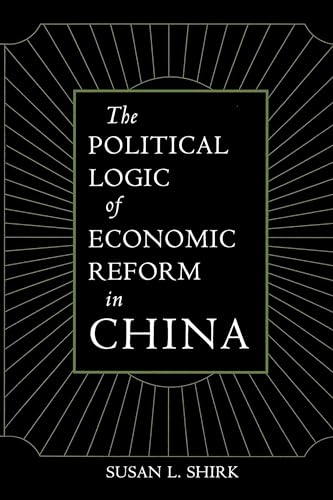
Inhaltsangabe
In the past decade, China was able to carry out economic reform without political reform, while the Soviet Union attempted the opposite strategy. How did China succeed at economic market reform without changing communist rule? Susan Shirk shows that Chinese communist political institutions are more flexible and less centralized than their Soviet counterparts were.
Shirk pioneers a rational choice institutional approach to analyze policy-making in a non-democratic authoritarian country and to explain the history of Chinese market reforms from 1979 to the present. Drawing on extensive interviews with high-level Chinese officials, she pieces together detailed histories of economic reform policy decisions and shows how the political logic of Chinese communist institutions shaped those decisions.
Combining theoretical ambition with the flavor of on-the-ground policy-making in Beijing, this book is a major contribution to the study of reform in China and other communist countries.
Shirk pioneers a rational choice institutional approach to analyze policy-making in a non-democratic authoritarian country and to explain the history of Chinese market reforms from 1979 to the present. Drawing on extensive interviews with high-level Chinese officials, she pieces together detailed histories of economic reform policy decisions and shows how the political logic of Chinese communist institutions shaped those decisions.
Combining theoretical ambition with the flavor of on-the-ground policy-making in Beijing, this book is a major contribution to the study of reform in China and other communist countries.
Die Inhaltsangabe kann sich auf eine andere Ausgabe dieses Titels beziehen.
Über die Autorin bzw. den Autor
Susan L. Shirk is Professor of Political Science at the University of California, San Diego, and the author of Competitive Comrades: Career Incentives and Student Strategies in China (California, 1982).
Auszug. © Genehmigter Nachdruck. Alle Rechte vorbehalten.
The Political Logic of Economic Reform in China
By Susan L. ShirkUniversity of California Press
Copyright © 1993 Susan L. ShirkAll right reserved.
ISBN: 9780520077072
The Political Logic of Economic Reform
In the fall of 1991 I visited China and Russia. Urban economic conditions in the two countries presented a striking contrast. The streets of Chinese cities were bustling with commercial activity. Shoppers thronged private and collective shops displaying the latest Hong Kong fashions manufactured in China. Couples debated whether to spend their savings on microwave ovens or tape recorders. Doting parents purchased Japanese electronic keyboards for their children. Market counters displayed an abundance of vegetables, fruit, meat, and seafood. People said that nowadays there was more fresh produce available in winter than there used to be in summer. Black-market currency traders no longer prowled the streets because the Chinese renminbi had been gradually devalued almost to the market rate. Urbanites still went to work on bicycles or crowded buses; they still lived in tiny, dilapidated apartments; the newspapers still complained about the low efficiency of stateowned factories. But it was obvious that starting from a relatively low base, Chinese urban living standards had improved markedly during the past decade.
Conditions in Russian cities were much bleaker. Compared with China, the number of private or collective businesses was infinitesimal and their supply of consumer goods meager. People stood in line for hours, and when they finally made it inside the shops, they found little to buy. The shelves of state stores were even barer. Basic foods were in short supply, especially in Moscow. Sugar and cheese were impossible to find and eggs almost as scarce, even in private markets. Uncertainty about the political and economic future had driven the expected value of the ruble to almost zero. People waited in long lines outside hard-currency shops, the only steady supply of food and consumer goods. Some vegetable sellers in private markets demanded that their customers pay in U.S. dollars. Many
mothers had quit their jobs because their ruble salaries were worthless and they had to forage for food. Russian C)migrC)s arrived in the West with serious health and nutrition problems. Soviet living standards had started from a higher base than that of the Chinese, and Russian citizens still drove private cars and lived in more modern apartments than did their counterparts in China; nevertheless, the lack of food and everyday consumer goods meant that basic subsistence was now in doubt.
What paths brought China and the Soviet Union to such different economic outcomes? Both countries introduced economic reforms during the 1980s, but their reform strategies were completely different. Deng Xiaoping, the Chinese Communist Party (CCP) leader, attempted to carry out economic reforms without political reforms. By contrast, Mikhail Gorbachev, the Soviet Communist Party leader, decided that the only way to accomplish economic reforms was to introduce political reforms first.
By the end of the 1980s the Chinese strategy of economic reform without political reform appeared to have worked, at least in overall economic terms. The economy was growing, and people were living better. Real per capita gross national product increased 7.2 percent annually from 1978 to 1990 (McMillan and Naughton 1991, 3). The economy grew out of the plan so that more than half of all economic activity was governed by the market (Naughton forthcoming). Private, collective, and foreign joint venture enterprises produced more than half of national income. Despite these changes, progress toward a market economy was not smooth. At several times during the decade the reform drive appeared to have been derailed by economic problems and political conflicts. Economic overheating threatened to stall reforms and necessitate a return to central economic controls in 1981 and again in 1987b 89. Over the course of the 1980s popular protests became more frequent (student demonstrations occurred in 1986, 1987, and 1989), and the conservative leaders in the party strengthened their hand. In 1989 Deng Xiaoping ordered the army to put down mass demonstrations in Beijing and more than eighty other cities. The violent repression, televised worldwide on CNN, tainted the CCP's international image as well as its domestic political legitimacy. After the Tiananmen crackdown, the CCP was split between a conservative leadership and a Central Committee that supported the reforms. With the party divided, the government bureaucracy was immobilized and economic
policy was stuck. Despite the lack of new reform intiatives, the marketization of the Chinese economy expanded on its own momentum, and mass living standards continued to improve. Over the decade Chinese groups had acquired vested interests in the economic reforms, and no one suggested turning back to the command economy.
The Soviet strategy of political reform before economic reform produced political chaos and disintegration and a decline in living standards and growth rates.1 Gorbachev dismantled the Communist Party's control over the government and the society and shifted authority to government institutions, including democratically elected legislatures. Despite radical political reforms, government officials continued to obstruct economic reform initiatives. After an abortive coup in August 1991 by conservative party and military leaders, the Communist Party was outlawed and the Soviet Union dissolved. The old centrally planned economy collapsed without a new economic system to take its place.
The overall economic success of the Chinese economic reform experience is surprising because we usually think of communist political institutions as rigid and hostile to innovation. We expect communist party and government officials to defend their vested interests in the command economy by blocking market reforms. Gorbachev's effort to change the political rules of the game before transforming the economic system accords with our views of communism better than Deng's strategy of economic reform without political reform does. Why, then, did China successfully achieve economic reform while the Soviet Union failed? How were the Chinese leaders able to introduce market reforms through communist political institutions?
In The Political Logic of Economic Reform in China I try to answer these questions by analyzing the political process of economic reform in China since 1979. The transformation of a Soviet-type centrally planned economy into a system of market socialism is an extremely complex and difficult task.2 Most of the previous attempts
The United Nations estimated that Soviet economic output would decline by 15 percent in 1991 (b U.N. Callsb 1991).
Throughout this book I use the term market reform to describe the Chinese economic reforms. The Chinese version of market reform involved introducing the profit motive, competition, and managerial autonomy into a socialist state- and collectively owned economy, not substituting private ownership for public ownership. It also involved combining market exchange among economic units with government planning, not substituting the market for planning. In other words, the Chinese market reform was intended to improve the economic performance of socialism, not to replace it with capitalism. Until 1992, the Chinese themselves always used the term socialist commodity economy (shehuizhuyi de shangpin...
„Über diesen Titel“ kann sich auf eine andere Ausgabe dieses Titels beziehen.
Suchergebnisse für The Political Logic of Economic Reform in China: Volume...

Beispielbild für diese ISBN
The Political Logic of Economic Reform in China
Verlag:
University of California Press, 1993
ISBN 10: 0520077075
ISBN 13: 9780520077072
Gebraucht
Paperback
Anbieter: World of Books (was SecondSale), Montgomery, IL, USA
Verkäuferbewertung 5 von 5 Sternen

Paperback. Zustand: Very Good. In the past decade, China was able to carry out economic reform without political reform, while the Soviet Union attempted the opposite strategy. How did China succeed at economic market reform without changing communist rule? Susan Shirk shows that Chinese communist political institutions are more flexible and less centralized than their Soviet counterparts were. Shirk pioneers a rational choice institutional approach to analyze policy-making in a non-democratic authoritarian country and to explain the history of Chinese market reforms from 1979 to the present. Drawing on extensive interviews with high-level Chinese officials, she pieces together detailed histories of economic reform policy decisions and shows how the political logic of Chinese communist institutions shaped those decisions. Combining theoretical ambition with the flavor of on-the-ground policy-making in Beijing, this book is a major contribution to the study of reform in China and other communist countries. Artikel-Nr. 00105100432
Gebraucht kaufen
EUR 6,07
Versand gratis
Versand innerhalb von USA
Versand innerhalb von USA
Anzahl: 1 verfügbar
Beispielbild für diese ISBN
The Political Logic of Economic Reform in China: Volume 24
Verlag:
University of California Press, 1993
ISBN 10: 0520077075
ISBN 13: 9780520077072
Gebraucht
Paperback
Anbieter: ThriftBooks-Atlanta, AUSTELL, GA, USA
Verkäuferbewertung 5 von 5 Sternen
Paperback. Zustand: Very Good. No Jacket. May have limited writing in cover pages. Pages are unmarked. ~ ThriftBooks: Read More, Spend Less. Artikel-Nr. G0520077075I4N00
Gebraucht kaufen
EUR 7,74
Versand gratis
Versand innerhalb von USA
Versand innerhalb von USA
Anzahl: 1 verfügbar
Beispielbild für diese ISBN
The Political Logic of Economic Reform in China
Verlag:
University of California Press, 1993
ISBN 10: 0520077075
ISBN 13: 9780520077072
Gebraucht
Softcover
Anbieter: Better World Books: West, Reno, NV, USA
Verkäuferbewertung 5 von 5 Sternen
Zustand: Very Good. Former library copy. Pages intact with possible writing/highlighting. Binding strong with minor wear. Dust jackets/supplements may not be included. Includes library markings. Stock photo provided. Product includes identifying sticker. Better World Books: Buy Books. Do Good. Artikel-Nr. 16454079-6
Gebraucht kaufen
EUR 10,34
Versand gratis
Versand innerhalb von USA
Versand innerhalb von USA
Anzahl: 1 verfügbar
Beispielbild für diese ISBN
The Political Logic of Economic Reform in China (California Series on Social Choice and Political Economy) (Volume 24)
Verlag:
University of California Press, 1993
ISBN 10: 0520077075
ISBN 13: 9780520077072
Gebraucht
paperback
Anbieter: Books From California, Simi Valley, CA, USA
Verkäuferbewertung 4 von 5 Sternen

paperback. Zustand: Good. Minimal markings from previous owner threwout pages. Artikel-Nr. mon0004211822
Gebraucht kaufen
EUR 12,24
EUR 4,44 Versand
Versand innerhalb von USA
Versand innerhalb von USA
Anzahl: 1 verfügbar
Beispielbild für diese ISBN
Social Choice and Political Economy: The Political Logic of Economic Reform in China (Volume 24)
Verlag:
University of California Press, 1993
ISBN 10: 0520077075
ISBN 13: 9780520077072
Gebraucht
Softcover
Anbieter: Anybook.com, Lincoln, Vereinigtes Königreich
Verkäuferbewertung 5 von 5 Sternen
Zustand: Poor. Volume 24. This is an ex-library book and may have the usual library/used-book markings inside.This book has soft covers. Book contains pen, pencil & highlighter markings. In poor condition, suitable as a reading copy. No dust jacket. Please note the Image in this listing is a stock photo and may not match the covers of the actual item,700grams, ISBN:9780520077072. Artikel-Nr. 8689431
Gebraucht kaufen
EUR 9,53
EUR 15,30 Versand
Versand von Vereinigtes Königreich nach USA
Versand von Vereinigtes Königreich nach USA
Anzahl: 1 verfügbar
Beispielbild für diese ISBN
The Political Logic of Economic Reform in China (California Series on Social Choice and Political Economy)
Verlag:
University of California Press, 1993
ISBN 10: 0520077075
ISBN 13: 9780520077072
Gebraucht
Softcover
Anbieter: Anybook.com, Lincoln, Vereinigtes Königreich
Verkäuferbewertung 5 von 5 Sternen
Zustand: Poor. This is an ex-library book and may have the usual library/used-book markings inside.This book has soft covers. Book contains pen & pencil markings. In poor condition, suitable as a reading copy. Please note the Image in this listing is a stock photo and may not match the covers of the actual item,700grams, ISBN:9780520077072. Artikel-Nr. 2279338
Gebraucht kaufen
EUR 19,79
EUR 15,30 Versand
Versand von Vereinigtes Königreich nach USA
Versand von Vereinigtes Königreich nach USA
Anzahl: 1 verfügbar
Beispielbild für diese ISBN
The Political Logic of Economic Reform in China
Verlag:
University of California Press, 1993
ISBN 10: 0520077075
ISBN 13: 9780520077072
Gebraucht
Softcover
Anbieter: Anybook.com, Lincoln, Vereinigtes Königreich
Verkäuferbewertung 5 von 5 Sternen
Zustand: Good. This is an ex-library book and may have the usual library/used-book markings inside.This book has soft covers. In good all round condition. Please note the Image in this listing is a stock photo and may not match the covers of the actual item,750grams, ISBN:9780520077072. Artikel-Nr. 2928745
Gebraucht kaufen
EUR 21,50
EUR 15,30 Versand
Versand von Vereinigtes Königreich nach USA
Versand von Vereinigtes Königreich nach USA
Anzahl: 1 verfügbar
Beispielbild für diese ISBN
The Political Logic of Economic Reform in China
Anbieter: PBShop.store US, Wood Dale, IL, USA
Verkäuferbewertung 5 von 5 Sternen
PAP. Zustand: New. New Book. Shipped from UK. Established seller since 2000. Artikel-Nr. WF-9780520077072
Beispielbild für diese ISBN
The Political Logic of Economic Reform in China (California Series on Social Choice and Political Economy) (Volume 24)
Verlag:
University of California Press, 1993
ISBN 10: 0520077075
ISBN 13: 9780520077072
Gebraucht
Paperback
Anbieter: WorldofBooks, Goring-By-Sea, WS, Vereinigtes Königreich
Verkäuferbewertung 5 von 5 Sternen
Paperback. Zustand: Very Good. The book has been read, but is in excellent condition. Pages are intact and not marred by notes or highlighting. The spine remains undamaged. Artikel-Nr. GOR003491789
Gebraucht kaufen
EUR 33,29
EUR 6,57 Versand
Versand von Vereinigtes Königreich nach USA
Versand von Vereinigtes Königreich nach USA
Anzahl: 1 verfügbar
Beispielbild für diese ISBN
The Political Logic of Economic Reform in China
Anbieter: PBShop.store UK, Fairford, GLOS, Vereinigtes Königreich
Verkäuferbewertung 5 von 5 Sternen
PAP. Zustand: New. New Book. Shipped from UK. Established seller since 2000. Artikel-Nr. WF-9780520077072
Neu kaufen
EUR 40,46
EUR 5,89 Versand
Versand von Vereinigtes Königreich nach USA
Versand von Vereinigtes Königreich nach USA
Anzahl: 1 verfügbar