
Verwandte Artikel zu In the Midst of Life: Affect and Ideation in the World...
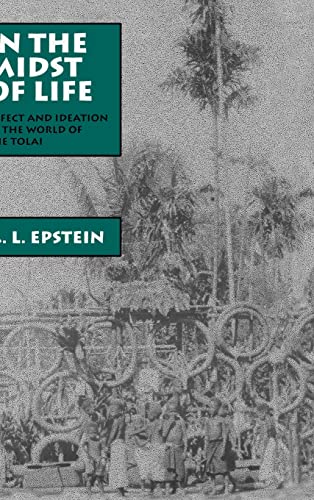
In the Midst of Life: Affect and Ideation in the World of the Tolai (Studies in Melanesian Anthropology, 9, Band 9) - Hardcover
Inhaltsangabe
The Tolai are among the most distinctive of Papua New Guinea's indigenous peoples. For all their success in the pursuit of modernity, the Tolai remain traditional in their attitudes toward death, the cultural elaboration of which colors almost every aspect of their existence.
In his new book, A. L. Epstein develops an emotional profile of the Tolai, contending that societies are distinguished as much by the shape of their emotional life as they are by their social arrangements and cultural styles. Epstein describes a wide range of mourning ceremonies and other more and less public occasions. By investigating not only the words that stand for emotions but also the way affect enters into and informs people's conduct, he charts a new course for ethnography that seeks to integrate the study of the emotions into anthropological analysis.
In his new book, A. L. Epstein develops an emotional profile of the Tolai, contending that societies are distinguished as much by the shape of their emotional life as they are by their social arrangements and cultural styles. Epstein describes a wide range of mourning ceremonies and other more and less public occasions. By investigating not only the words that stand for emotions but also the way affect enters into and informs people's conduct, he charts a new course for ethnography that seeks to integrate the study of the emotions into anthropological analysis.
Die Inhaltsangabe kann sich auf eine andere Ausgabe dieses Titels beziehen.
Über die Autorin bzw. den Autor
A. L. Epstein is Professor Emeritus of Social Anthropology at the University of Sussex.
Von der hinteren Coverseite
"An original work . . . it presents to anthropology the model for a new and very important field of inquiry."—Paula Brown Glick, State University of New York, Stony Brook
Aus dem Klappentext
"An original work . . . it presents to anthropology the model for a new and very important field of inquiry."—Paula Brown Glick, State University of New York, Stony Brook
Auszug. © Genehmigter Nachdruck. Alle Rechte vorbehalten.
In the Midst of Life: Affect and Ideation in the World of the Tolai
By A. L. EpsteinUniversity of California Press
Copyright © 1992 A. L. EpsteinAll right reserved.
ISBN: 0520075625
1
Exploring Affect: Some Preliminary Issues
Jenkin's election had taken Mr. Beavis long strides towards death. From being a man much younger than his years, he had suddenly come to look his age. An old man; and tired into the bargain, eroded from within.
"I'm worried," Pauline had confided to Anthony. "He's making himself ill. And for something so childish really. I can't make him see that it doesn't matter. Or rather I can't make him feel it. Because he sees it all right, but goes on worrying all the same."
I cite this passage from Aldous Huxley's novel Eyeless in Gaza (1969:468) not for any startling insight it offers, but rather because it embodies a number of assumptions that many would consider unexceptionable, if not trite: what we think and what we feel, we are being told, are far from being the same thing; thought is often overborne by feelings which can profoundly affect our physical well-being as well as our conduct. And indeed most of us are able to recognize without difficulty the importance that emotion plays not only in the lives of those characters we encounter in a novel or observe on stage and screen but in our own, too. So much of everyday social intercourse involves the expression of affect: we must be alert to the feelings of others just as we are careful what we disclose of our own. In negotiating these encounters we also come to recognize, if only subliminally, that how and what we feel is transmitted not just verbally but by nonverbal
cues as well, cues that may indeed carry the more vital information: in a given "message" tone of voice, a raising of the eyebrows or some other involuntary movement of the body may count as much as, or even more than, verbal content. Nor of course is it only in the context of such personal interaction that the important role of affect is to be seen: it is indeed difficult to think of any human activity or social event that is not ordinarily accompanied by some degree of emotional expression.
In such circumstances the layman might be led to suppose that anthropologists, whose preoccupation after all has been to explore the human experience in all its diversity, would have been quick to see this and give affect a prominent place in their inquiries. The facts, however, are quite otherwise. For despite the references to emotional states in many ethnographic accounts, or even the occasional instance of British and American anthropologists chiding their French colleagues for their neglect of the emotions in their structuralist analyses (e.g., Firth 1966; Geertz 1973; Spiro 1979), it remains the case that affect has never been a focus of anthropological research,1 even, surprisingly, within that branch of the discipline usually referred to today as psychological anthropology.2 The present study was conceived as an attempt to redress this situation; its central concern is to explore the role of the emotions in the social life of the Tolai people of the Gazelle Peninsula, New Britain. But before turning to this task it will be helpful to consider some of the reasons for the neglect. This will lead us directly to a number of methodological issues that need to be discussed at this stage.
A variety of reasons have been offered for the marked failure on the part of students of human society to attend to the part played by the emotions in social life. For some, the reason/emotion opposition already noted—a dichotomy that has deep historical roots in the cultural tradition of those Western societies from which hitherto most social and behavioral scientists have come—is itself seen as generating a powerful bias against research into affect. But the matter is undoubtedly more complex than this and, leaving to one side questions that properly belong to the sociology of knowledge, it also has to be acknowledged that the phenomena themselves present formidable obstacles to systematic inquiry. The point has neatly been made by Knapp (1958:55) when he remarks that "like a mountain peak, emotional experience has an apparent immediacy and concreteness, yet a way of receding into a conceptual haze."
The apparent immediacy and concreteness of many affective states, Knapp observes, arises in part from the participation in them of ob-
vious bodily processes. These processes have been the subject of much study by neurophysiologists who have given us some of our most detailed knowledge about the inner workings of the emotions. We can learn much from this work, for example, about what neural processes make possible or about the physiological mechanisms that underlie the expression of particular emotions. However, any assumption that one can adequately describe, still less explain, emotional experience in terms of experimentally generated physiological data soon runs into difficulty simply because even when a display of affect has a clear physiological basis, it is still not possible to infer from knowledge of the neural processes alone just what emotion has been experienced, if any. As Pribran (1963:228) has expressed it, the blush of a young woman or the flushing of her face may indicate embarrassment, or love, or that she has been in the sun all day and the burn is beginning to show, aided by the preprandial ingestion of alcohol.
Where the nature of what is to be studied is so uncertain, obvious difficulties stand in the way of applying methods of research that satisfy the usual standards of scientific rigour. Small wonder, then, that in such circumstances psychologists of a behaviorist persuasion, anxious to be rid of the "hocus pocus of mentalism," should sometimes have expressed the desire to see terms such as emotion disappear from the vocabulary of their discipline (see, e.g., Boring 1946). But even those psychologists who reject this stance, and have seriously attempted to come to grips with emotions, have been obliged to point out how the task of experimental investigation is enormously complicated by certain attributes of the affect system itself as well as by other factors (see, e.g., Tomkins 1963:1, 193, 324; Plutchik 1980:xvii; 1982:531). For many anthropologists, however, it is the subjective element which is seen as a major stumbling block to inquiry. Fairly representative of anthropological doubts in the matter are the comments of Abner Cohen. "Our subjective life," he observes, "is notoriously chaotic, whimsical, vague, shifty and very largely unconscious" (Cohen 1974a:x). The message is clear: the emotions represent an area of shifting sands from which the anthropologist is well-advised to steer clear; instead he should stick to observable and verifiable criteria; what matters sociologically is what people actually do, not what they subjectively think or feel. I do not need to dwell at this stage on the broader assumptions about what constitutes terra firma in anthropological research which underlie the kind of approach that cohen advocates. More pertinent to present concerns is that for all its seeming straightforwardness and its curt dismissal
of the "airy fairy," Cohen's position itself does not manage to avoid ambiguity. Elsewhere in the same discussion, for example, there are references to symbols that agitate strong feelings and emotions, but if his own criteria are applied one is left to wonder how these feelings and emotions are to be identified. The...
„Über diesen Titel“ kann sich auf eine andere Ausgabe dieses Titels beziehen.
Suchergebnisse für In the Midst of Life: Affect and Ideation in the World...

Beispielbild für diese ISBN
In the Midst of Life: Affect and Ideation in the World of the Tolai (Volume 9) (Studies in Melanesian Anthropology)
Verlag:
University of California Press, 1992
ISBN 10: 0520075625
ISBN 13: 9780520075627
Gebraucht
Hardcover
Anbieter: Books From California, Simi Valley, CA, USA
Verkäuferbewertung 4 von 5 Sternen

hardcover. Zustand: Very Good. Artikel-Nr. mon0003539950
Gebraucht kaufen
EUR 10,86
EUR 4,31 Versand
Versand innerhalb von USA
Versand innerhalb von USA
Anzahl: 1 verfügbar
Beispielbild für diese ISBN
In the Midst of Life: Affect and Ideation in the World of the Tolai
Verlag:
University of California Press, 1992
ISBN 10: 0520075625
ISBN 13: 9780520075627
Gebraucht
Hardcover
Anbieter: N. Fagin Books, Chicago, IL, USA
Verkäuferbewertung 5 von 5 Sternen

Hardcover. Zustand: Very Good. 1992. South Pacific, Melanesia. University of California Press. Very good cloth and dust jacket 317p. 5/23. Artikel-Nr. -1184950568
Gebraucht kaufen
EUR 17,77
EUR 5,18 Versand
Versand innerhalb von USA
Versand innerhalb von USA
Anzahl: 1 verfügbar
Beispielbild für diese ISBN
In the Midst of Life: Affect and Ideation in the World of the Tolai
Verlag:
California University Press, 1992
ISBN 10: 0520075625
ISBN 13: 9780520075627
Gebraucht
Hardcover
Anbieter: Anybook.com, Lincoln, Vereinigtes Königreich
Verkäuferbewertung 5 von 5 Sternen
Zustand: Good. This is an ex-library book and may have the usual library/used-book markings inside.This book has hardback covers. In good all round condition. No dust jacket. Please note the Image in this listing is a stock photo and may not match the covers of the actual item,700grams, ISBN:0520075625. Artikel-Nr. 2924421
Gebraucht kaufen
EUR 16,82
EUR 15,86 Versand
Versand von Vereinigtes Königreich nach USA
Versand von Vereinigtes Königreich nach USA
Anzahl: 1 verfügbar
Beispielbild für diese ISBN
In the midst of life: affect and ideation in the world of the Tolai.
Verlag:
University of California Press, 1992
ISBN 10: 0520075625
ISBN 13: 9780520075627
Gebraucht
Hardcover
Anbieter: Kloof Booksellers & Scientia Verlag, Amsterdam, Niederlande
Verkäuferbewertung 4 von 5 Sternen
Zustand: as new. Berkeley : University of California Press,1992. Orig. cloth binding. Dustjacket. x,317p. Index. Bibliography. (Studies in Melanesian anthropology 9). The Tolai are a people who live in the area Gazelle Peninsula on the island of New Britain; part of Papua New Guinea. Condition : as new copy. ISBN 9780520075627. Keywords : , anthropology. Artikel-Nr. 79512
Gebraucht kaufen
EUR 16,95
EUR 30,00 Versand
Versand von Niederlande nach USA
Versand von Niederlande nach USA
Anzahl: 1 verfügbar
Beispielbild für diese ISBN
In the Midst of Life: Affect and Ideation in the World of the Tolai
Verlag:
California University Press, 1992
ISBN 10: 0520075625
ISBN 13: 9780520075627
Gebraucht
Hardcover
Anbieter: Anybook.com, Lincoln, Vereinigtes Königreich
Verkäuferbewertung 5 von 5 Sternen
Zustand: Good. This is an ex-library book and may have the usual library/used-book markings inside.This book has hardback covers. Clean from markings. In good all round condition. Dust jacket in good condition. Please note the Image in this listing is a stock photo and may not match the covers of the actual item,750grams, ISBN:9780520075627. Artikel-Nr. 9932722
Gebraucht kaufen
EUR 34,87
EUR 15,86 Versand
Versand von Vereinigtes Königreich nach USA
Versand von Vereinigtes Königreich nach USA
Anzahl: 1 verfügbar
Beispielbild für diese ISBN
In the Midst of Life
Verlag:
University of California Press, 1992
ISBN 10: 0520075625
ISBN 13: 9780520075627
Neu
Hardcover
Anbieter: PBShop.store US, Wood Dale, IL, USA
Verkäuferbewertung 5 von 5 Sternen
HRD. Zustand: New. New Book. Shipped from UK. Established seller since 2000. Artikel-Nr. L2-9780520075627
Neu kaufen
EUR 68,50
Versand gratis
Versand innerhalb von USA
Versand innerhalb von USA
Anzahl: Mehr als 20 verfügbar
Beispielbild für diese ISBN
In the Midst of Life
Verlag:
University of California Press, 1992
ISBN 10: 0520075625
ISBN 13: 9780520075627
Neu
Hardcover
Anbieter: PBShop.store UK, Fairford, GLOS, Vereinigtes Königreich
Verkäuferbewertung 5 von 5 Sternen
HRD. Zustand: New. New Book. Shipped from UK. Established seller since 2000. Artikel-Nr. L2-9780520075627
Neu kaufen
EUR 63,44
EUR 6,84 Versand
Versand von Vereinigtes Königreich nach USA
Versand von Vereinigtes Königreich nach USA
Anzahl: Mehr als 20 verfügbar
Beispielbild für diese ISBN
In the Midst of Life: Affect and Ideation in the World of the Tolai (Studies in Melanesian Anthropology) (Volume 9)
Verlag:
University of California Press, 1992
ISBN 10: 0520075625
ISBN 13: 9780520075627
Neu
Hardcover
Anbieter: Ria Christie Collections, Uxbridge, Vereinigtes Königreich
Verkäuferbewertung 5 von 5 Sternen
Zustand: New. In. Artikel-Nr. ria9780520075627_new
Neu kaufen
EUR 62,71
EUR 13,97 Versand
Versand von Vereinigtes Königreich nach USA
Versand von Vereinigtes Königreich nach USA
Anzahl: Mehr als 20 verfügbar
Beispielbild für diese ISBN
In the Midst of Life
Verlag:
University of California Press, 1992
ISBN 10: 0520075625
ISBN 13: 9780520075627
Neu
Hardcover
Anbieter: Majestic Books, Hounslow, Vereinigtes Königreich
Verkäuferbewertung 4 von 5 Sternen
Zustand: New. pp. 326. Artikel-Nr. 4990258
Neu kaufen
EUR 92,76
EUR 7,58 Versand
Versand von Vereinigtes Königreich nach USA
Versand von Vereinigtes Königreich nach USA
Anzahl: 1 verfügbar
Beispielbild für diese ISBN
In the Midst of Life: Affect and Ideation in the World of the Tolai
Verlag:
Univ of California Pr on Demand, 1992
ISBN 10: 0520075625
ISBN 13: 9780520075627
Neu
Hardcover
Anbieter: Revaluation Books, Exeter, Vereinigtes Königreich
Verkäuferbewertung 5 von 5 Sternen
Hardcover. Zustand: Brand New. 328 pages. 9.50x6.50x1.00 inches. In Stock. Artikel-Nr. x-0520075625
Neu kaufen
EUR 101,82
EUR 14,57 Versand
Versand von Vereinigtes Königreich nach USA
Versand von Vereinigtes Königreich nach USA
Anzahl: 2 verfügbar