
Verwandte Artikel zu The Gorbachev Phenomenon: A Historical Interpretation
Inhaltsangabe
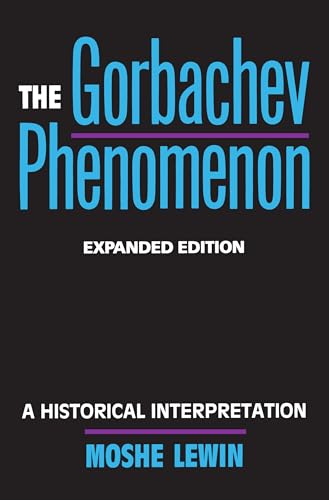
The "Gorbachev phenomenon" is seen as the product of complex developments during the last seventy years—developments that changed the Soviet Union from a primarily agrarian society into an urban, industrial one. Here, for the first time, a noted authority on Soviet society identifies the crucial historical events and social forces that explain Glasnost and political and economic life in the Soviet Union today.
Die Inhaltsangabe kann sich auf eine andere Ausgabe dieses Titels beziehen.
Über die Autorin bzw. den Autor
Moshe Lewin is Professor of History at the University of Pennsylvania and the author of several books on Soviet history.
Auszug. © Genehmigter Nachdruck. Alle Rechte vorbehalten.
The Gorbachev Phenomenon: A Historical Interpretation, Expanded edition
By Moshe LewinUniversity of California Press
Copyright © 1991 Moshe LewinAll right reserved.
ISBN: 0520074297
1
The Rural Dimension, from the Tsars to Stalin
Indispensable to our understanding of either the longer stretch of Russian/Soviet history or its most recent leg is an appreciation of the crucial role of agriculture and the peasantry. And any study of the rural sector in the modern period must take into account over two hundred years of efforts to accelerate economic development, starting from the times of Peter the Great. Throughout this period, the agrarian system weighed heavily on Russia, and the transformation of this system took several revolutions and costly, dramatic convulsions.
In theory, economic development may be promoted "from above," by the state or some of its leaders, or it may be taken up and followed up by social initiative, with or without state help. The classic examples of development from above are the policies of Peter the Great, followed by others equally well known. In contrast, during the last decades of tsarist Russia much of the initiative came from the emerging entrepreneurial classes. But whatever the pattern of development, the state is
either an advocate or an obstacle; the state is either coping well, weathering crises that result from the accelerated economic development, or it is not coping and eventually falls apart. In a nutshell, all such hypothetical outcomes were fulfilled at various times in Russian history.
Despite the vigorous economic and cultural advances that followed the emancipation of the peasants, and which continued, impressively, until World War I, tsarist Russia remained an agrarian system and state. The bulk of the population continued to be engaged in agriculture of a mostly primitive type, at a time when in the West a technologic and scientific revolution had long been working economic and social marvels. But most Russian landowners, the other part of the agrarian system, did not manage to transform their domains into modern enterprises, preferring to use the abundant and cheap labor of a mass of poor peasants who worked as sharecroppers or debtors, not as wage earners.
Obviously, this rather unproductive agrarian base could not offer enough resources to finance a hectic development, and the growing needs of the state constantly strained the peasants' ability to carry the burdens. Those are well-known facts. For our purposes we have to examine briefly the sociopolitical context of Tsardom. The same landowning class that did not show much ability to manage its estates profitably was also the political ruling class: they were at the top of the government bureaucracy, as well as dominant in the tsarist courts, where crucial policy decisions were made.
We can thus talk of a social pattern, composed of the peasantry, landowners (dvoriane ), and the royal court, with the tsar at its head, that also was still the political and economic reality of tsardom. The waves of capitalist expansion, the appearance of important industrial and
financial centers, which through market relations penetrated far corners of the empire and promised to transform the economy and society, did not go far enough or deep enough. The "rural nexus"—a term I have used in a recent work [62:12]—did not easily dissolve. Perched on this kind of nexus and reflecting it, the tsarist state could not reform fast enough to deal with the developmental tasks or, notably, with the requirements of warfare.
The revolution and civil war destroyed the old system and created a different kind of state. The social composition of the leadership, the personnel of governmental institutions, together with the very character of the system changed drastically (even if specialists and professionals from the previous era were still needed for their expertise). The new revolutionary ideology was, unlike that of the previous regime, deeply committed to industrialization and economic development. But, paradoxically, postrevolutionary Russia, during Lenin's New Economic Policy (NEP), was even more rural, and equally—if not more—backward than tsarist Russia. The urban population, by official count, merely returned to its prewar share of the total. A more exacting evaluation shows convincingly that no more than 16 percent of the people were city dwellers, leaving 84 percent in the countryside and dependent on a low-yielding agriculture [14:27–30].
Furthermore, during the revolution the peasants took over all lands that had belonged to landowners and to some richer peasants and thereby destroyed most of the market-oriented sectors of agriculture. The resulting ocean of small family farms was owned and organized under a complex, communal-cum-homestead system. The farmers' mediocre output—meant mainly for home consumption—left little to spare for the cities and the
state, and the capitalist inroads made possible by the reforms of the tsarist Prime Minister Piotr Arkadevich Stolypin were wiped out. The peasantry thus settled into a more archaic mode of life and production that imposed on the whole country the dilemmas of what is known today as underdevelopment. Indeed, a reputable Soviet sociologist, Iu. Arutiunian, considered the USSR in the 1920s to be at almost the same level as India and Egypt, for the combined effects of the civil war and the agrarian revolution had produced a dangerous economic backslide, as evidenced by most of the vital indices of the system. If the prerevolutionary society Lenin's government took over was backward enough, its problems were aggravated by the Civil War that wiped out many of the advanced social, cultural, and economic sectors of tsarist Russia. In sum, "archaization" [62:18] seems quite suitable to characterize the postrevolutionary situation, except for the emergence of a new agency in power-the party.
The mass of peasants now weighed more heavily on the new system than on the previous regime, notably because they restored to full dominance their communal arrangements, previously on the wane. The redistribution of land to peasants according to the number of mouths to feed in each family served a principle of justice befitting the peasants' way of life and need of survival, but it served less well the national need for agricultural productivity.
We have in mind here the famous peasant commune, the "mir," similar to ancient rural organizations elsewhere. These mits Marx characterized as "localized microcosms," adding that this type of organization does not occur everywhere but when it does "it erects over such [communities] a more or less centralized despotism" [66:405].
Lenin concurred, referring to the Russian peasantry as constituting "a massive and simple patriarchal foundation of the tsarist monarchy." At least, that is, until the 1905 revolution awakened those peasants from their "deep political slumber" [97:141]. In 1917 the peasantry again became politicized, but it soon fell back into its "slumber" and left Lenin with the bill to pay. He found himself in the clutches of a historical reality that had been created, to a large extent, by the system of "localized microcosms" that forced the state, reluctantly at first, with considerable relish thereafter, to erect "a more or less centralized despotism." The job to be done, however, for which the new state was bracing itself, was not of the type more...
„Über diesen Titel“ kann sich auf eine andere Ausgabe dieses Titels beziehen.
Suchergebnisse für The Gorbachev Phenomenon: A Historical Interpretation

Beispielbild für diese ISBN
The Gorbachev Phenomenon: A Historical Interpretation
Verlag:
University of California Press, 1991
ISBN 10: 0520074297
ISBN 13: 9780520074293
Gebraucht
Softcover
Anbieter: World of Books (was SecondSale), Montgomery, IL, USA
Verkäuferbewertung 5 von 5 Sternen

Zustand: Good. Item in good condition. Textbooks may not include supplemental items i.e. CDs, access codes etc. Artikel-Nr. 00099522673
Gebraucht kaufen
EUR 5,76
Versand gratis
Versand innerhalb von USA
Versand innerhalb von USA
Anzahl: 2 verfügbar
Beispielbild für diese ISBN
The Gorbachev Phenomenon: A Historical Interpretation
Verlag:
University of California Press, 1991
ISBN 10: 0520074297
ISBN 13: 9780520074293
Gebraucht
Paperback
Anbieter: ThriftBooks-Reno, Reno, NV, USA
Verkäuferbewertung 5 von 5 Sternen
Paperback. Zustand: Good. No Jacket. Pages can have notes/highlighting. Spine may show signs of wear. ~ ThriftBooks: Read More, Spend Less. Artikel-Nr. G0520074297I3N00
Gebraucht kaufen
EUR 5,77
Versand gratis
Versand innerhalb von USA
Versand innerhalb von USA
Anzahl: 1 verfügbar
Beispielbild für diese ISBN
The Gorbachev Phenomenon: A Historical Interpretation
Verlag:
University of California Press, 1991
ISBN 10: 0520074297
ISBN 13: 9780520074293
Gebraucht
Paperback
Anbieter: ThriftBooks-Dallas, Dallas, TX, USA
Verkäuferbewertung 5 von 5 Sternen
Paperback. Zustand: Very Good. No Jacket. May have limited writing in cover pages. Pages are unmarked. ~ ThriftBooks: Read More, Spend Less. Artikel-Nr. G0520074297I4N00
Gebraucht kaufen
EUR 5,80
Versand gratis
Versand innerhalb von USA
Versand innerhalb von USA
Anzahl: 1 verfügbar
Beispielbild für diese ISBN
The Gorbachev Phenomenon: A Historical Interpretation
Verlag:
University of California Press, 1991
ISBN 10: 0520074297
ISBN 13: 9780520074293
Gebraucht
Paperback
Anbieter: ThriftBooks-Dallas, Dallas, TX, USA
Verkäuferbewertung 5 von 5 Sternen
Paperback. Zustand: Good. No Jacket. Pages can have notes/highlighting. Spine may show signs of wear. ~ ThriftBooks: Read More, Spend Less. Artikel-Nr. G0520074297I3N00
Gebraucht kaufen
EUR 5,80
Versand gratis
Versand innerhalb von USA
Versand innerhalb von USA
Anzahl: 1 verfügbar
Beispielbild für diese ISBN
The Gorbachev Phenomenon: A Historical Interpretation
Verlag:
University of California Press, 1991
ISBN 10: 0520074297
ISBN 13: 9780520074293
Gebraucht
Paperback
Anbieter: ThriftBooks-Atlanta, AUSTELL, GA, USA
Verkäuferbewertung 5 von 5 Sternen
Paperback. Zustand: Good. No Jacket. Pages can have notes/highlighting. Spine may show signs of wear. ~ ThriftBooks: Read More, Spend Less. Artikel-Nr. G0520074297I3N00
Gebraucht kaufen
EUR 5,80
Versand gratis
Versand innerhalb von USA
Versand innerhalb von USA
Anzahl: 1 verfügbar
Beispielbild für diese ISBN
The Gorbachev Phenomenon: A Historical Interpretation
Verlag:
University of California Press, 1991
ISBN 10: 0520074297
ISBN 13: 9780520074293
Gebraucht
Softcover
Anbieter: Wonder Book, Frederick, MD, USA
Verkäuferbewertung 5 von 5 Sternen
Zustand: Good. Good condition. Expanded edition. A copy that has been read but remains intact. May contain markings such as bookplates, stamps, limited notes and highlighting, or a few light stains. Artikel-Nr. L21H-03864
Gebraucht kaufen
EUR 6,22
Versand gratis
Versand innerhalb von USA
Versand innerhalb von USA
Anzahl: 1 verfügbar
Beispielbild für diese ISBN
The Gorbachev Phenomenon : A Historical Interpretation
Verlag:
University of California Press, 1991
ISBN 10: 0520074297
ISBN 13: 9780520074293
Gebraucht
Softcover
Anbieter: Better World Books, Mishawaka, IN, USA
Verkäuferbewertung 5 von 5 Sternen
Zustand: Good. Pages intact with minimal writing/highlighting. The binding may be loose and creased. Dust jackets/supplements are not included. Stock photo provided. Product includes identifying sticker. Better World Books: Buy Books. Do Good. Artikel-Nr. 2363541-6
Gebraucht kaufen
EUR 9,78
Versand gratis
Versand innerhalb von USA
Versand innerhalb von USA
Anzahl: 1 verfügbar
Beispielbild für diese ISBN
The Gorbachev Phenomenon: A Historical Interpretation
Verlag:
University of California Press, 1991
ISBN 10: 0520074297
ISBN 13: 9780520074293
Gebraucht
Softcover
Anbieter: Anybook.com, Lincoln, Vereinigtes Königreich
Verkäuferbewertung 5 von 5 Sternen
Zustand: Good. This is an ex-library book and may have the usual library/used-book markings inside.This book has soft covers. In good all round condition. Please note the Image in this listing is a stock photo and may not match the covers of the actual item,450grams, ISBN:9780520074293. Artikel-Nr. 4128862
Gebraucht kaufen
EUR 3,01
EUR 15,89 Versand
Versand von Vereinigtes Königreich nach USA
Versand von Vereinigtes Königreich nach USA
Anzahl: 1 verfügbar
Beispielbild für diese ISBN
The Gorbachev Phenomenon: A Historical Interpretation
Verlag:
University of California Press, 1991
ISBN 10: 0520074297
ISBN 13: 9780520074293
Gebraucht
Softcover
Anbieter: Anybook.com, Lincoln, Vereinigtes Königreich
Verkäuferbewertung 5 von 5 Sternen
Zustand: Good. This is an ex-library book and may have the usual library/used-book markings inside.This book has soft covers. In good all round condition. Please note the Image in this listing is a stock photo and may not match the covers of the actual item,450grams, ISBN:9780520074293. Artikel-Nr. 4128861
Gebraucht kaufen
EUR 3,01
EUR 15,89 Versand
Versand von Vereinigtes Königreich nach USA
Versand von Vereinigtes Königreich nach USA
Anzahl: 1 verfügbar
Beispielbild für diese ISBN
The Gorbachev Phenomenon: A Historical Interpretation (Expanded Edition)
Verlag:
University of California Press, 1991
ISBN 10: 0520074297
ISBN 13: 9780520074293
Gebraucht
Softcover
Anbieter: Anybook.com, Lincoln, Vereinigtes Königreich
Verkäuferbewertung 5 von 5 Sternen
Zustand: Good. This is an ex-library book and may have the usual library/used-book markings inside.This book has soft covers. In good all round condition. Library sticker on front cover. Please note the Image in this listing is a stock photo and may not match the covers of the actual item,400grams, ISBN:0520074297. Artikel-Nr. 9414718
Gebraucht kaufen
EUR 3,01
EUR 15,89 Versand
Versand von Vereinigtes Königreich nach USA
Versand von Vereinigtes Königreich nach USA
Anzahl: 1 verfügbar