
Verwandte Artikel zu Risk and Rationality: Philosophical Foundations for...
Inhaltsangabe
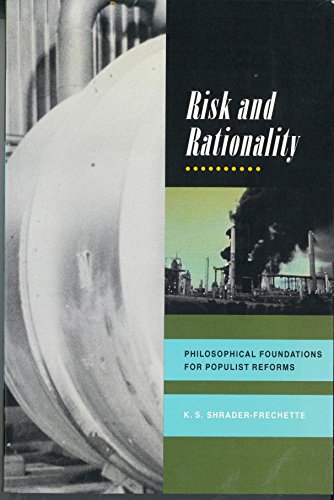
Only ten to twelve percent of Americans would voluntarily live within a mile of a nuclear plant or hazardous waste facility. But industry spokespersons claim that such risk aversion represents ignorance and paranoia, and they lament that citizen protests have delayed valuable projects and increased their costs.
Who is right? In Risk and Rationality, Kristin Shrader-Frechette argues that neither charges of irresponsible endangerment nor countercharges of scientific illiteracy frame the issues properly. She examines the debate over methodological norms for risk evaluation and finds analysts arrayed in a spectrum. Points of view extend from cultural relativists who believe that any risk can be justified (since no rational standards are ultimately possible) to naive positivists who believe that risk evaluation can be objective, neutral, and value free. Both camps, she argues, are wrong, because risk evaluation as a social process is rational and objective, even though all risk-evaluation rules are value-laden.
Shrader-Frechette defends a middle position called "scientific proceduralism." She shows why extremist views are unreliable, reveals misconceptions underlying current risk-evaluation methods and strategies, and sketches the reforms needed to set hazard assessment and risk evaluation on a publicly defensible foundation.
These reforms involve mathematical, economic, ethical, and legal procedures. They constitute a new paradigm for assessment when acceptance of public hazards is rational, recognizing that laypersons are often more rational in their evaluation of societal risks than either experts or governments have acknowledged. Such reforms would provide citizens with more influence in risk decisions and focus on mediating ethical conflicts, rather than seeking to impose the will of experts. Science, she argues, need not preclude democracy.
Who is right? In Risk and Rationality, Kristin Shrader-Frechette argues that neither charges of irresponsible endangerment nor countercharges of scientific illiteracy frame the issues properly. She examines the debate over methodological norms for risk evaluation and finds analysts arrayed in a spectrum. Points of view extend from cultural relativists who believe that any risk can be justified (since no rational standards are ultimately possible) to naive positivists who believe that risk evaluation can be objective, neutral, and value free. Both camps, she argues, are wrong, because risk evaluation as a social process is rational and objective, even though all risk-evaluation rules are value-laden.
Shrader-Frechette defends a middle position called "scientific proceduralism." She shows why extremist views are unreliable, reveals misconceptions underlying current risk-evaluation methods and strategies, and sketches the reforms needed to set hazard assessment and risk evaluation on a publicly defensible foundation.
These reforms involve mathematical, economic, ethical, and legal procedures. They constitute a new paradigm for assessment when acceptance of public hazards is rational, recognizing that laypersons are often more rational in their evaluation of societal risks than either experts or governments have acknowledged. Such reforms would provide citizens with more influence in risk decisions and focus on mediating ethical conflicts, rather than seeking to impose the will of experts. Science, she argues, need not preclude democracy.
Die Inhaltsangabe kann sich auf eine andere Ausgabe dieses Titels beziehen.
Über die Autorin bzw. den Autor
Kristin Shrader-Frechette holds degrees in mathematics, physics, and philosophy and is Distinguished Graduate Research Professor at the University of South Florida. She has published five other books and edits the Oxford University Press series "Environmental Ethics and Science Policy."
„Über diesen Titel“ kann sich auf eine andere Ausgabe dieses Titels beziehen.
Suchergebnisse für Risk and Rationality: Philosophical Foundations for...

Foto des Verkäufers
Risk & Rationaltiy (Paper): Philosophical Foundations for Populist Reforms
Verlag:
University of California Press, 1992
ISBN 10: 0520072898
ISBN 13: 9780520072893
Gebraucht
paperback
Anbieter: WeBuyBooks, Rossendale, LANCS, Vereinigtes Königreich
Verkäuferbewertung 5 von 5 Sternen

paperback. Zustand: Like New. Most items will be dispatched the same or the next working day. An apparently unread copy in perfect condition. Dust cover is intact with no nicks or tears. Spine has no signs of creasing. Pages are clean and not marred by notes or folds of any kind. Artikel-Nr. rev2640028214
Gebraucht kaufen
EUR 9,33
EUR 7,30 Versand
Versand von Vereinigtes Königreich nach USA
Versand von Vereinigtes Königreich nach USA
Anzahl: 1 verfügbar
Beispielbild für diese ISBN
Risk and Rationality: Philosophical Foundations for Populist Reforms
Verlag:
University of California Press, 1991
ISBN 10: 0520072898
ISBN 13: 9780520072893
Gebraucht
Paperback
Anbieter: Books From California, Simi Valley, CA, USA
Verkäuferbewertung 4 von 5 Sternen

Paperback. Zustand: Acceptable. Pages detaching from the spine of the cover. Artikel-Nr. mon0003533054
Gebraucht kaufen
EUR 26,42
EUR 4,43 Versand
Versand innerhalb von USA
Versand innerhalb von USA
Anzahl: 2 verfügbar