
Verwandte Artikel zu Adventures of a Mathematician
Inhaltsangabe
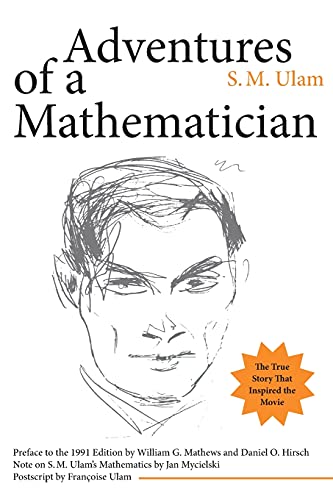
No detailed description available for "Adventures of a Mathematician".
Die Inhaltsangabe kann sich auf eine andere Ausgabe dieses Titels beziehen.
Über die Autorin bzw. den Autor
S. M. Ulam (1909-1984) was born in Poland and was a key member of the now legendary Polish School of Mathematics. In the United States from 1935 on, he received many academic appointments and honors and authored many articles, essays, and mathematical books, including Analogies between Analogies (California, 1990). Daniel Hirsch is President of the Committee to Bridge the Gap, located in Los Angeles. William G. Mathews is Professor of Astrophysics at the University of California, Santa Cruz. Françoise Ulam is a resident of Santa Fe, New Mexico. Jan Mycielski is Professor of Mathematics at the University of Colorado.
Von der hinteren Coverseite
With his wide-ranging interests, Ulam never emphasized the importance of his contribution to the research that resulted in the hydrogen bomb. Now William Mathews and Daniel Hirsch reveal the true story of Ulam's pivotal role in the making of the 'Super, ' in their historical introduction to this behind-the-scenes look at the minds and ideas that ushered in the nuclear age.
Auszug. © Genehmigter Nachdruck. Alle Rechte vorbehalten.
Adventures of a Mathematician
By S.M. UlamUniversity of California Press
Copyright © 1991 S.M. UlamAll right reserved.
ISBN: 0520071549
Chapter 1
Childhood
1909–1927
My father, Jozef Ulam, was a lawyer. He was born in Lwów, Poland, in 1877. At the time of his birth the city was the capital of the province of Galicia, part of the Austro-Hungarian Empire. When I was born in 1909 this was still true.
His father, my grandfather, was an architect and a building contractor. I understand that my great-grandfather had come to Lwów from Venice.
My mother, Anna Auerbach, was born in Stryj, a small town some sixty miles south of Lwów, near the Carpathian Mountains. Her father was an industrialist who dealt in steel and represented factories in Galicia and Hungary.
One of my earliest memories is of sitting on a window sill with my father and looking out at a street on which there was a great parade honoring the Crown Prince, who was visiting Lwów. I was not quite three years old.
I remember when my sister was born. I was told a little
girl had arrived, and I felt—it is hard to describe—somehow grown up. I was three.
When I was four, I remember jumping around on an oriental rug looking down at its intricate patterns. I remember my father's towering figure standing beside me, and I noticed that he smiled. I felt, "He smiles because he thinks I am childish, but I know these are curious patterns." I did not think in those very words, but I am pretty certain that it was not a thought that came to me later. I definitely felt, "I know something my father does not know. Perhaps I know better than my father."
I also have the memory of a trip to Venice with the family. We were on a vaporetto on a canal, and I had a balloon which fell overboard. As it bobbed along the side of the boat, my father tried to fish it out with the crooked end of his walking stick but failed. I was consoled by being allowed to select a souvenir model of a gondola made of Venetian beads and still remember the feeling of pride at being given such a task.
I remember the beginning of the first World War. As a boy, I was a Central Powers patriot when Austria, Germany, and Bulgaria—the "Central Powers"—were fighting against France, England, Russia, and Italy. Most of the Polish-speaking people were nationalistic and anti-Austrian, but nevertheless, at about the age of eight I wrote a little poem about the great victories of the Austrian and German armies.
Early in 1914, the Russian troops advanced into Galicia and occupied Lwów. My family left, taking refuge in Vienna. There I learned German, but my native language—the language we spoke at home—was Polish.
We lived in a hotel across from St. Stephen's cathedral. The strange thing is that even though I visited Vienna many times afterwards, I did not actually recognize this building again until one day in 1966 while I was walking through the streets with my wife. Perhaps because we were talking about my childhood I suddenly remembered it and pointed
it out to her. With this a number of other memories buried for over fifty years surfaced.
On the same visit, while walking through the Prater gardens, the sight of an outdoor café suddenly brought back the memory of how I had once choked in the wind with a sort of asthmatic reaction in front of that very café—a feeling that I was not to experience again until many years later in Madison, Wisconsin. Curiously the subsequent sensation did not make me recall the childhood episode. It is only when I was at that very spot many years later that this sensory memory returned as a result of the visual association.
I will not try to describe the mood of Vienna as seen through the eyes of a six-year-old. I wore a sort of military cap; when an officer saluted me on Kärntner Strasse (one of the main streets of Vienna) I remember vividly that I was absolutely delighted. But when somebody mentioned that the United States would have ten thousand airplanes (there was such a rumor) I began to have doubts about the victory of the Central Powers.
At about this time in Vienna I learned to read. Like so much of learning throughout my life, at first it was an unpleasant—a difficult, somewhat painful experience. After a while, everything fell into place and became easy. I remember walking the streets reading all the signs aloud with great pleasure, probably annoying my parents.
My father was an officer in the Austrian Army attached to military headquarters, and we traveled frequently. For a while we lived in Märisch Ostrau, and I went to school there for a time. In school we had to learn the multiplication tables, and I found learning arithmetic mildly painful. Once I was kept home with a cold just as we were at six times seven. I was sure that the rest of the class would be at twelve times fifteen by the time I went back. I think I went to ten times ten by myself. The rest of the time I had tutors, for we traveled so much it was not possible to attend school regularly.
I also remember how my father would sometime read to me from a children's edition of Cervantes' Don Quixote . Episodes that now seem only mildly funny to me, I considered hilarious. I thought the description of Don Quixote's fight with the windmills the funniest thing imaginable.
These are visual pictures, not nostalgic really but bearing a definite taste, and they leave a definite flavor of associations in the memory. They carry with them a consciousness of different intensities, different colors, different compositions, mixed with feelings which are not explicit—of well-being or of doubt. They certainly play simultaneously on many physically separate parts in the brain and produce a feeling perhaps akin to a melody. It is a reconstruction of how I felt. People often retain these random pictures, and the strange thing is that they persist throughout one's life.
Certain scenes are easier of access, but there are probably many other impressions which continue to exist: Experiments have re-created certain scenes from the past when areas of a patient's brain were touched with a needle during an operation. The scenes that can be summoned up from one's memory at will have a color or flavor which does not seem to change with time. Their re-creation by recollection does not seem to change them or refresh them. As far as I can tell when I try to observe in myself the chain of syllogisms initiated by these impressions, they are quite analogous now as to what they were when I was little. If I look now at an object, like a chair, or a tree, or a telegraph wire, it initiates a train of thought. And it seems to me that the succession of linked memories are quite the same as those I remember when I was five or six. When I look at a telegraph wire, I remember very well it gave me a sort of abstract or mathematical impulse. I wondered what else could do that. It was an attempt at generalization.
Perhaps the store of memory in the human brain is to a large extent already formed at a very early age, and external stimuli initiate a process of recording and classifying the im-
pressions along channels which exist in large numbers in very early childhood.
To learn how things are filed in the memory, it obviously helps to analyze one's thoughts. To understand how one understands...
„Über diesen Titel“ kann sich auf eine andere Ausgabe dieses Titels beziehen.
Suchergebnisse für Adventures of a Mathematician

Beispielbild für diese ISBN
Adventures of a Mathematician
Verlag:
University of California Press, 1991
ISBN 10: 0520071549
ISBN 13: 9780520071544
Gebraucht
Softcover
Anbieter: Wonder Book, Frederick, MD, USA
Verkäuferbewertung 5 von 5 Sternen

Zustand: As New. Like New condition. A near perfect copy that may have very minor cosmetic defects. Artikel-Nr. A09A-06021
Gebraucht kaufen
EUR 12,53
Versand gratis
Versand innerhalb von USA
Versand innerhalb von USA
Anzahl: 1 verfügbar
Beispielbild für diese ISBN
Adventures of a Mathematician
Verlag:
University of California Press, 1991
ISBN 10: 0520071549
ISBN 13: 9780520071544
Gebraucht
Softcover
Anbieter: Better World Books, Mishawaka, IN, USA
Verkäuferbewertung 5 von 5 Sternen
Zustand: Very Good. Former library copy. Pages intact with possible writing/highlighting. Binding strong with minor wear. Dust jackets/supplements may not be included. Includes library markings. Stock photo provided. Product includes identifying sticker. Better World Books: Buy Books. Do Good. Artikel-Nr. 11373698-6
Gebraucht kaufen
EUR 13,59
Versand gratis
Versand innerhalb von USA
Versand innerhalb von USA
Anzahl: 1 verfügbar
Beispielbild für diese ISBN
Adventures of a Mathematician
Verlag:
University of California Press, 1991
ISBN 10: 0520071549
ISBN 13: 9780520071544
Gebraucht
Softcover
Anbieter: Better World Books: West, Reno, NV, USA
Verkäuferbewertung 5 von 5 Sternen
Zustand: Very Good. Former library copy. Pages intact with possible writing/highlighting. Binding strong with minor wear. Dust jackets/supplements may not be included. Includes library markings. Stock photo provided. Product includes identifying sticker. Better World Books: Buy Books. Do Good. Artikel-Nr. 11373698-6
Gebraucht kaufen
EUR 13,59
Versand gratis
Versand innerhalb von USA
Versand innerhalb von USA
Anzahl: 1 verfügbar
Beispielbild für diese ISBN
Adventures of a Mathematician
Verlag:
University of California Press, 1991
ISBN 10: 0520071549
ISBN 13: 9780520071544
Gebraucht
Paperback
Anbieter: WorldofBooks, Goring-By-Sea, WS, Vereinigtes Königreich
Verkäuferbewertung 5 von 5 Sternen
Paperback. Zustand: Very Good. The book has been read, but is in excellent condition. Pages are intact and not marred by notes or highlighting. The spine remains undamaged. Artikel-Nr. GOR003587694
Gebraucht kaufen
EUR 11,06
EUR 6,52 Versand
Versand von Vereinigtes Königreich nach USA
Versand von Vereinigtes Königreich nach USA
Anzahl: 1 verfügbar
Foto des Verkäufers
Adventures of a Mathematician
Verlag:
University of California Press, 1991
ISBN 10: 0520071549
ISBN 13: 9780520071544
Gebraucht
paperback
Anbieter: WeBuyBooks, Rossendale, LANCS, Vereinigtes Königreich
Verkäuferbewertung 5 von 5 Sternen
paperback. Zustand: Very Good. Most items will be dispatched the same or the next working day. A copy that has been read, but is in excellent condition. Pages are intact and not marred by notes or highlighting. The spine remains undamaged. Artikel-Nr. rev9251397035
Gebraucht kaufen
EUR 12,20
EUR 7,80 Versand
Versand von Vereinigtes Königreich nach USA
Versand von Vereinigtes Königreich nach USA
Anzahl: 1 verfügbar
Beispielbild für diese ISBN
Adventures of a Mathematician
Anbieter: PBShop.store US, Wood Dale, IL, USA
Verkäuferbewertung 5 von 5 Sternen
PAP. Zustand: New. New Book. Shipped from UK. Established seller since 2000. Artikel-Nr. L2-9780520071544
Neu kaufen
EUR 31,17
Versand gratis
Versand innerhalb von USA
Versand innerhalb von USA
Anzahl: Mehr als 20 verfügbar
Beispielbild für diese ISBN
Adventures of a Mathematician
Anbieter: PBShop.store UK, Fairford, GLOS, Vereinigtes Königreich
Verkäuferbewertung 5 von 5 Sternen
PAP. Zustand: New. New Book. Shipped from UK. Established seller since 2000. Artikel-Nr. L2-9780520071544
Neu kaufen
EUR 28,26
EUR 5,84 Versand
Versand von Vereinigtes Königreich nach USA
Versand von Vereinigtes Königreich nach USA
Anzahl: Mehr als 20 verfügbar
Foto des Verkäufers
Adventures of a Mathematician.
Verlag:
California University Press, 1991
ISBN 10: 0520071549
ISBN 13: 9780520071544
Gebraucht
Paperback
Erstausgabe
Anbieter: Plurabelle Books Ltd, Cambridge, Vereinigtes Königreich
Verkäuferbewertung 5 von 5 Sternen
Paperback. Zustand: Very Good. xxxiv 329p fresh paperback, square and tight copy, spine not creased, no names or stamps excellent, with illustrations Language: English Weight (g): 757. Artikel-Nr. 246698
Gebraucht kaufen
EUR 21,58
EUR 13,97 Versand
Versand von Vereinigtes Königreich nach USA
Versand von Vereinigtes Königreich nach USA
Anzahl: 1 verfügbar
Beispielbild für diese ISBN
The Adventures of a Mathematician
Verlag:
University of California Press, 1991
ISBN 10: 0520071549
ISBN 13: 9780520071544
Neu
Softcover
Anbieter: Kennys Bookstore, Olney, MD, USA
Verkäuferbewertung 5 von 5 Sternen
Zustand: New. An autobiography of mathematician Stanislaw Ulam, one of the great scientific minds of the twentieth century, tells a story with prophetic speculations and peppered with anecdotes. Num Pages: 384 pages, black & white illustrations. BIC Classification: PBX. Category: (P) Professional & Vocational; (UP) Postgraduate, Research & Scholarly; (UU) Undergraduate. Dimension: 210 x 142 x 22. Weight in Grams: 500. . 1991. Paperback. . . . . Books ship from the US and Ireland. Artikel-Nr. V9780520071544
Neu kaufen
EUR 30,46
EUR 9,15 Versand
Versand innerhalb von USA
Versand innerhalb von USA
Anzahl: 1 verfügbar
Beispielbild für diese ISBN
Adventures of a Mathematician
Verlag:
University of California Press, 1991
ISBN 10: 0520071549
ISBN 13: 9780520071544
Neu
Softcover
Anbieter: Ria Christie Collections, Uxbridge, Vereinigtes Königreich
Verkäuferbewertung 5 von 5 Sternen
Zustand: New. In English. Artikel-Nr. ria9780520071544_new
Neu kaufen
EUR 28,24
EUR 13,14 Versand
Versand von Vereinigtes Königreich nach USA
Versand von Vereinigtes Königreich nach USA
Anzahl: Mehr als 20 verfügbar