
Verwandte Artikel zu A Critical Study of Philip Guston
Inhaltsangabe
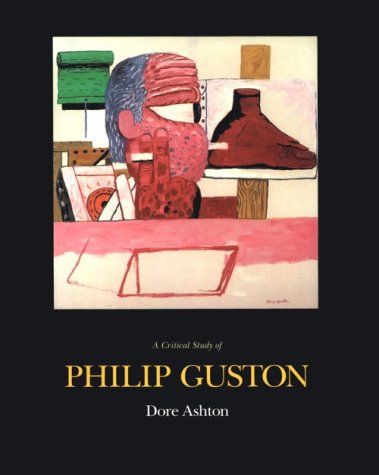
Dore Ashton has updated the bibliography and added a new concluding chapter to her classic study of the paintings and drawings of Philip Guston, the only study of his work completely authorized by the artist.
Philip Guston (1913-1980) was one of the most independent of the painters whose work was loosely linked by the term "abstract expressionism" during the 1950s, and he baffled admirers of his lushly beautiful abstract expressionist paintings by moving abruptly in mid-career to gritty figurative paintings in an almost cartoon-like style. One of the few critics who saw this at the time as a progressive development in his work was Dore Ashton, who here analyzes Guston's paintings and drawings in the context of the cultural milieu in which he worked, illuminating the dilemma facing artists who try to live with, understand, and express both the ideals of art and the reality of the world.
Philip Guston (1913-1980) was one of the most independent of the painters whose work was loosely linked by the term "abstract expressionism" during the 1950s, and he baffled admirers of his lushly beautiful abstract expressionist paintings by moving abruptly in mid-career to gritty figurative paintings in an almost cartoon-like style. One of the few critics who saw this at the time as a progressive development in his work was Dore Ashton, who here analyzes Guston's paintings and drawings in the context of the cultural milieu in which he worked, illuminating the dilemma facing artists who try to live with, understand, and express both the ideals of art and the reality of the world.
Die Inhaltsangabe kann sich auf eine andere Ausgabe dieses Titels beziehen.
Über die Autorin bzw. den Autor
Dore Ashton is Professor of Art History, The Cooper Union, and author of many books, including Fragonard in the Universe of Painting, About Rothko, A Fable of Modern Art, A Joseph Cornell Album, The New York School: A Cultural Reckoning.
Auszug. © Genehmigter Nachdruck. Alle Rechte vorbehalten.
A Critical Study of Philip Guston
By Dore AshtonUniversity of California Press
Copyright © 1990 Dore AshtonAll right reserved.
ISBN: 9780520069329
Introduction
One could write a history of art as a history of temperaments, but it would be as rigid and exclusive as a history of style alone, or of political epochs. Some temperaments, as revealed in works of art, have more or less in common, but art itself shuns commonality: while the scientist may seek the phenomenon that repeats itself, the artist seeks the exception. There are some temperaments that can be defined in terms of the questions they pose. These questions may well have been hovering in the human psyche for centuries, and they recur in the fugue of existence. Such questions are the special province of the arts.
"In the anti-historical position, each artist ishimself."1 In one of his ruminations, Guston confidently maintains the singularity that marks the artists he has enshrined. But, in another, he challenges the notion of "himself" and expatiates on the relationships that bind the family of artists he admires throughout history. He is, as almost all writers on his work have recognized, a man of dialogue. His work is clearly cyclical. His painting tone alternates, now caressing, now strident. His tastes veer from the sublime equilibrium of certain fifteenth-century masters to the dark reveries of the Romantics. Irreconcilables are the staff of his life.
Guston's reflexive dialecticism is well known to those who have
followed him over the years. They have learned to be comfortable with shifts in conversation from one position to another which, in the long dialogue of his life's work, are finally not inconsistent. Others may wonder at the dualities: the calm Elysian aspiration in the early figurative paintings and the abstractions of the early 1950s juxtaposed with the eruptive abstractions of the early 1960s and the works of the 1970s. They might read a balance sheet of remarks by Guston as proof of his ambivalence. But it would be a false reading. The very basis of his art is the holding in balance of seeming antitheses.
Guston has, as he said of his friend Bradley Walker Tomlin, "a tensile-and at times precarious-balance that covers an anguished sense of alternatives."2 He can long for experiences "more remote than I know" and dally in the regions of near-mysticism, and he can return purposively to the simplest experiences, curtly replying to his interlocutors when asked about his work, "What do I do? I eat. I drink from a cup."3 He can exult in the remoteness of Piero della Francesca's oeuvre: "Piero-you don't want to touch it"; he can relish Rembrandt, "all flesh and paint quality." He offers abstract aphorisms such as "doubt is the sharp awareness of the validity of alternatives,"4 but he also answers his own question "What am I working with?" wryly: "It's only colored dirt."5 He tells an interviewer in 1965 that he wants to end with something "that will baffle me for some time,"6 and a few months later tells the same writer, "I am only interested in the weight of the familiar." He makes a public statement that "there is something ridiculous and miserly in the myths we inherit from abstract art-that painting is autonomous, pure and for itself. But painting is 'impure.' It is the adjustments of impurities which forces painting's continuity."7 On the other hand, in a taped interview, he states flatly: "I don't believe in alternatives."8 Yet, alternatives juxtaposed, pondered, worried, turned, and finally neutralized in the finished work, which temporarily dissolves them, are Guston's most familiar companions. They are what he thinks and how he thinks. Like Woyzeck, the creature of B|chner, he can exclaim:
The human being! A lot can happen.-Nice weather, Captain. Such a pretty, solid gray sky. Do you see? One is tempted to drive a log into it and hang oneself thereon, just because of the little hyphen between yes, and yes again-and no. Captain, yes and no? Is the yes to blame for the no, or the no for the yes? Let me think it over.9
Born in 1913, the year of the Armory Show, Guston inherited the
conflicts inherent in modern art. His has been an epoch bedeviled by dialectics. Once Hegelianism had swept the Western world, dialecticism became the habitual mode of thinking. The whole history of modern art could be boxed rather neatly in dialectical sections, and many of its protagonists have consciously adopted the modern method of rhetorical combat. One movement contravened another, one leader gave way to the next, one single purpose deposed another single purpose, and always the anticipated synthesis was held in abeyance. A man of Guston's generation could not avoid the lines of battle, where the rallying cry was always: You must take a position. And it had to be an immediate and definite position before the ground gave way.
But for a man with a sense of the full measure of human experience and an affection for what remains of the past-the works of man's imagination-the position could only be provisional. Guston has consistently maintained an eccentric position-eccentric to the mores of his culture; eccentric to the temporary enthusiasms of the art world; eccentric to, but not alienated from, the given problems of modern art.
Among the numerous dilemmas spawned by the modern tradition are the basic questions: What, after all, is a painting and who is the artist? In the early phases of modern art when Symbolism prevailed, the idea was that a painting, like a poem, was a matter of essences. An image. Something whose value resided in its memorability, its aura, its synthesis of sensations that came together in the mind of the beholder somewhere outside of its actual physical facture. Not a thing, an image.
Such idealism met its dialectical response in realism, which maintained just as positively that a painting was not so much an image or idea as an object. Realists made things, not essences. Whether they were Cubist paintings or abstract paintings, they were to be regarded as concrete entities in a world of things. The clash of the Symbolist and realist views brought a problem peculiar to the twentieth century. In the past it had been taken for granted that analogy was the primary mode of perception in the arts. Recognition sprang from the just analogy, and paint was in the service of memory and sensibility. A few strokes and voil` asparagus-not real asparagus but an analogy for asparagus. However, when painting became autonomous, a thing among other things, the given system of analogies was challenged. If the canvas was a thing in itself, complete, concrete, and not virtual, the dimension of analogy either had to be purged, or adjusted. Some artists simply sidestepped, while others attempted to create a new
kind of analogy, a psychological one that was not immediately apparent. But all were caught in the toils of paradox. The art of painting in the twentieth century has careened wildly between extremes that make the earnest quarrels in the last century between the Ingres and Delacroix camps seem mild by comparison.
At one time or another Guston has met with all the contradictions in the modern tradition. Like most complex artists, he has had several relationships with his time, and those not always exclusive. Yet certain of the inherited problems in his case have found more or less consistent answers, as for instance in the problem of content. Can matter alone carry expressive meaning? He says no. It is not enough to make a mark on a canvas, even if it creates radiant light or rhythmic sequence. Although he experiments constantly, his...
„Über diesen Titel“ kann sich auf eine andere Ausgabe dieses Titels beziehen.
Suchergebnisse für A Critical Study of Philip Guston

Beispielbild für diese ISBN
A Critical Study of Philip Guston
Verlag:
University of California Press, 1990
ISBN 10: 0520069323
ISBN 13: 9780520069329
Gebraucht
Paperback
Anbieter: ThriftBooks-Atlanta, AUSTELL, GA, USA
Verkäuferbewertung 5 von 5 Sternen

Paperback. Zustand: Good. No Jacket. Pages can have notes/highlighting. Spine may show signs of wear. ~ ThriftBooks: Read More, Spend Less. Artikel-Nr. G0520069323I3N00
Gebraucht kaufen
EUR 16,32
Versand gratis
Versand innerhalb von USA
Versand innerhalb von USA
Anzahl: 1 verfügbar
Foto des Verkäufers
A Critical Study of Philip Guston
Verlag:
University of California Press, 1990
ISBN 10: 0520069323
ISBN 13: 9780520069329
Gebraucht
Soft cover
Erstausgabe
Anbieter: Paradou Books, Richmond, VA, USA
Verkäuferbewertung 5 von 5 Sternen
Soft cover. Zustand: Good. 1st Edition. Softcover, 216 pgs. Some corner wear, price stickers on covers; no internal markings. Artikel-Nr. ABE-1783292112864
Gebraucht kaufen
EUR 22,44
EUR 3,44 Versand
Versand innerhalb von USA
Versand innerhalb von USA
Anzahl: 1 verfügbar
Foto des Verkäufers
A Critical Study of Philip Guston
Verlag:
University of California Press, Berkeley, CA, 1990
ISBN 10: 0520069323
ISBN 13: 9780520069329
Gebraucht
Softcover
Erstausgabe
Anbieter: Jeff Hirsch Books, ABAA, Wadsworth, IL, USA
Verkäuferbewertung 5 von 5 Sternen
First Edition. First edition thus. Softcover. 216 pages. Ashton's long examination of the work of American artist Philip Guston. Includes some color and numerous black and white illustrations. A very good plus copy in wrappers with some very minor wear. Internally a clean copy. Artikel-Nr. 212130
Gebraucht kaufen
EUR 22,44
EUR 6,10 Versand
Versand innerhalb von USA
Versand innerhalb von USA
Anzahl: 1 verfügbar
Beispielbild für diese ISBN
A Critical Study Of Philip Guston
Verlag:
University of California Press, 1990
ISBN 10: 0520069323
ISBN 13: 9780520069329
Neu
Softcover
Anbieter: Romtrade Corp., STERLING HEIGHTS, MI, USA
Verkäuferbewertung 5 von 5 Sternen
Zustand: New. This is a Brand-new US Edition. This Item may be shipped from US or any other country as we have multiple locations worldwide. Artikel-Nr. ABBB-94232
Beispielbild für diese ISBN
A Critical Study of Philip Guston
Verlag:
University of California Press, 1990
ISBN 10: 0520069323
ISBN 13: 9780520069329
Gebraucht
Softcover
Anbieter: Majestic Books, Hounslow, Vereinigtes Königreich
Verkäuferbewertung 4 von 5 Sternen

Zustand: Used. pp. 216. Artikel-Nr. 5798605
Gebraucht kaufen
EUR 47,08
EUR 7,57 Versand
Versand von Vereinigtes Königreich nach USA
Versand von Vereinigtes Königreich nach USA
Anzahl: 1 verfügbar
Beispielbild für diese ISBN
A Critical Study of Philip Guston
Verlag:
University of California Press, 1990
ISBN 10: 0520069323
ISBN 13: 9780520069329
Gebraucht
Softcover
Anbieter: Biblios, Frankfurt am main, HESSE, Deutschland
Verkäuferbewertung 4 von 5 Sternen
Zustand: Used. pp. 216. Artikel-Nr. 183130648
Gebraucht kaufen
EUR 46,29
EUR 9,95 Versand
Versand von Deutschland nach USA
Versand von Deutschland nach USA
Anzahl: 1 verfügbar