
Verwandte Artikel zu Dear Carnap, Dear Van: The Quine-Carnap Correspondence...
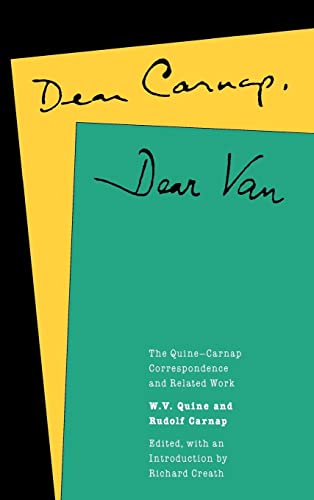
Dear Carnap, Dear Van: The Quine-Carnap Correspondence and Related Work: Edited and with an introduction by Richard Creath (Centennial Books) - Hardcover
Inhaltsangabe
Rudolf Carnap and W. V. Quine, two of the twentieth century's most important philosophers, corresponded at length—and over a long period of time—on matters personal, professional, and philosophical. Their friendship encompassed issues and disagreements that go to the heart of contemporary philosophic discussions. Carnap (1891-1970) was a founder and leader of the logical positivist school. The younger Quine (1908-) began as his staunch admirer but diverged from him increasingly over questions in the analysis of meaning and the justification of belief. That they remained close, relishing their differences through years of correspondence, shows their stature both as thinkers and as friends. The letters are presented here, in full, for the first time.
The substantial introduction by Richard Creath offers a lively overview of Carnap's and Quine's careers and backgrounds, allowing the nonspecialist to see their writings in historical and intellectual perspective. Creath also provides a judicious analysis of the philosophical divide between them, showing how deep the issues cut into the discipline, and how to a large extent they remain unresolved.
The substantial introduction by Richard Creath offers a lively overview of Carnap's and Quine's careers and backgrounds, allowing the nonspecialist to see their writings in historical and intellectual perspective. Creath also provides a judicious analysis of the philosophical divide between them, showing how deep the issues cut into the discipline, and how to a large extent they remain unresolved.
Die Inhaltsangabe kann sich auf eine andere Ausgabe dieses Titels beziehen.
Über die Autorin bzw. den Autor
Richard Creath is Associate Professor of Philosophy at Arizona State University.
Auszug. © Genehmigter Nachdruck. Alle Rechte vorbehalten.
Dear Carnap, Dear Van: The Quine-Carnap Correspondence and Related Work
By W.V. Quine and Rudolf CarnapUniversity of California Press
Copyright 1991 W.V. Quine and Rudolf CarnapAll right reserved.
ISBN: 0520068475
[Lecture I]
The A Priori
These three lectures are to be concerned with Carnap's very recent work only. His earlier book, Der Logische Aufban der Welt , must be excluded entirely, because, although a very important piece of work, it lies outside the direction of Carnap's latest book and articles; these lectures must, for lack of time, be confined to the new Carnap.
Carnap's central doctrine, which is the main concern of these lectures, is the doctrine that philosophy is syntax. In this hour I shall lead up to that doctrine by discussing the analytic character of the a priori . I will present none of Carnap's actual work this time, but will attempt only to put the mentioned doctrine in a suitable setting. In the remaining two lectures we can get into the details of Carnap's own developments.
The efforts of Carnap and his associates in the Viennese Circle have been directed in large part to showing us how to avoid metaphysics. Perhaps it will bear poor testimony to their success if I start out by discussing Kant. But a discussion of the analytic and the a priori starts us off with Kant.
According to Kant, a priori judgments and analytic judgments do not entirely coincide; for him all analytic judgments are of course a priori , but not all a priori judgments are analytic. A judgment is a priori if it has "the character of an inward necessity," as Kant says, and holds independently of any possible experience.
An analytic judgment is a judgment the truth of which may be established directly by analysis of the concepts involved. An analytic judgment can do no more than call our attention to something already contained in the definitions of our terms. Analytic judgments are consequences of definitions, conventions as to the uses
of words. They are consequences of linguistic fiat. Clearly they are a priori ; their truth does not depend upon experience, but upon vocabulary. Among analytic judgments are to be reckoned logic and the bulk, at least, of mathematics.
Analytic judgments are a priori ; but the converse, according to Kant, does not obtain. He holds that there are a priori truths, not dependent upon experience, which yet do not follow merely from the definitions of terms. He thus recognizes synthetic , or nonanalytic, a priori judgments. Among these a priori synthetic judgments he reckons the propositions of geometry.
But the development of foundational studies in mathematics during the past century has made it clear that none of mathematics, not even geometry, need rest on anything but linguistic conventions of a definitional kind. In this way it becomes possible to relegate geometry to the analytic realm, along with the rest of mathematics. This empties out the a priori synthetic. The analytic and the a priori become coxtensive. Thus Professor Lewis writes: "The a priori is not a material truth, delimiting or delineating the content of experience as such, but is definitive or analytic in its nature."1
It will be worth while, by way of examining this doctrine, to consider in detail the nature of the analytic. To begin with, let us distinguish two kinds of definition. First there is explicit definition, which is merely a convention of abbreviation. For example the definition of momentum as mass times velocity is an explicit definition: it is a linguistic convention whereby the word "momentum" is introduced as an arbitrary abbreviation for the compound expression "mass times velocity." The explicit definition is perhaps what we ordinarily think of as a definition.
An implicit definition is of an entirely different form. An implicit definition of a notion K is a set of one or more rules specifying that all sentences containing the word K in such and such a way are to be accepted, by convention, as true; their truth constitutes the meaning of K. For example, a set of postulates containing an undefined word K can be construed as an implicit definition of K: the postulates are adopted as true by convention, and the sign K is
Mind and the World Order , p. 231.
thereby partially or completely defined. An implicit definition, like an explicit definition, is a convention as to how the word in question is to be used. An explicit definition stipulates our use of the word, say "momentum", by referring us to our uses of certain other words, in this case "mass", "times" and "velocity", where the use of these words has presumably been already stipulated in the past. An explicit definition, unlike an implicit definition, is thus necessarily relative.
Often the word "definition" is restricted to explicit definition, and that has been my procedure elsewhere. But it will be convenient at present to use the word in the broader sense, covering both implicit and explicit definitions. This usage also has precedent; for the phrase "implicit definition" is not my own.
The analytic depends upon nothing more than definition, or conventions as to the uses of words. But in the ordinary uncriticized language of common sense we have little to do with deliberate definition. We learn our vocabulary through the usual process of psychological conditioning. We proceed glibly to use our vocabulary, and so long as we move among compatriots we get on without much difficulty: for their conditioning has been substantially the same as ours. At this level we feel no need of defining our terms, or introducing deliberate conventions as to the use of language. This comes only at a more sophisticated stagefor example in mathematics and in science.
Suppose now we start at a common-sense level, or an ultra-common-sense level, at which no conscious or deliberate definition has taken place. Then suppose we schematically run through the whole process of thoroughly defining the terms which we had been using without definition all along.
Let K be any word mathematical, logical or otherwiseperhaps the word "if", or perhaps "two", or "cat". Now let us consider the whole range of admittedly true sentences in which K occurs: true sentences, I mean, under the usual implicit, common-sense use of the word K, and true according to the given stage in the progress of science. The distinction between a priori and empirical does not concern me here. Let us call these accepted sentences the accepted K-sentences .
Now suppose we are confronted with the job of defining K. If we can frame a definition which fulfills all the accepted K-sentences,
then obviously we shall have done a perfectly satisfactory job. Nobody who was inclined to dispute the definition could point to a single respect in which the definition diverged from the accepted usage of the word K: for all accepted K-sentences would be verified.
Such a definition of K would be easily accomplished if there were only say three dozen accepted K-sentences. K could be given implicit definition by setting down those three dozen sentences, by fiat, and declaring that this was how you proposed to use the word K. Of course the definition might not be completely determinate; there might be several distinct notions all of which...
„Über diesen Titel“ kann sich auf eine andere Ausgabe dieses Titels beziehen.
Suchergebnisse für Dear Carnap, Dear Van: The Quine-Carnap Correspondence...

Beispielbild für diese ISBN
Dear Carnap, Dear Van: The Quine-Carnap Correspondence and Related Work
Verlag:
California University Press, 1990
ISBN 10: 0520068475
ISBN 13: 9780520068476
Gebraucht
Hardcover
Anbieter: Anybook.com, Lincoln, Vereinigtes Königreich
Verkäuferbewertung 5 von 5 Sternen

Zustand: Good. This is an ex-library book and may have the usual library/used-book markings inside.This book has hardback covers. In good all round condition. No dust jacket. Please note the Image in this listing is a stock photo and may not match the covers of the actual item,1100grams, ISBN:0520068475. Artikel-Nr. 5797254
Gebraucht kaufen
EUR 51,08
EUR 15,63 Versand
Versand von Vereinigtes Königreich nach USA
Versand von Vereinigtes Königreich nach USA
Anzahl: 1 verfügbar
Beispielbild für diese ISBN
Dear Carnap, Dear Van
Verlag:
University of California Press, 1991
ISBN 10: 0520068475
ISBN 13: 9780520068476
Neu
Hardcover
Anbieter: Kennys Bookstore, Olney, MD, USA
Verkäuferbewertung 5 von 5 Sternen
Zustand: New. Rudolf Carnap and WV Quine, two of the twentieth century's important philosophers, corresponded at length - and over a long period of time - on matters personal, professional, and philosophical. Their friendship encompassed issues and disagreements that go to the heart of contemporary philosophic discussions. This title presents their letters. Editor(s): Creath, Richard. Num Pages: 499 pages, illustrations. BIC Classification: HPC. Category: (P) Professional & Vocational; (UP) Postgraduate, Research & Scholarly; (UU) Undergraduate. Dimension: 150 x 230 x 38. Weight in Grams: 944. . 1991. Hardcover. . . . . Books ship from the US and Ireland. Artikel-Nr. V9780520068476
Neu kaufen
EUR 76,68
EUR 9,35 Versand
Versand innerhalb von USA
Versand innerhalb von USA
Anzahl: 1 verfügbar
Beispielbild für diese ISBN
Dear Carnap, Dear Van: The Quine-Carnap Correspondence and Related Work: Edited and with an introduction by Richard Creath (Centennial Books)
Verlag:
University of California Press, 1991
ISBN 10: 0520068475
ISBN 13: 9780520068476
Neu
Hardcover
Anbieter: Ria Christie Collections, Uxbridge, Vereinigtes Königreich
Verkäuferbewertung 5 von 5 Sternen
Zustand: New. In English. Artikel-Nr. ria9780520068476_new
Neu kaufen
EUR 76,41
EUR 17,75 Versand
Versand von Vereinigtes Königreich nach USA
Versand von Vereinigtes Königreich nach USA
Anzahl: Mehr als 20 verfügbar
Beispielbild für diese ISBN
Dear Carnap, Dear Van
Verlag:
University of California Press, 1991
ISBN 10: 0520068475
ISBN 13: 9780520068476
Neu
Hardcover
Anbieter: Majestic Books, Hounslow, Vereinigtes Königreich
Verkäuferbewertung 4 von 5 Sternen

Zustand: New. pp. 499. Artikel-Nr. 4989696
Neu kaufen
EUR 106,79
EUR 7,72 Versand
Versand von Vereinigtes Königreich nach USA
Versand von Vereinigtes Königreich nach USA
Anzahl: 1 verfügbar
Foto des Verkäufers
Carnap, R: Dear Carnap, Dear Van
Verlag:
University of California Press, 1992
ISBN 10: 0520068475
ISBN 13: 9780520068476
Neu
Hardcover
Anbieter: moluna, Greven, Deutschland
Verkäuferbewertung 5 von 5 Sternen
Zustand: New. Rudolf Carnap and WV Quine, two of the twentieth century s important philosophers, corresponded at length - and over a long period of time - on matters personal, professional, and philosophical. Their friendship encompassed issues and disagreements that go . Artikel-Nr. 594720109
Neu kaufen
EUR 77,56
EUR 48,99 Versand
Versand von Deutschland nach USA
Versand von Deutschland nach USA
Anzahl: Mehr als 20 verfügbar
Beispielbild für diese ISBN
Dear Carnap, Dear Van: The Quine Carnap Correspondence and Related Work
Verlag:
Univ of California Pr on Demand, 1991
ISBN 10: 0520068475
ISBN 13: 9780520068476
Neu
Hardcover
Anbieter: Revaluation Books, Exeter, Vereinigtes Königreich
Verkäuferbewertung 5 von 5 Sternen
Hardcover. Zustand: Brand New. 499 pages. 9.75x6.50x1.50 inches. In Stock. Artikel-Nr. x-0520068475
Neu kaufen
EUR 118,39
EUR 14,85 Versand
Versand von Vereinigtes Königreich nach USA
Versand von Vereinigtes Königreich nach USA
Anzahl: 2 verfügbar
Foto des Verkäufers
Dear Carnap, Dear Van : The Quine-Carnap Correspondence and Related Work: Edited and with an introduction by Richard Creath
Anbieter: AHA-BUCH GmbH, Einbeck, Deutschland
Verkäuferbewertung 5 von 5 Sternen
Buch. Zustand: Neu. Neuware - Rudolf Carnap and W. V. Quine, two of the twentieth century's most important philosophers, corresponded at length--and over a long period of time--on matters personal, professional, and philosophical. Their friendship encompassed issues and disagreements that go to the heart of contemporary philosophic discussions. Carnap (1891-1970) was a founder and leader of the logical positivist school. The younger Quine (1908-) began as his staunch admirer but diverged from him increasingly over questions in the analysis of meaning and the justification of belief. That they remained close, relishing their differences through years of correspondence, shows their stature both as thinkers and as friends. The letters are presented here, in full, for the first time.The substantial introduction by Richard Creath offers a lively overview of Carnap's and Quine's careers and backgrounds, allowing the nonspecialist to see their writings in historical and intellectual perspective. Creath also provides a judicious analysis of the philosophical divide between them, showing how deep the issues cut into the discipline, and how to a large extent they remain unresolved. Artikel-Nr. 9780520068476
Neu kaufen
EUR 105,04
EUR 35,00 Versand
Versand von Deutschland nach USA
Versand von Deutschland nach USA
Anzahl: 2 verfügbar