
Verwandte Artikel zu For Those Who Come After: A Study of Native American...
Inhaltsangabe
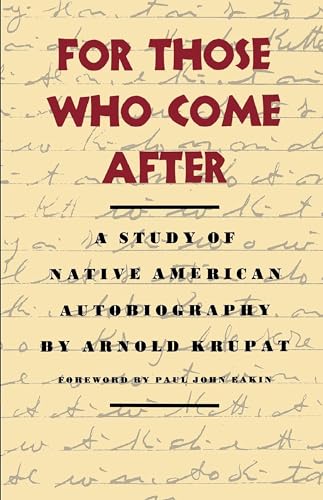
Drawing on the life stories of Native Americans solicited by historians during the 19th century and, later, by anthropologists concerned with amplifying the cultural record, Arnold Krupat examines the Indian autobiography as a specific genre of American writing.
Die Inhaltsangabe kann sich auf eine andere Ausgabe dieses Titels beziehen.
Über die Autorin bzw. den Autor
Arnold Krupat is a member of the Literature faculty at Sarah Lawrence College.
Von der hinteren Coverseite
For Those Who Come After seems indeed to be quite a specialized book, a study of texts concerning a marginalized people, texts themselves marginalized (at least until recently) by their exclusion from the canon of American literature traditionally taught in the United States.
Auszug. © Genehmigter Nachdruck. Alle Rechte vorbehalten.
For Those Who Come After: A Study of Native American Autobiography
By Arnold KrupatUniversity of California Press
Copyright 1989 Arnold KrupatAll right reserved.
ISBN: 0520066065
1
An Approach to Native American Texts
Critical commentary on Native American literature dates virtually from the very moment of its "discovery" by Euramericans, a discovery which perhaps did not occur until the second quarter of the nineteenth century. But the earliest students of Indian literatures had little in the way of sound cultural and linguistic data on which to base their understanding. It was probably not until the twentieth century, the result, largely, of the work of Franz Boas and his students, that an approximately accurate scientific knowledge of the many Native languages and cultures of America began
Manuscript page of Sam Blowsnake's (Crashing Thunder's) autobiography in the Winnebago syllabary. From the Paul Radin papers, courtesy of the American Philosophical Society Library, Philadelphia, Pennsylvania.
to be achieved. And it is only since the 1950s that structural analysis of Native literatures, spurred by Lvi-Strauss's work on "myth," has made much progress.
Lvi-Strauss's binary method of analysis opposed the "myth" to the "poem," the first infinitely translatable, the second virtually untranslatable. In Lvi-Strauss's work, much of what might be considered the literature of "primitive" people is treated as myth, its content available for transformation into abstract pairs while its form, its actual language and performative dynamics, is largely ignored or dismissed.
Dell Hymes contributed significantly to the study of Native American texts by producing the conceptual structures of Native American narratives as a function of their particular linguistic structures, thus accepting Lvi-Strauss's insistence on their broad meaningfulness while rejecting his indifference to the actual terms of their presentation. Hymes has recently reminded us of what should have been obvious all along, that "the problems of understanding what Native American narrators have intended and expressed is difficult enough. It is far more difficult if, in a certain sense, we do not know what they said."1 In all too many cases it is not possible to "know what they said," for what they said was never transcribedor if transcribed, not preserved. All the more reason, then, to pay particularly close attention to those transcriptions (and, more recently, tapes) which do exist. Hymes himself, unusually learned in Native languages, has shown how informed scrutiny of transcriptions can reveal structural patterns which had been entirely obscured in English prose translation.
Beyond the considerable difficulty of knowing "what they said" lies the difficulty of knowing how they said it. For
Native American literature presents itself exclusively in the form of oral performances, not textual objects; no matter how scrupulous a transcription may be, it is inevitably a declension from the narrative as act.
Recent developments in poststructuralism, whatever their effect on the reading of Western literature, have had an enormously salutary effect on the reading of Native American literature. With the reexamination of such concepts as voice, text, and performance, and of the ontological and epistemological status of the sign, has come a variety of effective means for specifying and demonstrating the complexity and richness of Native American literature. Attempting to recuperate the performative dimension, Dennis Tedlock worked directly from tape recordings to produce his well-known anthology from the Zuni, Finding the Center (1972). Tedlock used typographical variations to convey changes of pitch, volume, and pace; he also indicated the audience responses important to Native American narrative. Tedlock is perhaps foremost among those students of Indian literature wishing to move "toward an oral poetics."2
Although it seems the case that our textual culture is presently restructuring itself to replace print with the printout, moving, in Father Walter Ong's phrase, to the "secondary orality of the electronic age,"3 I still do not think we are likely to develop an "oral poetics." The concept of an oral poetics nonetheless remains important as a check to the Euramerican tendency to project alphabetic categories onto the nonalphabetic practice of Native Americans. We need to acknowledge the (very nearly disabling) fact that most of us (non-Indians, but a great many Indians, too) are going to experience Native American literary art almost
exclusively in textual form. No matter how the type is sized or arranged on the page, it will be, in Gayatri Spivak's phrase, the "graphic of the trace" that we encounter, not the presence of the voice.4 Yet we need to acknowledge as well that our desire for lost originals here is not the nostalgia of Western metaphysics but the price of Western imperial history. It is as a result of the conquest and dispossession of the tribes that the signifier replaces the act; our script marked on the page is the pale trace of what their voices performed. There is, nonetheless, every reason to attempt to understand the texts we have and to try to imagine the performances we have lost (some of them the better imagined because of the tape recordings of performances which we do have).
There has been a sufficient amount of sophisticated writing about Native American literature in the last ten years or so to constitute a New Indian Criticism. In the remainder of this chapter, I want to move in the direction of a systematization by examining the concepts of (1) the mode of production of the text, (2) the author, (3) literature, and (4) canonicity to show how they can be organized into an approach to Native American texts.
The Mode of Production of the TextThe concept of the mode of productionwhich includes the forces or means of production and the relations of productionderives from Marxist studies in which it designates the particular form of a given society's economic organization at a given time. Because the mode of productionthe economic baseis considered largely to determine social relationships, and social relationships to determine consciousness and its material expressions, the importance of the mode of production to literary studiespart of the su-
perstructure of culture, law, religion, and the likeis clear. This is, of course, to assert what should be apparent but in a great deal of American liberal criticism is notthat texts are social and material, that they are made actively and by the expenditure of labor, and that they are commodities whose exchange value is not solely a question of the economics of publishing.
Important as this is for Euramerican writing, it is absolutely crucial for Native American texts, which cannot even be thought except as the products of a complex but historically specifiable division of labor. There simply were no Native American texts until whites decided to collaborate with Indians and make them. Nor is it unworthy of mention that they did not decide to make them until the late nineteenth century, when the American economy itself had shifted its base to making. Earlier, in the colonial period, trade was economically paramount. From the Revolutionary period into the nineteenth century,...
„Über diesen Titel“ kann sich auf eine andere Ausgabe dieses Titels beziehen.
Suchergebnisse für For Those Who Come After: A Study of Native American...

Beispielbild für diese ISBN
For Those Who Come After: A study of Native Americ
Verlag:
University of California Press, 1989
ISBN 10: 0520066065
ISBN 13: 9780520066069
Gebraucht
Softcover
Anbieter: N. Fagin Books, Chicago, IL, USA
Verkäuferbewertung 5 von 5 Sternen

1985/1989. North America, Native Americans. University of California Press. Very good used paperback167p. Artikel-Nr. -532876822
Gebraucht kaufen
EUR 3,66
EUR 5,33 Versand
Versand innerhalb von USA
Versand innerhalb von USA
Anzahl: 1 verfügbar
Beispielbild für diese ISBN
For Those Who Come After. A Study of Native American Autobiography.
ISBN 10: 0520066065
ISBN 13: 9780520066069
Gebraucht
Softcover
Anbieter: Antiquariaat Hortus Conclusus, Bergambacht, Niederlande
Verkäuferbewertung 5 von 5 Sternen
Paperback, minor traces of use, else in (very) good condition. Please see description or ask for photos. Artikel-Nr. 29982
Gebraucht kaufen
EUR 6,50
EUR 14,50 Versand
Versand von Niederlande nach USA
Versand von Niederlande nach USA
Anzahl: 1 verfügbar
Beispielbild für diese ISBN
For Those Who Come After
Anbieter: PBShop.store US, Wood Dale, IL, USA
Verkäuferbewertung 5 von 5 Sternen
PAP. Zustand: New. New Book. Shipped from UK. Established seller since 2000. Artikel-Nr. L2-9780520066069
Neu kaufen
EUR 37,01
Versand gratis
Versand innerhalb von USA
Versand innerhalb von USA
Anzahl: Mehr als 20 verfügbar
Beispielbild für diese ISBN
For Those Who Come After
Anbieter: PBShop.store UK, Fairford, GLOS, Vereinigtes Königreich
Verkäuferbewertung 5 von 5 Sternen
PAP. Zustand: New. New Book. Shipped from UK. Established seller since 2000. Artikel-Nr. L2-9780520066069
Neu kaufen
EUR 35,22
EUR 4,89 Versand
Versand von Vereinigtes Königreich nach USA
Versand von Vereinigtes Königreich nach USA
Anzahl: Mehr als 20 verfügbar
Beispielbild für diese ISBN
For Those Who Come After: A Study of Native American Autobiography
Verlag:
University of California Press, 1989
ISBN 10: 0520066065
ISBN 13: 9780520066069
Neu
Softcover
Anbieter: Ria Christie Collections, Uxbridge, Vereinigtes Königreich
Verkäuferbewertung 5 von 5 Sternen
Zustand: New. In English. Artikel-Nr. ria9780520066069_new
Neu kaufen
EUR 38,61
EUR 11,03 Versand
Versand von Vereinigtes Königreich nach USA
Versand von Vereinigtes Königreich nach USA
Anzahl: Mehr als 20 verfügbar
Beispielbild für diese ISBN
For Those Who Come After
Verlag:
University of California Press, 1989
ISBN 10: 0520066065
ISBN 13: 9780520066069
Neu
Softcover
Anbieter: Majestic Books, Hounslow, Vereinigtes Königreich
Verkäuferbewertung 4 von 5 Sternen

Zustand: New. pp. 204. Artikel-Nr. 4989813
Neu kaufen
EUR 49,08
EUR 7,65 Versand
Versand von Vereinigtes Königreich nach USA
Versand von Vereinigtes Königreich nach USA
Anzahl: 1 verfügbar
Beispielbild für diese ISBN
For Those Who Come After: A Study of Native American Autobiography
Verlag:
Univ of California Pr on Demand, 1989
ISBN 10: 0520066065
ISBN 13: 9780520066069
Neu
Hardcover
Anbieter: Revaluation Books, Exeter, Vereinigtes Königreich
Verkäuferbewertung 5 von 5 Sternen
Hardcover. Zustand: Brand New. reprint edition. 204 pages. 8.50x5.75x0.75 inches. In Stock. Artikel-Nr. x-0520066065
Neu kaufen
EUR 51,89
EUR 11,77 Versand
Versand von Vereinigtes Königreich nach USA
Versand von Vereinigtes Königreich nach USA
Anzahl: 2 verfügbar
Foto des Verkäufers
FOR THOSE WHO COME AFTER
Anbieter: moluna, Greven, Deutschland
Verkäuferbewertung 5 von 5 Sternen
Zustand: New. Drawing on the life stories of Native Americans solicited by historians during the 19th century and, later, by anthropologists concerned with amplifying the cultural record, this title examines the Indian autobiography as a specific genre of American writin. Artikel-Nr. 594720061
Neu kaufen
EUR 44,76
EUR 48,99 Versand
Versand von Deutschland nach USA
Versand von Deutschland nach USA
Anzahl: Mehr als 20 verfügbar