
Verwandte Artikel zu Two Churches: England and Italy in the Thirteenth Century,...
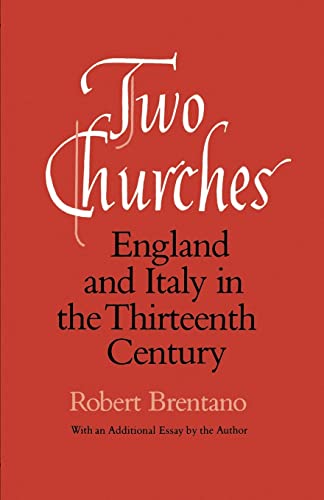
Two Churches: England and Italy in the Thirteenth Century, With an additional essay by the Author. - Softcover
Inhaltsangabe
This book is not meant to be a definitive exploration of the whole of the two churches in any case. The attempt would be absurd. But the book is not meant, either, to be an intense exploration of "certain aspects" of the two churches. It is meant rather to be an extended essay about the connected differences between the two churches, to use "aspects" as touchstones for comparison. It is meant to be a comparison of two total styles. These are not architectural styles, although there is a marked and significant difference between English and Italian ecclesiastical architecture in the thirteenth century. The nonarchitectural style of the thirteenth-century Italian church might in fact be called sustained Romanesque, or perhaps sustained Burgundian.
Comparing England (or Britain) with Italy in order to expose more fully one or both is not a new idea. Historians, like Tacitus and Collingwood, have made the comparison, and so have poets, like Browning and, with superb intellectuality, Clough. This is, at least locally, where angels feared to tread. The famous Venetian Anonymous wrote from the other side in his Relation (of about 1500), and condensed for us his comparison in the observation that unlike the Italians the English felt no real love, only lust. The spring bough and the melon-flower, Collingwood's city and field—the long continuity of the difference is startlingly apparent. Explaining the continuity (and perhaps there is no more difficult sort of historical explanation—its difficulty is painful to the mind) is not the job that this book sets itself. But it would be dull and dishonest to ignore the fact that the continuity exists. All that this book has to say may be no more than that the thirteenthcentury Italian church was in fact, as Browning warned, a melon-flower. The book may be only a gloss on amore. The symbol is more inclusive, more evocative, less guilty of excluding the essential but undefined, than detailed description can be. Melon-flower and amore, however, fortunately for the purpose of this book, say very little about the intricate, connected detail of administrative history. Collingwood's (after Tacitus's) city against field presses less deeply but says more. The general difference between the styles of the English and Italian churches has a great deal to do, and very directly, with the fact that the inhabitants of Italy were continually city-dwellers and the inhabitants of Britain were essentially not.
Although this book is about both England and Italy, it approaches them differently. The thirteenth-century Italian church is, particularly in English and French, practically unknown. Before it can be explained or analyzed, it must be recreated, formed again in detail. The job is in part really archaeological. The outline of past existence must be uncovered. This is not at all true of the thirteenth-century English church. It has been well explored. This disparity in past observation forces my book to talk much more of Italy than of England; but, if it is a book about one church rather than the other, it is a book about England. England is meant to be seen, for a change, against what it was not. In this sort of profile it has a different look. England may no longer seem a country in the frozen North, incapable, in the distance, of responding fully to Lateran enthusiasm. Its full response to ecclesiastical government may seem clearly connected with its, of course relatively, full response to secular government.
Die Inhaltsangabe kann sich auf eine andere Ausgabe dieses Titels beziehen.
Über die Autorin bzw. den Autor
Robert Brentano (1926-2002) was Professor of History at the University of California, Berkeley, and author of Rome Before Avignon: A Social History of Thirteenth-Century Rome (California).
Von der hinteren Coverseite
"Profound and exact scholarship, the results of extensive archival research, and a lively literary style combine to create a work of unusual distinction, a classic in the field of thirteenth-century ecclesiastical history."
--Committee on Award of the Haskins Medal
"A first-rate work of history. Brentano is the single best writer among medieval historians in America today."
--Lester K. Little, Smith College
"One of the very best works of medieval history written since World War II. Bretano is one of the finest medievalists in the United States."
--William Bowsky, University of California, Davis
Aus dem Klappentext
"Profound and exact scholarship, the results of extensive archival research, and a lively literary style combine to create a work of unusual distinction, a classic in the field of thirteenth-century ecclesiastical history."
--Committee on Award of the Haskins Medal
"A first-rate work of history. Brentano is the single best writer among medieval historians in America today."
--Lester K. Little, Smith College
"One of the very best works of medieval history written since World War II. Bretano is one of the finest medievalists in the United States."
--William Bowsky, University of California, Davis
Auszug. © Genehmigter Nachdruck. Alle Rechte vorbehalten.
Two Churches: England and Italy in the Thirteenth Century, With an additional essay by the Author.
By Robert BrentanoUniversity of California Press
Copyright © 1988 Robert BrentanoAll right reserved.
ISBN: 0520060989
I—
The Connection
In November 1237, as heavy winds blew and black tower-like clouds formed and the planets were said to be gathering together under the sign of Capricorn, the cardinal legate Otto sat on a high seat raised in the west end of Saint Paul's in London and presided over a council of the church in England. The prelates of England, tired and peeved by the winter roads and the legate's insistence, gathered together around and beneath the cardinal's throne.1 It was, in the long run of the century, a remarkably, a surprisingly, successful council. The legate preached from the text "And in the midst of the throne, and round about the throne, were four beasts, full of eyes before and behind."2 And to this text succeeding English prelates were as a sea of glass. The English bishops of the later thirteenth century were—as close as their political humanity could come to it—the ideally vigilant bishops of the reformed Roman church of Innocent III's Lateran Council of 1215, reasserted and made pointedly local by Otto's London council with its flaming text.
Otto was one of a series of thirteenth-century Roman legates who, in their persons, brought the elevating connection of Rome to England.3 Otto's most distinguished successor, Otto-
Matthew Paris, Chronica Majora , ed. H. R. Luard, Rolls Series (London, 1872-1883), III, 414-420.
Ibid. , 419; Revelations 4:6; the canons (glossed) of Otto's council may be found in Constitutiones Legatinae . . . D. Othonis et D. Othoboni Cardinalium . . . (Oxford, 1679), 3-73, printed with William Lyndwood's Provinciale ; they are also printed in David Wilkins, Concilia Magnae Britanniae et Hiberniae (London, 1737), I, 649-656. (Also see F. M. Powicke and C. R. Cheney, Councils and Synods with Other Documents Relating to the English Church , II. i [Oxford, 1964], 237-259.)
For legates to England through Guala (1216-1218) see Helene Tillmann, Die päpstlichen Legaten in England bis zur Beendigung der Legation Gualas (1218) (Bonn, 1926); it is hoped that this book will do something toward substantiating the extravagant claim for the English bishops; I think that my estimate's being higher than, say, that of Miss Gibbs' and Miss Lang's book is due to my looking at English bishops in comparison with the bishops of another church: cf. Marion Gibbs and Jane Lang, Bishops and Reform, 1215-1272 (Oxford, 1934), 174-179.
buono Fieschi, later briefly Pope Hadrian V, scion of a brilliant but morally rather ambiguous Genoese-papal family, caught the wracked England of the 1260's and helped to raise it toward the ideal of the Christian feudal kingdom.4 Otto's predecessor, Nicholas, cardinal bishop of Tusculum, had, in 1213, with an Italian Cistercian abbot in his train, descended upon the abbey of Evesham and rid it of Roger Norreys, its disgustingly immoral abbot, who had been plundering it and deforming it for years.5 These men cut through petty local boundaries and fought to make the universal church work. They were, at their best, great men of high purpose, and their most serious work knew no nationality.
In the spring of 1238 the legate Otto came to Oxford and stayed in the abbey at Osney. His presence and that of his Italian, trans-Alpine, Roman household excited the clerks of Oxford to nationalist riot. The riot started, according to Matthew Paris, with the raised Roman voice of an Italian porter.6 The riot of Oxford and the council of London, it must with difficulty be remembered, circled around the same man. The international church of the thirteenth century was also for the most part an Italian church; and the presence of the international church's representatives in England meant the presence of Italian clerks who had been brought up in its ways and taught to think in its terms—although it is possible that some
For Ottobuono see particularly F. M. Powicke, King Henry III and the Lord Edward (Oxford, 1947), I, 246 n. I; II, 557-558, 562-563; for Ottobuono's unpopularity because of his connection with the tenth of 1266, ibid. , II, 559-561.
Chronicon Abbatiae de Evesham , ed. W. D. Macray, Rolls Series (London, 1863), 230-256, particularly 250; for the legate Giovanni of Ferentino's activities, C. R. Cheney, "The Papal Legate and English Monasteries in 1206," English Historical Review , XLVI (1931), 443-452; and "Cardinal John of Ferentino, Papal Legate in England in 1206," English Historical Review , LXXVI (1961), 654-660.
Matthew Paris, Chronica Majora , III, 482; and see Powicke, Henry III , I, 353, and Dorothy M. Williamson, "Some Aspects of the Legation of Cardinal Otto in England, 1233-41," English Historical Review , LXIV (1949), 145-173, particularly 171-173.
of them, perhaps Guala or Ottobuono, prepared no doubt by the pervasive thought of Paris, may have come to prefer the ways of the English church.
Just before the beginning of the century a sharp-eyed, sharp-tongued monk and proctor from Christ Church, John Bremble, wrote back to Canterbury to tell the monks at home what the curia, in which they had become involved, was like. "This I'll tell you," he wrote, "at Rome I have found all Romans, and the pope [Clement III, Paolino Scolare] is a Roman, both by birth and by type."7
John Bremble meant that the pope was greedy. Greed is the quality that Matthew Paris most constantly connected with Italians. Matthew created, in his Chronica Majora , an intensely and critically observed England-centered world for the years from 1235 to 1259, and in it he watched Otto at last set sail from Dover leaving a kingdom desolated by him as a vineyard might have been by a wild boar. Matthew's Otto had, with quadruple greed, extorted English money and dispersed English livings for himself and for the pope.8 Greed and nationalism are both major themes in Matthew's work; and Matthew is particularly interesting on the international church as an Italian church because it upset him in both guises. He was made intensely uncomfortable by any sort of central reform that threatened or might seem to threaten the heavy properties of the rich houses of the old religious orders, and he was a xenophobe. Directly and in quotation Matthew's sulphurous billows of disturbed image find bellow-mouths and sponge-bellies at Rome and Italian spies poking into and discovering the secret treasury of England.
Matthew was, however, not more concerned than Robert Grosseteste. Grosseteste, from 1235 to 1253 the scholar bishop of Lincoln, of all bishops most thoughtfully aware of the pastoral function and like Stephen Langton the mirror of thirteenth-century episcopal excellence, found the provided Italian
Epistolae Cantuarienses (vol. 11 of Chronicles and Memorials of the Reign of Richard I ), ed. William Stubbs, Rolls Series (London, 1865), 194.
Matthew Paris, Chronica Majora , IV, 84-85; for a considerably fuller discussion of Matthew Paris as historian see Chapter V, below.
and the Italian legate a threat to the cure of souls and to the integrity of ecclesiastical administration.9 The careful, painful letters with which Grosseteste tried, in obedience, to resist Otto's provisions have none of Matthew's facility and bombast.10 They preserve a quite different...
„Über diesen Titel“ kann sich auf eine andere Ausgabe dieses Titels beziehen.
Suchergebnisse für Two Churches: England and Italy in the Thirteenth Century,...

Beispielbild für diese ISBN
Two Churches: England and Italy in the Thirteenth Century, with an Additional Essay by the Author.
Verlag:
University of California Press, 1988
ISBN 10: 0520060989
ISBN 13: 9780520060982
Gebraucht
Paperback
Anbieter: ThriftBooks-Atlanta, AUSTELL, GA, USA
Verkäuferbewertung 5 von 5 Sternen

Paperback. Zustand: Good. No Jacket. Pages can have notes/highlighting. Spine may show signs of wear. ~ ThriftBooks: Read More, Spend Less. Artikel-Nr. G0520060989I3N00
Gebraucht kaufen
EUR 7,75
Versand gratis
Versand innerhalb von USA
Versand innerhalb von USA
Anzahl: 1 verfügbar
Beispielbild für diese ISBN
Two Churches : England and Italy in the Thirteenth Century, with an Additional Essay by the Author
Verlag:
University of California Press, 1988
ISBN 10: 0520060989
ISBN 13: 9780520060982
Gebraucht
Softcover
Anbieter: Better World Books, Mishawaka, IN, USA
Verkäuferbewertung 5 von 5 Sternen
Zustand: Good. rev. Former library copy. Pages intact with minimal writing/highlighting. The binding may be loose and creased. Dust jackets/supplements are not included. Includes library markings. Stock photo provided. Product includes identifying sticker. Better World Books: Buy Books. Do Good. Artikel-Nr. 10287563-6
Gebraucht kaufen
EUR 9,77
Versand gratis
Versand innerhalb von USA
Versand innerhalb von USA
Anzahl: 1 verfügbar
Beispielbild für diese ISBN
Two Churches : England and Italy in the Thirteenth Century, with an Additional Essay by the Author
Verlag:
University of California Press, 1988
ISBN 10: 0520060989
ISBN 13: 9780520060982
Gebraucht
Softcover
Anbieter: Better World Books: West, Reno, NV, USA
Verkäuferbewertung 5 von 5 Sternen
Zustand: Very Good. rev. Former library copy. Pages intact with possible writing/highlighting. Binding strong with minor wear. Dust jackets/supplements may not be included. Includes library markings. Stock photo provided. Product includes identifying sticker. Better World Books: Buy Books. Do Good. Artikel-Nr. GRP95491693
Gebraucht kaufen
EUR 9,77
Versand gratis
Versand innerhalb von USA
Versand innerhalb von USA
Anzahl: 1 verfügbar
Beispielbild für diese ISBN
Two Churches: England and Italy in the Thirteenth Century, with an additional essay by the author
Verlag:
University of California Press, 1988
ISBN 10: 0520060989
ISBN 13: 9780520060982
Gebraucht
Paperback
Anbieter: WorldofBooks, Goring-By-Sea, WS, Vereinigtes Königreich
Verkäuferbewertung 5 von 5 Sternen
Paperback. Zustand: Very Good. The book has been read, but is in excellent condition. Pages are intact and not marred by notes or highlighting. The spine remains undamaged. Artikel-Nr. GOR008293070
Gebraucht kaufen
EUR 3,36
EUR 6,53 Versand
Versand von Vereinigtes Königreich nach USA
Versand von Vereinigtes Königreich nach USA
Anzahl: 1 verfügbar
Beispielbild für diese ISBN
Two Churches : England and Italy in the Thirteenth Century, with an Additional Essay by the Author
Verlag:
University of California Press, 1988
ISBN 10: 0520060989
ISBN 13: 9780520060982
Gebraucht
Softcover
Anbieter: Better World Books Ltd, Dunfermline, Vereinigtes Königreich
Verkäuferbewertung 5 von 5 Sternen
Zustand: Good. rev. Former library copy. Pages intact with minimal writing/highlighting. The binding may be loose and creased. Dust jackets/supplements are not included. Includes library markings. Stock photo provided. Product includes identifying sticker. Better World Books: Buy Books. Do Good. Artikel-Nr. 10287563-6
Gebraucht kaufen
EUR 6,06
EUR 5,83 Versand
Versand von Vereinigtes Königreich nach USA
Versand von Vereinigtes Königreich nach USA
Anzahl: 1 verfügbar
Beispielbild für diese ISBN
Two Churches: England and Italy in the Thirteenth Century, With An Additional Essay by the Author
Verlag:
University of California Press, 1988
ISBN 10: 0520060989
ISBN 13: 9780520060982
Gebraucht
Softcover
Anbieter: Anybook.com, Lincoln, Vereinigtes Königreich
Verkäuferbewertung 5 von 5 Sternen
Zustand: Good. This is an ex-library book and may have the usual library/used-book markings inside.This book has soft covers. In good all round condition. Please note the Image in this listing is a stock photo and may not match the covers of the actual item,550grams, ISBN:0520060989. Artikel-Nr. 4145926
Gebraucht kaufen
EUR 3,01
EUR 15,86 Versand
Versand von Vereinigtes Königreich nach USA
Versand von Vereinigtes Königreich nach USA
Anzahl: 1 verfügbar
Beispielbild für diese ISBN
Two Churches: England and Italy in the Thirteenth Century, With An Additional Essay by the Author
Verlag:
University of California Press, 1988
ISBN 10: 0520060989
ISBN 13: 9780520060982
Gebraucht
Softcover
Anbieter: Anybook.com, Lincoln, Vereinigtes Königreich
Verkäuferbewertung 5 von 5 Sternen
Zustand: Good. This is an ex-library book and may have the usual library/used-book markings inside.This book has soft covers. In good all round condition. Please note the Image in this listing is a stock photo and may not match the covers of the actual item,550grams, ISBN:0520060989. Artikel-Nr. 5814303
Gebraucht kaufen
EUR 3,35
EUR 15,86 Versand
Versand von Vereinigtes Königreich nach USA
Versand von Vereinigtes Königreich nach USA
Anzahl: 1 verfügbar
Foto des Verkäufers
Two churches : England and Italy in the thirteenth century / Robert Brentano
Verlag:
Princeton, N.J. : Princeton University Press, 1988
ISBN 10: 0520060989
ISBN 13: 9780520060982
Gebraucht
Softcover
Anbieter: MW Books, New York, NY, USA
Verkäuferbewertung 5 von 5 Sternen
Reprint. Good paperback copy; edges somewhat dust-dulled and nicked. Remains quite well-preserved overall. Physical description: xvi, 372 p., [8] p. of plates : ill., maps ; 22 cm. Subjects: England 1066 485; Italy 476 400; Church; England Church history Medieval period, 1066-1485; Italy Church history 476-1400; Italy Civilization 476-1268; England. 1 Kg. Artikel-Nr. 442680
Gebraucht kaufen
EUR 25,32
Versand gratis
Versand innerhalb von USA
Versand innerhalb von USA
Anzahl: 1 verfügbar
Foto des Verkäufers
Two Churches: England and Italy in the Thirteenth Century, With an additional essay
Verlag:
University of California Press, United Kingdom, 1988
ISBN 10: 0520060989
ISBN 13: 9780520060982
Gebraucht
Soft cover
Anbieter: Pendleburys - the bookshop in the hills, Llanwrda, Vereinigtes Königreich
Verkäuferbewertung 5 von 5 Sternen
Soft cover. Zustand: Very Good. No Jacket. paperback, a very good tightly bound copy with a clean and unmarked text, b&w plates, xx + 400pp. Artikel-Nr. 271150
Gebraucht kaufen
EUR 13,21
EUR 13,41 Versand
Versand von Vereinigtes Königreich nach USA
Versand von Vereinigtes Königreich nach USA
Anzahl: 1 verfügbar
Beispielbild für diese ISBN
Two Churches: England and Italy in the Thirteenth Century
Verlag:
University of California Press, Berkeley, 1988
ISBN 10: 0520060989
ISBN 13: 9780520060982
Gebraucht
Soft cover
Anbieter: Salsus Books (P.B.F.A.), Kidderminster, Vereinigtes Königreich
Verkäuferbewertung 5 von 5 Sternen
Soft cover. Zustand: Fair. 2nd Edition. xx 400pp paperback, lacks front free-end-paper, bw plates, fair. Artikel-Nr. 044723
Gebraucht kaufen
EUR 10,81
EUR 17,49 Versand
Versand von Vereinigtes Königreich nach USA
Versand von Vereinigtes Königreich nach USA
Anzahl: 1 verfügbar