
Verwandte Artikel zu Thinking Big: How the Evolution of Social Life Shaped...
Inhaltsangabe
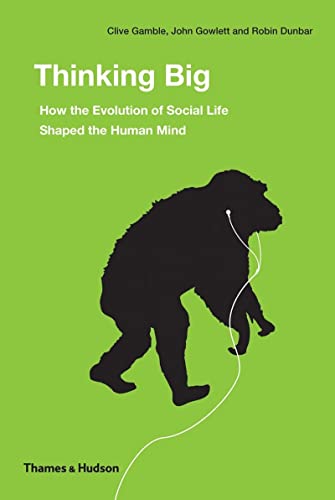
We are at a pivotal moment in understanding our remote ancestry and its implications for how we live today. The barriers to what we can know about our distant relatives have been falling as a result of scientific advance, such as decoding the genomes of humans and Neanderthals, and bringing together different perspectives to answer common questions. These collaborations have brought new knowledge and suggested fresh concepts to examine. The results have shaken the old certainties.The results are profound; not just for the study of the past but for appreciating why we conduct our social lives in ways, and at scales, that are familiar to all of us. But such basic familiarity raises a dilemma. When surrounded by the myriad technical and cultural innovations that support our global, urbanized lifestyles we can lose sight of the small social worlds we actually inhabit and that can be traced deep into our ancestry. So why do we need art, religion, music, kinship, myths, and all the other facets of our over-active imaginations if the reality of our effective social worlds is set by a limit of some one hundred and fifty partners (Dunbar s number) made of family, friends, and useful acquaintances? How could such a social community lead to a city the size of London or a country as large as China? Do we really carry our hominin past into our human present? It is these small worlds, and the link they allow to the study of the past that forms the central point in this book.
Die Inhaltsangabe kann sich auf eine andere Ausgabe dieses Titels beziehen.
Über die Autorinnen und Autoren
Clive Gamble is a British archaeologist and anthropologist, and Professor of Archaeology at Southampton University. He has been described as the 'UK’s foremost archaeologist investigating our earliest ancestors'.
John Gowlett is Professor of Archaeology, Classics and Egyptology at Liverpool University. He is involved in fieldwork in eastern and southern Africa.
Robin Dunbar is a British anthropologist and evolutionary psychologist specialised in primate behaviour. He is currently head of the Social and Evolutionary Neuroscience Research Group in the Department of Experimental Psychology at the University of Oxford. He is best known for formulating Dunbar's number, a measurement of the 'cognitive limit to the number of individuals with whom any one person can maintain stable relationships'.
Von der hinteren Coverseite
When and how did the brains of our hominin ancestors become human minds? When and why did our capacity for language or art, music and dance evolve? It is the contention of this pathbreaking and provocative book that it was the need for early humans to live in ever-larger social groups, and to maintain social relations over ever-greater distances the ability to think big that drove the enlargement of the human brain and the development of the human mind. This social brain hypothesis, put forward by evolutionary psychologists such as Robin Dunbar, one of the authors of this book, can be tested against archaeological and fossil evidence, as archaeologists Clive Gamble and John Gowlett show in the second part of Thinking Big. Along the way, the three authors touch on subjects as diverse and diverting as the switch from finger-tip grooming to vocal grooming or the crucial importance of making fire for the lengthening of the social day. Ultimately, the social worlds we inhabit today can be traced back to our Stone Age ancestors.
„Über diesen Titel“ kann sich auf eine andere Ausgabe dieses Titels beziehen.
Suchergebnisse für Thinking Big: How the Evolution of Social Life Shaped...

Beispielbild für diese ISBN
Thinking Big: How the Evolution of Social Life Shaped the Human Mind
Anbieter: AwesomeBooks, Wallingford, Vereinigtes Königreich
Verkäuferbewertung 5 von 5 Sternen

Hardcover. Zustand: Very Good. Thinking Big: How the Evolution of Social Life Shaped the Human Mind This book is in very good condition and will be shipped within 24 hours of ordering. The cover may have some limited signs of wear but the pages are clean, intact and the spine remains undamaged. This book has clearly been well maintained and looked after thus far. Money back guarantee if you are not satisfied. See all our books here, order more than 1 book and get discounted shipping. Artikel-Nr. 7719-9780500051801
Gebraucht kaufen
EUR 4,26
EUR 4,91 Versand
Versand von Vereinigtes Königreich nach USA
Versand von Vereinigtes Königreich nach USA
Anzahl: 2 verfügbar
Beispielbild für diese ISBN
Thinking Big: How the Evolution of Social Life Shaped the Human Mind
Anbieter: WorldofBooks, Goring-By-Sea, WS, Vereinigtes Königreich
Verkäuferbewertung 5 von 5 Sternen
Paperback. Zustand: Fine. Artikel-Nr. GOR011137561
Gebraucht kaufen
EUR 18,94
EUR 6,68 Versand
Versand von Vereinigtes Königreich nach USA
Versand von Vereinigtes Königreich nach USA
Anzahl: 2 verfügbar
Beispielbild für diese ISBN
Thinking Big: How the Evolution of Social Life Shaped the Human Mind
Anbieter: WorldofBooks, Goring-By-Sea, WS, Vereinigtes Königreich
Verkäuferbewertung 5 von 5 Sternen
Paperback. Zustand: Very Good. The book has been read, but is in excellent condition. Pages are intact and not marred by notes or highlighting. The spine remains undamaged. Artikel-Nr. GOR006321396
Gebraucht kaufen
EUR 18,94
EUR 6,68 Versand
Versand von Vereinigtes Königreich nach USA
Versand von Vereinigtes Königreich nach USA
Anzahl: 4 verfügbar
Beispielbild für diese ISBN
Thinking Big: How the Evolution of Social Life Shaped the Human Mind
Anbieter: WorldofBooks, Goring-By-Sea, WS, Vereinigtes Königreich
Verkäuferbewertung 5 von 5 Sternen
Paperback. Zustand: Fair. A readable copy of the book which may include some defects such as highlighting and notes. Cover and pages may be creased and show discolouration. Artikel-Nr. GOR015000818
Gebraucht kaufen
EUR 18,94
EUR 6,68 Versand
Versand von Vereinigtes Königreich nach USA
Versand von Vereinigtes Königreich nach USA
Anzahl: 1 verfügbar
Beispielbild für diese ISBN
Thinking Big: How the Evolution of Social Life Shaped the Human Mind
Anbieter: Bahamut Media, Reading, Vereinigtes Königreich
Verkäuferbewertung 4 von 5 Sternen

Hardcover. Zustand: Very Good. This book is in very good condition and will be shipped within 24 hours of ordering. The cover may have some limited signs of wear but the pages are clean, intact and the spine remains undamaged. This book has clearly been well maintained and looked after thus far. Money back guarantee if you are not satisfied. See all our books here, order more than 1 book and get discounted shipping. Artikel-Nr. 6545-9780500051801
Gebraucht kaufen
EUR 20,97
EUR 8,32 Versand
Versand von Vereinigtes Königreich nach USA
Versand von Vereinigtes Königreich nach USA
Anzahl: 2 verfügbar
Beispielbild für diese ISBN
Thinking Big
Anbieter: Mooney's bookstore, Den Helder, Niederlande
Verkäuferbewertung 4 von 5 Sternen
Zustand: Very Good. Artikel-Nr. 05602F7B6E3183A
Gebraucht kaufen
EUR 35,68
EUR 14,95 Versand
Versand von Niederlande nach USA
Versand von Niederlande nach USA
Anzahl: 1 verfügbar