
Verwandte Artikel zu Principles of Maritime Strategy (Dover Military History,...
Inhaltsangabe
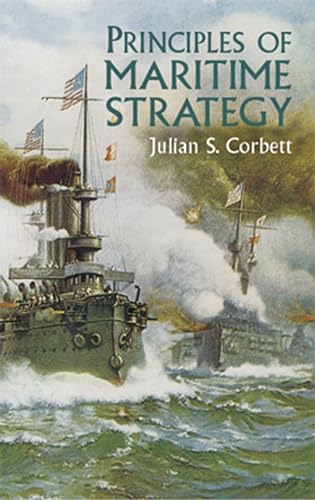
This brilliant exposition established British naval historian Julian Corbett (1854–1922) as one of the great maritime strategists. Corbett placed naval warfare within the larger framework of human conflict, proposing that the key to maritime dominance lies in effective use of sea lines for communications and in denying that use to the enemy. His concept — which regarded naval strategy not as an end in itself but as a means to an end, with that end defined by national strategy — makes this a work of enduring value.
Principles of Maritime Strategy emphasizes precise definitions of terminology and ideas as the antidote to loose and purposeless discussion and the direct path to the fundamental data on which all are agreed. As Corbett notes in the Introduction, "In this way we prepare the apparatus of practical discussion; we secure the means of arranging the factors in manageable shape, and of deducing from them with precision and rapidity a practical course of action. Without such apparatus no two men can even think on the same line; much less can they ever hope to detach the real point of difference that divides them and isolate it for quiet solution."
Much quoted and referenced, this ever-relevant work is an indispensable resource for military professionals, historians, and students.
Die Inhaltsangabe kann sich auf eine andere Ausgabe dieses Titels beziehen.
Suchergebnisse für Principles of Maritime Strategy (Dover Military History,...

Beispielbild für diese ISBN
Principles of Maritime Strategy
Verlag:
Dover Publications Inc., 2004
ISBN 10: 0486437434
ISBN 13: 9780486437439
Gebraucht
Paperback
Anbieter: World of Books (was SecondSale), Montgomery, IL, USA
Verkäuferbewertung 5 von 5 Sternen

Paperback. Zustand: Very Good. The flute (or closely related instrument) has been known since prehistoric times, but up until the middle of the nineteenth century it was still far from being a satisfactory instrument, despite the quantity of important music that had been written for it. Its tone was poor and thin, its volume was low, its keying system was inefficient, and it was very difficult to play.The man who changed all this and invented the modern flute was Theobald Boehm (1794-1881), a Bavarian flute virtuoso, who played at the royal court in Munich. Boehm worked upon the flute for many years; indeed, he even went to the length of studying acoustics at the University of Munich, in order to apply the exact data and principles of the sciences to instrument design. After many years of experimentation and preliminary steps, he created the modern flute in 1847. It was silver and cylindrical, furnished with a parabolic head-joint, accurately placed finger holes, and efficient key mechanism. With only small modifications, this is the flute that is used today.In 1871 Boehm published an account of his research and accomplishments, a book that has come to be recognized as one of the classics of musicology. In it he covered the acoustics of the instrument; the technique for establishing its proportions and keying; his new system of fingering; the key mechanism; the bass flute in G; and similar topics. In the second half of the volume he provided insights on performance, as they emerged from his remarkable virtuosity. This is not a treatise on how to play the flute, but comments upon the development of tone, finger exercises, practicing method, and interpretation, including coloratura. This book is very clearly written and requires no technical knowledge of its reader. It has long been a favorite not only of flutists but also of musicologists, acousticians, and lay persons interested in music.This edition of Boehm's work, translated by Dayton C. Miller of the Case School of Applied Science, also contains biographical notes about Boehm, a list of Boehm's musical compositions, a short bibliography, and a critical introduction. More than 50 musical excerpts and illustrations accompany the text, while the renowned contemporary flutist Samuel Baron has written a new Introduction for the Dover edition. Artikel-Nr. CIN0486437434VG
Gebraucht kaufen
EUR 5,94
Versand gratis
Versand innerhalb von USA
Versand innerhalb von USA
Anzahl: 1 verfügbar
Beispielbild für diese ISBN
Principles of Maritime Strategy (Dover Military History, Weapons, Armor)
Anbieter: Wonder Book, Frederick, MD, USA
Verkäuferbewertung 5 von 5 Sternen
Zustand: As New. Like New condition. A near perfect copy that may have very minor cosmetic defects. Artikel-Nr. D11M-01230
Gebraucht kaufen
EUR 6,54
Versand gratis
Versand innerhalb von USA
Versand innerhalb von USA
Anzahl: 1 verfügbar
Beispielbild für diese ISBN
Principles of Maritime Strategy
Anbieter: ThriftBooks-Phoenix, Phoenix, AZ, USA
Verkäuferbewertung 5 von 5 Sternen
Paperback. Zustand: Very Good. No Jacket. May have limited writing in cover pages. Pages are unmarked. ~ ThriftBooks: Read More, Spend Less. Artikel-Nr. G0486437434I4N00
Gebraucht kaufen
EUR 6,63
Versand gratis
Versand innerhalb von USA
Versand innerhalb von USA
Anzahl: 1 verfügbar
Beispielbild für diese ISBN
Principles of Maritime Strategy
Anbieter: ThriftBooks-Dallas, Dallas, TX, USA
Verkäuferbewertung 5 von 5 Sternen
Paperback. Zustand: Very Good. No Jacket. May have limited writing in cover pages. Pages are unmarked. ~ ThriftBooks: Read More, Spend Less. Artikel-Nr. G0486437434I4N00
Gebraucht kaufen
EUR 6,67
Versand gratis
Versand innerhalb von USA
Versand innerhalb von USA
Anzahl: 1 verfügbar
Beispielbild für diese ISBN
Principles of Maritime Strategy
Anbieter: ThriftBooks-Atlanta, AUSTELL, GA, USA
Verkäuferbewertung 5 von 5 Sternen
Paperback. Zustand: Very Good. No Jacket. May have limited writing in cover pages. Pages are unmarked. ~ ThriftBooks: Read More, Spend Less. Artikel-Nr. G0486437434I4N00
Gebraucht kaufen
EUR 6,67
Versand gratis
Versand innerhalb von USA
Versand innerhalb von USA
Anzahl: 1 verfügbar
Beispielbild für diese ISBN
Principles of Maritime Strategy
Verlag:
Dover Publications September 2004, 2004
ISBN 10: 0486437434
ISBN 13: 9780486437439
Gebraucht
Trade Paperback
Anbieter: The Book Garden, Bountiful, UT, USA
Verkäuferbewertung 4 von 5 Sternen

Trade Paperback. Zustand: Very Good - Cash. Light reader wear and rubbing to the edges, corners, covers, and pages. The book is in great condition! Stock photos may not look exactly like the book. Artikel-Nr. 1177861
Gebraucht kaufen
EUR 9,17
EUR 6,45 Versand
Versand innerhalb von USA
Versand innerhalb von USA
Anzahl: 1 verfügbar
Beispielbild für diese ISBN
Principles of Maritime Strategy (Dover Military History, Weapons, Armor)
Anbieter: WorldofBooks, Goring-By-Sea, WS, Vereinigtes Königreich
Verkäuferbewertung 5 von 5 Sternen
Paperback. Zustand: Very Good. The book has been read, but is in excellent condition. Pages are intact and not marred by notes or highlighting. The spine remains undamaged. Artikel-Nr. GOR005842108
Gebraucht kaufen
EUR 17,57
EUR 6,72 Versand
Versand von Vereinigtes Königreich nach USA
Versand von Vereinigtes Königreich nach USA
Anzahl: 2 verfügbar
Foto des Verkäufers
Principles Of Maritime Strategy
Anbieter: GreatBookPricesUK, Woodford Green, Vereinigtes Königreich
Verkäuferbewertung 5 von 5 Sternen
Zustand: good. May show signs of wear, highlighting, writing, and previous use. This item may be a former library book with typical markings. No guarantee on products that contain supplements Your satisfaction is 100% guaranteed. Twenty-five year bookseller with shipments to over fifty million happy customers. Artikel-Nr. 2577690-5
Gebraucht kaufen
EUR 18,39
EUR 17,99 Versand
Versand von Vereinigtes Königreich nach USA
Versand von Vereinigtes Königreich nach USA
Anzahl: 1 verfügbar
Beispielbild für diese ISBN
Principles of Maritime Strategy
Anbieter: Revaluation Books, Exeter, Vereinigtes Königreich
Verkäuferbewertung 5 von 5 Sternen
Paperback. Zustand: Brand New. dover ed edition. 317 pages. 8.50x5.25x0.75 inches. In Stock. Artikel-Nr. 0486437434
Neu kaufen
EUR 36,54
EUR 12,00 Versand
Versand von Vereinigtes Königreich nach USA
Versand von Vereinigtes Königreich nach USA
Anzahl: 1 verfügbar
Beispielbild für diese ISBN
Principles of Maritime Strategy (Dover Military History, Weapons, Armor)
Verlag:
Dover Publications Inc., 2004
ISBN 10: 0486437434
ISBN 13: 9780486437439
Gebraucht
Softcover
Anbieter: Buchmarie, Darmstadt, Deutschland
Verkäuferbewertung 5 von 5 Sternen
Zustand: Good. Artikel-Nr. 3697098_ee0_x
Gebraucht kaufen
EUR 25,10
EUR 105,00 Versand
Versand von Deutschland nach USA
Versand von Deutschland nach USA
Anzahl: 1 verfügbar