
Verwandte Artikel zu The Impossible Machine: A Genealogy of South Africa's...
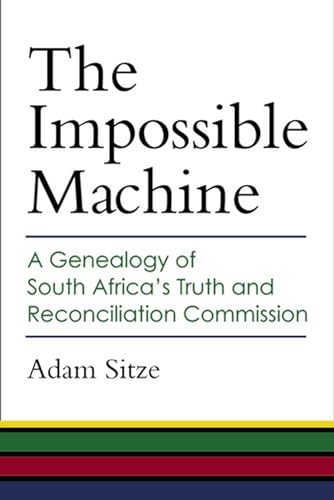
The Impossible Machine: A Genealogy of South Africa's Truth and Reconciliation Commission - Hardcover
Inhaltsangabe
Adam Sitze meticulously traces the origins of South Africa&;s Truth and Reconciliation Commission back to two well-established instruments of colonial and imperial governance: the jurisprudence of indemnity and the commission of inquiry. This genealogy provides a fresh, though counterintuitive, understanding of the TRC&;s legal, political, and cultural importance. The TRC&;s genius, Sitze contends, is not the substitution of &;forgiving&; restorative justice for &;strict&; legal justice but rather the innovative adaptation of colonial law, sovereignty, and government. However, this approach also contains a potential liability: if the TRC&;s origins are forgotten, the very enterprise intended to overturn the jurisprudence of colonial rule may perpetuate it. In sum, Sitze proposes a provocative new means by which South Africa&;s Truth and Reconciliation Commission should be understood and evaluated.
Die Inhaltsangabe kann sich auf eine andere Ausgabe dieses Titels beziehen.
Über die Autorin bzw. den Autor
Adam Sitze is Associate Professor of Law, Jurisprudence, and Social Thought at Amherst College.
Auszug. © Genehmigter Nachdruck. Alle Rechte vorbehalten.
The Impossible Machine
A Genealogy of South Africa's Truth and Reconciliation Commission
By Adam SitzeThe University of Michigan Press
Copyright © 2013 University of Michigan
All rights reserved.
ISBN: 978-0-472-11875-5All rights reserved.
Contents
Acknowledgments,
Introduction,
PART 1,
CHAPTER 1. Indemnity and Amnesty,
CHAPTER 2. Indemnity and Sovereignty,
CHAPTER 3. Indemnity in Crisis,
CHAPTER 4. Indemnity in the TRC,
PART 2,
CHAPTER 5. What Is a Commission?,
CHAPTER 6. The Rise and Fall of the Tumult Commission,
CHAPTER 7. A Tumult Commission of a Special Type?,
CHAPTER 8. Out of Commission: Salus or Ubuntu?,
EPILOGUE: Toward a Critique of Transitional Justice,
Notes,
Bibliography,
Index,
CHAPTER 1
INDEMNITY AND AMNESTY
1.1 One of the main concerns of transitional justice has been the question of why and how South Africa's TRC is unprecedented. The consensus within transitional justice is that the TRC is unprecedented because its amnesties were not issued en masse but were individualized and conditional upon public, full disclosure of crimes. This consensus is reached by way of a narrative, international in scope, which contrasts the TRC with the Latin American Truth Commissions, on the one hand, and the Nuremberg Trials, on the other. According to this narrative, the TRC is distinct both from the retributive justice dispensed at the Nuremberg Trials and from the blanket amnesties passed in Latin America during the 1970s and 1980s, because its power to offer amnesty was, on the one hand, individualized (not general) and, on the other, not exclusive of punishment (because there was the chance that, absent full disclosure, an amnesty application could fail). On this view, the TRC was unprecedented for the way it offered a sort of "third way" or "golden mean" between blanket amnesty and individualized punishment. Indeed, the TRC's "individualized, accountable amnesty process," its focus on the "concrete particular," was one of the main reasons it was able to lay claim to a paradigmatic status within the field of transitional justice. It is as though South Africa's practice of individualized amnesty were the last and best chapter in an international learning curve, the apex and the exemplar of transitional justice, the best illustration of how to conduct a transition from authoritarian rule to liberalism, the most compelling reason why the TRC should be studied as a "model" around the world.
Although this narrative quickly took hold within studies of the TRC, it rests on a set of premises that are far from unquestionable. To begin, there is good reason to doubt the narrative of the Nuremberg Trials as a simple paradigm of retributive justice. As only one small but significant part of a complicated juridical response to Nazism that cannot be understood apart from later extraditions, trials, and reparations, the executions that resulted from the Nuremberg Trials especially cannot be evaluated apart from Chancellor Konrad Adenauer's amnesties of 1949 and 1954, which together exempted from punishment close to one million former Nazis whose crimes could be said to have been committed on a "political basis." Similar combinations of execution and amnesty emerged in postwar France (where 791 collaborationists were executed for treason and close to 30,000 were exempted from severe punishments by amnesty laws passed in 1947 and 1951) and Italy (where fifty fascists were executed and many thousands more were covered by a 1946 amnesty law). In their punishment of Nazi, fascist, and collaborationist leaders and t
„Über diesen Titel“ kann sich auf eine andere Ausgabe dieses Titels beziehen.
Suchergebnisse für The Impossible Machine: A Genealogy of South Africa's...

Beispielbild für diese ISBN
The Impossible Machine
Verlag:
LUP - University of Michigan Press, 2013
ISBN 10: 0472118757
ISBN 13: 9780472118755
Neu
Hardcover
Anbieter: PBShop.store UK, Fairford, GLOS, Vereinigtes Königreich
Verkäuferbewertung 5 von 5 Sternen

HRD. Zustand: New. New Book. Shipped from UK. Established seller since 2000. Artikel-Nr. FW-9780472118755
Neu kaufen
EUR 91,81
EUR 6,85 Versand
Versand von Vereinigtes Königreich nach USA
Versand von Vereinigtes Königreich nach USA
Anzahl: 1 verfügbar
Beispielbild für diese ISBN
The Impossible Machine: A Genealogy of South Africa's Truth and Reconciliation Commission
Anbieter: Ria Christie Collections, Uxbridge, Vereinigtes Königreich
Verkäuferbewertung 5 von 5 Sternen
Zustand: New. In English. Artikel-Nr. ria9780472118755_new
Neu kaufen
EUR 90,51
EUR 13,17 Versand
Versand von Vereinigtes Königreich nach USA
Versand von Vereinigtes Königreich nach USA
Anzahl: 1 verfügbar
Beispielbild für diese ISBN
The Impossible Machine A Genealogy of South Africa's Truth and Reconciliation Commission
Anbieter: Revaluation Books, Exeter, Vereinigtes Königreich
Verkäuferbewertung 5 von 5 Sternen
Hardcover. Zustand: Brand New. 392 pages. 9.00x6.00x1.00 inches. In Stock. Artikel-Nr. __0472118757
Neu kaufen
EUR 104,09
EUR 14,58 Versand
Versand von Vereinigtes Königreich nach USA
Versand von Vereinigtes Königreich nach USA
Anzahl: 1 verfügbar
Beispielbild für diese ISBN
The Impossible Machine: A Genealogy of South Africa's Truth and Reconciliation Commission
Anbieter: Kennys Bookstore, Olney, MD, USA
Verkäuferbewertung 5 von 5 Sternen
Zustand: New. Traces the origins of South Africa's Truth and Reconciliation Commission to two well-established instruments of colonial and imperial governance: the jurisprudence of indemnity and the commission of inquiry. The TRC's genius, he contends, is its innovative adaptation of colonial law, sovereignty, and government. Num Pages: 392 pages, 1 illustration. BIC Classification: 1HFMS; JPQ; JPVH; LNAC5. Category: (G) General (US: Trade). Dimension: 160 x 236 x 34. Weight in Grams: 736. . 2013. hardcover. . . . . Books ship from the US and Ireland. Artikel-Nr. V9780472118755
Neu kaufen
EUR 143,33
EUR 9,15 Versand
Versand innerhalb von USA
Versand innerhalb von USA
Anzahl: 1 verfügbar