
Verwandte Artikel zu Someone to Watch over Me: The Life And Music of Ben...
Inhaltsangabe
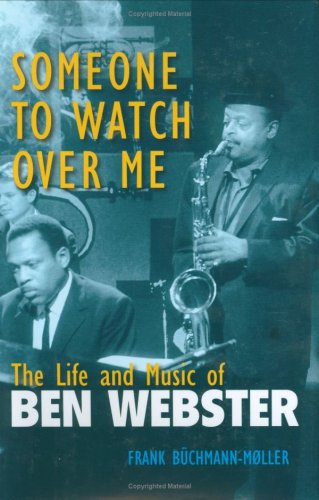
For a half century, Ben Webster, one of the "big three" of swing tenors-along with Coleman Hawkins and Lester Young-was one of the best-known and most popular saxophonists.
Early in his career, Webster worked with many of the greatest orchestras of the time, including those led by Willie Bryant, Cab Calloway, Benny Carter, Fletcher Henderson, Andy Kirk, Bennie Moten, and Teddy Wilson. In 1940 Webster became Duke Ellington's first major tenor soloist, and during the next three years he played on many famous recordings, including "Cotton Tail."
Someone to Watch Over Me tells, for the first time, the complete story of Ben Webster's brilliant and troubled career. For this comprehensive study of Webster, author Frank Büchmann-Møller interviewed more than fifty people in the United States and Europe, and he includes numerous translated excerpts from European periodicals and newspapers, none previously available in English. In addition, the author studies every known Webster recording and film, including many private recordings from Webster's home collection not available to the public.
Exhaustively researched, this is a much needed and long overdue study of the life and music of one of jazz's most important artists.
Early in his career, Webster worked with many of the greatest orchestras of the time, including those led by Willie Bryant, Cab Calloway, Benny Carter, Fletcher Henderson, Andy Kirk, Bennie Moten, and Teddy Wilson. In 1940 Webster became Duke Ellington's first major tenor soloist, and during the next three years he played on many famous recordings, including "Cotton Tail."
Someone to Watch Over Me tells, for the first time, the complete story of Ben Webster's brilliant and troubled career. For this comprehensive study of Webster, author Frank Büchmann-Møller interviewed more than fifty people in the United States and Europe, and he includes numerous translated excerpts from European periodicals and newspapers, none previously available in English. In addition, the author studies every known Webster recording and film, including many private recordings from Webster's home collection not available to the public.
Exhaustively researched, this is a much needed and long overdue study of the life and music of one of jazz's most important artists.
Die Inhaltsangabe kann sich auf eine andere Ausgabe dieses Titels beziehen.
Über die Autorin bzw. den Autor
Frank Buchman-Moller is head of the jazz archive at Carl Nielsen Academy of Music in Odense, Denmark. He is the author of You Just Fight for Your Life: The Story of Lester Young and You Got to Be Original, Man!: The Music of Lester Young.
Auszug. © Genehmigter Nachdruck. Alle Rechte vorbehalten.
SOMEONE TO WATCH OVER ME
The Life and Music of Ben WebsterBy Frank Bchmann-MllerUNIVERSITY OF MICHIGAN PRESS
Copyright © 2006 University of MichiganAll right reserved.
ISBN: 978-0-472-11470-2
Contents
Preface.....................................................................viiAcknowledgments.............................................................ixIntroduction................................................................xiii1. Kansas City Childhood (1909-1927).......................................12. From Piano to Saxophone (1927-1931).....................................113. From Kansas City to New York (1931-1934)................................184. From Smack to Duke (1934-1940)..........................................305. Golden Years with Ellington (1940-1943).................................576. From Fifty-second Street to Kansas City (1943-1949).....................1007. From Kansas City to Monterey (1949-1959)................................1348. Last Years in the United States (1959-1964).............................1799. First Years in Europe (1964-1966).......................................21310. The Dutch Years (1966-1969)............................................23711. The Last Busy Years in Denmark (1969-1973).............................268Appendix: Ben Webster on CD, DVD, and VHS...................................323Notes.......................................................................327Index.......................................................................347
Chapter One
Kansas City Childhood (1909-1927)
Kansas City, Missouri-to the jazz aficionado the name rings as romantic and sweet as New Orleans, Chicago, and New York. One imagines jam sessions and small, smoke-filled rooms, where jazz is played till early morning by legendary musicians like Bennie Moten, Andy Kirk, Count Basie, Lester Young, Mary Lou Williams, Dick Wilson-and Ben Webster.
The real Kansas City of the early twentieth century was more mundane. It was an enterprising town, situated where the Kansas River-also called Kaw River-meets the Missouri. It became a junction for Midwestern trade, traffic, finance, and industry. A small trading station in the 1820s, by 1860 the town had grown to forty-five hundred inhabitants, and when a railway bridge over the Missouri was completed in 1869, development intensified even more. By the end of that year, seven railroads led to Kansas City, a number that was to double over the next ten years. As a result, trade with livestock from Texas and grain from the North blossomed. The city's livestock market grew to become the country's second largest after Chicago, as did its meat industry. In the humid summer heat, a heady stench from the livestock markets and industrial chimneys clung to the city.
The grain market and flour production grew to become the nation's third largest. Work was plentiful, and the population exploded. The Kansas City of 1880 had a population of 55,000. By 1890 that number had multiplied to 132,000, to 164,000 in 1900, to 250,000 in 1910, and to 325,000 in 1920. By 1930, 400,000 people lived in the city. From 1910 to 1930, the black population stayed at a fairly constant 10 percent.
Around 1900, the black population, initially spread over the city, became concentrated in an area bordered by Independence Avenue to the north, Prospect Avenue to the east, Twenty-seventh Street to the south, and Oak Street to the west. Most blacks were employed as industrial workers, waiters, janitors, or assistants of some sort.
On March 27, 1909, at 12:02 P.M., at 2441 Highland Avenue, on the south side of the black ghetto, Mayme Barker gave birth to a boy baptized Benjamin Francis Webster.
In the early nineteenth century, one of Ben's great-grandmothers was brought as a slave from Guinea in West Africa to a Kentucky plantation. Her son fled from slavery and settled in Liberty, Missouri. He called himself Missourian Sall. His wife bore him four daughters, one named Alice, another Agnes. Alice married into the Barker family and gave birth to five children, among them one girl, Mayme, born in 1872. Mr. Barker died early and Alice remarried George Ruff, but had no more children.
Alice's sister Agnes (1864-1963) came to play an important part in Ben's and Mayme's lives, helping to raise Mayme and her sister Blanche, as Alice and George Ruff worked to make ends meet. Agnes Johnson was a woman of principle and strong will, a puritan with a good heart. When Blanche left home to marry Harley W. Robinson Sr., Mayme stayed on with Agnes in Kansas City and attended teacher's college, just as her older sister had.
When she was thirty-five, Mayme went to Chicago to take a course at the University of Chicago. At a party in Bob Mott's Pekin Temple at 2700 South State Street she met a tall, handsome man six years her senior. His name was Walter Webster. They were married on Sunday, September 17, 1907, in the hometown of the bride. The ceremony was held at West Point Baptist Church, and Mayme's eleven-year-old niece, Joyce Cockrell, was bridesmaid. The newly married couple moved to Chicago, where Walter was employed as a waiter on the Pullman Company's dining cars.
The marriage was a disaster. Reality proved to be much less poetic than Walter's promises had been. They lived in a one-room apartment on the southeast side of the Windy City's Black Belt, where they shared utilities with three other families. What was worse, the mild-tempered Mayme soon discovered that Walter was a crude, violent, and alcoholic womanizer. In September 1908, a visiting family member found Mayme pregnant, undernourished, and weak. Agnes decided to intervene. In January 1909 she arrived in Chicago, and through her resolution and authority managed to take Mayme back home to Kansas City, where she once again moved into the house on Highland Avenue.
Mayme and Walter were not yet officially divorced when Ben was born, which is why he was given his father's name. Mayme took back her maiden name after the divorce. Shortly after Ben's birth, the three of them moved to a two-story house at 1222 Woodland Avenue close to the corner of Twelfth Street, and after summer vacation Mayme resumed teaching. Agnes presumably gave up her job to raise Ben until he was old enough for school.
Ben was spoiled equally by his mother, whom he called "Mayme," and by Agnes, whom he called "Mom." He always got his way: "I was pretty lucky when I was a kid, very lucky. I should say fortunate," he recalled later in life. "If I wanted a bicycle, my mother would buy it for me. If I wanted a wagon, she would buy it, and if I wanted skates, my mother would buy that for me." Apparently the family had no financial worries; pianist Mary Lou Williams, later Ben's girlfriend and lifelong friend, recounts that Ben "came from a very wealthy, wonderful family of doctors and lawyers and teachers," and that he always dressed in the most expensive clothes.
Spoiling Ben might have been one way of keeping peace in the household. His temper was known to fluctuate from one extreme to the other. "Mayme, his mother, was a very intelligent, quiet, lovely person of high morals," Joyce Cockrell remembered. "And his father was earthy, and he had a high temper, so that was responsible for him [Ben] being a dual personality. Ben could be just as lovely and sweet as he possibly could be, but if you made him angry, he could be violent and almost brutal."
While Ben was still a small boy, Mayme married Frank W. Love, an army officer six years her senior, but Ben never...
„Über diesen Titel“ kann sich auf eine andere Ausgabe dieses Titels beziehen.
Suchergebnisse für Someone to Watch over Me: The Life And Music of Ben...

Beispielbild für diese ISBN
Someone to Watch over Me : The Life and Music of Ben Webster
Verlag:
University of Michigan Press, 2006
ISBN 10: 0472114700
ISBN 13: 9780472114702
Gebraucht
Hardcover
Anbieter: Better World Books, Mishawaka, IN, USA
Verkäuferbewertung 5 von 5 Sternen

Zustand: Very Good. Former library copy. Pages intact with possible writing/highlighting. Binding strong with minor wear. Dust jackets/supplements may not be included. Includes library markings. Stock photo provided. Product includes identifying sticker. Better World Books: Buy Books. Do Good. Artikel-Nr. 6093254-6
Gebraucht kaufen
EUR 22,41
Versand gratis
Versand innerhalb von USA
Versand innerhalb von USA
Anzahl: 1 verfügbar
Beispielbild für diese ISBN
Someone to Watch over Me : The Life and Music of Ben Webster
Verlag:
University of Michigan Press, Jackson, TN, U.S.A., 2006
ISBN 10: 0472114700
ISBN 13: 9780472114702
Gebraucht
Erstausgabe
Anbieter: Lazy S Books, Austin, TX, USA
Verkäuferbewertung 4 von 5 Sternen

No Binding. Zustand: Very Good - Fine. Zustand des Schutzumschlags: Very Good - Fine. First Edition. A biography of one of the "big three" of swing tenor saxophonists. No noticeable wear a very good or better copy. Artikel-Nr. 005871
Gebraucht kaufen
EUR 59,76
EUR 6,25 Versand
Versand innerhalb von USA
Versand innerhalb von USA
Anzahl: 1 verfügbar
Foto des Verkäufers
Someone to Watch Over Me: The Life and Music of Ben Webster (Jazz Perspectives)
Verlag:
The University of Michigan Press, 2006
ISBN 10: 0472114700
ISBN 13: 9780472114702
Gebraucht
Hardcover
Anbieter: WeBuyBooks, Rossendale, LANCS, Vereinigtes Königreich
Verkäuferbewertung 5 von 5 Sternen
hardcover. Zustand: Very Good. Most items will be dispatched the same or the next working day. A copy that has been read, but is in excellent condition. Pages are intact and not marred by notes or highlighting. The spine remains undamaged. Artikel-Nr. rev9656881493
Gebraucht kaufen
EUR 57,00
EUR 9,71 Versand
Versand von Vereinigtes Königreich nach USA
Versand von Vereinigtes Königreich nach USA
Anzahl: 1 verfügbar
Foto des Verkäufers
Someone to Watch Over Me: The Life and Music of Ben Webster
Verlag:
University of Michigan Press, Ann Arbor, 2006
ISBN 10: 0472114700
ISBN 13: 9780472114702
Gebraucht
Hardcover
Anbieter: PsychoBabel & Skoob Books, Didcot, Vereinigtes Königreich
Verkäuferbewertung 5 von 5 Sternen
hardcover. Zustand: Very Good. Zustand des Schutzumschlags: Very Good. Hardcover in very good condition. From the collection of John Chilton, with correspondence between him and the publisher laid-in. One or two marks on page block; otherwise excellent. TS. Used. Artikel-Nr. 449065
Gebraucht kaufen
EUR 57,25
EUR 14,93 Versand
Versand von Vereinigtes Königreich nach USA
Versand von Vereinigtes Königreich nach USA
Anzahl: 1 verfügbar