
Verwandte Artikel zu The Politics of Rights: Lawyers, Public Policy, and...
Inhaltsangabe
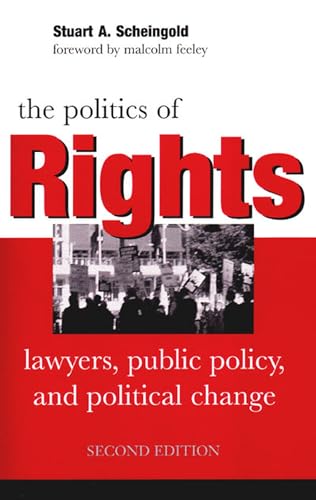
Stuart A. Scheingold's landmark work introduced a new understanding of the contribution of rights to progressive social movements, and thirty years later it still stands as a pioneering and provocative work, bridging political science and sociolegal studies. In the preface to this new edition, the author provides a cogent analysis of the burgeoning scholarship that has been built on the foundations laid in his original volume. A new foreword from Malcolm Feeley of Berkeley's Boalt Hall School of Law traces the intellectual roots of The Politics of Rights to the classic texts of social theory and sociolegal studies.
"Scheingold presents a clear, thoughtful discussion of the ways in which rights can both empower and constrain those seeking change in American society. While much of the writing on rights is abstract and obscure, The Politics of Rights stands out as an accessible and engaging discussion."
-Gerald N. Rosenberg, University of Chicago
"This book has already exerted an enormous influence on two generations of scholars. It has had an enormous influence on political scientists, sociologists, and anthropologists, as well as historians and legal scholars. With this new edition, this influence is likely to continue for still more generations. The Politics of Rights has, I believe, become an American classic."
-Malcolm Feeley, Boalt Hall School of Law, University of California, Berkeley, from the foreword
"Scheingold presents a clear, thoughtful discussion of the ways in which rights can both empower and constrain those seeking change in American society. While much of the writing on rights is abstract and obscure, The Politics of Rights stands out as an accessible and engaging discussion."
-Gerald N. Rosenberg, University of Chicago
"This book has already exerted an enormous influence on two generations of scholars. It has had an enormous influence on political scientists, sociologists, and anthropologists, as well as historians and legal scholars. With this new edition, this influence is likely to continue for still more generations. The Politics of Rights has, I believe, become an American classic."
-Malcolm Feeley, Boalt Hall School of Law, University of California, Berkeley, from the foreword
Stuart A. Scheingold is Professor Emeritus of Political Science at the University of Washington.
Die Inhaltsangabe kann sich auf eine andere Ausgabe dieses Titels beziehen.
Über die Autorinnen und Autoren
Stuart A. Scheingold is Professor Emeritus of Political Science at the University of Washington.
Stuart A. Scheingold is Professor Emeritus of Political Science at the University of Washington.
Auszug. © Genehmigter Nachdruck. Alle Rechte vorbehalten.
THE POLITICS OF RIGHTS
Lawyers, Public Policy, and Political ChangeBy STUART A. SCHEINGOLDTHE UNIVERSITY OF MICHIGAN PRESS
Copyright © 2004University of MichiganAll right reserved.
ISBN: 978-0-472-03005-7
Contents
Foreword.............................................................................................xiPreface to the Second Edition........................................................................xviiPreface to the First Edition.........................................................................xlix1. Legal Rights and Political Action.................................................................32. Law as Ideology: An Introduction to the Myth of Rights............................................133. An Ideologist's Eye View of the Myth of Rights....................................................234. The Call of the Law: The Myth of Rights as Political Rhetoric.....................................395. The Political Resonance of the Myth of Rights.....................................................626. Rights as Resources...............................................................................837. Constitutional Values and Political Goals.........................................................978. The Implementation of Public Policy...............................................................1179. Legal Rights and Political Mobilization...........................................................13110. Legal Education and Professional Socialization: The Myth of Rights Revisited.....................15111. The Activist Bar: Programs and Prospects.........................................................17012. The Political Relevance of Legal Rights..........................................................203Index................................................................................................221
Chapter One
LEGAL RIGHTS AND POLITICAL ACTION
This is a book about the law. The law is real, but it is also a figment of our imaginations. Like all fundamental social institutions it casts a shadow of popular belief that may ultimately be more significant, albeit more difficult to comprehend, than the authorities, rules, and penalties that we ordinarily associate with law. What we believe reflects our values; it also colors our perceptions. What we believe about the law is related directly to the legitimacy of our political institutions.
Traditional views about the law in America see it as beneficent and tend to reinforce legitimacy and stabilize the polity. Surely these views have, at least until quite recently, dominated the literature on law and politics in the United States. But now a radical interpretation which equates law with repression has begun to gain support. Thus, myth and countermyth compete for our attention and acceptance.
The purpose of this study is not necessarily to choose between these competing visions, each of which seems to be flawed in significant ways. If, however, we can understand how the law lends itself to such dramatically contrasting interpretations, a more satisfactory appraisal of the relationship between law and change in America will surely be possible.
The specific aim of this book is to assess the part that lawyers and litigation can play in altering the course of public policy. While this problem has been considered in a number of previous studies, each of them has provided only a partial glimpse of the process. Their tendency has been to concentrate on a particular institution—most frequently the Supreme Court—or a single policy problem like civil rights. There has also been a pronounced inclination to separate theory (or jurisprudence) from empirical analysis. The result has been a proliferation of data and theories but no efforts at general synthesis. At a time when serious questions are being raised about the role of law in the United States, a systematic look at the total picture is surely in order.
The most important distinguishing feature of this study is that it abandons the conventional legal perspective and replaces it with a political approach to the problem of law and change. In the United States we have long been accustomed to associating lawyers (albeit a small minority of the bar) with programs to alter the status quo. The lawyers' basic tool has been litigation, and it has been used doggedly and inventively on behalf of goals like school desegregation, free speech, and the rights of defendants. The successes and failures of these efforts to influence public policy have provided the raw material for studies of law and change in the United States, and analysts have, for the most part, accepted the actors' legal frame of reference.
The Myth of Rights
Legal frames of reference tunnel the vision of both activists and analysts leading to an oversimplified approach to a complex social process—an approach that grossly exaggerates the role that lawyers and litigation can play in a strategy for change. The assumption is that litigation can evoke a declaration of rights from courts; that it can, further, be used to assure the realization of these rights; and, finally, that realization is tantamount to meaningful change. The myth of rights is, in other words, premised on a direct linking of litigation, rights, and remedies with social change.
There are a number of difficulties with this myth of rights approach to change. Judges cannot necessarily be counted upon to formulate a right to fit all worthwhile social goals. Even when a right exists, it can hardly be taken for granted that a remedy is close behind. Activist attorneys and those who chronicle their work are ordinarily unwilling to face up to these problems. They prefer to believe that persistence and legal ingenuity will ultimately be rewarded. The result is an ad hoc search for targets of opportunity rather than a careful sorting out of priorities as they relate to long-range goals.
But even rather sophisticated strategies of litigation have been flawed in a fundamental way by the confining legal perspective. Rights-and-remedies is primarily a test of wills and resources between the parties to suits, and it is not directly assimilable to a program of social action. Legal approaches and the rules under which courts operate tend to reduce political conflicts to disputes between parties at a given time. While these encounters are often symptomatic of underlying social struggles and ordinarily reflect more general forces, success depends on establishing a personal entitlement and often turns on distinguishing one's cause from others with similiar claims. In thus driving a wedge between potential allies, litigative tactics can impose a heavy burden on the process of political organization. There are still other problems that flow from mistakenly identifying isolated courtroom victories with real progress. Confusion of the symbolic with the real diverts attention from the inertial forces which sustain the status quo. Lawyers are, moreover, reinforced in their natural inclinations to think of litigation apart from other political tactics rather than as part of a coordinated strategy.
The Politics of Rights
The simplicities and exaggerations of the myth of rights have led in the past to overrating the progressive capacities of the law. These days, it is fashionable to employ evidence and premises that are every bit as questionable to identify legal processes with reactionary forces in the society. Neither approach will do. So basic and pervasive a...
„Über diesen Titel“ kann sich auf eine andere Ausgabe dieses Titels beziehen.
Suchergebnisse für The Politics of Rights: Lawyers, Public Policy, and...

Beispielbild für diese ISBN
The Politics of Rights: Lawyers, Public Policy, and Political Change
Verlag:
The University of Michigan Press, 2004
ISBN 10: 0472030051
ISBN 13: 9780472030057
Gebraucht
Paperback
Anbieter: World of Books (was SecondSale), Montgomery, IL, USA
Verkäuferbewertung 5 von 5 Sternen

Paperback. Zustand: Good. Stuart Scheingold's landmark work introduced a new understanding of the contribution of rights to progressive social movements. It still stands as a pioneering and provocative work, bridging political science and sociolegal studies. Artikel-Nr. 00106414463
Gebraucht kaufen
EUR 4,03
Versand gratis
Versand innerhalb von USA
Versand innerhalb von USA
Anzahl: 2 verfügbar
Beispielbild für diese ISBN
The Politics of Rights: Lawyers, Public Policy, and Political Change
Verlag:
University of Michigan Press, 2004
ISBN 10: 0472030051
ISBN 13: 9780472030057
Gebraucht
Paperback
Anbieter: ThriftBooks-Dallas, Dallas, TX, USA
Verkäuferbewertung 5 von 5 Sternen
Paperback. Zustand: Good. No Jacket. Pages can have notes/highlighting. Spine may show signs of wear. ~ ThriftBooks: Read More, Spend Less. Artikel-Nr. G0472030051I3N00
Gebraucht kaufen
EUR 6,06
Versand gratis
Versand innerhalb von USA
Versand innerhalb von USA
Anzahl: 1 verfügbar
Beispielbild für diese ISBN
The Politics of Rights: Lawyers, Public Policy, and Political Change
Verlag:
University of Michigan Press, 2004
ISBN 10: 0472030051
ISBN 13: 9780472030057
Gebraucht
Paperback
Anbieter: ThriftBooks-Dallas, Dallas, TX, USA
Verkäuferbewertung 5 von 5 Sternen
Paperback. Zustand: Very Good. No Jacket. May have limited writing in cover pages. Pages are unmarked. ~ ThriftBooks: Read More, Spend Less. Artikel-Nr. G0472030051I4N00
Gebraucht kaufen
EUR 6,06
Versand gratis
Versand innerhalb von USA
Versand innerhalb von USA
Anzahl: 1 verfügbar
Beispielbild für diese ISBN
The Politics of Rights: Lawyers, Public Policy, and Political Change
Verlag:
University of Michigan Press, 2004
ISBN 10: 0472030051
ISBN 13: 9780472030057
Gebraucht
Paperback
Anbieter: ThriftBooks-Atlanta, AUSTELL, GA, USA
Verkäuferbewertung 5 von 5 Sternen
Paperback. Zustand: Good. No Jacket. Pages can have notes/highlighting. Spine may show signs of wear. ~ ThriftBooks: Read More, Spend Less. Artikel-Nr. G0472030051I3N00
Gebraucht kaufen
EUR 6,06
Versand gratis
Versand innerhalb von USA
Versand innerhalb von USA
Anzahl: 1 verfügbar
Beispielbild für diese ISBN
The Politics of Rights: Lawyers, Public Policy, and Political Change
Verlag:
University of Michigan Press, 2004
ISBN 10: 0472030051
ISBN 13: 9780472030057
Gebraucht
Paperback
Anbieter: ThriftBooks-Atlanta, AUSTELL, GA, USA
Verkäuferbewertung 5 von 5 Sternen
Paperback. Zustand: Fair. No Jacket. Readable copy. Pages may have considerable notes/highlighting. ~ ThriftBooks: Read More, Spend Less. Artikel-Nr. G0472030051I5N00
Gebraucht kaufen
EUR 6,06
Versand gratis
Versand innerhalb von USA
Versand innerhalb von USA
Anzahl: 1 verfügbar
Beispielbild für diese ISBN
The Politics of Rights: Lawyers, Public Policy, and Political Change
Verlag:
University of Michigan Press, 2004
ISBN 10: 0472030051
ISBN 13: 9780472030057
Gebraucht
Paperback
Anbieter: ThriftBooks-Atlanta, AUSTELL, GA, USA
Verkäuferbewertung 5 von 5 Sternen
Paperback. Zustand: As New. No Jacket. Pages are clean and are not marred by notes or folds of any kind. ~ ThriftBooks: Read More, Spend Less. Artikel-Nr. G0472030051I2N00
Gebraucht kaufen
EUR 6,06
Versand gratis
Versand innerhalb von USA
Versand innerhalb von USA
Anzahl: 1 verfügbar
Beispielbild für diese ISBN
The Politics of Rights: Lawyers, Public Policy, and Political Change
Verlag:
University of Michigan Press, 2004
ISBN 10: 0472030051
ISBN 13: 9780472030057
Gebraucht
Paperback
Anbieter: ThriftBooks-Dallas, Dallas, TX, USA
Verkäuferbewertung 5 von 5 Sternen
Paperback. Zustand: Good. No Jacket. Former library book; Pages can have notes/highlighting. Spine may show signs of wear. ~ ThriftBooks: Read More, Spend Less. Artikel-Nr. G0472030051I3N10
Gebraucht kaufen
EUR 6,06
Versand gratis
Versand innerhalb von USA
Versand innerhalb von USA
Anzahl: 1 verfügbar
Beispielbild für diese ISBN
The Politics of Rights: Lawyers, Public Policy, and Political Change
Verlag:
University of Michigan Press, 2004
ISBN 10: 0472030051
ISBN 13: 9780472030057
Gebraucht
Softcover
Anbieter: Wonder Book, Frederick, MD, USA
Verkäuferbewertung 5 von 5 Sternen
Zustand: Good. Good condition. A copy that has been read but remains intact. May contain markings such as bookplates, stamps, limited notes and highlighting, or a few light stains. Artikel-Nr. G10L-0458
Gebraucht kaufen
EUR 6,43
Versand gratis
Versand innerhalb von USA
Versand innerhalb von USA
Anzahl: 1 verfügbar
Beispielbild für diese ISBN
The Politics of Rights : Lawyers, Public Policy, and Political Change
Verlag:
University of Michigan Press, 2004
ISBN 10: 0472030051
ISBN 13: 9780472030057
Gebraucht
Softcover
Anbieter: Better World Books, Mishawaka, IN, USA
Verkäuferbewertung 5 von 5 Sternen
Zustand: Good. 2nd Edition. Pages intact with minimal writing/highlighting. The binding may be loose and creased. Dust jackets/supplements are not included. Stock photo provided. Product includes identifying sticker. Better World Books: Buy Books. Do Good. Artikel-Nr. 8960356-6
Gebraucht kaufen
EUR 11,19
Versand gratis
Versand innerhalb von USA
Versand innerhalb von USA
Anzahl: 1 verfügbar
Beispielbild für diese ISBN
The Politics of Rights: Lawyers, Public Policy, and Political Change
Verlag:
University of Michigan Press, 2004
ISBN 10: 0472030051
ISBN 13: 9780472030057
Gebraucht
Softcover
Anbieter: medimops, Berlin, Deutschland
Verkäuferbewertung 5 von 5 Sternen
Zustand: as new. Wie neu/Like new. Artikel-Nr. M00472030051-N
Gebraucht kaufen
EUR 15,92
EUR 10,00 Versand
Versand von Deutschland nach USA
Versand von Deutschland nach USA
Anzahl: 1 verfügbar