
Verwandte Artikel zu Architectural Principles in the Age of Humanism (Academy...
Inhaltsangabe
"Professor Wittkower's....studies of humanist architecture are masterpieces of scholarship."-Sir Kenneth Clark, Architectural Review.
A fourth edition of the forty-year-old classic.
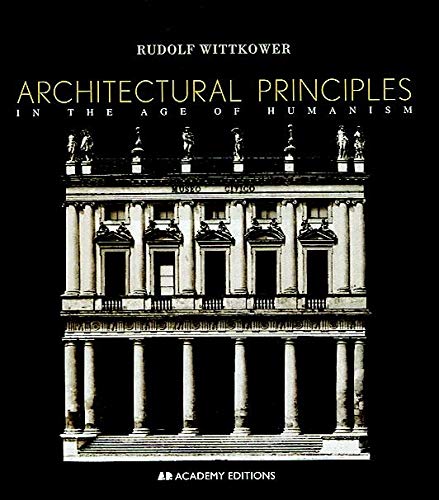
Focusing on the principal architects of that time-from Alberti to Palladio-this bestselling classic explains the true significance of certain architectural forms, bringing to light the connections between the architecture and culture of the period. With publication scheduled to coincide with that of Architectonics of Humanism, this important reference is superbly reproduced in a new, large square format.
The late RUDOLF WITTKOWER was a college professor and eminent scholar residing in London, England.
Die Inhaltsangabe kann sich auf eine andere Ausgabe dieses Titels beziehen.
Über die Autorin bzw. den Autor
Rudolf Wittkower was born in Berlin in 1901. Leaving Germany when the Nazis came to power, he was one of the animators of the Warburg Institute of London. In 1941 he organized, with Fritz Saxl, the exhibition British Art and the Mediterranean, the publication of which (1948) forms an important document of the aims and methods of the Warburg Institute. A great scholar of Italian Renaissance and Baroque art, Wittkower taught at both the University of London and Columbia University. His books, all important works of scholarship, include Die Zeichnungen des Gian Lorenzo Bernini (with H. Bruer, 1931), The Drawings of the Carracci at Windsor Castle (1952), Gian Lorenzo Bernini, the Sculptor of Roman Baroque (1955), Art and Architecture in Italy, 1600-1750 (1958), Born under Saturn (with Margot Wittkower, 1963), and Divine Michelangelo: The Florentine Academy's Homage on His Death in 1564 (with Margot Wittkower, 1964). In addition, he was a frequent contributor to the Journal of the Warbung and Courtauld Institute, the Art Bulletin, Burlington Magazine and the Journal of the Society of Architectural Historians, among others.
Von der hinteren Coverseite
Rudolf Wittkower Architectural Principles in the Age of Humanism 'Scores have profited from, and been inspired by, Architectural Principles in the Age of Humanism and its lesson of the importance of consistent modular relations. No other book on the subject of architectural history written by scholars of his generation has had such a creative effect on men in practice.' Nikolaus Pevsner, Foreword to Art and Architecture in Italy 'Professor Wittkower's mind is not only inquiring but immensely well stored and tenacious. His studies of humanist architecture are masterpieces of scholarship.' Sir Kenneth Clark, Architectural Review 'To say that this is the best study of Italian Renaissance architecture in English is faint praise.' John Coolidge, Magazine of Art Since its original publication in 1949, Architectural Principles in the Age of Humanism has acquired the status of a classic, having brought to light, through exemplary scholarship, the connections between the architecture and the culture of the Renaissance. Focusing on the work of the main Renaissance architects from Alberti to Palladio, Rudolf Wittkower has produced definitive explanations of the true significance of certain architecture forms, and has at the same time revealed the limitations of a purely aesthetic theory of Renaissance architecture. This fifth edition of Architectural Principles in the Age of Humanism, intended to mark the fiftieth anniversary of the publication of the book, integrates the illustrations with the text and includes an edited selection of lectures on Proportion by Professor Wittkower.
Aus dem Klappentext
Rudolf Wittkower Architectural Principles in the Age of Humanism 'Scores have profited from, and been inspired by, Architectural Principles in the Age of Humanism and its lesson of the importance of consistent modular relations. No other book on the subject of architectural history written by scholars of his generation has had such a creative effect on men in practice.' Nikolaus Pevsner, Foreword to Art and Architecture in Italy 'Professor Wittkower's mind is not only inquiring but immensely well stored and tenacious. His studies of humanist architecture are masterpieces of scholarship.' Sir Kenneth Clark, Architectural Review 'To say that this is the best study of Italian Renaissance architecture in English is faint praise.' John Coolidge, Magazine of Art Since its original publication in 1949, Architectural Principles in the Age of Humanism has acquired the status of a classic, having brought to light, through exemplary scholarship, the connections between the architecture and the culture of the Renaissance. Focusing on the work of the main Renaissance architects from Alberti to Palladio, Rudolf Wittkower has produced definitive explanations of the true significance of certain architecture forms, and has at the same time revealed the limitations of a purely aesthetic theory of Renaissance architecture. This fifth edition of Architectural Principles in the Age of Humanism, intended to mark the fiftieth anniversary of the publication of the book, integrates the illustrations with the text and includes an edited selection of lectures on Proportion by Professor Wittkower.
„Über diesen Titel“ kann sich auf eine andere Ausgabe dieses Titels beziehen.
Suchergebnisse für Architectural Principles in the Age of Humanism (Academy...

Beispielbild für diese ISBN
Architectural Principles in the Age of Humanism
Verlag:
Academy Press (edition 2), 1998
ISBN 10: 0471977632
ISBN 13: 9780471977636
Gebraucht
Paperback
Anbieter: BooksRun, Philadelphia, PA, USA
Verkäuferbewertung 5 von 5 Sternen

Paperback. Zustand: Very Good. 2. It's a well-cared-for item that has seen limited use. The item may show minor signs of wear. All the text is legible, with all pages included. It may have slight markings and/or highlighting. Artikel-Nr. 0471977632-11-1
Gebraucht kaufen
EUR 13,82
Versand gratis
Versand innerhalb von USA
Versand innerhalb von USA
Anzahl: 1 verfügbar
Beispielbild für diese ISBN
Architectural Principles in the Age of Humanism
Anbieter: ThriftBooks-Dallas, Dallas, TX, USA
Verkäuferbewertung 5 von 5 Sternen
Paperback. Zustand: Good. No Jacket. Pages can have notes/highlighting. Spine may show signs of wear. ~ ThriftBooks: Read More, Spend Less. Artikel-Nr. G0471977632I3N00
Gebraucht kaufen
EUR 15,88
Versand gratis
Versand innerhalb von USA
Versand innerhalb von USA
Anzahl: 1 verfügbar
Beispielbild für diese ISBN
Architectural Principles in the Age of Humanism
Anbieter: WorldofBooks, Goring-By-Sea, WS, Vereinigtes Königreich
Verkäuferbewertung 5 von 5 Sternen
Paperback. Zustand: Very Good. The book has been read, but is in excellent condition. Pages are intact and not marred by notes or highlighting. The spine remains undamaged. Artikel-Nr. GOR004966956
Gebraucht kaufen
EUR 26,81
EUR 6,53 Versand
Versand von Vereinigtes Königreich nach USA
Versand von Vereinigtes Königreich nach USA
Anzahl: 3 verfügbar
Foto des Verkäufers
Architectural Principles in the Age of Humanism
Verlag:
Academy Press, 1998
ISBN 10: 0471977632
ISBN 13: 9780471977636
Gebraucht
Paperback
Erstausgabe
Anbieter: Lion Books PBFA, Kidderminster, WORCS, Vereinigtes Königreich
Verkäuferbewertung 5 von 5 Sternen
Paperback. Zustand: Very Good. First Edition. Academy Editions; 8vo 8" - 9" tall; 160 pages. Artikel-Nr. 89345
Gebraucht kaufen
EUR 24,02
EUR 9,33 Versand
Versand von Vereinigtes Königreich nach USA
Versand von Vereinigtes Königreich nach USA
Anzahl: 1 verfügbar
Beispielbild für diese ISBN
Architectural Principles in the Age of Humanism
Anbieter: Antiquariaat Ovidius, Bredevoort, Niederlande
Verkäuferbewertung 4 von 5 Sternen

Zustand: Gebraucht / Used. Paperback. Good. 160pp. Artikel-Nr. 113383
Gebraucht kaufen
EUR 24,00
EUR 22,00 Versand
Versand von Niederlande nach USA
Versand von Niederlande nach USA
Anzahl: 1 verfügbar
Beispielbild für diese ISBN
Architectural Principles in the Age of Humanism
Anbieter: PBShop.store UK, Fairford, GLOS, Vereinigtes Königreich
Verkäuferbewertung 5 von 5 Sternen
PAP. Zustand: New. New Book. Shipped from UK. Established seller since 2000. Artikel-Nr. FW-9780471977636
Neu kaufen
EUR 61,80
EUR 4,85 Versand
Versand von Vereinigtes Königreich nach USA
Versand von Vereinigtes Königreich nach USA
Anzahl: 15 verfügbar
Beispielbild für diese ISBN
Architectural Principles in the Age of Humanism
Anbieter: Ria Christie Collections, Uxbridge, Vereinigtes Königreich
Verkäuferbewertung 5 von 5 Sternen
Zustand: New. In English. Artikel-Nr. ria9780471977636_new
Neu kaufen
EUR 67,89
EUR 10,93 Versand
Versand von Vereinigtes Königreich nach USA
Versand von Vereinigtes Königreich nach USA
Anzahl: Mehr als 20 verfügbar
Beispielbild für diese ISBN
Architectural Principles in the Age of Humanism, 2nd Edition
Anbieter: Majestic Books, Hounslow, Vereinigtes Königreich
Verkäuferbewertung 4 von 5 Sternen
Zustand: New. Artikel-Nr. 7485124
Neu kaufen
EUR 79,56
EUR 7,58 Versand
Versand von Vereinigtes Königreich nach USA
Versand von Vereinigtes Königreich nach USA
Anzahl: 3 verfügbar
Beispielbild für diese ISBN
Architectural Principles in the Age of Humanism, 2nd Edition
Anbieter: Revaluation Books, Exeter, Vereinigtes Königreich
Verkäuferbewertung 5 von 5 Sternen
Paperback. Zustand: Brand New. 5th sub edition. 160 pages. 9.50x8.75x0.25 inches. In Stock. Artikel-Nr. __0471977632
Neu kaufen
EUR 76,48
EUR 11,66 Versand
Versand von Vereinigtes Königreich nach USA
Versand von Vereinigtes Königreich nach USA
Anzahl: 1 verfügbar
Beispielbild für diese ISBN
Architectural Principles in the Age of Humanism
Anbieter: Kennys Bookstore, Olney, MD, USA
Verkäuferbewertung 5 von 5 Sternen
Zustand: New. 1998. Second Edition. Paperback. Focusing on the principal architects of that time--from Alberti to Palladio--this bestselling classic explains the true significance of certain architectural forms, bringing to light the connections between the architecture and culture of the period. Num Pages: 160 pages, illustrations. BIC Classification: ACND; AMA. Category: (P) Professional & Vocational; (UP) Postgraduate, Research & Scholarly; (UU) Undergraduate. Dimension: 238 x 225 x 12. Weight in Grams: 390. . . . . . Books ship from the US and Ireland. Artikel-Nr. V9780471977636
Neu kaufen
EUR 91,75
EUR 9,14 Versand
Versand innerhalb von USA
Versand innerhalb von USA
Anzahl: 1 verfügbar