
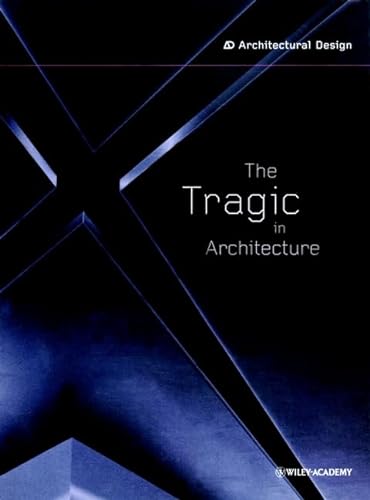
The Tragic in Architecture: Symposium at the Royal Academy London, 1999 (Architectural Design) - Softcover
Inhaltsangabe
Is modern architecture no longer equipped to deal with the 'great themes' in architecture? By focusing on the tragic genre, this title asks some of the most far-reaching questions about the meaning of contemporary architecture. Has a modern delight in functionalism and repression of figuration put paid to the expression of human themes and narrative content? When put to the test, what has been the approach of contemporary architects who have been called upon to tackle the most abject horrors of our age such as the Holocaust?
By holding the classical form of the tragic up for scrutiny, the texts in this title explore the ways that architects have also been seeking to deal with the incomplete, the fragmented and partial, the historicisation of nature and the appearance of the popular culture. There are substantial essays on the theme by Robert Maxwell, John Outram, David Hamilton Eddy and Richard Patterson. Buildings are also analysed, which express some of the great human themes or tragedies in our time. These include, among others, Foster's Berlin Reichstag, Libeskind's Jewish Museum and Chipperfield's designs for the San Michele Cemetery in Venice.
Architects
David Chipperfield
Peter Eisenman
Foster and Partners
James Ingo Freed
Daniel Libeskind
John Outram
Die Inhaltsangabe kann sich auf eine andere Ausgabe dieses Titels beziehen.
Über die Autorin bzw. den Autor
Richard Patterson, De Montfort University, Leicester, UK.
Von der hinteren Coverseite
Is modern architecture no longer equipped to deal with the 'great themes' in architecture? By focusing on the tragic genre, this title asks some of the most far-reaching questions about the meaning of contemporary architecture. Has a modern delight in functionalism and repression of figuration put paid to the expression of human themes and narrative content? When put to the test, what has been the approach of contemporary architects who have been called upon to tackle the most abject horrors of our age such as the Holocaust?
By holding the classical form of the tragic up for scrutiny, the texts in this title explore the ways that architects have also been seeking to deal with the incomplete, the fragmented and partial, the historicisation of nature and the appearance of the popular culture. There are substantial essays on the theme by Robert Maxwell, John Outram, David Hamilton Eddy and Richard Patterson. Buildings are also analysed, which express some of the great human themes or tragedies in our time. These include, among others, Foster's Berlin Reichstag, Libeskind's Jewish Museum and Chipperfield's designs for the San Michele Cemetery in Venice.
Architects
David Chipperfield
Peter Eisenman
Foster and Partners
James Ingo Freed
Daniel Libeskind
John Outram
Aus dem Klappentext
Is modern architecture no longer equipped to deal with the 'great themes' in architecture? By focusing on the tragic genre, this title asks some of the most far-reaching questions about the meaning of contemporary architecture. Has a modern delight in functionalism and repression of figuration put paid to the expression of human themes and narrative content? When put to the test, what has been the approach of contemporary architects who have been called upon to tackle the most abject horrors of our age such as the Holocaust?
By holding the classical form of the tragic up for scrutiny, the texts in this title explore the ways that architects have also been seeking to deal with the incomplete, the fragmented and partial, the historicisation of nature and the appearance of the popular culture. There are substantial essays on the theme by Robert Maxwell, John Outram, David Hamilton Eddy and Richard Patterson. Buildings are also analysed, which express some of the great human themes or tragedies in our time. These include, among others, Foster's Berlin Reichstag, Libeskind's Jewish Museum and Chipperfield's designs for the San Michele Cemetery in Venice.
Architects
David Chipperfield
Peter Eisenman
Foster and Partners
James Ingo Freed
Daniel Libeskind
John Outram
Auszug. © Genehmigter Nachdruck. Alle Rechte vorbehalten.
Introduction
'The Tragic in Art and Architecture' was the title of a symposium, initiated by Jeremy Melvin and Robert Maxwell, held at the Royal Academy in March 1999. It posed the question of the 'tragic' as the most extreme case for the possibility of representation and narrative in architecture. The meaning of narrative and tragedy, however, vary greatly in the usage to which they are put, and this is reflected in breadth of positions and assumptions adopted by the various contributors to this issue.
For architecture to convey any meaning, however vague, there must be a presumption that it is structured like a text. If it were as simple a thing as a written text, it would presumably be possible to 'read' it in some way, to comprehend it explicitly as a narrative capable of sustaining a reflective and critical analysis of events and of portraying explicit meanings. The iconographic tradition, particularly of the 16th - 18th centuries, would be a case in point, but even this was based on images made explicit only through painting and sculpture. Vitruvius's discussion of appropriate styles of architecture [Doric, Ionic or Corinthian] provided the grounds for another attempt to justify belief in an aesthetic naturalism, that architectural form and decoration have a natural propriety and meaning. But in addition to its potential textual coherence, architecture is also a site and a framework within which narratives of independent origin come to be registered and judged.
The argument presented in this issue begins properly with Renaissance classical architecture. As historians have long known, the architecture of the Renaissance was not continuous with, nor an historical or archaeological revival of Rome. It was a new invention, based on an odd collection of material fragments of old buildings, stitched together by Alberti into a theoretical, systematic whole, by way of compositional principles and values derived from elsewhere. If we inspect those principles, we discover that they are largely derived, as in Vitruvius himself, from rhetoric, and moreover, that they are almost wholly derived from principles that have their origin in 'tragedy'.
Classical 'imitation' can be either imitation of an 'idea' or of another 'imitation'. In the case of a painting, the 'imitation' is of another image, itself an imitation; in geometry, in the drawing of geometric forms, the imitation is of an idea. In the case of architecture, imitation is of a type, motif, or figure, possibly, metaphorically of nature, but in that architecture is not natural, always of an abstract idea. In the classical world [prior to neo-classical academic architecture] the execution of architecture was never by way of direct copy, but always by way of emulation. It was none the less an 'imitation', but not of the world of appearance.
Along with the statement 'Tragedy is essentially an imitation not of persons but of action and life, happiness and misery', Aristotle mentioned that it represented people in a way that was better than they actually were [whereas comedy represented them in a way that was worse]. 'Imitation' in the sense that Aristotle used it is emphatically not a synonym for replication. The Tragic, in similarly 'imitating' events, leaves out a substantial amount of 'realistic' detail. Tragedy is not, in fact, a representation of the world as it actually is. It is, rather, a generic form, a 'genre', in which certain events or actions are presented in such a way as to represent significance or experience for a 'subject'. This it does through having a plot in a way that neither epic or comedy do, that is a plot about which one can specify essential parts and, by implication, a limit or period.
In the essays that follow, the question of the expressive capability of architecture is explored in many different ways. In some areas, it is the formal legacy which is of central concern. In others, there is greater emphasis on the experience and expression of what at various times has been referred to as 'tragic', the experience and observation of fear and pity.
„Über diesen Titel“ kann sich auf eine andere Ausgabe dieses Titels beziehen.
Suchergebnisse für The Tragic in Architecture: Symposium at the Royal...

Beispielbild für diese ISBN
The Tragic in Architecture (Architectural Design)
Anbieter: WorldofBooks, Goring-By-Sea, WS, Vereinigtes Königreich
Verkäuferbewertung 5 von 5 Sternen

Paperback. Zustand: Fair. A readable copy of the book which may include some defects such as highlighting and notes. Cover and pages may be creased and show discolouration. Artikel-Nr. GOR013727174
Gebraucht kaufen
EUR 1,44
EUR 6,48 Versand
Versand von Vereinigtes Königreich nach USA
Versand von Vereinigtes Königreich nach USA
Anzahl: 1 verfügbar
Beispielbild für diese ISBN
The Tragic in Architecture (Architectural Design) [Paperback] [Nov 28, 2000] Patterson, Richard
Anbieter: Devils in the Detail Ltd, Oxford, Vereinigtes Königreich
Verkäuferbewertung 5 von 5 Sternen
Soft cover. Zustand: Very Good. scuff marks to cover, little peeling to corners of cover, pages in very nice condition, shipped from the UK. Artikel-Nr. 732/RE/489P.
Gebraucht kaufen
EUR 2,39
EUR 18,51 Versand
Versand von Vereinigtes Königreich nach USA
Versand von Vereinigtes Königreich nach USA
Anzahl: 1 verfügbar
Beispielbild für diese ISBN
The Tragic ion Architecture.
Anbieter: Buchhandlung&Antiquariat Arnold Pascher, Neuss, Deutschland
Verkäuferbewertung 1 von 5 Sternen

Softcover. 112 S., kart., Quart, zahlreiche Abb., ungelesenes Exemplar, Architectural Design. Artikel-Nr. 05210d
Gebraucht kaufen
EUR 1,34
EUR 38,00 Versand
Versand von Deutschland nach USA
Versand von Deutschland nach USA
Anzahl: 1 verfügbar
Beispielbild für diese ISBN
The Tragic in Architecture (Architectural Design)
Anbieter: Majestic Books, Hounslow, Vereinigtes Königreich
Verkäuferbewertung 4 von 5 Sternen

Zustand: Used. pp. 112. Artikel-Nr. 7485113
Gebraucht kaufen
EUR 62,91
EUR 7,53 Versand
Versand von Vereinigtes Königreich nach USA
Versand von Vereinigtes Königreich nach USA
Anzahl: 1 verfügbar
Beispielbild für diese ISBN
The Tragic in Architecture (Architectural Design)
Anbieter: Biblios, Frankfurt am main, HESSE, Deutschland
Verkäuferbewertung 4 von 5 Sternen
Zustand: Used. Artikel-Nr. 18362860
Gebraucht kaufen
EUR 62,74
EUR 9,95 Versand
Versand von Deutschland nach USA
Versand von Deutschland nach USA
Anzahl: 1 verfügbar