
Inhaltsangabe
The updated edition of the classic, fundamental book on weed science
Weed Science provides a detailed examination of the principles of integrated weed management with important details on how chemical herbicides work and should be used. This revised Fourth Edition addresses recent developments affecting weed science. These include the increased use of conservation-tillage systems, environmental concerns about the runoff of agrochemicals, soil conservation, crop biotechnology, resistance of weeds and crops to herbicides, weed control in nonagricultural settings and concerns regarding invasive plants, wetland restoration, and the need for a vastly improved understanding of weed ecology.
Current management practices are covered along with guidance for selecting herbicides and using them effectively. To serve as a more efficient reference, herbicides are cross-listed by chemical and brand name and grouped by mechanism of action and physiological effect rather than chemical structure. In addition, an introduction to organic chemistry has been added to familiarize readers with organic herbicides. Also included are guidelines on weed-control practices for specific crops or situations, such as small grains, row crops, horticultural crops, lawns and turf, range land, brush, and aquatic plant life.
Generously supplemented with 300 drawings, photographs, and tables, Weed Science is an essential book for students taking an introductory course in weed science, as well as a reference for agricultural advisors, county agents, extension specialists, and professionals throughout the agrochemical industry.
Die Inhaltsangabe kann sich auf eine andere Ausgabe dieses Titels beziehen.
Über die Autorin bzw. den Autor
About the authors FLOYD M. ASHTON taught in the Department of Botany, University of California, Davis, for over thirty years until his retirement in 1988. An influential figure in weed science, Dr. Ashton has authored or coauthored numerous scientific papers, reviews, book chapters, and articles on weed science and plant physiology and Mode of Action of Herbicides, Second Edition (Wiley, 1981). A recipient of many honors, Dr. Ashton has received a National Institute of Health Senior Fellowship and served as the USA Delegate to the First United Nations Conference on Weed Control and the USA Delegate to the National Science Foundation INDO-US Conference on Biodegradable Pesticides. He also received the Outstanding Research Award from the Weed Science Society of America and is also an elected Fellow of the Society, Dr. Ashton received his BS from the University of Illinois and a PhD from Ohio State University. THOMAS J. MONACO is a professor and head of the Department of Horticultural Science at North Carolina State University. Dr. Monaco served as president of the Weed Science Society of North Carolina, on the executive board of the Weed Science Society of America, and as associate editor of the Weed Science Journal. The recipient of numerous honors and awards, Dr. Monaco received the Outstanding Contributions to Agriculture Award from Ciba-Geigy (1983) and Outstanding Graduate Educator Award from the American Society for Horticultural Science (1986). Dr. Monaco received a BS in horticulture and an MS in agronomy/weed science from Rutgers University and a PhD in crop science/weed science from North Carolina State University.
Von der hinteren Coverseite
Mode of Action of Herbicides Second Edition Floyd M. Ashton and Alden S. Crafts Completely revised and updated version of the basic introduction to the physiology and biochemistry of chemical weed killers. It summarizes current international information on each class of herbicide, including specific information on absorption and translocation, molecular fate, biochemical responses, and mode of action. 1981 (0 471–04847–X) 525 pp. Weed Ecology Implications for Vegetation Management Steven R. Radosevich and Jodie S. Holt This is the first book to deal specifically with weeds as a biologically important class of vegetation. This important work defines the concept of a weed in biological and ecological terms, and concentrates on the crop and weed responses caused by environmental change rather than the tools used to manipulate vegetation. It develops the underlying principles for weed management from studies of the adaptations of weeds to their environment and to other plants. 1984 (0 471–87674–7) 265 pp. Crop Protection Chemicals Reference Seventh Edition Completely updated for 1991, this standard reference provides the complete text of product labels for crop protection chemicals. Professionals will learn instantly what products can best treat a particular crop problem, what quantities of the chemical to use, and under what restrictions and precautions. The book includes extensive and easily accessed indices and appendices on such matters as codings when transporting products, safety practices, calibrations, and more. 1991 (0 471–53282–7) 2,206 pp.
Aus dem Klappentext
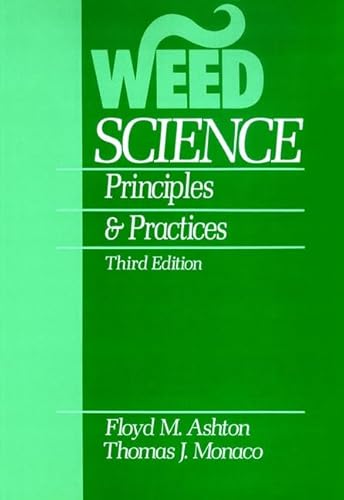
The science of weed control has advanced more during the past 50 years than in the previous 100 centuries. In this book, the old reliable weed control methods are integrated with modern chemical techniques. Together, these practices result in more effective and less expensive weed control programs. Weed Science, Third Edition also focuses on the growing interest in the environmental impact and safety of weed control practices and the development of new herbicides of low mammalian toxicity that can be used at very low rates. It features new material on the biology and ecology of weeds and the use of more effective control methods. More details on the use of herbicides are now provided and the common names and trade names of herbicides are cross-indexed in the appendix for quick, easy access. This invaluable work is organized into three sectionsPrinciples, Herbicides, and Practices. The first section deals with the basic concepts underlying material that is presented in the following sections. It also covers such topics as weed biology and ecology, weed management practices, environmental impact and herbicide registration, herbicides and the plant, herbicides and the soil, and the application equipment and formulation. The second section is subdivided into 23 chemical classes of over 120 individual herbicides. It gives their general properties, influences of soil, mode of action, and uses. Other important topics presented include crop or use sites, rate of application, herbicide combinations, and method of application. Finally, the last section covers weed control practices in specific crops, lawn, turf and ornamentals, pastures and rangelands, brush and undesirable tree control, aquatic weed control and total vegetation control. The book also discusses application techniques, control of spray drift, volatility, and similar basic principles in depth. In addition to its use as a textbook in college and university classrooms, this revised Third Edition is an invaluable addition to the reference library of extension specialists, county agents, pesticide advisors, agricultural consultants, herbicide manufacturers, agriculture, and landscape architects.
„Über diesen Titel“ kann sich auf eine andere Ausgabe dieses Titels beziehen.
Weitere beliebte Ausgaben desselben Titels

Suchergebnisse für Weed Science: Principles and Practices

Beispielbild für diese ISBN
Weed Science: Principles and Practices, 3rd Edition
Anbieter: ThriftBooks-Dallas, Dallas, TX, USA
Verkäuferbewertung 5 von 5 Sternen

Hardcover. Zustand: Very Good. No Jacket. May have limited writing in cover pages. Pages are unmarked. ~ ThriftBooks: Read More, Spend Less. Artikel-Nr. G0471600849I4N00
Gebraucht kaufen
EUR 14,29
Versand gratis
Versand innerhalb von USA
Versand innerhalb von USA
Anzahl: 1 verfügbar
Beispielbild für diese ISBN
Weed Science : Principles and Practices
Verlag:
Wiley & Sons, Incorporated, John, 1991
ISBN 10: 0471600849
ISBN 13: 9780471600848
Gebraucht
Hardcover
Anbieter: Better World Books, Mishawaka, IN, USA
Verkäuferbewertung 5 von 5 Sternen
Zustand: Good. 3rd Edition. Former library copy. Pages intact with minimal writing/highlighting. The binding may be loose and creased. Dust jackets/supplements are not included. Includes library markings. Stock photo provided. Product includes identifying sticker. Better World Books: Buy Books. Do Good. Artikel-Nr. GRP98024022
Gebraucht kaufen
EUR 16,88
Versand gratis
Versand innerhalb von USA
Versand innerhalb von USA
Anzahl: 1 verfügbar
Foto des Verkäufers
Weed Science: Principles and Practices:Third Edition
Verlag:
Wiley-Interscience, New York, 1991
ISBN 10: 0471600849
ISBN 13: 9780471600848
Gebraucht
Hardcover
Anbieter: THE BOOK BROTHERS, CHATHAM, ON, Kanada
Verkäuferbewertung 4 von 5 Sternen

Hardcover. Zustand: Very Good +. Zustand des Schutzumschlags: Very Good +. Third Edition. Very good + copy. (see picture) 466 pages including index. Owner's name on the inside first page. Artikel-Nr. 005228
Gebraucht kaufen
EUR 12,83
EUR 9,19 Versand
Versand von Kanada nach USA
Versand von Kanada nach USA
Anzahl: 1 verfügbar