Von der hinteren Coverseite
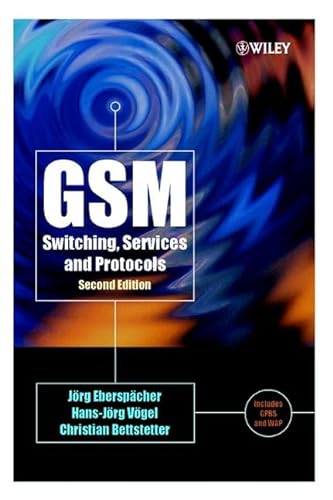
Since the publication of the first edition the number of GSM subscribers has exploded and it is now deployed in more than 140 countries worldwide. Revised and updated GSM Switching, Services and Protocols now features the abundant new services and applications that GSM can provide. By focusing on the fundamentals of the mobile radio systems, it provides an excellent introductory insight to the whole area of GSM cellular radio.
By providing an easy-to-follow instructive text, this second edition will have insight appeal to telecommunication engineers, researchers, adn developers. The highly graphical approach and numerous illustrations will also make it an indispensable reference for senior undergraduates and postgraduates in electrical and computer engineering.
- Details the GSM phase 2+ services, including new data and speech services and service platforms, such as AMR, ASCI. CAMEL and EFR
- Features a brand new chapter on General Packet Radio Service (GPRS)
- Contains a completly revised and expanded chapter 'GSM - The story goes on'
- Presents new sections on Wireles s Application Protocol (WAP) and the migration to UMTS
- Includes expaned and updated chapters on Logical Channels and Channel Coding
Auszug. © Genehmigter Nachdruck. Alle Rechte vorbehalten.
1.
Introduction
1.1
Digital, Mobile, Global: Evolution of Networks
Communication everywhere, with everybody, and at any time - we have come much closer to this goal during the last few years. Digitalization of communication systems, enormous progress in microelectronics, computers, and software technology, inventions of efficient algorithms and procedures for compression, security, and processing of all kinds of signals, as well as the development of flexible communication protocols have been important prerequisites for this progress. Today, technologies are available that enable the realization of high-performance and cost-effective communication systems for many application areas.
In the field of fixed networks - where the end systems (user equipment) are connected to the network over a line (two-wire copper line, coaxial cable, glass fiber) - new network technologies (such as xDSL and cable modem) have been introduced, providing broadband access to the Internet.
The largest technological and organizational challenge is, however, the support of subscriber mobility. It can be distinguished between two kinds of mobility: terminal mobility and personal mobility.
In the case of terminal mobility, the subscriber is connected to the network in a wireless way - via radio or light waves - and can move with his or her terminal freely, even during a communication connection. The degree of mobility depends on the type of mobile radio network. The requirements for a cordless in-house telephone are much less critical than for a mobile telephone that can be used in a car or train. If mobility is to be supported across the whole network (or country) or even beyond the network (or national) boundaries, additional switching technology and administrative functions are required, to enable the subscribers to communicate in wireless mode outside of their home areas.
Such extended network functions are also needed to realize personal mobility and universal reachability. This is understood to comprise the possibility of location-independent use of all kinds of telecommunication services - including and especially in fixed networks. The user identifies himself or herself (the person), e.g. by using a chip card, at the place where he or she is currently staying and has access to the network. There, the same communication services can be used as at home, limited only by the properties of the local network or terminal used. A worldwide unique and uniform addressing is an important requirement.
In the digital mobile communication system GSM (Global System for Mobile Communication), which is the subject of this book, terminal mobility is the predominant issue. Wireless communication has become possible with GSM in any town, any country, and even on any continent. GSM technology contains the essential "intelligent" functions for the support of personal mobility, especially with regard to user identification and authentication, and for the localization and administration of mobile users. Here it is often overlooked that in mobile communication networks by far the largest part of the communication occurs over the fixed network part, which interconnects the radio stations (base stations). Therefore it is no surprise that in the course of further development and evolution of the telecommunication networks, a lot of thought is given to the convergence of fixed and mobile networks.
Today, GSM is used mainly for speech communication, but its use for mobile data communication is growing steadily. The GSM Short Message Service (SMS) is a great success story: several billion text messages are being exchanged between mobile users each month. The driving factor for new (and higher bandwidth) data services is the wireless access to the Internet. The key technologies that have been introduced in GSM, the General Packet Radio Service (GPRS) and the Wireless Application Protocol (WAP), are also explained in this book.
The next generation of mobile communications is known as Universal Mobile Telecommunication System (UMTS) in Europe and as International Mobile Telecommunication System 2000 (IMT-2000) worldwide. The standardization has already progressed quite far, such that the first networks are expected to start operation in 2002.
Despite the differences to GSM (in particular with regard to transmission technique and capacity), it is a clear goal of this future network technology to keepthe newly introduced GSM technologies and make them essential components of UMTS /IMT-2000.
1.2 Classification of Mobile Communication Systems
This book deals almost exclusively with GSM; however, GSM is only one of many facets of modern mobile communication. Figure 1. 1 shows the whole spectrum of today's and - as far as can be seen - future mobile communication systems.
For the bidirectional - and hence genuine - communication systems, the simplest variant is the cordless telephone with very limited mobility (in Europe especially the DECT standard). This technology is also employed for the expansion of digital PBXs with mobile extensions. A related concept is Radio in the Local Loop (RLL) or Wireless Local Loop (WLL). Both concepts require only limited mobility.
Local Area Networks (LANS) have also been augmented with mobility functions: Wireless LANs have been standardized and are now offered by several companies. WLANs offer IP-based, wireless data communication with very high bit rates but limited mobility. IEEE 802.11 systems transmit up to 11 Mbit/s, and HIPERLAN will offer up to 25 Mbit/s. Both systems form pico-cellular networks. They are installed, for example, in office environments and airports, as supplement or alternative to wired LANs, and they are also considered to be a good supplement to UMTS access technologies. The efforts to "mobilize" the Internet are also worth mentioning in this context. A new routing protocol called Movile IP (48,49) has been developed, which allows a mobile computer to change its point of attachment to theInternet. A further strong innovation impulse for mobile data and multimedia communication is the development of wireless Mobile ATM systems based on the exchange technology Asynchronous Transfer Mode (ATM).
„Über diesen Titel“ kann sich auf eine andere Ausgabe dieses Titels beziehen.
Weitere beliebte Ausgaben desselben Titels

Suchergebnisse für GSM: Switching, Services and Protocols

Beispielbild für diese ISBN
GSM Switching, Services, and Protocols
Anbieter: Wonder Book, Frederick, MD, USA
Verkäuferbewertung 5 von 5 Sternen

Zustand: Good. Good condition. 2nd edition. A copy that has been read but remains intact. May contain markings such as bookplates, stamps, limited notes and highlighting, or a few light stains. Artikel-Nr. H15A-02322
Beispielbild für diese ISBN
GSM Switching, Services, and Protocols
Anbieter: ThriftBooks-Atlanta, AUSTELL, GA, USA
Verkäuferbewertung 5 von 5 Sternen
Hardcover. Zustand: Very Good. No Jacket. Missing dust jacket; May have limited writing in cover pages. Pages are unmarked. ~ ThriftBooks: Read More, Spend Less. Artikel-Nr. G047149903XI4N01
Beispielbild für diese ISBN
GSM Switching, Services, and Protocols
Anbieter: ThriftBooks-Dallas, Dallas, TX, USA
Verkäuferbewertung 5 von 5 Sternen
Hardcover. Zustand: Very Good. No Jacket. May have limited writing in cover pages. Pages are unmarked. ~ ThriftBooks: Read More, Spend Less. Artikel-Nr. G047149903XI4N00
Beispielbild für diese ISBN
GSM Switching, Services, and Protocols
Anbieter: ThriftBooks-Atlanta, AUSTELL, GA, USA
Verkäuferbewertung 5 von 5 Sternen
Hardcover. Zustand: Fair. No Jacket. Readable copy. Pages may have considerable notes/highlighting. ~ ThriftBooks: Read More, Spend Less. Artikel-Nr. G047149903XI5N00
Beispielbild für diese ISBN
GSM Switching, Services, and Protocols
Anbieter: ThriftBooks-Atlanta, AUSTELL, GA, USA
Verkäuferbewertung 5 von 5 Sternen
Hardcover. Zustand: Very Good. No Jacket. May have limited writing in cover pages. Pages are unmarked. ~ ThriftBooks: Read More, Spend Less. Artikel-Nr. G047149903XI4N00
Beispielbild für diese ISBN
GSM Switching, Services and Protocols
Verlag:
Wiley & Sons, Incorporated, John, 2001
ISBN 10: 047149903X
ISBN 13: 9780471499039
Gebraucht
Hardcover
Anbieter: Better World Books: West, Reno, NV, USA
Verkäuferbewertung 5 von 5 Sternen
Zustand: Very Good. Used book that is in excellent condition. May show signs of wear or have minor defects. Artikel-Nr. 12441570-75
Beispielbild für diese ISBN
GSM: Switching, Services and Protocols
Anbieter: Anybook.com, Lincoln, Vereinigtes Königreich
Verkäuferbewertung 5 von 5 Sternen
Zustand: Fair. This is an ex-library book and may have the usual library/used-book markings inside.This book has hardback covers. In fair condition, suitable as a study copy. No dust jacket. Please note the Image in this listing is a stock photo and may not match the covers of the actual item,800grams, ISBN:9780471499039. Artikel-Nr. 5754751
Gebraucht kaufen
EUR 3,64
Versand:
EUR 15,34
Von Vereinigtes Königreich nach USA
Anzahl: 1 verfügbar
Beispielbild für diese ISBN
GSM: Switching, Services and Protocols
Anbieter: Anybook.com, Lincoln, Vereinigtes Königreich
Verkäuferbewertung 5 von 5 Sternen
Zustand: Fair. This is an ex-library book and may have the usual library/used-book markings inside.This book has hardback covers. Book contains pencil markings. In fair condition, suitable as a study copy. Please note the Image in this listing is a stock photo and may not match the covers of the actual item,800grams, ISBN:9780471499039. Artikel-Nr. 5754752
Gebraucht kaufen
EUR 3,64
Versand:
EUR 15,34
Von Vereinigtes Königreich nach USA
Anzahl: 1 verfügbar
Beispielbild für diese ISBN
Gsm Switching, Services, and Protocols
Verlag:
Wiley Professional Software, 1999
ISBN 10: 047149903X
ISBN 13: 9780471499039
Gebraucht
Hardcover
Anbieter: Ammareal, Morangis, Frankreich
Verkäuferbewertung 5 von 5 Sternen
Hardcover. Zustand: Moyen. Ancien livre de bibliothèque. Traces d'usure sur la couverture. Couverture légèrement déchirée. Salissures sur la tranche. Edition 1999. Ammareal reverse jusqu'à 15% du prix net de cet article à des organisations caritatives. ENGLISH DESCRIPTION Book Condition: Used, Acceptable. Former library book. Signs of wear on the cover. Slightly torn cover. Stains on the edge. Edition 1999. Ammareal gives back up to 15% of this item's net price to charity organizations. Artikel-Nr. D-524-540
Gebraucht kaufen
EUR 3,00
Versand:
EUR 20,50
Von Frankreich nach USA
Anzahl: 1 verfügbar
Beispielbild für diese ISBN
Gsm Switching, Services, and Protocols
Verlag:
Wiley Professional Software, 2001
ISBN 10: 047149903X
ISBN 13: 9780471499039
Gebraucht
Hardcover
Anbieter: Ammareal, Morangis, Frankreich
Verkäuferbewertung 5 von 5 Sternen
Hardcover. Zustand: Très bon. Ancien livre de bibliothèque. Ammareal reverse jusqu'à 15% du prix net de cet article à des organisations caritatives. ENGLISH DESCRIPTION Book Condition: Used, Very good. Former library book. Ammareal gives back up to 15% of this item's net price to charity organizations. Artikel-Nr. D-598-502
Gebraucht kaufen
EUR 3,00
Versand:
EUR 20,50
Von Frankreich nach USA
Anzahl: 1 verfügbar