
Verwandte Artikel zu Behavioral Finance (Wiley Finance)
Inhaltsangabe
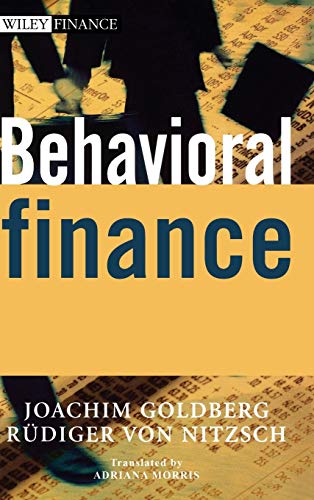
This fascinating book explains the new science of behavioral finance. It demonstrates clearly how behavior-orientated analysis of the financial markets can explain and account for fundamental principles in technical analysis. The book is divided into the following chapters, each offering practical analysis and advice;
Forecasts, An analysis of exposure, Dams to combat the flood of information, Everything is relative, People like to see themselves in a favorable light, Everyone is different and Free advice - valuable tips for successful trades.
Die Inhaltsangabe kann sich auf eine andere Ausgabe dieses Titels beziehen.
Über die Autorin bzw. den Autor
JOACHIM GOLDBERG worked for many years in a major German investment bank, specializing in behavioral finance. In 2000, he founded his own company called Cognitrend.
RÜDIGER VON NITZSCH is Professor of Finance at the University of Aachen. His research centers on the decision manners of humans the the psychology of the stock markets. He has written a number of scientific books, journals and papers and is on the board of Axio.
Von der hinteren Coverseite
The accurate prediction of stock market trends is the ultimate objective of all involved in the financial markets. Increasingly sophisticated mathematical models have been developed in order to predict future trends and minimize risk. Yet they have done little to increase the reliability of predictions. The reason is the central role played by human psychology in all investment decisions.
Irrational decisions, the authors argue, are not made due to a lack of technical tools but as a result of particular behavior patterns. Strong emotions, such as greed and fear, over confidence in one's own abilities and the desire to be ahead of competitors influence (and often override) perception and the decision making process.
Behavioral finance is the scientific study of human behavior. This new young science is rapidly proving invaluable to the financial community to assist traders in controlling their own irrational behavior and predicting that of others.
A fascinating book that demonstrates clearly how behavior-orientated analysis of the financial markets can explain and account for fundamental principles in technical analysis, this book will be an essential companion for anybody interested in this exciting new discipline.
Aus dem Klappentext
Pure financial theory does not take into account people's emotions, prejudices or expectations. These frequently lead to poor decision making.
Despite knowing the slim chances of success, many people are prepared to gamble on events in which they have little chance of winning in the hope of high rewards. This is evidenced by the success of lotteries throughout the world. Therefore, the behavior patterns of society can override the mathematical theory. Many people also listen to gossip and tips or follow the crowd rather than impartially evaluating the facts.
In this book the authors, an experienced financial practitioner and a financial theorist with specialist knowledge of market psychology, explain the new science of behavioral finance. The book examines the human decisions that cause price movements in the stock market, how investors select their information and what informs their trading, in their quest to find even better opportunities for investment.
The book is divided into seven chapters, each offering practical analysis and advice:
* Forecasts: fundamentals, technical analysis and behavioral finance
* An analysis of exposure: desire and reality
* Dams to combat the flood of information: strategies for controlling difficult situations
* Everything is relative - even the evaluation of gains and losses
* People like to see themselves in a favorable light: the consequences of psychological needs
* Everyone is different: three types of market participants
* Free advice: valuable tips for successful trades
Auszug. © Genehmigter Nachdruck. Alle Rechte vorbehalten.
Chapter 1
Forecasts - Fundamentals, technical analysis and behavioral finance
Many people wish to look into the future and know what is going to happen. They do not like surprises sprung on them by fate or by other people; they prefer to be in control of their own destinies, and sometimes other people's destinies as well. Predictions of one kind or another have been popular from the beginning of civilization, particularly where far-reaching and difficult decisions are involved. Remember the prophets of the Old Testament, the Oracle at Delphi, the Sibylline Oracles, and astrology, practiced for thousands of years? Such authorities would be consulted when the future looked uncertain.
Forecasts relating to future price trends of, for example, stocks and shares, currency prices, and commodities are sought after by those trading in the financial markets so they can take positions that yield most profit within the shortest possible time. Forecasts have become the be all and end all of the financial markets. Without them, many a player would lack the necessary imagination in respect of future developments and commitments in the markets, as well as the necessary confidence in the form of the supposed guarantee to be able to shape at least part of their future.
Well-founded forecasts are difficult to compile, and many people consider it impossible to make sound predictions for the long term. That does not prevent a whole host of analysts all over the world from trading on a product called "the future". Their job is to compile forecasts. Analysts who get it right think that they are better than others and believe they can therefore also indirectly control what happens in the markets. This often proves to be an illusion.
The motivation for acting on forecasts lies not only in the quest for the greatest possible gains, or in insurance against unfavorable market developments. People would prefer to eliminate any uncertainty as to whether a particular decision will lead to success. The bottom line is not just a positive material result, for to many people appearing clever means at least as much as a small gain.
The success or otherwise of forecasts is very difficult to measure. The popular prediction that the dollar will reach point x in 12 months time may well turn out to be true, but the crux for the market participant is how the currency gets to point x. People will normally discover this only if they themselves have traded on the forecast question, in other words they have entered into a commitment. That is when they discover that prices don t move in a straight line over the forecast period, and that movements are, for the most part, irregular. Investment losses in the short term can exert psychological pressure on market participants to the extent that they are forced to give up midway, i.e. they liquidate their position. To add insult to injury, a year later they then read the following phrase in investment letters: As we said 12 months ago, the dollar will stand at point x in a year s time. The forecast has come true. Unfulfilled predictions, however, are forgotten quickly. Nobody boasts about having been let down by a false prediction.
Professional analysts tend to issue predictions in line with other analysts, and even to deliberately match their predictions to those of their colleagues. This makes it more or less unlikely for an individual analyst to be rejected by his or her band of followers, as no one upsets the general harmony by offering a contrary opinion. The outsider tip, on the other hand, causes a greater stir. If the tip is successful, then the forecaster s reputation is made, particularly as a beginner; if not, then it doesn t matter, because the forecast was not based on realistic assumptions anyway, and only ever had a very small chance of coming true.
Directional predictions (rises and falls) are useless if we do not know by how much the price of the commodity will change. The likelihood of a hit is relatively great if the extent of the predicted movement is only small. But what happens if the direction of the movement is wrong? Market participants are left high and dry just when it becomes clear that a forecast might be wrong they often do not know which market factors will render a forecast useless. Only those who acted on the forecast and subsequently suffered a loss will be made aware of them.
So, analysts are under pressure to perform: they must be right as often as possible, and their forecasts must show a high hit rate. Yet more than anything, forecasts must sell well, which is why analysts often resort to vague predictions. The prediction of an event, for instance, is often accompanied by a probability score. Take the Central Bank will raise the bank rate at its next meeting, with a probability score of 70 per cent, which gives the impression of a worthwhile prediction but contains a high degree of uncertainty if you remember the odds of 50:50 are in fact completely useless. Scores of 90 or 10 per cent, on the other hand, are hardly ever offered by analysts in these investment letters.
The recommendation to buy share x at a price that lies between 40 and 45 euros, accompanied by a short-term target yield of 110 euros, must be regarded as a vague recommendation. Even if the shares could be bought at 45 euros only, and possibly also only in small quantities, then the originator of this forecast will still assume, mostly wrongly, that all buy orders can be executed at 45 euros. This typically happens when the analyst does not have any experience of trading or is not close to the market. Of course, people are pleased when the share price subsequently rises to 110 euros as predicted. But who, apart from the analysts, whose reputation is enhanced, can profit from such recommendations if no one is selling?
Until barely two decades ago, and particularly
„Über diesen Titel“ kann sich auf eine andere Ausgabe dieses Titels beziehen.
Suchergebnisse für Behavioral Finance (Wiley Finance)

Beispielbild für diese ISBN
Behavioral Finance (Wiley Finance)
Anbieter: AwesomeBooks, Wallingford, Vereinigtes Königreich
Verkäuferbewertung 5 von 5 Sternen

Hardcover. Zustand: Very Good. Behavioral Finance (Wiley Finance) This book is in very good condition and will be shipped within 24 hours of ordering. The cover may have some limited signs of wear but the pages are clean, intact and the spine remains undamaged. This book has clearly been well maintained and looked after thus far. Money back guarantee if you are not satisfied. See all our books here, order more than 1 book and get discounted shipping. Artikel-Nr. 7719-9780471497844
Gebraucht kaufen
EUR 4,80
EUR 4,80 Versand
Versand von Vereinigtes Königreich nach USA
Versand von Vereinigtes Königreich nach USA
Anzahl: 2 verfügbar
Beispielbild für diese ISBN
Behavioral Finance
Verlag:
Wiley & Sons, Incorporated, John, 2001
ISBN 10: 0471497843
ISBN 13: 9780471497844
Gebraucht
Hardcover
Erstausgabe
Anbieter: Better World Books, Mishawaka, IN, USA
Verkäuferbewertung 5 von 5 Sternen
Zustand: Good. 1st Edition. Former library copy. Pages intact with minimal writing/highlighting. The binding may be loose and creased. Dust jackets/supplements are not included. Includes library markings. Stock photo provided. Product includes identifying sticker. Better World Books: Buy Books. Do Good. Artikel-Nr. GRP82460798
Gebraucht kaufen
EUR 10,61
Versand gratis
Versand innerhalb von USA
Versand innerhalb von USA
Anzahl: 1 verfügbar
Foto des Verkäufers
Behavioral Finance (Wiley Finance)
Anbieter: WeBuyBooks, Rossendale, LANCS, Vereinigtes Königreich
Verkäuferbewertung 5 von 5 Sternen
hardcover. Zustand: Good. Most items will be dispatched the same or the next working day. A copy that has been read but remains in clean condition. All of the pages are intact and the cover is intact and the spine may show signs of wear. The book may have minor markings which are not specifically mentioned. No dust jacket. Artikel-Nr. rev4191229431
Gebraucht kaufen
EUR 2,51
EUR 8,27 Versand
Versand von Vereinigtes Königreich nach USA
Versand von Vereinigtes Königreich nach USA
Anzahl: 1 verfügbar
Beispielbild für diese ISBN
Behavioral Finance
Anbieter: ThriftBooks-Dallas, Dallas, TX, USA
Verkäuferbewertung 5 von 5 Sternen
Hardcover. Zustand: Very Good. No Jacket. May have limited writing in cover pages. Pages are unmarked. ~ ThriftBooks: Read More, Spend Less. Artikel-Nr. G0471497843I4N00
Gebraucht kaufen
EUR 11,17
Versand gratis
Versand innerhalb von USA
Versand innerhalb von USA
Anzahl: 1 verfügbar
Beispielbild für diese ISBN
Behavioral Finance
Anbieter: Anybook.com, Lincoln, Vereinigtes Königreich
Verkäuferbewertung 5 von 5 Sternen
Zustand: Fair. This is an ex-library book and may have the usual library/used-book markings inside.This book has hardback covers. In fair condition, suitable as a study copy. Dust jacket in fair condition. Please note the Image in this listing is a stock photo and may not match the covers of the actual item,600grams, ISBN:9780471497844. Artikel-Nr. 9209186
Gebraucht kaufen
EUR 9,36
EUR 15,86 Versand
Versand von Vereinigtes Königreich nach USA
Versand von Vereinigtes Königreich nach USA
Anzahl: 1 verfügbar
Beispielbild für diese ISBN
Behavioral Finance (Wiley Finance)
Anbieter: Bahamut Media, Reading, Vereinigtes Königreich
Verkäuferbewertung 5 von 5 Sternen
Hardcover. Zustand: Very Good. Shipped within 24 hours from our UK warehouse. Clean, undamaged book with no damage to pages and minimal wear to the cover. Spine still tight, in very good condition. Remember if you are not happy, you are covered by our 100% money back guarantee. Artikel-Nr. 6545-9780471497844
Gebraucht kaufen
EUR 27,75
EUR 8,14 Versand
Versand von Vereinigtes Königreich nach USA
Versand von Vereinigtes Königreich nach USA
Anzahl: 1 verfügbar
Beispielbild für diese ISBN
Behavioral Finance
Anbieter: PBShop.store UK, Fairford, GLOS, Vereinigtes Königreich
Verkäuferbewertung 5 von 5 Sternen
HRD. Zustand: New. New Book. Shipped from UK. Established seller since 2000. Artikel-Nr. FW-9780471497844
Neu kaufen
EUR 105,93
EUR 5,85 Versand
Versand von Vereinigtes Königreich nach USA
Versand von Vereinigtes Königreich nach USA
Anzahl: 15 verfügbar
Beispielbild für diese ISBN
Behavioral Finance (Wiley Finance)
Anbieter: Ria Christie Collections, Uxbridge, Vereinigtes Königreich
Verkäuferbewertung 5 von 5 Sternen
Zustand: New. In English. Artikel-Nr. ria9780471497844_new
Neu kaufen
EUR 105,23
EUR 13,17 Versand
Versand von Vereinigtes Königreich nach USA
Versand von Vereinigtes Königreich nach USA
Anzahl: Mehr als 20 verfügbar
Foto des Verkäufers
Behavioral Finance
Anbieter: moluna, Greven, Deutschland
Verkäuferbewertung 5 von 5 Sternen
Zustand: New. JOACHIM GOLDBERG worked for many years in a major German investment bank, specializing in behavioral finance. In 2000, he founded his own company called Cognitrend.RUeDIGER VON NITZSCH is Professor of Finance at the University of Aachen. His research centers. Artikel-Nr. 385635944
Neu kaufen
EUR 116,26
EUR 48,99 Versand
Versand von Deutschland nach USA
Versand von Deutschland nach USA
Anzahl: Mehr als 20 verfügbar
Beispielbild für diese ISBN
Behavioural Finance
Anbieter: Kennys Bookstore, Olney, MD, USA
Verkäuferbewertung 5 von 5 Sternen
Zustand: New. Behavioral Finance, a translation of a highly successful German book, provides the necessary scientific and practical knowledge to enable investors to overcome their inherent irrationality, while taking advantage of that of others. Series: Wiley Finance. Num Pages: 238 pages, Illustrations. BIC Classification: KFF. Category: (P) Professional & Vocational. Dimension: 237 x 154 x 21. Weight in Grams: 530. . 2001. 1st Edition. Hardcover. . . . . Books ship from the US and Ireland. Artikel-Nr. V9780471497844
Neu kaufen
EUR 163,99
EUR 9,05 Versand
Versand innerhalb von USA
Versand innerhalb von USA
Anzahl: Mehr als 20 verfügbar