
Verwandte Artikel zu Performance Drivers: A Practical Guide to Using the...
Inhaltsangabe
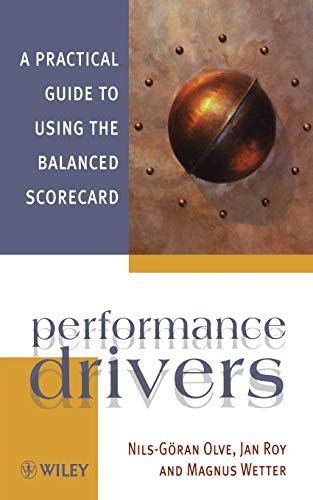
A Practical Guide to Using the Balanced Scorecard performance drivers Nils-Goran Olve, Jan Roy and Magnus Wetter Since the groundbreaking work of Robert S. Kaplan and David P. Norton, the concept of the Balanced Scorecard has achieved increasing popularity in the business world. Previously, many organizations had built their business objectives around financial targets and goals that bore little relation to a long-term strategic vision. Typically, this leaves a gap between the development of a company's strategy and its implementation. The business scorecard, however, provides a more 'balanced view' by looking at not just-financial concerns, but also customers, internal business processes, and learning and growth. But it is not just a system of performance measurement - by focusing on future potential success it can be used as a dynamic management system that reinforces, implements and drives corporate strategy forward. In this book, the authors draw on their extensive experience with scorecard projects to provide a step-by-step method for introducing the Balanced Scorecard into an organization. This is done through the use of some of the most important practical examples in existence, with case studies from ABB, Coca Cola, Electrolux, British Telecom, Nat West, Skandia and Volvo. The desired strategic control system using scorecards that is presented focuses on creating and communicating a total comprehensive picture to all members of the organization from the top down, a long-term view of what the company's strategic objectives really are, how to make use of knowledge gained through experience and the required flexibility of such a system to cope with the fast-changing business environment. This book will provide senior and operational managers, consultants and business academics with a comprehensive view of emerging Balanced Scorecard practice supported by both business advice and a theoretical foundation. Reflections on the relations between the Balanced Scorecard and other areas, such as TQM, information systems and intellectual capital and knowledge management are also made. Business Strategy
Die Inhaltsangabe kann sich auf eine andere Ausgabe dieses Titels beziehen.
Über die Autorin bzw. den Autor
NILS-GÖRAN OLVE is Adjunct Professor at Linköping University. He has worked extensively in management development and co-authored one previous Wiley book, Virtual Organizations and Beyond, 1997. His work concentrates on management control issues, in particular the Balanced Scorecard and the management of IT and immaterial assets.
JAN ROY worked as CEO of several Swedish companies, especially in the retail industry. As a consultant, he mainly deals with strategic change processes.
Jan Roy and Nils-Göran Olve are both active in ConcoursCepro, a Stockholm-based consultancy where Jan Roy is the CEO. ConcoursCepro is part of The Concours Group (www.concours-group.com), which has a growing number of consultants in the US and Europe specializing in the strategic and operational uses of human assets and information technology. Scorecards is an important tool in many of its projects.
MAGNUS WETTER is a management consultant specializing in strategic development and strategic execution. He has an MSc in Business and Administration from Lund University and also studied at McGill University in Montreal.
Von der hinteren Coverseite
performance drivers
A PRACTICAL GUIDE TO USING THE BALANCED SCORECARD
Since the groundbreaking work of Robert S. Kaplan and David P. Norton, the concept of the Balanced Scorecard has achieved increasing popularity in the business world. Previously, many organizations had built their business objectives around financial targets and goals that bore little relation to a long-term strategic vision. Typically, this leaves a gap between the development of a company's strategy and its implementation. The business scorecard, however, provides a more 'balanced view' by looking at not just financial concerns, but also customers, internal business processes, and learning and growth. But it is not just a system of performance measurement - by focusing on future potential success it can be used as a dynamic management system that reinforces, implements and drives corporate strategy forward.
In this book, the authors draw on their extensive experience with scorecard projects to provide a step-by-step method for introducing the Balanced Scorecard into an organization. This is done through the use of some of the most important practical examples in existence, with case studies from ABB, Coca Cola, Electrolux, British Telecom, Nat West, Skandia and Volvo. The desired strategic control system using scorecards that is presented focuses on creating and communicating a total comprehensive picture to all members of the organization from the top down, a long-term view of what the company's strategic objectives really are, how to make use of knowledge gained through experience and the required flexibility of such a system to cope with the fast-changing business environment.
The treatment of the Balanced Scorecard in this book should not be seen in isolation, but will be of interest to any organization introducing new forms of control. Related areas of interest include performance measures, management control, business strategy, strategy development, strategic planning, strategy implementation, knowledge management, intellectual capital and quality management.
Aus dem Klappentext
performance drivers
A PRACTICAL GUIDE TO USING THE BALANCED SCORECARD
Since the groundbreaking work of Robert S. Kaplan and David P. Norton, the concept of the Balanced Scorecard has achieved increasing popularity in the business world. Previously, many organizations had built their business objectives around financial targets and goals that bore little relation to a long-term strategic vision. Typically, this leaves a gap between the development of a company's strategy and its implementation. The business scorecard, however, provides a more 'balanced view' by looking at not just financial concerns, but also customers, internal business processes, and learning and growth. But it is not just a system of performance measurement - by focusing on future potential success it can be used as a dynamic management system that reinforces, implements and drives corporate strategy forward.
In this book, the authors draw on their extensive experience with scorecard projects to provide a step-by-step method for introducing the Balanced Scorecard into an organization. This is done through the use of some of the most important practical examples in existence, with case studies from ABB, Coca Cola, Electrolux, British Telecom, Nat West, Skandia and Volvo. The desired strategic control system using scorecards that is presented focuses on creating and communicating a total comprehensive picture to all members of the organization from the top down, a long-term view of what the company's strategic objectives really are, how to make use of knowledge gained through experience and the required flexibility of such a system to cope with the fast-changing business environment.
The treatment of the Balanced Scorecard in this book should not be seen in isolation, but will be of interest to any organization introducing new forms of control. Related areas of interest include performance measures, management control, business strategy, strategy development, strategic planning, strategy implementation, knowledge management, intellectual capital and quality management.
Auszug. © Genehmigter Nachdruck. Alle Rechte vorbehalten.
CHAPTER 1: WHY A BALANCED SCORECARD?
In this chapter we introduce the Balanced Scorecard - a concept and a method to help us in our discussions on where our business should be heading. The idea of looking at a business in terms of a 'scorecard' has aroused considerable interest since 1992 when it was introduced. The reason, we believe, is that more and more managers find that they need something more than the short-term reports so prevalent up to now.
Describing the Essentials of What We Do Responsibility are trust are watchwords at today's companies. But what is a manager responsible for? For decades we have been talking about 'decentralized' profit responsibility'. We usually measure results in monetary terms. The income statements which we prepare for particular business units and departments are modeled on the income statement of the company. Is this enough? Is the mission of the various parts of a company simply to create profits and return on investment? In many cases probably not. Wise executives know that their company must develop the capabilities which it will to prosper in the future. But doing so will produce no profits and in the current year, only costs. Here, we believe, lies the fundamental reason why companies require a balanced scorecard. The need is even clearer for the many organizations without profit as a goal, including government agencies, internal staff units in industry, and others. We have to do more to describe what we expect of an operation, and how well our expectations are being met.
Perhaps this matter was less urgent before. Both sales and production were primarily focused on the short run. Preparing for the future was something companies did in their development departments and through requirements of centralized authorization for capital expenditures. Today we no longer consider this approach adequate. Preparing for the future is about investing in competence, cultivating customer relationships, and creating databases. Much of this work is done elsewhere in the organization than at headquarters. There is a danger that profit targets will clash with long-term decisions. Later we will consider how profit targets can be reformed so as better to reflect what is really important. But for many employees throughout the company, other ways of describing what the do will say more and be more convincing. These other ways are what we want to use in our scorecards. The balanced scorecard is a method for reaching agreement on where an operation should be heading and for making sure that it stays on course.
Using terms other than monetary ones to explain what you are doing is nothing new. Various kinds of key ratios can be found in abundance in business and the public sector. The difference lies in focusing on a deliberately selected set of measures - few enough to keep track of - and in using them to achieve and communicate a shared view of the organization's strategy for its future development. As the term implies, the scorecard is an aid in creating a 'balance' among various factors to be considered. The balance adopted reflects the strategic choices of the business.
We regard the measures selected as a complement to financial controls, and as a means of reducing the danger of a harmful short-term approach while at the same time making the employees of the organization more aware of the meaning of their work and of the underlying assumptions about the future and about the company. Some refer to a change of approach from economic control to strategic control. However, the question is really one of economy in a deeper sense than the monetary one carelessly used in everyday parlance. Good economy means good resource management. Today's companies are so much more than just an investment in monetary capital. For many of us, how we manage talent, market position, and accumulated knowledge is at least as important!
An Example For a number of years the Product Company had been endeavouring to spread profitability awareness throughout the organization. Capital turnover was satisfactory, and production costs had been squeezed down. Selling efforts were focused on the most profitable products.
But there was a hitch. The factory was extremely reluctant to modernize its technology, and sales gave higher priority than ever to existing customers. The reason was their concern with profitability. Certainly the Product Company was anxious not to spend too much on uncertain projects for the future. But the managing director realized that the company would be in trouble if something happened to the existing plant and equipment or to existing customers. The board of directors had just been discussing visions and strategies for the coming century. But were the employees also thinking along these lines?
The managing director brought up this subject with the financial vice-president, who agreed that financial control at the company tended to be short-sighted. But there was a way to add other considerations beside profitability awareness, and to emphasize a balance between profits today and preparedness for tomorrow. The methods, referred to as the balanced scorecard, meant that employees would share the vision of the board of directors.
A Simple Basic Concept The initial thinking on the balanced-scorecard concept was, presented in an article by Robert S. Kaplan and David P. Norton in the first issue of the 1992 Harvard Business Review. In viewing a company from four vital perspectives (Figure1.1), the balanced scorecard is intended to link short-international control to the long-term vision and strategy of the business. In this way the company focuses on a few critical key ratios in meaningful target areas. In other words, the company is forced to control and monitor day-to-day operation as they affect development tomorrow. Therefore, the balanced scorecard concept is based on three dimensions in time: yesterday, today, and tomorrow. What we do today for tomorrow may have no noticeable financial impact until the day after tomorrow. The company's focus is thus broadened, and it becomes relevant to keep a continuous watch on non-financial key ratios.
„Über diesen Titel“ kann sich auf eine andere Ausgabe dieses Titels beziehen.
Suchergebnisse für Performance Drivers: A Practical Guide to Using the...

Beispielbild für diese ISBN
Performance Drivers: A Practical Guide to Using the Balanced Scorecard
Anbieter: AwesomeBooks, Wallingford, Vereinigtes Königreich
Verkäuferbewertung 5 von 5 Sternen

Paperback. Zustand: Very Good. Performance Drivers: A Practical Guide to Using the Balanced Scorecard This book is in very good condition and will be shipped within 24 hours of ordering. The cover may have some limited signs of wear but the pages are clean, intact and the spine remains undamaged. This book has clearly been well maintained and looked after thus far. Money back guarantee if you are not satisfied. See all our books here, order more than 1 book and get discounted shipping. Artikel-Nr. 7719-9780471495420
Gebraucht kaufen
EUR 3,70
EUR 4,79 Versand
Versand von Vereinigtes Königreich nach USA
Versand von Vereinigtes Königreich nach USA
Anzahl: 2 verfügbar
Foto des Verkäufers
Performance Drivers: A Practical Guide to Using the Balanced Scorecard
Anbieter: WeBuyBooks, Rossendale, LANCS, Vereinigtes Königreich
Verkäuferbewertung 5 von 5 Sternen
paperback. Zustand: Very Good. Most items will be dispatched the same or the next working day. A copy that has been read, but is in excellent condition. Pages are intact and not marred by notes or highlighting. The spine remains undamaged. Artikel-Nr. rev4676483237
Gebraucht kaufen
EUR 1,61
EUR 7,03 Versand
Versand von Vereinigtes Königreich nach USA
Versand von Vereinigtes Königreich nach USA
Anzahl: 1 verfügbar
Beispielbild für diese ISBN
Performance Drivers : A Practical Guide to Using the Balanced Scorecard
Verlag:
Wiley & Sons, Incorporated, John, 2001
ISBN 10: 0471495425
ISBN 13: 9780471495420
Gebraucht
Softcover
Anbieter: Better World Books, Mishawaka, IN, USA
Verkäuferbewertung 5 von 5 Sternen
Zustand: Good. Pages intact with minimal writing/highlighting. The binding may be loose and creased. Dust jackets/supplements are not included. Stock photo provided. Product includes identifying sticker. Better World Books: Buy Books. Do Good. Artikel-Nr. GRP16270244
Gebraucht kaufen
EUR 8,81
Versand gratis
Versand innerhalb von USA
Versand innerhalb von USA
Anzahl: 1 verfügbar
Beispielbild für diese ISBN
Performance Drivers P
Anbieter: ThriftBooks-Atlanta, AUSTELL, GA, USA
Verkäuferbewertung 5 von 5 Sternen
Paperback. Zustand: Good. No Jacket. Pages can have notes/highlighting. Spine may show signs of wear. ~ ThriftBooks: Read More, Spend Less. Artikel-Nr. G0471495425I3N00
Gebraucht kaufen
EUR 10,19
Versand gratis
Versand innerhalb von USA
Versand innerhalb von USA
Anzahl: 1 verfügbar
Beispielbild für diese ISBN
Performance Drivers : A Practical Guide to Using the Balanced Scorecard
Verlag:
Wiley & Sons, Incorporated, John, 2001
ISBN 10: 0471495425
ISBN 13: 9780471495420
Gebraucht
Softcover
Anbieter: Better World Books Ltd, Dunfermline, Vereinigtes Königreich
Verkäuferbewertung 5 von 5 Sternen
Zustand: Very Good. Former library copy. Pages intact with possible writing/highlighting. Binding strong with minor wear. Dust jackets/supplements may not be included. Includes library markings. Stock photo provided. Product includes identifying sticker. Better World Books: Buy Books. Do Good. Artikel-Nr. GRP65434579
Gebraucht kaufen
EUR 5,67
EUR 5,82 Versand
Versand von Vereinigtes Königreich nach USA
Versand von Vereinigtes Königreich nach USA
Anzahl: 2 verfügbar
Beispielbild für diese ISBN
Performance Drivers : A Practical Guide to Using the Balanced Scorecard
Verlag:
Wiley & Sons, Incorporated, John, 2001
ISBN 10: 0471495425
ISBN 13: 9780471495420
Gebraucht
Softcover
Anbieter: Better World Books Ltd, Dunfermline, Vereinigtes Königreich
Verkäuferbewertung 5 von 5 Sternen
Zustand: Good. Former library copy. Pages intact with minimal writing/highlighting. The binding may be loose and creased. Dust jackets/supplements are not included. Includes library markings. Stock photo provided. Product includes identifying sticker. Better World Books: Buy Books. Do Good. Artikel-Nr. GRP21252320
Gebraucht kaufen
EUR 5,67
EUR 5,82 Versand
Versand von Vereinigtes Königreich nach USA
Versand von Vereinigtes Königreich nach USA
Anzahl: 1 verfügbar
Beispielbild für diese ISBN
Performance Drivers: A Practical Guide to Using the Balanced Scorecard
Anbieter: Bahamut Media, Reading, Vereinigtes Königreich
Verkäuferbewertung 5 von 5 Sternen
Paperback. Zustand: Very Good. This book is in very good condition and will be shipped within 24 hours of ordering. The cover may have some limited signs of wear but the pages are clean, intact and the spine remains undamaged. This book has clearly been well maintained and looked after thus far. Money back guarantee if you are not satisfied. See all our books here, order more than 1 book and get discounted shipping. Artikel-Nr. 6545-9780471495420
Gebraucht kaufen
EUR 4,07
EUR 8,12 Versand
Versand von Vereinigtes Königreich nach USA
Versand von Vereinigtes Königreich nach USA
Anzahl: 2 verfügbar
Beispielbild für diese ISBN
Performance Drivers: A Practical Guide to Using the Balanced Scorecard
Anbieter: Phatpocket Limited, Waltham Abbey, HERTS, Vereinigtes Königreich
Verkäuferbewertung 5 von 5 Sternen
Zustand: Good. Your purchase helps support Sri Lankan Children's Charity 'The Rainbow Centre'. Ex-library, so some stamps and wear, but in good overall condition. Our donations to The Rainbow Centre have helped provide an education and a safe haven to hundreds of children who live in appalling conditions. Artikel-Nr. Z1-C-079-C-00765
Gebraucht kaufen
EUR 1,20
EUR 12,38 Versand
Versand von Vereinigtes Königreich nach USA
Versand von Vereinigtes Königreich nach USA
Anzahl: 2 verfügbar
Beispielbild für diese ISBN
Performance Drivers
Anbieter: PBShop.store UK, Fairford, GLOS, Vereinigtes Königreich
Verkäuferbewertung 5 von 5 Sternen
PAP. Zustand: New. New Book. Shipped from UK. Established seller since 2000. Artikel-Nr. FW-9780471495420
Neu kaufen
EUR 21,35
EUR 4,84 Versand
Versand von Vereinigtes Königreich nach USA
Versand von Vereinigtes Königreich nach USA
Anzahl: 15 verfügbar
Beispielbild für diese ISBN
Performance Drivers: A Practical Guide to Using the Balanced Scorecard
Anbieter: Majestic Books, Hounslow, Vereinigtes Königreich
Verkäuferbewertung 4 von 5 Sternen

Zustand: New. pp. 364. Artikel-Nr. 7478349
Neu kaufen
EUR 25,69
EUR 7,56 Versand
Versand von Vereinigtes Königreich nach USA
Versand von Vereinigtes Königreich nach USA
Anzahl: 3 verfügbar