
Verwandte Artikel zu WCDMA for UMTS: Radio Access for Third Generation Mobile...
Inhaltsangabe
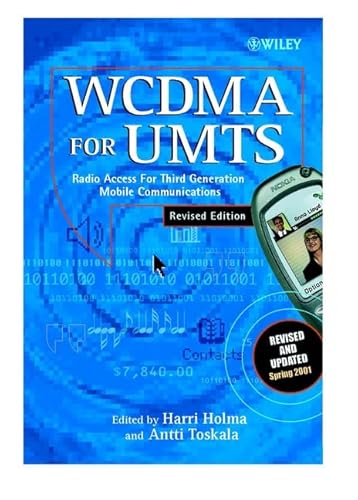
"WCDMA for UMTS" provides a complete picture of the Wideband CDMA (Code Division Multiple Access) air interface of the 3rd generation cellular systems - UMTS (Universal Mobile Telecommunications Systems). "WCDMA" is designed for multimedia communications including high quality images and video, and access to services with high data rates. These capabilities will create new business opportunities for manufacturers, operators and for the providers of content and applications. The key features: explains the key parts of the WCDMA standard and provides guidelines for its efficient use; presents network dimensioning and coverage and capacity planning of WCDMA; introduces radio resource management algorithms in the WCDMA network; examines the coverage and capacity of WCDMA up to 2Mbps using numerous simulation results; introduces the TDD (Time Divisions Duplex) mode; and discusses the co-existence of TDD and FDD (Frequency Divisions Duplex) and highlights their main differences. Now includes the main modifications made to the 3GPP standard up until the end of 2000 and features the following new material: Reference terminal classes, current status of UMTS licensing, capacity upgrade paths and capacity per km2, inter-frequency handovers and inter-system handovers to GSM, and antenna diversity gain measurements in the WCDMA experimental system. Written by leading experts in the field, this practical approach to the key features in WCDMA will have wide-ranging appeal to Research and Development Engineers, Practising Engineers, Cellular Operators, Technical Managers and Students on Telecommunications courses.
Die Inhaltsangabe kann sich auf eine andere Ausgabe dieses Titels beziehen.
Über die Autorin bzw. den Autor
DR HARRI HOLMA, Senior Research Engineer, Nokia Group, Finland DR ANTTI TOSKALA, Standardisation Manager, Nokia Group, Finland
Von der hinteren Coverseite
WCDMA for UMTS provides a complete picture of the Wideband CDMA (Code Division Multiple Access) air interface of the 3rd generation cellular systems - UMTS (Universal Mobile Telecommunications Systems). WCDMA is designed for multimedia communications including high quality images and video, and access to services with high data rates. These capabilities will create new business opportunities for manufacturers, operators and for the providers of content and applications.
* Explains the key parts of the 3GPP/WCDMA standard and provides guidelines for its efficient use
* Presents network dimensioning and coverage and capacity planning of WCDMA
* Introduces radio resource management algorithms in the WCDMA network
* Examines the coverage and capacity of WCDMA up to 2Mbps using numerous simulation results
* Introduces the TDD (Time Divisions Duplex) mode
* Discusses the co-existence of TDD and FDD (Frequency Divisions and Duplex) and highlights their main differences
Written by leading experts in the field, this practical approach to the key features in WCDMA will have wide-ranging appeal to Research and Development Engineers, Practising Engineers, Cellular Operators, Technical Managers and Students on Telecommunications courses.
Now includes the main modifications made to the 3GPP standard up until the end of 2000 and features the following new material:
* Reference terminal classes
* Current status of UMTS licensing
* Capacity upgrade paths and capacity per km2
* Inter-frequency handovers and inter-system handovers to GSM
* Antenna diversity gain measurements in the WCDMA experimental system
Auszug. © Genehmigter Nachdruck. Alle Rechte vorbehalten.
Preface
Second generation telecommunication systems, such as GSM, enabled voice traffic to go wireless: the number of mobile phones exceeds the number of landline phones and the mobile phone penetration exceeds 70% in countries with the most advanced wireless markets. The data handling capabilities of second generation systems are limited, however, and the third generation systems are needed to provide the high bit rate services that enable high quality images and video to be transmitted and received, and to provide access to the web with high data rates. These third generation mobile communication systems are referred to in this book as UMTS (Universal Mobile Communications System). WCDMA (Wideband Code Division Multiple Access) is the main third generation air interface in the world and will be deployed in Europe and Asia, including Japan and Korea, in the same frequency band, around 2 GHz. The large market for WCDMA and its flexible multimedia capabilities will create new business opportunities for manufacturers, operators, and the providers of content and applications. This book gives a detailed description of the WCDMA air interface and its utilisation. The contents are summarised in Figure 1.
Chapter 1 introduces the third generation air interfaces, the spectrum allocation, the time schedule, and the main differences from second generation air interfaces. Chapter 2 presents example UMTS applications, concept phones and the quality of service classes. Chapter 3 introduces the principles of the WCDMA air interface, including spreading, Rake receiver, power control and handovers. Chapter 4 presents the background to WCDMA, the global harmonisation process and the standardisation. Chapters 5-7 give a detailed presentation of the WCDMA standard, while chapters 8-11 cover the utilisation of the standard and its performance. Chapter 5 describes the architecture of the radio access network, interfaces within the radio access network between base stations and radio network controllers (RNC), and the interface between the radio access network and the core network. Chapter 6 covers the physical layer (layer 1), including spreading, modulation, user data and signalling transmission, and the main physical layer procedures of power control, paging, transmission diversity and handover measurements. Chapter 7 introduces the radio interface protocols, consisting of the data link layer (layer 3). Chapter 8 presents the guidelines for radio network dimensioning, gives an example of detailed capacity and coverage planning, and covers GSM co-planning. Chapter 9 covers the radio resources and the quality of service. These algorithms are power control, handovers, admission and load control. Chapter 10 depicts packet access and verifies the approach presented in dynamic system simulations. Chapter 11 analyses the coverage and capacity of the WCDMA air interface with bit rates up to 2Mbps. Chapter 12 introduces the time division duplex (TDD) mode of the WCDMA air interface and its differences from the frequency division duplex (FDD) mode. In addition to WCDMA, third generation services can also be provided with EDGE or with multicarrier CDMA. EDGE is the evolution of GSM for high data rates and within the GSM carrier spacing. Multicarrier CDMA is the evolution of IS-95 for high data rates using three IS-95 carriers, and introduced in Chapter 13.
This reprint of the book includes the key modifications of 3GPP specification done since the official completion of Release'99 until December 2000.
This book is aimed at operators, network and terminal manufacturers, service providers, university students and frequency regulators. A deep understanding of the WCDMA air interface, its capabilities and its optimal usage is the key to success in the UMTS business. This book represents the views of their employers.
„Über diesen Titel“ kann sich auf eine andere Ausgabe dieses Titels beziehen.
Suchergebnisse für WCDMA for UMTS: Radio Access for Third Generation Mobile...

Beispielbild für diese ISBN
WCDMA for UMTS: Radio Access for Third Generation Mobile Communications, Revised Edition
Anbieter: ThriftBooks-Dallas, Dallas, TX, USA
Verkäuferbewertung 5 von 5 Sternen

Hardcover. Zustand: Very Good. No Jacket. May have limited writing in cover pages. Pages are unmarked. ~ ThriftBooks: Read More, Spend Less. Artikel-Nr. G0471486876I4N00
Gebraucht kaufen
EUR 6,85
Versand gratis
Versand innerhalb von USA
Versand innerhalb von USA
Anzahl: 1 verfügbar
Beispielbild für diese ISBN
WCDMA for UMTS: Radio Access for Third Generation Mobile Communications, Revised Edition
Anbieter: ThriftBooks-Dallas, Dallas, TX, USA
Verkäuferbewertung 5 von 5 Sternen
Hardcover. Zustand: As New. No Jacket. Pages are clean and are not marred by notes or folds of any kind. ~ ThriftBooks: Read More, Spend Less. Artikel-Nr. G0471486876I2N00
Gebraucht kaufen
EUR 6,85
Versand gratis
Versand innerhalb von USA
Versand innerhalb von USA
Anzahl: 1 verfügbar
Beispielbild für diese ISBN
WCDMA for UMTs : Radio Access for Third Generation Mobile Communications
Verlag:
Wiley & Sons, Incorporated, John, 2001
ISBN 10: 0471486876
ISBN 13: 9780471486879
Gebraucht
Hardcover
Anbieter: Better World Books: West, Reno, NV, USA
Verkäuferbewertung 5 von 5 Sternen
Zustand: Very Good. rev Edition. Pages intact with possible writing/highlighting. Binding strong with minor wear. Dust jackets/supplements may not be included. Stock photo provided. Product includes identifying sticker. Better World Books: Buy Books. Do Good. Artikel-Nr. 4938137-6
Gebraucht kaufen
EUR 9,68
Versand gratis
Versand innerhalb von USA
Versand innerhalb von USA
Anzahl: 1 verfügbar
Foto des Verkäufers
WCDMA for UMTS: Radio Access for Third Generation Mobile Communications, Revised Edition
Anbieter: WeBuyBooks, Rossendale, LANCS, Vereinigtes Königreich
Verkäuferbewertung 5 von 5 Sternen
hardcover. Zustand: Very Good. Most items will be dispatched the same or the next working day. A copy that has been read, but is in excellent condition. Pages are intact and not marred by notes or highlighting. The spine remains undamaged. Artikel-Nr. rev8736500991
Gebraucht kaufen
EUR 4,86
EUR 9,13 Versand
Versand von Vereinigtes Königreich nach USA
Versand von Vereinigtes Königreich nach USA
Anzahl: 1 verfügbar
Beispielbild für diese ISBN
WCDMA for UMTS: Radio Access for Third Generation Mobile Communications, Revised Edition Holma, Harri and Toskala, Antti
Anbieter: GridFreed, San Diego, CA, USA
Verkäuferbewertung 5 von 5 Sternen
Hardcover. Zustand: New. In shrink wrap. Artikel-Nr. 10-21150
Neu kaufen
EUR 17,37
EUR 6,18 Versand
Versand innerhalb von USA
Versand innerhalb von USA
Anzahl: 1 verfügbar
Foto des Verkäufers
WCDMA for UMTs : Radio Access for Third Generation Mobile Communications
Verlag:
John Wiley & Sons Ltd, Chichester u.a.:, 2001
ISBN 10: 0471486876
ISBN 13: 9780471486879
Gebraucht
Hardcover
Anbieter: Gebrauchtbücherlogistik H.J. Lauterbach, Gummersbach, NRW, Deutschland
Verkäuferbewertung 5 von 5 Sternen
Hardcover. Zustand: Gut. Revised Edition. 25 cm XXIII, 313 S. :. Hardcover. Sprache: Englisch, Zustand: Gut bis Sehr Gut (Innen); Besitzerstempel; Einband Außen hat geringe bis leichte Gebrauchsspuren; Nichtöffentliches Archivex. mit Klebestreifenrest (Außen); * Die Photos sind original von uns erstellt worden, u.a. erkennbar an einem kleinen weißen Stück Papier im oberen Schnitt. Ab und an verwenden Suchmaschinen Verlagsphotos, bei den Portalen selbst, werden aber nur unsere Originalphotos gezeigt. Artikel-Nr. 387311
Gebraucht kaufen
EUR 4,87
EUR 27,00 Versand
Versand von Deutschland nach USA
Versand von Deutschland nach USA
Anzahl: 1 verfügbar
Beispielbild für diese ISBN
WCDMA for UMTS: Radio Access for Third Generation Mobile Communications, Re vised Edition
Anbieter: Infinity Books Japan, Tokyo, TKY, Japan
Verkäuferbewertung 2 von 5 Sternen

Hardcover. Zustand: Very Good. Artikel-Nr. RWARE0000050568
Gebraucht kaufen
EUR 6,90
EUR 46,27 Versand
Versand von Japan nach USA
Versand von Japan nach USA
Anzahl: 1 verfügbar
Beispielbild für diese ISBN
WCDMA for UMTS Radio Access for Third Generation Mobile Communications
Anbieter: Romtrade Corp., STERLING HEIGHTS, MI, USA
Verkäuferbewertung 5 von 5 Sternen
Zustand: New. This is a Brand-new US Edition. This Item may be shipped from US or any other country as we have multiple locations worldwide. Artikel-Nr. ABBB-33849
Beispielbild für diese ISBN
Wcdma for Umts
Anbieter: Majestic Books, Hounslow, Vereinigtes Königreich
Verkäuferbewertung 4 von 5 Sternen

Zustand: New. pp. xxiii + 313 Illus. Artikel-Nr. 7578463
Neu kaufen
EUR 61,42
EUR 7,71 Versand
Versand von Vereinigtes Königreich nach USA
Versand von Vereinigtes Königreich nach USA
Anzahl: 4 verfügbar
Beispielbild für diese ISBN
WCDMA FOR UMTS- RADIO ACCESS FOR THIRD GENERATION MOBILE COMM [REVISED EDITION]
Anbieter: Romtrade Corp., STERLING HEIGHTS, MI, USA
Verkäuferbewertung 5 von 5 Sternen
Zustand: New. This is a Brand-new US Edition. This Item may be shipped from US or any other country as we have multiple locations worldwide. Artikel-Nr. ABBB-221639