
Verwandte Artikel zu The Home Buyer's Advisor: A Handbook for First-Time...
Inhaltsangabe
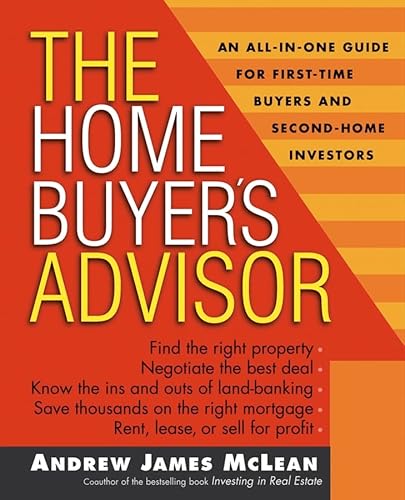
The tax-smart guide for first-time buyers and second-home investors
Whether you're a first-time home buyer or a seasoned investor, this practical guide covers everything you need to know to invest safely, confidently, and profitably in today's real estate market-while getting the most out of the latest tax laws.
The Home Buyer's Advisor shows you precisely what to look for in a real estate investment, where to find the best buying opportunities, how to use proven holding strategies such as land-banking and lease options, and how to make your home a secure foundation for future real estate investments. Ideas for a secure retirement are also included. Packed with ideas, strategies, and real-world examples, Andrew McLean's Home Buyer's Advisor will show you how to:
* Take advantage of a wide range of financing methods, such as originating new VA, FHA, and conventional loans; loan assumption; wrap-around loans; and other alternative financing methods
* Hunt for bargain properties using the Internet
* Profit from HUD and VA repossessions and bank foreclosures, and bid for property at special auctions
* Use professional appraisal techniques to ensure you're getting the best value for your investment
* Utilize smart investment strategies and holding techniques
* Manage properties without all the hassles
* Minimize, defer, and transfer more of your tax liability
* And much more!
Die Inhaltsangabe kann sich auf eine andere Ausgabe dieses Titels beziehen.
Über die Autorin bzw. den Autor
ANDREW JAMES McLEAN is the coauthor of the Wiley bestseller Investing in Real Estate, which has sold more than 100,000 copies. He is currently an active investor in the Las Vegas and Mississippi Gulf Coast real estate markets. He holds a BA in business administration from Michigan State University.
Von der hinteren Coverseite
The tax-smart guide for first-time buyers and second-home investors
Whether you?re a first-time home buyer or a seasoned investor, this practical guide covers everything you need to know to invest safely, confidently, and profitably in today?s real estate market?while getting the most out of the latest tax laws.
The Home Buyer?s Advisor shows you precisely what to look for in a real estate investment, where to find the best buying opportunities, how to use proven holding strategies such as land-banking and lease options, and how to make your home a secure foundation for future real estate investments. Ideas for a secure retirement are also included. Packed with ideas, strategies, and real-world examples, Andrew McLean?s Home Buyer?s Advisor will show you how to:
- Take advantage of a wide range of financing methods, such as originating new VA, FHA, and conventional loans; loan assumption; wrap-around loans; and other alternative financing methods
- Hunt for bargain properties using the Internet
- Profit from HUD and VA repossessions and bank foreclosures, and bid for property at special auctions
- Use professional appraisal techniques to ensure you?re getting the best value for your investment
- Utilize smart investment strategies and holding techniques
- Manage properties without all the hassles
- Minimize, defer, and transfer more of your tax liability
- And much more!
Aus dem Klappentext
The tax-smart guide for first-time buyers and second-home investors
Whether you’re a first-time home buyer or a seasoned investor, this practical guide covers everything you need to know to invest safely, confidently, and profitably in today’s real estate market–while getting the most out of the latest tax laws.
The Home Buyer’s Advisor shows you precisely what to look for in a real estate investment, where to find the best buying opportunities, how to use proven holding strategies such as land-banking and lease options, and how to make your home a secure foundation for future real estate investments. Ideas for a secure retirement are also included. Packed with ideas, strategies, and real-world examples, Andrew McLean’s Home Buyer’s Advisor will show you how to:
- Take advantage of a wide range of financing methods, such as originating new VA, FHA, and conventional loans; loan assumption; wrap-around loans; and other alternative financing methods
- Hunt for bargain properties using the Internet
- Profit from HUD and VA repossessions and bank foreclosures, and bid for property at special auctions
- Use professional appraisal techniques to ensure you’re getting the best value for your investment
- Utilize smart investment strategies and holding techniques
- Manage properties without all the hassles
- Minimize, defer, and transfer more of your tax liability
- And much more!
Auszug. © Genehmigter Nachdruck. Alle Rechte vorbehalten.
The Home Buyer's Advisor
A Handbook for First-Time Buyers and Second-Home InvestorsBy Andrew James McLeanJohn Wiley & Sons
Copyright © 2004 Andrew James McLeanAll right reserved.
ISBN: 978-0-471-46641-3
Chapter One
Why Buying a Home Is a Great Investment
Home is where the heart is, said Charles Osgood, host of the popular CBS television show Sunday Morning. That particular show, which aired April 27, 2003, had a segment about how Americans have retreated to their homes for safety since the attacks of September 11, 2001, and have made them their sanctuary from the rest of the world.
But the home has much more virtue than just sentimental value, or its value as a great refuge. Not only is the home a great investment, it also is a natural wealth builder and a superior tax shelter. Your home can even be the foundation for a pyramid of other profitable realty investments, yielding a lifetime of worry-free income.
Reasons Why Real Estate Outperforms Other Forms of Investment
A monumental event involving America's stock market took place in the spring of 2003-on March 24, the bear market turned three years old. During that time, the Dow Jones average had lost over 30 percent of its value (measured not in billions, but in trillions of dollars), and unfortunately the bear's birthday coincided with the onset of a new age of uncertainty. Americans faced a steady media drumbeat of war, terror, fear, and recession. The United States initiated its first preemptive war, against Iraq. Fear of terrorism stymied economic growth. Scandals put distrust in financial statements and Wall Street research. Seasoned investors now no longer view the stock market as a direct route to a comfortable retirement. The sound investment strategies that earned great returns in the 1990s don't work any more.
Meanwhile, what do you think happened to America's median home price-half sold for more, half for less-during that same three-year period of declining stock prices? It jumped 8.8 percent year-over-year in the October to December quarter of 2002. The increase broke a six-month trend of moderating home price increases. As Figure 1.1 shows, home price increases ranged from a low of 3 percent to a peak of 8.8 percent during that three-year period.
The 8.8 percent jump was the biggest such increase reported by the National Association of Realtors (NAR) since 1981. And the upward push on prices is widespread: 39 metropolitan areas registered double-digit price increases for the quarter, triple the number of metro areas with such growth in 1999. NAR chief economist David Lereah is quoted as saying, "The big jump reflects the explosive mix of tight supplies of homes for sale and mortgage interest rates below 6 percent, the lowest in four decades."
Like many other housing economists, Lereah forecasts that the growth in home prices will decelerate to just 3 percent by the end of this year. His scenario: a strengthening U.S. economy leading the way to higher mortgage interest rates, and a modest cooling in what continues to be a red-hot housing market.
What's the end result after three years of declining stock prices in an economic recession? The average stock market investor took a beating in the portfolio. Conversely, over the same three-year span, the average home owner or real estate investor experienced steady appreciation with solid gains in value.
This comparison has served to emphasize the enduring benefits of owning a home. Most Americans prefer safe investments with historically good track records. Housing is one of those standards of enduring value, and adult Americans have most of their wealth invested in their homes. Two out of three adults living in the United States own their own home. Investment in a home gives the owner a hedge against inflation, an opportunity to shelter income from taxes, and, more important, a chance to accumulate wealth for the future.
"Okay," you may be saying, "you've convinced me that real estate has looked good in the past three years, but what does the future look like?"
Expect Increasing Rents and Appreciation
Although short-term economic recessions may temporarily cause a rise in vacancies and depress rents, rent levels and appreciation will go up over the long term, because future demand will increase faster than future supply. Here are four reasons why:
1. Growth in America's population. Moderate growth projections for the next 20 years reveal that the U.S. population will increase from its current figure of 284 million to a figure of 334 million-an increase of 50 million people. In just two decades, America will add more people than are currently living in the three states of Florida, Michigan, and Texas.
2. Growth in the number of households. Americans presently average 2.2 persons per household. But continuing with a declining trend, that figure is likely to fall to around 2.0, given the relative trend of families having fewer children, more singles living alone, and more baby boomers of the mid-1940s moving into retirement. Thus, America will need 25 million additional housing units just to adequately house a net gain of 50 million people.
3. Growth in personal income. People need money to rent apartments or to buy homes. Accordingly, people earn more money when the national economy is growing. But what does the future hold for growth in the U.S. economy-will it be productive, and can it adequately supply the employment needed to generate this income? It's gratifying to know that the outlook for growth in the national economy is very promising. Expansion of markets for U.S. products due to globalization, continued corporate cost cutting, higher levels of competition among businesses, and technical innovation will bring more gains to incomes and economic productivity. In addition, a growing number of two-earner households increases overall household buying power.
4. Growth in second-home ownership. Currently, approximately 8 million households own a second home. Taking into consideration the prevailing market conditions that tend to stimulate more real estate investment-low interest rates for mortgage loans and dispirited stock investors bailing out of the market to invest in real estate-forecasters expect this number to expand significantly over the next 20 years. They're predicting that by 2024, about 20 million households will own at least two homes.
As you can see, expanding population over the next two decades will generate record numbers of people needing adequate housing. This additional demand on the housing market will put a lot of upward pressure on the nation's overall housing supply, with corresponding increases in both rents and home prices. Yet, you might respond, "What about the law of supply and demand-that builders will expand their capacity to erect more new housing to satisfy the demand? Or, is it possible that they could go overboard and build too much, and glut the housing market?"
The answer is no to both questions. Here's why:
In the classic economic theory, supply increases to satisfy demand. Shortage of a product increases the demand for it, which inevitably makes its price rise. As the price continues to escalate, more suppliers see the profit potential and begin competing to produce the product, which eventually adds to the supply and curbs runaway prices. This theory is...
„Über diesen Titel“ kann sich auf eine andere Ausgabe dieses Titels beziehen.
Suchergebnisse für The Home Buyer's Advisor: A Handbook for First-Time...

Beispielbild für diese ISBN
The Home Buyer's Advisor : A Handbook for First-Time Buyers and Second-Home Investors
Verlag:
Wiley & Sons, Incorporated, John, 2004
ISBN 10: 0471466417
ISBN 13: 9780471466413
Gebraucht
Softcover
Erstausgabe
Anbieter: Better World Books, Mishawaka, IN, USA
Verkäuferbewertung 5 von 5 Sternen

Zustand: Good. 1st Edition. Former library copy. Pages intact with minimal writing/highlighting. The binding may be loose and creased. Dust jackets/supplements are not included. Includes library markings. Stock photo provided. Product includes identifying sticker. Better World Books: Buy Books. Do Good. Artikel-Nr. 584288-6
Gebraucht kaufen
EUR 9,46
Versand gratis
Versand innerhalb von USA
Versand innerhalb von USA
Anzahl: 1 verfügbar
Beispielbild für diese ISBN
The Home Buyer's Advisor : A Handbook for First-Time Buyers and Second-Home Investors
Verlag:
Wiley & Sons, Incorporated, John, 2004
ISBN 10: 0471466417
ISBN 13: 9780471466413
Gebraucht
Softcover
Erstausgabe
Anbieter: Better World Books: West, Reno, NV, USA
Verkäuferbewertung 5 von 5 Sternen
Zustand: Good. 1st Edition. Former library copy. Pages intact with minimal writing/highlighting. The binding may be loose and creased. Dust jackets/supplements are not included. Includes library markings. Stock photo provided. Product includes identifying sticker. Better World Books: Buy Books. Do Good. Artikel-Nr. 584288-6
Gebraucht kaufen
EUR 9,46
Versand gratis
Versand innerhalb von USA
Versand innerhalb von USA
Anzahl: 1 verfügbar
Beispielbild für diese ISBN
The Home Buyer's Advisor : A Handbook for First-Time Buyers and Second-Home Investors
Verlag:
Wiley & Sons, Incorporated, John, 2004
ISBN 10: 0471466417
ISBN 13: 9780471466413
Gebraucht
Softcover
Erstausgabe
Anbieter: Better World Books: West, Reno, NV, USA
Verkäuferbewertung 5 von 5 Sternen
Zustand: Very Good. 1st Edition. Pages intact with possible writing/highlighting. Binding strong with minor wear. Dust jackets/supplements may not be included. Stock photo provided. Product includes identifying sticker. Better World Books: Buy Books. Do Good. Artikel-Nr. 18568568-6
Gebraucht kaufen
EUR 9,46
Versand gratis
Versand innerhalb von USA
Versand innerhalb von USA
Anzahl: 1 verfügbar
Beispielbild für diese ISBN
The Home Buyer's Advisor: A Handbook for First-Time Buyers and Second-Home Investors
Anbieter: ThriftBooks-Atlanta, AUSTELL, GA, USA
Verkäuferbewertung 5 von 5 Sternen
Paperback. Zustand: Good. No Jacket. Former library book; Pages can have notes/highlighting. Spine may show signs of wear. ~ ThriftBooks: Read More, Spend Less. Artikel-Nr. G0471466417I3N10
Gebraucht kaufen
EUR 10,97
Versand gratis
Versand innerhalb von USA
Versand innerhalb von USA
Anzahl: 1 verfügbar
Foto des Verkäufers
The Home Buyer's Advisor: A Handbook for FirstTime Buyers and SecondHome Investors
Anbieter: WeBuyBooks, Rossendale, LANCS, Vereinigtes Königreich
Verkäuferbewertung 5 von 5 Sternen
paperback. Zustand: Very Good. Most items will be dispatched the same or the next working day. A copy that has been read, but is in excellent condition. Pages are intact and not marred by notes or highlighting. The spine remains undamaged. Artikel-Nr. rev5573855373
Gebraucht kaufen
EUR 26,02
EUR 8,24 Versand
Versand von Vereinigtes Königreich nach USA
Versand von Vereinigtes Königreich nach USA
Anzahl: 1 verfügbar