
Verwandte Artikel zu The CEO and the Monk: One Company's Journey to...
Inhaltsangabe
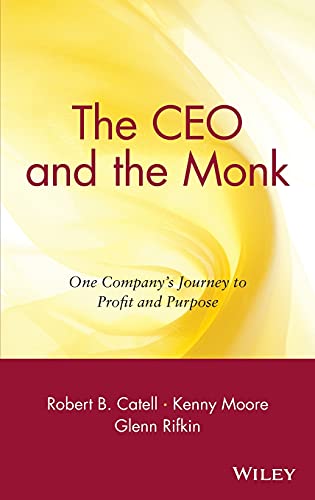
In a business era in which executives are taken away in handcuffs and corporate malfeasance and scandal dominates the business headlines, there is tremendous value in the stories of ethical companies and spiritual business leaders. The CEO and the Monk is one such compelling story, the story of KeySpan, the nation's fifth largest energy giant and a profitable, Fortune 500 company, and the two KeySpan executives one a former monks whose unique working relationship is based on something as simple and powerful as "doing the right thing." This isn't yet another prescriptive business guide written by breathless consultants. It is a story about a real business and how two unusual and dedicated humanists can keep their eyes on profits and ethics at the same time.
Die Inhaltsangabe kann sich auf eine andere Ausgabe dieses Titels beziehen.
Über die Autorin bzw. den Autor
Robert B. CATELL is the CEO of KeySpan, one of the nation’s largest energy providers. He is one of the most highly respected business leaders in New York.
KENNY MOORE is a former monk who left the religious life for a successful career in human resources. He is currently Corporate Ombudsman at KeySpan.
GLENN RIFKIN is a veteran business journalist who has written extensively for the New York Times and coauthored many groundbreaking business books, including the Wiley title Radical Marketing, The CEO Chronicles, and The Ultimate Entrepreneur.
Von der hinteren Coverseite
Advance praise for The CEO and the Monk
"The CEO and the Monk is an enormously interesting and utterly charming book. We all know that we have to restore faith in our capitalist system if it is to survive and flourish. Bob Catell, with the assistance of an unusual advisor, did just that at a critical moment in his company s evolution and our nation s history. This is a rare business story that will both amaze and inspire you."
David Rockefeller
"This is a wonderful story of commitment, integrity, and the power of relationships. It offers the possibility that executives who care about community and people bring both honor and economic success to their business. Inspiring and practical, The CEO and the Monk threatens to restore our faith in those who lead us. I tip my hat to Bob and Kenny for telling the story of how human values can be brought into the marketplace. This book is unique and much needed."
Peter Block, consultant, speaker, and author of many bestselling books, including The Answer to How Is Yes, winner of the 2002 Independent Publisher Book Award for Business Breakthrough of the Year
"The CEO and the Monk offers great lessons for any leader or HR professional who wants to build a positive work environment. Where else can you learn to handle such business challenges as mergers and acquisitions, growth, deregulation, cutbacks, and change intertwined with the human issues like employee involvement and communication in one place? Filled with best practice concrete examples, this is one of the finest case studies for engagement and retention that I have ever seen."
Beverly Kaye, founder and CEO, Career Systems International, and coauthor of Love It, Don t Leave It: 26 Ways to Get What You Want at Work
"Managers don t always recognize the critical need for trust and understanding. The CEO and the Monk will awaken their sensibilities. It brilliantly blurs the line between the soft and the hard of business, and proves that you don t have to sacrifice your soul to make a profit."
Jim Champy, Chairman of Consulting for Perot Systems and coauthor of Reengineering the Corporation
Aus dem Klappentext
In an era in which headlines decry the dishonesty of some corporate leaders, we tend to overlook more inspiring business stories. This is one of those stories.
While some energy companies were playing fast and loose with the new rules of deregulation cooking the books to inflate the price of their stock KeySpan maintained the sort of good corporate citizenship that many people thought impossible. And while other energy businesses imploded in a wave of misguided management and dishonest accounting, KeySpan s leadership was characterized by its steadfast belief in doing the right thing and embracing the very best that its employees and the communities it served had to offer.
The CEO and the Monk describes the unlikely partnership of a savvy CEO and a former monk who led their company to the top even while embracing a higher set of business standards. It examines KeySpan s success from the perspective of Robert Catell and Kenny Moore, who have formed an unusual but potent relationship that has enabled the company s rise from a small local utility monopoly to one of the nation s largest and fastest-growing energy providers. It has done so by adopting the values of the community it serves and espousing a management philosophy that brought caring and a sense of soul into the workplace. The results not only improved the bottom line, but forged a corporate culture with meaning.
Unlike other business books that claim to offer lessons in ethical leadership, The CEO and the Monk goes beyond the theoretical into the real world, where commerce and spirituality rarely intersect. This is a true account of a real business, with real business leaders and tough issues to overcome. Faced with deregulation, traumatic mergers, a slowing economy, the terror of 9/11, and a shifting business landscape, Catell and Moore infused KeySpan with a sense of values without ever losing sight of the bottom line. Theirs is a story that will resonate with corporate leaders who want to lead as well as inspire their organizations.
Auszug. © Genehmigter Nachdruck. Alle Rechte vorbehalten.
The CEO and the Monk
One Company's Journey to Profit and PurposeBy Robert B. Catell Kenny Moore Glenn RifkinJossey-Bass
Copyright © 2004 Robert B. CatellAll right reserved.
ISBN: 978-0-471-45011-5
Chapter One
The FuneralThe secret of success in life is for a man to be ready for his opportunity when it comes. -Benjamin Disraeli
One autumn evening in 1994, on the eve of his company's one hundredth birthday, Bob Catell got up from his desk on the twenty-third floor of the company's gleaming new headquarters in downtown Brooklyn and headed to the elevators. As he punched the button for the second floor, Catell felt a twist of anticipation and trepidation. His destination was the corporate auditorium, where he would help preside over the company's funeral.
Brooklyn Union Gas Company had died, at least symbolically. In his three years as president and CEO, Catell had come to understand that a new era was beginning in the energy industry, and in order to compete, Brooklyn Union had to reinvent itself. It had to wade into the rising tide of deregulation, into new, competitive marketplaces, and find a strategic path to growth and profitability. The old comfort zone that characterized this cozy, monopolistic entity was being torn apart, brick by brick, and a century's worth of business identity, capability, and culture was being confronted with a dramatic challenge: Change quickly or become irrelevant. In his three years at the helm, Catell had enjoyed the last vestiges of a long period of sustained growth at Brooklyn Union. Starting in the late 1950s, the natural gas business had blossomed into a sweet spot in the energy market, a clean, plentiful alternative to oil, and Brooklyn Union had taken full advantage in selling to its densely populated marketplace. By the early 1990s, it had saturated its existing territories in Brooklyn, Staten Island, and Queens. With more than one million customers, Brooklyn Union Gas owned 80 percent of the residential market and 50 percent of the commercial market. Sure, it owned the pipes in the ground, and as long as the winter winds and frigid temperatures chilled New York, customers would need to heat their homes and offices. But this annuity had no room for growth and expansion. Catell understood an age-old business tenet: Stagnation generally leads to extinction.
And there was more. The New York Public Service Commission, the watchdog government agency that controlled rates and regulated the state's energy industry, had followed the Federal Energy Regulatory Commission's call for deregulation. In the mid-1980s, interstate gas pipelines, heretofore run as tightly protected monopolies, now had to open up their systems to other transporters. Local distribution companies like Brooklyn Union had always been a captive market, forced to buy from the pipeline company that controlled its territory. Now, they would have a choice. Like deregulation efforts in other industries such as airlines and telecommunications, the notion was that an open market would foster competition, reduce prices, increase service quality, and be good for the consumer.
The distribution companies themselves became the next targets. They, too, would have to open up their pipes so that other sellers could offer gas to local customers. Much like the telephone companies in the late 1990s, the energy distributors were being thrown, like it or not, into a new and chaotic business environment. The rules were being changed almost overnight, and in pure Darwinian fashion, those who adapted best would survive.
Catell, in his short tenure as chief executive, had done a reasonable job as steward of the Brooklyn Union legacy. In his 36 years at the company, he had risen up the ranks, admirably impressing his bosses at every stop with his business instincts and his people skills. He was a quick study, and he had that intangible but alluring characteristic that the company's executives couldn't ignore: He simply loved the gas business. He read every periodical, joined every relevant association, attended seminars, and established relationships in every corner of the global gas network, from South America to Calgary, relationships that would give him not only knowledge but access.
In 1991, he was the natural choice to succeed Elwin Larson as CEO, and in early 1994 he'd been handed the chairmanship of Brooklyn Union as well. It should have been-and was in many ways-the perfect endgame of a textbook business career.
But Catell was discontented. He had never been much interested in being a steward and then sliding nicely into retirement with a fat pension and a stately condo in Florida. About 15 minutes after becoming CEO, he had been asked to describe his vision for Brooklyn Union. "I'd like us to become the premier energy company in the Northeast," he had replied.
With tough competitors like Con Edison and Enron, that had been a bold prognostication. But Catell believed that Brooklyn Union had the kind of solid foundation and strong management force to make that vision real. Now, three years later, he was not so sure. He felt a malaise settling in on the company as the realities of deregulation began to seep into the halls and out in the field. Brooklyn Union was in the early stages of a metamorphosis, and people were dragging their feet, procrastinating, even ignoring the new realities. They had grown to love the Brooklyn Union culture, as had their mothers, fathers, and uncles before them. Change might be flying through the air at them, but they would prefer to duck out of the way rather than reach out to grab it.
Catell understood that he was entering the toughest, most daunting era in Brooklyn Union's long history, and as its ninth CEO he didn't want to be the one to drop the ball. Decisions made on his watch would determine not only the company's future success or failure, but whether it would continue to exist as an independent entity at all.
So as he stepped out of the elevator, Catell felt a clear twinge of that business clich: It is indeed lonely at the top. Kenny Moore, the former monk who had become something of corporate confessor, facilitator, and psychologist rolled into one, awaited Catell outside the conference room. The funeral had been Moore's idea. His reasoning was simple and pious: In order to begin something new, something else must come to an end. One could not embrace the future until the past had been properly and ceremoniously left behind. People held funerals when loved ones died. Why not a similar service when a beloved company passes on?
Though it might have struck most executives as outlandish, Catell was intrigued. He was beginning to believe that outlandish was what he needed to shake things up around here. Catell had called on Kenny Moore more often in recent months. In his work setting up corporate performance reviews and a high-level management by objective program, Moore had brought a unique perspective and insight to Brooklyn Union. There he had been, sitting with senior-level executives, helping them set annual goals on which their performance would be measured and their compensation levels set. Yet he had no business background at all.
Feeling terrified and inadequate, Moore nonetheless had plowed ahead and begun to realize that it wasn't business knowledge that mattered. A good deal of his value lay in the very experiences he had left behind in the ministry. When it became clear to those with whom he was consulting that Moore had no personal...
„Über diesen Titel“ kann sich auf eine andere Ausgabe dieses Titels beziehen.
Suchergebnisse für The CEO and the Monk: One Company's Journey to...

Beispielbild für diese ISBN
The CEO and the Monk : One Company's Journey to Profit and Purpose
Verlag:
Wiley & Sons, Incorporated, John, 2004
ISBN 10: 0471450111
ISBN 13: 9780471450115
Gebraucht
Hardcover
Anbieter: Better World Books: West, Reno, NV, USA
Verkäuferbewertung 5 von 5 Sternen

Zustand: Very Good. Pages intact with possible writing/highlighting. Binding strong with minor wear. Dust jackets/supplements may not be included. Stock photo provided. Product includes identifying sticker. Better World Books: Buy Books. Do Good. Artikel-Nr. 3302346-75
Gebraucht kaufen
EUR 6,19
Versand gratis
Versand innerhalb von USA
Versand innerhalb von USA
Anzahl: 1 verfügbar
Beispielbild für diese ISBN
The CEO and the Monk : One Company's Journey to Profit and Purpose
Verlag:
Wiley & Sons, Incorporated, John, 2004
ISBN 10: 0471450111
ISBN 13: 9780471450115
Gebraucht
Hardcover
Anbieter: Better World Books, Mishawaka, IN, USA
Verkäuferbewertung 5 von 5 Sternen
Zustand: Very Good. Former library copy. Pages intact with possible writing/highlighting. Binding strong with minor wear. Dust jackets/supplements may not be included. Includes library markings. Stock photo provided. Product includes identifying sticker. Better World Books: Buy Books. Do Good. Artikel-Nr. 13331483-6
Gebraucht kaufen
EUR 6,19
Versand gratis
Versand innerhalb von USA
Versand innerhalb von USA
Anzahl: 1 verfügbar
Beispielbild für diese ISBN
The CEO and the Monk: One Company's Journey to Profit and Purpose
Anbieter: Wonder Book, Frederick, MD, USA
Verkäuferbewertung 5 von 5 Sternen
Zustand: Very Good. Very Good condition. Very Good dust jacket. A copy that may have a few cosmetic defects. May also contain light spine creasing or a few markings such as an owner's name, short gifter's inscription or light stamp. Artikel-Nr. Z05A-02517
Gebraucht kaufen
EUR 6,43
Versand gratis
Versand innerhalb von USA
Versand innerhalb von USA
Anzahl: 1 verfügbar
Beispielbild für diese ISBN
The CEO and the Monk: One Company's Journey to Profit and Purpose
Anbieter: ThriftBooks-Phoenix, Phoenix, AZ, USA
Verkäuferbewertung 5 von 5 Sternen
Hardcover. Zustand: Very Good. No Jacket. May have limited writing in cover pages. Pages are unmarked. ~ ThriftBooks: Read More, Spend Less. Artikel-Nr. G0471450111I4N00
Gebraucht kaufen
EUR 7,03
Versand gratis
Versand innerhalb von USA
Versand innerhalb von USA
Anzahl: 1 verfügbar
Beispielbild für diese ISBN
The CEO and the Monk: One Company's Journey to Profit and Purpose
Anbieter: ThriftBooks-Dallas, Dallas, TX, USA
Verkäuferbewertung 5 von 5 Sternen
Hardcover. Zustand: Very Good. No Jacket. May have limited writing in cover pages. Pages are unmarked. ~ ThriftBooks: Read More, Spend Less. Artikel-Nr. G0471450111I4N00
Gebraucht kaufen
EUR 7,03
Versand gratis
Versand innerhalb von USA
Versand innerhalb von USA
Anzahl: 1 verfügbar
Beispielbild für diese ISBN
CEO and the Monk: One Company's Journey to Profit and Purpose
Anbieter: Books End Bookshop, Syracuse, NY, USA
Verkäuferbewertung 4 von 5 Sternen

Hardcover. Zustand: Very Good. Zustand des Schutzumschlags: Very Good. Age toned pages fmc2%262D. Artikel-Nr. 1055492
Gebraucht kaufen
EUR 5,98
EUR 5,36 Versand
Versand innerhalb von USA
Versand innerhalb von USA
Anzahl: 1 verfügbar
Beispielbild für diese ISBN
The CEO and the Monk: One Company's Journey to Profit and Purpose
Anbieter: Anybook.com, Lincoln, Vereinigtes Königreich
Verkäuferbewertung 5 von 5 Sternen
Zustand: Fair. This is an ex-library book and may have the usual library/used-book markings inside.This book has hardback covers. Clean from markings. In fair condition, suitable as a study copy. Dust jacket in fair condition. Please note the Image in this listing is a stock photo and may not match the covers of the actual item,550grams, ISBN:9780471450115. Artikel-Nr. 9480885
Gebraucht kaufen
EUR 6,07
EUR 15,41 Versand
Versand von Vereinigtes Königreich nach USA
Versand von Vereinigtes Königreich nach USA
Anzahl: 1 verfügbar
Beispielbild für diese ISBN
The CEO and the Monk
Anbieter: Majestic Books, Hounslow, Vereinigtes Königreich
Verkäuferbewertung 4 von 5 Sternen
Zustand: New. pp. ix + 246. Artikel-Nr. 8148693
Neu kaufen
EUR 34,56
EUR 7,68 Versand
Versand von Vereinigtes Königreich nach USA
Versand von Vereinigtes Königreich nach USA
Anzahl: 3 verfügbar
Beispielbild für diese ISBN
The CEO and the Monk: One Company's Journey to Profit and Purpose
Anbieter: Ria Christie Collections, Uxbridge, Vereinigtes Königreich
Verkäuferbewertung 5 von 5 Sternen
Zustand: New. In English. Artikel-Nr. ria9780471450115_new
Neu kaufen
EUR 35,67
EUR 13,34 Versand
Versand von Vereinigtes Königreich nach USA
Versand von Vereinigtes Königreich nach USA
Anzahl: Mehr als 20 verfügbar
Beispielbild für diese ISBN
The CEO and the Monk
Anbieter: Kennys Bookstore, Olney, MD, USA
Verkäuferbewertung 5 von 5 Sternen
Zustand: New. The CEO and the Monk tells the story of the working relationship between the CEO of KeySpan energy and his company's spiritual guide - an actual monk. KeySpan has found success as company that is both profitable and ethical in its business decisions. Num Pages: 256 pages, black & white illustrations. BIC Classification: KJC; KJM. Category: (P) Professional & Vocational; (U) Tertiary Education (US: College). Dimension: 239 x 174 x 21. Weight in Grams: 526. . 2004. 1st Edition. Hardcover. . . . . Books ship from the US and Ireland. Artikel-Nr. V9780471450115
Neu kaufen
EUR 45,28
EUR 9,38 Versand
Versand innerhalb von USA
Versand innerhalb von USA
Anzahl: Mehr als 20 verfügbar