
Verwandte Artikel zu Sports Science: 40 Goal-Scoring, High-Flying, Medal-Winning...
Inhaltsangabe
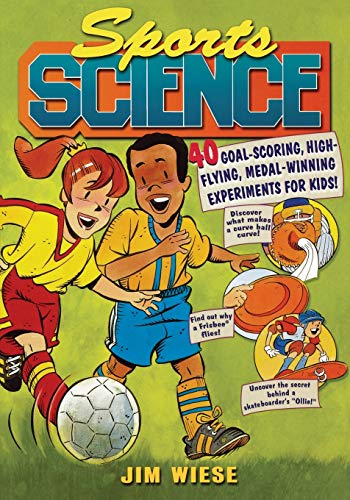
Dive headfirst into the science behind sports----and come up a winner!* Have you ever wondered if there's a secret to stopping a soccer ball, why ice skates have metal blades, or how a boat can sail into the wind? * Would you like to learn to balance like a gymnast, how to improve your free-throw ability, or how to swim like a shark? * Are you looking for exciting ideas for your next science fair project? If you answered "Yes" to any of these questions, then Sports Science is for you! From basketball to biking to snowboarding and more, you'll discover the science behind all your favorite sports. Dozens of fun-filled activities help you see for yourself how a batter can hit a 90-mile-an-hour pitch, why a "spiral" is the best way to throw a football, how the surface of a ball affects its bounce, and much, much more. All of the projects are safe and easy to do, and all you need is everyday stuff from around the house. So take the plunge and get ready for Sports Science fun!
Die Inhaltsangabe kann sich auf eine andere Ausgabe dieses Titels beziehen.
Über die Autorin bzw. den Autor
JIM WIESE is a science teacher and an educational consultant for nonprofit organizations. He is the author of the popular kids' science activity books Movie Science, Roller Coaster Science, Rocket Science, Detective Science, Cosmic Science, and many more, all from Wiley.
Von der hinteren Coverseite
Dive headfirst into the science behind sports and come up a winner!
- Have you ever wondered if there s a secret to stopping a soccer ball, why ice skates have metal blades, or how a boat can sail into the wind?
- Would you like to learn to balance like a gymnast, how to improve your free-throw ability, or how to swim like a shark?
- Are you looking for exciting ideas for your next science fair project?
If you answered "Yes" to any of these questions, then Sports Science is for you! From basketball to biking to snowboarding and more, you ll discover the science behind all your favorite sports. Dozens of fun-filled activities help you see for yourself how a batter can hit a 90-mile-an-hour pitch, why a "spiral" is the best way to throw a football, how the surface of a ball affects its bounce, and much, much more. All of the projects are safe and easy to do, and all you need is everyday stuff from around the house. So take the plunge and get ready for Sports Science fun!
Aus dem Klappentext
Dive headfirst into the science behind sports——and come up a winner!
- Have you ever wondered if there’s a secret to stopping a soccer ball, why ice skates have metal blades, or how a boat can sail into the wind?
- Would you like to learn to balance like a gymnast, how to improve your free-throw ability, or how to swim like a shark?
- Are you looking for exciting ideas for your next science fair project?
If you answered "Yes" to any of these questions, then Sports Science is for you! From basketball to biking to snowboarding and more, you’ll discover the science behind all your favorite sports. Dozens of fun-filled activities help you see for yourself how a batter can hit a 90-mile-an-hour pitch, why a "spiral" is the best way to throw a football, how the surface of a ball affects its bounce, and much, much more. All of the projects are safe and easy to do, and all you need is everyday stuff from around the house. So take the plunge and get ready for Sports Science fun!
Auszug. © Genehmigter Nachdruck. Alle Rechte vorbehalten.
Sports Science
40 Goal-Scoring, High-Flying, Medal-Winning Experiments for KidsBy Jim WieseJohn Wiley & Sons
ISBN: 0-471-44258-5Chapter One
Getting in the ZoneStarting Right
You may not realize it, but your muscles are not the most important part of your body when you are doing a sport. Believe it or not, the most important part is your brain! The brain is part of your nervous system. The nervous system consists of your brain, spinal cord, and nerves. Nerves are special cells that communicate by using electrochemical impulses. An electrochemical impulse uses chemicals to send an electrical signal. So, the nervous system is an elaborate communication system that collects information and sends messages throughout your body. Your brain alone contains more than 100 billion nerve cells.
Sensory nerves collect information about your environment. They then change this information into sensations such as hot, cold, touch, pressure, and pain. They send this information to your brain, which then decides how to react. Once your brain decides on the appropriate response, it sends messages to other nerves called motor nerves, which direct your muscles to move.
The activities in this section will help you investigate how your brain and nervous system help you perform better in sports.
Project 1 THINK FAST
In many sports you need to react very quickly to something. For example, you may have to return a tennis ball that is moving at 60 miles (100 km) an hour or more or swing a bat at a baseball moving just as fast. You barely have time between when you first see the ball moving toward you and when you have to hit it back. In that short time your brain has to tell your body to move, and your body has to react. How long does it take? And can you improve your reaction time? Try this activity to find out.
Materials
ruler helper
Procedure
1. Hold a ruler up vertically by the 12-inch (30-cm) end so that the 0-inch (0-cm) end is closest to the ground.
2. Have a helper stand facing you so that his thumb and index fingers of one hand are on either side of the bottom of the ruler. The thumb and index finger should be close to the ruler, but not touching it.
3. Drop the ruler at any time. With his hand held steady, your helper should try to catch the ruler as quickly as possible between his thumb and index finger.
4. Measure the distance the ruler fell before it was caught. Use the Reaction Time Table below to convert the distance the ruler falls into a time.
More Fun Stuff to Do
Try this several times. Does the distance the ruler falls before your helper catches it decrease with practice? Have several friends try the same activity. Do some people have faster reaction times than others?
Explanation
The ruler will fall a short distance and your helper will catch it between his thumb and index finger. The distance the ruler falls can be used to determine your helper's reaction time. Reaction time is the amount of time it takes for a message to travel from the brain to the muscles in the body and cause a movement.
When the ruler drops, the motor cortex of the brain sends an electrochemical message to the fingers. The motor cortex is the area of the brain responsible for creating and sending the messages that cause movement. The message travels along the thick bundles of nerve cells, the spinal cord, that are inside the bones of the spine. Then the message travels to the finger muscles through the smaller bundles of motor nerves that branch from the spinal cord. The finger muscles get the message and close, catching the ruler.
Sports Science in Action
A good pitcher in the major leagues can throw a ball at speeds of between 90 and 100 miles per hour (144 and 160 km/h). What does that mean to a batter? The ball will take about 0.46 to 0.41 seconds to travel from a pitcher's hand to the plate. If you figure it takes about 0.3 seconds to actually swing, the batter may have only 0.1 to 0.2 seconds to decide when and where to swing and get the message to the arm and hand muscles. It's truly amazing that the human body can perform at this speed.
Project 2 ON THE LEVEL
Your brain controls many functions in your body without your even having to think about them. For example, it keeps your lungs breathing in and out and makes your eyes blink. Your ability to balance or even just stand upright is also controlled by the brain. To learn more about how the brain does this, try this activity.
Materials
2-by-4-by-24-inch (5-by-10-by-60-cm) piece of wood (measurements do not have to be exact)
stopwatch or watch with a second hand
Procedure
1. Lay the board flat on the floor.
2. Step on the board with one foot near the middle of the board.
3. Lift your other foot off the ground and try to balance yourself on only one foot. Can you do it?
4. Continue to try to balance over a period of 5 minutes. Does your balance improve in that amount of time?
More Fun Stuff to Do
Get a longer piece of wood and lay it flat. Can you walk from one end of the board to the other without losing your balance and falling? Try practicing for several days. Do you get better at walking the length of the board?
Explanation
You should be able to learn to balance yourself on the board after several minutes.
Your sense of balance is controlled by parts of your inner ear. Small granules in two fluid-filled sacs detect which way is up and which way is down, and three fluid-filled semicircular canals detect motion.
At the bottom of the sacs are sensory cells that contain small hair fibers. When you stand up, gravity, a force that pulls all objects toward Earth, pulls down on the granules. The granules touch the hair fibers, which sends a message to the brain and tells it that you are upright.
For example, when you lose your balance and begin to fall to the right, gravity pulls the granules to the right. The hair fibers then send a message to the brain telling it that you are tilting to the right. The brain sends a message to the muscles in your neck and legs, trying to get your head and the rest of your body back in balance. With practice, you learn what kinds of little adjustments your body needs to make to balance. When you walk the length of a longer board you learn to balance by a similar process.
Sports Science in Action
Balance is very important in the sport of women's gymnastics. The balance beam is a piece of wood that is 4 inches (10 cm) wide, 5.5 feet (1.67 m) off the ground, and 16 feet (4.85 m) long. In addition to balancing on the beam and walking from one end to the other, gymnasts have to perform flips, spins, and other maneuvers on the beam without losing their balance throughout the entire routine! It's a remarkable skill that takes a keen sense of balance and many years of practice.
Project 3 DREAMING OF GREATNESS
You've been practicing shooting free throws for several days and still don't seem to get any better. Is there anything else you can do to improve your shooting ability? Try this activity to find out.
Materials
basketball pencil basketball hoop 2 helpers paper
Procedure
1. After warming up, you and your two helpers should each take 20 free throws at the basket. (If shooting from the free-throw line is too difficult, take your...
„Über diesen Titel“ kann sich auf eine andere Ausgabe dieses Titels beziehen.
Suchergebnisse für Sports Science: 40 Goal-Scoring, High-Flying, Medal-Winning...

Beispielbild für diese ISBN
Sports Science 40 GoalScoring
Anbieter: World of Books (was SecondSale), Montgomery, IL, USA
Verkäuferbewertung 5 von 5 Sternen

Zustand: Good. Item in good condition. Textbooks may not include supplemental items i.e. CDs, access codes etc. Artikel-Nr. 00053268053
Gebraucht kaufen
EUR 4,26
Versand gratis
Versand innerhalb von USA
Versand innerhalb von USA
Anzahl: 1 verfügbar
Beispielbild für diese ISBN
Sports Science: 40 Goal-Scoring, High-Flying, Medal-Winning Experiments for Kids
Anbieter: Wonder Book, Frederick, MD, USA
Verkäuferbewertung 5 von 5 Sternen
Zustand: Very Good. Very Good condition. A copy that may have a few cosmetic defects. May also contain light spine creasing or a few markings such as an owner's name, short gifter's inscription or light stamp. Artikel-Nr. Y02I-00728
Gebraucht kaufen
EUR 6,18
Versand gratis
Versand innerhalb von USA
Versand innerhalb von USA
Anzahl: 1 verfügbar
Beispielbild für diese ISBN
Sports Science : 40 Goal-Scoring, High-Flying, Medal-Winning Experiments for Kids
Verlag:
Wiley & Sons, Incorporated, John, 2002
ISBN 10: 0471442585
ISBN 13: 9780471442585
Gebraucht
Softcover
Erstausgabe
Anbieter: Better World Books, Mishawaka, IN, USA
Verkäuferbewertung 5 von 5 Sternen
Zustand: Good. 1st. Pages intact with minimal writing/highlighting. The binding may be loose and creased. Dust jackets/supplements are not included. Stock photo provided. Product includes identifying sticker. Better World Books: Buy Books. Do Good. Artikel-Nr. 6268822-6
Gebraucht kaufen
EUR 6,32
Versand gratis
Versand innerhalb von USA
Versand innerhalb von USA
Anzahl: 1 verfügbar
Beispielbild für diese ISBN
Sports Science : 40 Goal-Scoring, High-Flying, Medal-Winning Experiments for Kids
Verlag:
Wiley & Sons, Incorporated, John, 2002
ISBN 10: 0471442585
ISBN 13: 9780471442585
Gebraucht
Softcover
Erstausgabe
Anbieter: Better World Books, Mishawaka, IN, USA
Verkäuferbewertung 5 von 5 Sternen
Zustand: Good. 1st. Former library copy. Pages intact with minimal writing/highlighting. The binding may be loose and creased. Dust jackets/supplements are not included. Includes library markings. Stock photo provided. Product includes identifying sticker. Better World Books: Buy Books. Do Good. Artikel-Nr. GRP77510849
Gebraucht kaufen
EUR 6,32
Versand gratis
Versand innerhalb von USA
Versand innerhalb von USA
Anzahl: 2 verfügbar
Beispielbild für diese ISBN
Sports Science: 40 Goal-Scoring, High-Flying, Medal-Winning Experiments for Kids
Anbieter: ThriftBooks-Dallas, Dallas, TX, USA
Verkäuferbewertung 5 von 5 Sternen
Paperback. Zustand: Very Good. No Jacket. May have limited writing in cover pages. Pages are unmarked. ~ ThriftBooks: Read More, Spend Less. Artikel-Nr. G0471442585I4N00
Gebraucht kaufen
EUR 6,72
Versand gratis
Versand innerhalb von USA
Versand innerhalb von USA
Anzahl: 1 verfügbar
Beispielbild für diese ISBN
Sports Science: 40 Goal-Scoring, High-Flying, Medal-Winning Experiments for Kids!
Verlag:
John Wiley & Sons Inc, United States, New York, 2002
ISBN 10: 0471442585
ISBN 13: 9780471442585
Gebraucht
Paperback
Anbieter: WorldofBooks, Goring-By-Sea, WS, Vereinigtes Königreich
Verkäuferbewertung 5 von 5 Sternen
Paperback. Zustand: Very Good. Dive headfirst into the science behind sports----and come up a winner! * Have you ever wondered if there's a secret to stopping a soccer ball, why ice skates have metal blades, or how a boat can sail into the wind? * Would you like to learn to balance like a gymnast, how to improve your free-throw ability, or how to swim like a shark? * Are you looking for exciting ideas for your next science fair project? If you answered "Yes" to any of these questions, then Sports Science is for you! From basketball to biking to snowboarding and more, you'll discover the science behind all your favorite sports. Dozens of fun-filled activities help you see for yourself how a batter can hit a 90-mile-an-hour pitch, why a "spiral" is the best way to throw a football, how the surface of a ball affects its bounce, and much, much more. All of the projects are safe and easy to do, and all you need is everyday stuff from around the house. So take the plunge and get ready for Sports Science fun! The book has been read, but is in excellent condition. Pages are intact and not marred by notes or highlighting. The spine remains undamaged. Artikel-Nr. GOR007825063
Gebraucht kaufen
EUR 3,85
EUR 6,53 Versand
Versand von Vereinigtes Königreich nach USA
Versand von Vereinigtes Königreich nach USA
Anzahl: 3 verfügbar
Beispielbild für diese ISBN
Sports Science : 40 Goal-Scoring, High-Flying, Medal-Winning Experiments for Kids
Verlag:
Wiley & Sons, Incorporated, John, 2002
ISBN 10: 0471442585
ISBN 13: 9780471442585
Gebraucht
Softcover
Erstausgabe
Anbieter: Better World Books Ltd, Dunfermline, Vereinigtes Königreich
Verkäuferbewertung 5 von 5 Sternen
Zustand: Very Good. 1st. Pages intact with possible writing/highlighting. Binding strong with minor wear. Dust jackets/supplements may not be included. Stock photo provided. Product includes identifying sticker. Better World Books: Buy Books. Do Good. Artikel-Nr. 4861477-20
Gebraucht kaufen
EUR 5,61
EUR 5,83 Versand
Versand von Vereinigtes Königreich nach USA
Versand von Vereinigtes Königreich nach USA
Anzahl: 1 verfügbar
Beispielbild für diese ISBN
Sports Science
Anbieter: Majestic Books, Hounslow, Vereinigtes Königreich
Verkäuferbewertung 4 von 5 Sternen

Zustand: New. pp. vi + 122 Illus. Artikel-Nr. 7477961
Neu kaufen
EUR 15,97
EUR 7,58 Versand
Versand von Vereinigtes Königreich nach USA
Versand von Vereinigtes Königreich nach USA
Anzahl: 3 verfügbar
Beispielbild für diese ISBN
Sports Science 40 GoalScoring, HighFlying, MedalWinning Experiments for Kids
Anbieter: Revaluation Books, Exeter, Vereinigtes Königreich
Verkäuferbewertung 5 von 5 Sternen
Paperback. Zustand: Brand New. 1st edition. 128 pages. 10.00x7.00x0.50 inches. In Stock. Artikel-Nr. x-0471442585
Neu kaufen
EUR 17,05
EUR 11,67 Versand
Versand von Vereinigtes Königreich nach USA
Versand von Vereinigtes Königreich nach USA
Anzahl: 2 verfügbar
Beispielbild für diese ISBN
Sports Science: 40 Goal-Scoring, High-Flying, Medal-Winning Experiments for Kids
Anbieter: Ria Christie Collections, Uxbridge, Vereinigtes Königreich
Verkäuferbewertung 5 von 5 Sternen
Zustand: New. In. Artikel-Nr. ria9780471442585_new
Neu kaufen
EUR 17,07
EUR 13,98 Versand
Versand von Vereinigtes Königreich nach USA
Versand von Vereinigtes Königreich nach USA
Anzahl: Mehr als 20 verfügbar