
Verwandte Artikel zu The Value Reporting Revolution: Moving Beyond the Earnings...
Inhaltsangabe
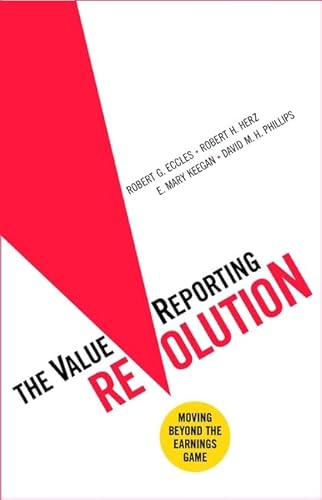
The Value Reporting Revolution is a rallying cry for radical improvements in corporate reporting-a call to be heeded not just by executives who report on corporate performance and the investors who listen to what they say but also by governing boards, accounting firms, securities analysts, and regulators worldwide. This revolution is about information. To make sound, long-term investment decisions, large institutional investors and astute individuals alike want to know more about what companies actually do to create value. They especially need information about market dynamics, corporate strategy, and nonfinancial value drivers that are leading indicators of a company's future financial performance and stock price.Yet too many companies today find themselves locked in "The Earnings Game". It's a never-ending and highly dysfunctional game focused myopically on short-term earnings, which in reality say very little about future stock price performance. The consequences of the game? Excessive stock price volatility, inaccurate valuations, and over-reliance on market gossip. Nothing short of a Value Reporting Revolution will end this game and rid the markets of the crippling consequences. This book delivers a trenchant and often biting analysis of the severe problems that plague today's capital markets. More important, it articulates an array of practical, though controversial, solutions. "Value Reporting" calls on corporate executives to provide more, rather than less, of the kind of information they use to create value. It exhorts investors to demand that companies do this. It urges boards of directors to make sure it gets done. And it puts accounting firms and securities analysts on notice that they must become part of the solution rather than part of the problem. Often provocative and never hesitant to tell it like it is, "The Value Reporting Revolution" speaks with authority and clarity. It sounds its compelling call to arms to anyone with an interest in dramatically improving the markets on which so many depend.
Die Inhaltsangabe kann sich auf eine andere Ausgabe dieses Titels beziehen.
Über die Autorin bzw. den Autor
ROBERT G. ECCELES Dr. Eccles is a founder and President of Advisory Capital Partners, Inc. and a Senior Fellow of PricewaterhouseCoopers. He was a tenured professor at the Harvard Business School, where he served on the faculty for 14 years. While there, one of his major research interests was performance measurement and reporting. Dr. Eccles received his undergraduate degrees from the Massachusetts Institute of Technology and his Ph.D. from Harvard University. ROBERT H. HERZ A partner with PricewaterhouseCoopers, Robert Herz is the firm's North America Leader of Professional, Technical, Risk, and Quality. His professional service includes positions on the FASB's Emerging Issues and Financial Instruments Task Forces, the Financial Accounting Standards Committee of the American Accounting Association, and chair of the SEC Regulations Committee of the AICPA. He is a U.S. Certified Public Accountant and a U.K. Chartered Accountant. E. MARY KEEGAN Mary Keegan coauthored this book as Head of the Global Corporate Reporting Group of PricewaterhouseCoopers, where she specialized in international corporate governance and reporting. She has also served as Vice President of the Federation des Experts Comptables Europeens and as a member of the IASC's Standing Interpretations Committee. She is now the Chairman of the U.K. Accounting Standards Board. DAVID M. H. PHILLIPS David Phillips is a partner with PricewaterhouseCoopers in the Assurance/Business Advisory Services practice in the United Kingdom and serves as the European Leader of ValueReporting. He is a graduate of Nottingham University, where he read Industrial Economics, and is a U.K. CharteredAccountant.
Aus dem Klappentext
The ValueReportingTM Revolution: Moving Beyond the Earnings Game
The ValueReporting Revolution is a rallying cry for radical improvements in corporate reporting-a call to be heeded not just by executives who report on corporate performance and the investors who listen to what they say but also by governing boards, accounting firms, securities analysts, and regulators worldwide.
This revolution is about information. To make sound, long-term investment decisions, large institutional investors and astute individuals alike want to know more about what companies actually do to create value. They especially need information about market dynamics, corporate strategy, and nonfinancial value drivers that are leading indicators of a company's future financial performance and stock price.
Yet too many companies today find themselves locked in The Earnings Game. It's a never-ending and highly dysfunctional game focused myopically on short-term earnings, which in reality say very little about future stock price performance. The consequences of the game? Excessive stock price volatility, inaccurate valuations, and over-reliance on market gossip.
Nothing short of a ValueReporting Revolution will end this game and rid the markets of the crippling consequences. This book delivers a trenchant and often biting analysis of the severe problems that plague today's capital markets. More important, it articulates an array of practical, though controversial, solutions.
ValueReporting calls on corporate executives to provide more, rather than less, of the kind of information they use to create value. It exhorts investors to demand that companies do this. It urges boards of directors to make sure it gets done. And it puts accounting firms and securities analysts on notice that they must become part of the solution rather than part of the problem.
Often provocative and never hesitant to tell it like it is, The ValueReporting Revolution speaks with authority and clarity. It sounds its compelling call to arms to anyone with an interest in dramatically improving the markets on which so many depend.s
Auszug. © Genehmigter Nachdruck. Alle Rechte vorbehalten.
This book sends a wake-up call--to executives, securities analysts, market regulators, investors, and, not least of all, to accountants: The world of external corporate reporting is ripe for a revolution. And all have a vital interest in making it happen.
When I joined the accounting profession 20 years ago, stock ownership in my country, the United States, was largely limited to a small fraction of upper-income households. At that time, those with the resources to do so typically made investment decisions after scrutinizing a company's quarterly and annual corporate reports, consulting with a broker, and perhaps trotting off to the local library to do a bit of research on their own. Once they acquired stock in a company, they usually held it for years--even decades. In most other developed countries, all but the most affluent had about as much exposure to equity investing as they did to quantum physics.
Things have changed. For better and for worse, the common man and woman have evolved into Homo investus. In the United States, more than half of the adult population now owns stock, directly or indirectly through pension and mutual funds. In the United Kingdom, the number is 25 percent, and in Europe it's more than 12 percent and growing rapidly.
In many developed countries, stock market capitalization--the market value of all listed companies--now rivals or exceeds the size of the domestic economy. Initial public offerings (IPOs) and market gyrations are the stuff of everyday conversations. Electronic chat rooms ply us with investment advice. Stock alert pagers keep us constantly in touch. And after-hours trading keeps us buying and selling into the night.
It's not just investor behavior that has changed; the ways in which businesses compete and create value have changed, too. These days, many companies measure their worth in "clicks" rather than "bricks," while others possess assets--like an outstanding work force, a commanding market share, or instant brand recognition--that provide value far in excess of their tangible assets. Certainly, the market recognizes these "soft" assets and, to widely varying degrees of accuracy, factors them into projections of cash flow and then prices shares accordingly.
Technology--most spectacularly evidenced by the Internet--has changed the investment world, too. Today, information travels unconstrained by time and distance. With a click of a mouse, investors can have immediate delivery of a mind-boggling array of investment data and advice. All too often, it's the sort that's worth exactly what they pay for it--next to nothing.
But the kinds of information that companies regularly report, and that firms like mine audit and assure, simply do not serve today's investors well. While technologies are emerging to support assured, data-rich, online, real-time corporate reporting, it's fair to state that the accounting profession has yet to deliver on the promise of the Information Age.
Likewise, despite great strides in the development of internal performance measurement systems, the kinds of information that business executives report to the market--and the means by which they do so--have changed hardly at all in the past 100 years.
Let's face it: When it comes to corporate reporting, our mental models have not kept pace with change. Certainly, traditional financial statements, designed to the requirements of an industrialized age, have lagged far behind the evolution of our knowledge-and-network economy. They do not speak to the interests of stakeholders beyond the finite circle of a company's shareholders. An historical reporting perspective alone seems totally inappropriate to a world living on Internet time.
Nevertheless, once standards, regulations, and mental models are set, they become very hard to alter. The fear of harming our respective national reporting systems--which up to this point have worked pretty well--has held many of us back from trying something new.
Nature abhors a vacuum, in this case an information vacuum. To fill it, in have stepped analysts and advisors of every stripe. Good, bad, or indifferent, most don't understand how to test and validate their opinions, and they seldom expect to be held accountable for their judgments. The worst of them go so far as to try to manipulate markets.
While I don't believe in a divine right to existence for accounting firms, I do believe that firms like mine are distinguished by their responsibility to further the public's vital interest in having someone ensure that objective and relevant corporate information is made available. If the information needs of investors aren't being served, it's time to set things right. As a start, I think all can agree that too little of the information that really matters finds its way to the marketplace.
Clearly, we need a more expansive, flexible approach to corporate reporting and auditing. One that acknowledges that the world has grown more complex and demanding. One that recognizes that in today's world, aggregative, reductive methods alone do not impart a solid understanding of value, opportunity, and risk.
A new approach must be forged through creative discussion and intense debate among all parties involved, worldwide. Doing that will require leadership. I contend that no organization is better qualified to lead on these matters than mine.
So, consider this book an opening shot across the bow. Not everyone will agree with the views expressed herein. Indeed, some may feel discomfort or even anger at what they read here. This book will certainly raise tough questions for members of the accounting profession and for my own firm. But if it succeeds in stirring further thought and action, it will have served a good purpose.
To the authors--Bob Eccles, Bob Herz, Mary Keegan, and David Phillips--I offer my personal appreciation for their unwavering enthusiasm for spreading the gospel of quality, relevancy, and transparency and for fanning the flames of the ValueReporting Revolution...
J. Frank Brown Global Leader, Assurance and Business Advisory Services PricewaterhouseCoopers
„Über diesen Titel“ kann sich auf eine andere Ausgabe dieses Titels beziehen.
Suchergebnisse für The Value Reporting Revolution: Moving Beyond the Earnings...

Beispielbild für diese ISBN
The ValueReporting Revolution: Moving Beyond the Earnings Game
Anbieter: Wonder Book, Frederick, MD, USA
Verkäuferbewertung 5 von 5 Sternen

Zustand: Very Good. Very Good condition. Very Good dust jacket. A copy that may have a few cosmetic defects. May also contain a few markings such as an owner's name, short gifter's inscription or light stamp. Artikel-Nr. L07A-02310
Gebraucht kaufen
EUR 5,77
Versand gratis
Versand innerhalb von USA
Versand innerhalb von USA
Anzahl: 1 verfügbar
Beispielbild für diese ISBN
The ValueReporting Revolution: Moving Beyond the Earnings Game
Anbieter: Wonder Book, Frederick, MD, USA
Verkäuferbewertung 5 von 5 Sternen
Zustand: Very Good. Very Good condition. Good dust jacket. A copy that may have a few cosmetic defects. May also contain light spine creasing or a few markings such as an owner's name, short gifter's inscription or light stamp. Artikel-Nr. U13M-00269
Gebraucht kaufen
EUR 6,43
Versand gratis
Versand innerhalb von USA
Versand innerhalb von USA
Anzahl: 1 verfügbar
Beispielbild für diese ISBN
The ValueReporting Revolution: Moving Beyond the Earnings Game
Anbieter: ThriftBooks-Dallas, Dallas, TX, USA
Verkäuferbewertung 5 von 5 Sternen
Hardcover. Zustand: Very Good. No Jacket. Missing dust jacket; May have limited writing in cover pages. Pages are unmarked. ~ ThriftBooks: Read More, Spend Less. Artikel-Nr. G0471398799I4N01
Gebraucht kaufen
EUR 7,32
Versand gratis
Versand innerhalb von USA
Versand innerhalb von USA
Anzahl: 1 verfügbar
Beispielbild für diese ISBN
The ValueReporting Revolution: Moving Beyond the Earnings Game
Anbieter: Books From California, Simi Valley, CA, USA
Verkäuferbewertung 4 von 5 Sternen

Hardcover. Zustand: Good. Zustand des Schutzumschlags: Includes dust jacket. Dust jacket shows minor shelf wear and light creasing. Pages are clean, text and pictures are intact and unmarred. Artikel-Nr. mon0003667440
Gebraucht kaufen
EUR 4,17
EUR 4,45 Versand
Versand innerhalb von USA
Versand innerhalb von USA
Anzahl: 1 verfügbar
Beispielbild für diese ISBN
The Value Reporting Revolution: Moving Beyond the Earnings Game
Anbieter: AwesomeBooks, Wallingford, Vereinigtes Königreich
Verkäuferbewertung 5 von 5 Sternen
Hardcover. Zustand: Very Good. The Value Reporting Revolution: Moving Beyond the Earnings Game This book is in very good condition and will be shipped within 24 hours of ordering. The cover may have some limited signs of wear but the pages are clean, intact and the spine remains undamaged. This book has clearly been well maintained and looked after thus far. Money back guarantee if you are not satisfied. See all our books here, order more than 1 book and get discounted shipping. Artikel-Nr. 7719-9780471398790
Gebraucht kaufen
EUR 4,30
EUR 4,87 Versand
Versand von Vereinigtes Königreich nach USA
Versand von Vereinigtes Königreich nach USA
Anzahl: 2 verfügbar
Beispielbild für diese ISBN
The ValueReporting Revolution : Moving Beyond the Earnings Game
Verlag:
Wiley & Sons, Incorporated, John, 2001
ISBN 10: 0471398799
ISBN 13: 9780471398790
Gebraucht
Hardcover
Erstausgabe
Anbieter: Better World Books Ltd, Dunfermline, Vereinigtes Königreich
Verkäuferbewertung 5 von 5 Sternen
Zustand: Very Good. 1st Edition. Former library copy. Pages intact with possible writing/highlighting. Binding strong with minor wear. Dust jackets/supplements may not be included. Includes library markings. Stock photo provided. Product includes identifying sticker. Better World Books: Buy Books. Do Good. Artikel-Nr. GRP21254588
Gebraucht kaufen
EUR 5,72
EUR 5,91 Versand
Versand von Vereinigtes Königreich nach USA
Versand von Vereinigtes Königreich nach USA
Anzahl: 2 verfügbar
Beispielbild für diese ISBN
The Value Reporting Revolution: Moving Beyond the Earnings Game
Anbieter: Bahamut Media, Reading, Vereinigtes Königreich
Verkäuferbewertung 4 von 5 Sternen
Hardcover. Zustand: Very Good. This book is in very good condition and will be shipped within 24 hours of ordering. The cover may have some limited signs of wear but the pages are clean, intact and the spine remains undamaged. This book has clearly been well maintained and looked after thus far. Money back guarantee if you are not satisfied. See all our books here, order more than 1 book and get discounted shipping. Artikel-Nr. 6545-9780471398790
Gebraucht kaufen
EUR 5,65
EUR 8,25 Versand
Versand von Vereinigtes Königreich nach USA
Versand von Vereinigtes Königreich nach USA
Anzahl: 2 verfügbar
Beispielbild für diese ISBN
The Value Reporting Revolution: Moving Beyond the Earnings Game
Anbieter: medimops, Berlin, Deutschland
Verkäuferbewertung 5 von 5 Sternen
Zustand: good. Befriedigend/Good: Durchschnittlich erhaltenes Buch bzw. Schutzumschlag mit Gebrauchsspuren, aber vollständigen Seiten. / Describes the average WORN book or dust jacket that has all the pages present. Artikel-Nr. M00471398799-G
Gebraucht kaufen
EUR 4,37
EUR 10,00 Versand
Versand von Deutschland nach USA
Versand von Deutschland nach USA
Anzahl: 1 verfügbar
Beispielbild für diese ISBN
The ValueReporting Revolution: Moving Beyond the Earnings Game
Anbieter: WorldofBooks, Goring-By-Sea, WS, Vereinigtes Königreich
Verkäuferbewertung 5 von 5 Sternen
Hardback. Zustand: Very Good. The book has been read, but is in excellent condition. Pages are intact and not marred by notes or highlighting. The spine remains undamaged. Artikel-Nr. GOR001911591
Gebraucht kaufen
EUR 8,29
EUR 6,62 Versand
Versand von Vereinigtes Königreich nach USA
Versand von Vereinigtes Königreich nach USA
Anzahl: 2 verfügbar
Beispielbild für diese ISBN
The Valuereporting Revolution: Moving Beyond the Earnings Game
Anbieter: Anybook.com, Lincoln, Vereinigtes Königreich
Verkäuferbewertung 5 von 5 Sternen
Zustand: Fair. This is an ex-library book and may have the usual library/used-book markings inside.This book has hardback covers. In fair condition, suitable as a study copy. No dust jacket. Please note the Image in this listing is a stock photo and may not match the covers of the actual item,750grams, ISBN:0471398799. Artikel-Nr. 8619765
Gebraucht kaufen
EUR 3,05
EUR 15,41 Versand
Versand von Vereinigtes Königreich nach USA
Versand von Vereinigtes Königreich nach USA
Anzahl: 1 verfügbar