
Verwandte Artikel zu Value Investing: A Balanced Approach (Frontiers in...
Inhaltsangabe
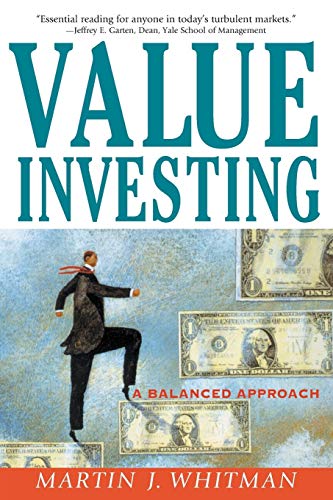
Provides a modern analytical framework for assessing a company's true value
Written by a true value investor known for his ability to buy undervalued companies and re-sell them at a substantial profit, Value Investing provides an analytical framework that evaluates the impact of real events-including restructuring, regulations, mergers and acquisitions, and other important factors-on a company's value.
Well-known for his success with distressed corporations and value investing, author Martin Whitman wages a controversial attack on the modern financial practice of focusing on price movements and short-term trading. In Value Investing, Whitman identifies fundamental factors affecting the value of companies and entire markets from the ground up and takes value investing one step further by demonstrating how industry movement and public policy decisions can lead to greater returns. He also highlights the shortcomings of all the popularly applied analytical techniques.
Die Inhaltsangabe kann sich auf eine andere Ausgabe dieses Titels beziehen.
Über die Autorin bzw. den Autor
MARTIN J. WHITMAN, CFA, is Chairman, CEO, and portfolio manager of the successful Third Avenue Value Fund and the Third Avenue Small Cap Value Fund. A leader in value investing, he is a Management Fellow at the Yale University School of Management.
Von der hinteren Coverseite
"Essential reading for anyone in today's turbulent markets."
Jeffrey E. Garten, Dean, Yale School of Management
Praise for MARTIN J. WHITMAN and
VALUE INVESTING
"An excellent book on investments. But, more importantly, this volume is a primer explaining to Main Street, especially Main Street businesspeople, how Wall Street really operates."
Eugene M. Isenberg, Chairman of the Board, Nabors Industries, Inc.
"A must read for all thoughtful investors interested in a rational, disciplined, risk-averse template for successful long-term compounding."
O. Mason Hawkins, CFA, Chairman and CEO, Southeastern Asset Management, Inc. and The Longleaf Partners Funds
"This author knows whereof he speaks. His many years of extremely successful experience as a professional manager of investments, his academic training, and his period of teaching at a major university all make their mark on this illuminating volume. It reveals how a bright, analytically minded person with extensive practical experience studies and evaluates investments."
William J. Baumol, Professor and Director, C.V. Starr Center, NYU Professor Emeritus, Princeton University
"This book by an experienced and practicing master, Martin Whitman, is a treasure and a reference book on how to think and feel like an owner of a business without the headache of running it day to day."
Papkens Der Torossian, Chairman and CEO, Silicon Valley Group, Inc.
"Marty Whitman is renowned for his uncanny instincts and insights in picking bargains in stocks and bonds. His book is a real bargain. To benefit from decades of Marty's experience is invaluable and to have such a commonsense and realistic approach is an extra dividend."
Milton Cooper, Chairman, Kimco Realty Corporation
Aus dem Klappentext
"Essential reading for anyone in today's turbulent markets."
—Jeffrey E. Garten, Dean, Yale School of Management
Praise for MARTIN J. WHITMAN and
VALUE INVESTING
"An excellent book on investments. But, more importantly, this volume is a primer explaining to Main Street, especially Main Street businesspeople, how Wall Street really operates."
—Eugene M. Isenberg, Chairman of the Board, Nabors Industries, Inc.
"A must read for all thoughtful investors interested in a rational, disciplined, risk-averse template for successful long-term compounding."
—O. Mason Hawkins, CFA, Chairman and CEO, Southeastern Asset Management, Inc. and The Longleaf Partners Funds
"This author knows whereof he speaks. His many years of extremely successful experience as a professional manager of investments, his academic training, and his period of teaching at a major university all make their mark on this illuminating volume. It reveals how a bright, analytically minded person with extensive practical experience studies and evaluates investments."
—William J. Baumol, Professor and Director, C.V. Starr Center, NYU Professor Emeritus, Princeton University
"This book by an experienced and practicing master, Martin Whitman, is a treasure and a reference book on how to think and feel like an owner of a business without the headache of running it day to day."
—Papkens Der Torossian, Chairman and CEO, Silicon Valley Group, Inc.
"Marty Whitman is renowned for his uncanny instincts and insights in picking bargains in stocks and bonds. His book is a real bargain. To benefit from decades of Marty's experience is invaluable and to have such a commonsense and realistic approach is an extra dividend."
—Milton Cooper, Chairman, Kimco Realty Corporation
Auszug. © Genehmigter Nachdruck. Alle Rechte vorbehalten.
Chapter 1: What Is Value Investing?
"The difficulty lies not in the new ideas but in escaping from the old ones which ramify, for those who have been brought up as most of us have been, into every corner of our minds."
--J. M. Keynes
Value investing is different from other kinds of investing. It is wholly unrelated to technical and chartist analyses. The underlying approaches to and goals of value investing differ quite materially from those used in academic finance under the rubrics of the efficient market hypothesis (EMH) and efficient portfolio theory (EPT), from those that are part of fundamental analysis as described in the various editions of Security Analysis by Benjamin Graham, David Dodd, and Sidney Cottle, popularly known as Graham and Dodd, and from those that seem to be the lifeblood of security analysis as practiced by conventional money managers and by research analysts employed by brokers/dealers. These fundamental differences are based on seven characteristics:
Value investing uses a balanced approach to analysis so that there is no a priori primacy given to any one factor in an appraisal.
In accounting terms, value investing treats every accounting number as being as important as any other number, with each number being derived from, a function of, and modified by all other accounting numbers. Businesses are examined as integrated wholes. The quality and quantity of resources existing in a business and the long-term wealth-creation potentials of a business are each consequential factors in value investing, and each factor is related integrally to the other. If future wealth creation, in the forms of increased operating profits, increased cash flows, or enhanced underlying takeover values, cannot be created out of the present existence of high-quality assets and high-quantity assets, then either those assets never existed in the first place or what assets did exist were mismanaged. If future earnings or cash flows do not create wealth (i.e., resources for the company, its shareholders, or both), then those earnings were fictitious to begin with.
In contrast to value investing's three-pronged approach, the approaches used by academic finance, Graham and Dodd, and conventional money managers give primacy to forecasting future flows, whether those flows are cash flows, reported earnings, adjusted earnings, or all three in valuation. Other accounting figures, especially balance sheet data, are correspondingly downweighted as increased significance is placed on estimated future flows.
In value investing, the essential goal is to value a business or the workout potential for credits issued by troubled companies.
In the other disciplines, the goal is to forecast the prices at which a security will sell in markets populated by outside passive minority investors (OPMIs). Business value may be one factor to consider in forecasting market prices for securities, but it is rarely, if ever, the sole factor and is frequently an unimportant factor. In value investing, equity holdings are viewed as permanent or semipermanent commitments, subject only to a risk arbitrage exception.
The risk arbitrage exception exists when there are relatively determinant workouts in relatively determinant periods of time, such as when there has been a publicly announced merger transaction. In the other disciplines, equity investments are viewed as trading vehicles because of the importance placed on near-term price performance in markets. In value investing, macrofactors such as the level of stock averages (e.g., the Dow-Jones Industrials), forecasts of interest rates, or the gross domestic product (GDP) are ignored.
The emphasis is strictly on microfactors that specifically will affect a company over the long term. In the other disciplines, the first factors to be considered usually are macrofactors. In value investing, as part of a balanced approach, businesses are viewed as both going concerns and as resource converters, deploying and redeploying their asset bases and liabilities into new areas including mergers and acquisitions, changes in control, massive refinancings, initial public offerings (IPOs), and leveraged buyouts (LBOs).
The tendency in other disciplines is to view companies as strict going concerns engaged wholly in day-to-day operations in specific industries financed as they have typically been financed and managed as they typically have been managed. In value investing, corporate analysis is viewed as something separate and distinct from market analysis.
In other disciplines, corporate analysis and market analysis are almost always integrated with each other. In value investing, a price decline for a security in the absence of any corporate permanent impairment of capital is viewed as a temporary phenomenon. In the other disciplines, a price decline is viewed as a loss of value. In value investing, the analyst is extremely price conscious in making judgments about the attractiveness of a security.
In other disciplines, the strong tendency is to be outlook conscious rather than price conscious. Conventional asset allocators make investments on the basis of views about general or specific outlooks. In value investing, asset allocations are driven by price as related to the three factors inherent in a company: quality of resources, quantity of resources, and long-term wealth-creation potential.
The tools of value investing seem commonplace and important throughout the industrialized world, used not only by deal makers in the financial community but also by most private businesses for the analysis and financing of enterprises; yet those tools are largely ignored or deemed unimportant when OPMIs invest in publicly traded common stocks. Virtually all investment literature-whether written about trading systems, written in an academic context, or written as fundamental analysis as propounded by Graham and Dodd and their followers-is directed toward OPMIs. It seems as if virtually all business television shows and newspaper articles are directed toward a special kind of OPMI-"the average investor." On Wall Street, value investing seems very much to be a minority approach restricted to investors trafficking in corporate control; but on Main Street, where most businesses are privately owned, it appears to be the majority approach...
„Über diesen Titel“ kann sich auf eine andere Ausgabe dieses Titels beziehen.
Suchergebnisse für Value Investing: A Balanced Approach (Frontiers in...

Beispielbild für diese ISBN
Value Investing: A Balanced Approach
Anbieter: World of Books (was SecondSale), Montgomery, IL, USA
Verkäuferbewertung 5 von 5 Sternen

Paperback. Zustand: Good. Die hier vorgestellte Methode des 'Value Investing' (Investitionsentscheidungen nach der Wertanalyse) lost die traditionelle Praxis ubertriebener Preisbeobachtungen ab. Die moderne Unternehmensbewertung wird von einem echten Value-Investor vorgestellt, der bekannt ist fur seine Treffsicherheit beim Kauf von unterbewerteten Unternehmen, die er spater wieder mit betrachtlichem Gewinn verkauft. Value Investing zeigt Ihnen, wie Sie von der Informationsvielfalt profitieren, z.B. von Fusionen und Akquisitionen und Unternehmens- oder offentlichen Finanzierungen. Whitman definiert die grundlegenden Faktoren, die den Unternehmenswert und ganze Markte beeinflussen konnen und befurwortet die Abkehr von der herkommlichen Analyse der Preisbewegungen und kurzfristigen Handelszielen. Artikel-Nr. 00100219064
Gebraucht kaufen
EUR 4,35
Versand gratis
Versand innerhalb von USA
Versand innerhalb von USA
Anzahl: 2 verfügbar
Beispielbild für diese ISBN
Value Investing: A Balanced Approach (Frontiers in Finance Series)
Anbieter: BooksRun, Philadelphia, PA, USA
Verkäuferbewertung 5 von 5 Sternen
Paperback. Zustand: Very Good. 1. It's a well-cared-for item that has seen limited use. The item may show minor signs of wear. All the text is legible, with all pages included. It may have slight markings and/or highlighting. Artikel-Nr. 0471398101-11-22
Gebraucht kaufen
EUR 5,06
Versand gratis
Versand innerhalb von USA
Versand innerhalb von USA
Anzahl: 1 verfügbar
Beispielbild für diese ISBN
Value Investing P
Anbieter: ThriftBooks-Reno, Reno, NV, USA
Verkäuferbewertung 5 von 5 Sternen
Paperback. Zustand: Very Good. No Jacket. May have limited writing in cover pages. Pages are unmarked. ~ ThriftBooks: Read More, Spend Less. Artikel-Nr. G0471398101I4N00
Gebraucht kaufen
EUR 6,16
Versand gratis
Versand innerhalb von USA
Versand innerhalb von USA
Anzahl: 1 verfügbar
Beispielbild für diese ISBN
Value Investing P
Anbieter: ThriftBooks-Dallas, Dallas, TX, USA
Verkäuferbewertung 5 von 5 Sternen
Paperback. Zustand: Very Good. No Jacket. May have limited writing in cover pages. Pages are unmarked. ~ ThriftBooks: Read More, Spend Less. Artikel-Nr. G0471398101I4N00
Gebraucht kaufen
EUR 6,16
Versand gratis
Versand innerhalb von USA
Versand innerhalb von USA
Anzahl: 1 verfügbar
Beispielbild für diese ISBN
Value Investing : A Balanced Approach
Verlag:
Wiley & Sons, Incorporated, John, 2000
ISBN 10: 0471398101
ISBN 13: 9780471398103
Gebraucht
Softcover
Anbieter: Better World Books: West, Reno, NV, USA
Verkäuferbewertung 5 von 5 Sternen
Zustand: Very Good. Former library copy. Pages intact with possible writing/highlighting. Binding strong with minor wear. Dust jackets/supplements may not be included. Includes library markings. Stock photo provided. Product includes identifying sticker. Better World Books: Buy Books. Do Good. Artikel-Nr. 5826701-6
Gebraucht kaufen
EUR 6,16
Versand gratis
Versand innerhalb von USA
Versand innerhalb von USA
Anzahl: 1 verfügbar
Beispielbild für diese ISBN
Value Investing : A Balanced Approach
Verlag:
Wiley & Sons, Incorporated, John, 2000
ISBN 10: 0471398101
ISBN 13: 9780471398103
Gebraucht
Softcover
Anbieter: Better World Books, Mishawaka, IN, USA
Verkäuferbewertung 5 von 5 Sternen
Zustand: Good. Pages intact with minimal writing/highlighting. The binding may be loose and creased. Dust jackets/supplements are not included. Stock photo provided. Product includes identifying sticker. Better World Books: Buy Books. Do Good. Artikel-Nr. 6222561-6
Gebraucht kaufen
EUR 6,16
Versand gratis
Versand innerhalb von USA
Versand innerhalb von USA
Anzahl: 2 verfügbar
Beispielbild für diese ISBN
Value Investing : A Balanced Approach
Verlag:
Wiley & Sons, Incorporated, John, 2000
ISBN 10: 0471398101
ISBN 13: 9780471398103
Gebraucht
Softcover
Anbieter: Better World Books, Mishawaka, IN, USA
Verkäuferbewertung 5 von 5 Sternen
Zustand: Fine. Used book that is in almost brand-new condition. May contain a remainder mark. Better World Books: Buy Books. Do Good. Artikel-Nr. 15628355-6
Gebraucht kaufen
EUR 6,16
Versand gratis
Versand innerhalb von USA
Versand innerhalb von USA
Anzahl: 1 verfügbar
Beispielbild für diese ISBN
Value Investing P
Anbieter: ThriftBooks-Atlanta, AUSTELL, GA, USA
Verkäuferbewertung 5 von 5 Sternen
Paperback. Zustand: Good. No Jacket. Former library book; Pages can have notes/highlighting. Spine may show signs of wear. ~ ThriftBooks: Read More, Spend Less. Artikel-Nr. G0471398101I3N10
Gebraucht kaufen
EUR 6,16
Versand gratis
Versand innerhalb von USA
Versand innerhalb von USA
Anzahl: 1 verfügbar
Beispielbild für diese ISBN
Value Investing P
Anbieter: ThriftBooks-Dallas, Dallas, TX, USA
Verkäuferbewertung 5 von 5 Sternen
Paperback. Zustand: Good. No Jacket. Pages can have notes/highlighting. Spine may show signs of wear. ~ ThriftBooks: Read More, Spend Less. Artikel-Nr. G0471398101I3N00
Gebraucht kaufen
EUR 6,16
Versand gratis
Versand innerhalb von USA
Versand innerhalb von USA
Anzahl: 1 verfügbar
Beispielbild für diese ISBN
Value Investing P
Anbieter: ThriftBooks-Atlanta, AUSTELL, GA, USA
Verkäuferbewertung 5 von 5 Sternen
Paperback. Zustand: Very Good. No Jacket. May have limited writing in cover pages. Pages are unmarked. ~ ThriftBooks: Read More, Spend Less. Artikel-Nr. G0471398101I4N00
Gebraucht kaufen
EUR 6,16
Versand gratis
Versand innerhalb von USA
Versand innerhalb von USA
Anzahl: 1 verfügbar