
Verwandte Artikel zu The Warren Buffett Portfolio: Mastering the Power of...
Inhaltsangabe
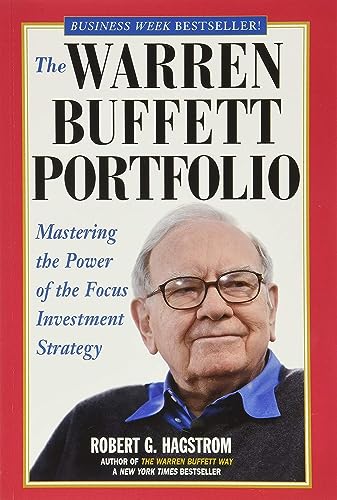
The Warren Buffett Way provided the first look into the strategies that the master uses to pick stocks. A New York Times bestseller, it is a valuable and practical primer on the principles behind the remarkable investment run of the famed oracle of Omaha. In this much-awaited companion to that book, author Robert Hagstrom takes the next logical step, revealing how to profitably manage stocks once you select them. THE WARREN BUFFETT PORTFOLIO will help you through the process of building a superior portfolio and managing the stocks going forward.
Building a concentrated portfolio is critical for investment success. THE WARREN BUFFETT PORTFOLIO introduces the next wave of investment strategy, called focus investing. A comprehensive investment strategy used with spectacular results by Buffett, focus investing directs investors to select a concentrated group of businesses by examining their management and financial positions as compared to their stock prices. A strategy that has historically outperformed the market, focus investing is based on the principle that a shareholder's return from owning a stock is ultimately determined by the economics of the underlying business.
Hagstrom explains in easy-to-understand terms exactly what focus investing is, how it works, and how it can be applied by any investor at any level of experience. He demonstrates how Buffett arranges his stocks in a focus portfolio and reveals why this is as responsible for his incredible returns as the individual stocks he picks. Ultimately, Hagstrom shows how to use this technique to build and manage a portfolio to achieve the best possible results.
Die Inhaltsangabe kann sich auf eine andere Ausgabe dieses Titels beziehen.
Über die Autorin bzw. den Autor
ROBERT G. HAGSTROM is the author of the New York Times bestseller The Warren Buffett Way and The NASCAR Way: The Business That Drives the Sport. Hagstrom is Senior Vice President and Director of Legg Mason Focus Trust Mutual Fund.
Von der hinteren Coverseite
Praise for THE WARREN BUFFETT PORTFOLIO
THE EXTRAORDINARY FOLLOW-UP TO “THE MOST IMPORTANT STOCK BOOK OF THE 1990s.”
―KENNETH L. FISHER, Forbes
“This is an outstanding investment book and an important one. In The Warren Buffett Way, Robert Hagstrom explained how Warren Buffett invests. In The Warren Buffett Portfolio, he explains how you can become a better investor. Studied carefully and taken to heart, the principles and methods covered in this book will profit the novice and professional alike. A rare achievement.”
―BILL MILLER, PRESIDENT, LEGG MASON FUND ADVISOR, INC., AND MORNINGSTAR’S 1998 DOMESTIC MQUITY FUND MANAGER OF THE YEAR
“Thank you, Robert Hagstrom, for the finely honed thinking, the clear writing and the simple strategies that help all of us be more successful at one of life’s most intriguing and intimidating tasks: investing our money.”
―JANET LOWE, AUTHOR, Warren Buffett Speaks and The Rediscovered Benjamin Graham
“Does your favorite mutual fund own too many stocks for its own good? Do fewer stocks produce happier returns? Hagstrom makes a persuasive and provocative case.”
―JOHN ROTHCHILD, AUTHOR, The Bear Book: Survive and Profit in Ferocious Markets
“One of the top 10 investing books of the year 1999.”
―HARRY EDWARDS, BUSINESS EDITOR, amazon.com
Aus dem Klappentext
Praise for THE WARREN BUFFETT PORTFOLIO
THE EXTRAORDINARY FOLLOW-UP TO "THE MOST IMPORTANT STOCK BOOK OF THE 1990s."--KENNETH L. FISHER, Forbes
"This is an outstanding investment book and an important one. In The Warren Buffett Way, Robert Hagstrom explained how Warren Buffett invests. In The Warren Buffett Portfolio, he explains how you can become a better investor. Studied carefully and taken to heart, the principles and methods covered in this book will profit the novice and professional alike. A rare achievement."--BILL MILLER, President, Legg Mason Fund Advisor, Inc.,and Morningstar's 1998 Domestic Equity Fund Manager of the Year
"Thank you, Robert Hagstrom, for the finely honed thinking, the clear writing and the simple strategies that help all of us be more successful at one of life's most intriguing and intimidating tasks: investing our money."--JANET LOWE, Author, Warren Buffett Speaks and The Rediscovered Benjamin Graham
"Does your favorite mutual fund own too many stocks for its own good? Do fewer stocks produce happier returns? Hagstrom makes a persuasive and provocative case."--JOHN ROTHCHILD, Author, The Bear Book: Survive and Profit in Ferocious Markets
"One of the top 10 investing books of the year 1999."--HARRY EDWARDS, Business Editor, amazon.com
Please visit our Web site at www.wileyfinance.com
Auszug. © Genehmigter Nachdruck. Alle Rechte vorbehalten.
From Chapter One
Robert, we just focus on a few outstanding companies. We're focus investors. - Warren Buffett
I remember that conversation with Warren Buffett as if it happened yesterday. It was for me a defining moment, for two reasons. First, it moved my thinking in a totally new direction; and second, it gave a name to an approach to portfolio management that I instinctively felt made wonderful sense but that our industry had long overlooked. That approach is what we now call focus investing, and it is the exact opposite of what most people imagine that experienced investors do. Hollywood has given us a visual cliche of what a money manager looks like: talking into two phones at once, frantically taking notes while trying to keep an eye on jittery computer screens that blink and blip at him from all directions, tearing at his hair whenever one of those computer blinks shows a minuscule drop in stock price.
Warren Buffett, the quintessential focus investor, is about as far from that kind of frenzy as anything imaginable. The man whom many consider the world's greatest investor is usually described with words like "soft-spoken," "down-to-earth," and "grandfatherly." He moves with the calm that comes of great confidence, yet his accomplishments and his performance record are legendary. It is no accident that so many pay such close attention to what he does. If Buffett characterizes his approach as "focus investing," we would be wise to learn what that means and how it is done.
Focus investing is a remarkably simple idea, and yet, like most simple ideas, it rests on a complex foundation of interlocking concepts. If we hold the idea up to the light and look closely at all its facets, below the bright clarity of the surface we will find depth, substance, and solid thinking. In the chapters that follow, we will look more closely at these underlying concepts, one at a time. Here I hope merely to introduce you to the core notion of focus investing. The goal of this overview chapter is also, broadly speaking, the goal of the book: to give you a new way of thinking about investment decisions and managing investment portfolios. Fair warning: it is in all likelihood the opposite of what you have always been told about investing in the stock market. It is as far from the usual way of thinking about stocks as Warren Buffett is from that Hollywood cliche.
The essence of focus investing can be stated quite simply: choose a few stocks that are likely to produce above-average returns over the long haul, concentrate the bulk of your investments in those stocks, and have the fortitude to hold steady during any short-term market gyrations.
Easier said than done, you may be thinking. No doubt that summary statement immediately raises all sorts of questions in your mind:
How do I know which are those above-average stocks?
How many is "a few"?
What do you mean by "concentrate"?
How long must I hold?
And most of all, Why should I do this?
The full answers to those questions are found in the subsequent chapters. For now, let us construct an overview of the focus process, beginning with the very sensible question of why you should bother.
Portfolio Management Today: A Choice of Two
The current state of portfolio management appears to be locked into a tug-of-war between two competing strategies - active portfolio management and index investing.
Active portfolio managers are constantly at work buying and selling a great number of common stocks. Their job is to try to keep their clients satisfied, and that means consistently outperforming the market so that on any given day should a client apply the obvious measuring stick - how is my portfolio doing compared to the market overall - the answer is positive and the client leaves her money in the fund. To keep on top, active managers try to predict what will happen with stocks in the coming six months and continually churn the portfolio, hoping to take advantage of their predictions. On average, common stock mutual funds own more than one hundred stocks and generate 80 percent turnover ratios. Index investing, on the other hand, is a buy-and-hold passive approach. It involves assembling, and then holding, a broadly diversified portfolio of common stocks deliberately designed to mimic the behavior of a specific benchmark index, such as the Standard & Poor's 500.
Compared to active management, index investing is somewhat new and far less common. Ever since the 1980s, when index funds fully came into their own as a legitimate alternative strategy, proponents of both approaches have waged combat to determine which one will ultimately yield the higher investment return. Active portfolio managers argue that, by virtue of their superior stock-picking skills, they can do better than any index. Index strategists, for their part, have recent history on their side. In a study that tracked results in a twenty-year period, from 1977 through 1997, the percentage number of equity mutual funds that have been able to beat the Standard & Poor's 500 Index dropped dramatically, from 50 percent in the early years to barely 25 percent in the last four years. Since 1997, the news is even worse. As of November 1998, 90 percent of actively managed funds were underperforming the market (averaging 14 percent lower than the S&P 500), which means that only 10 percent were doing better [Barron's, November 16, 1998].
Active portfolio management as commonly practised today stands a very small chance of outperforming the index. Frenetically buying and selling hundreds of stocks each year, institutional money managers have in a sense become the market. Their basic theory is, buy today whatever we predict can be sold soon at a profit, regardless of what it is; the fatal flaw in that logic is that given the complex nature of the financial universe, predictions are impossible (see Chapter 7 for a description of complex adaptive systems).
„Über diesen Titel“ kann sich auf eine andere Ausgabe dieses Titels beziehen.
Suchergebnisse für The Warren Buffett Portfolio: Mastering the Power of...

Beispielbild für diese ISBN
The Warren Buffett Portfolio: Mastering the Power of the Focus Investment Strategy
Anbieter: World of Books (was SecondSale), Montgomery, IL, USA
Verkäuferbewertung 5 von 5 Sternen

Paperback. Zustand: Good. The Warren Buffett Way provided the first look into the strategies that the master uses to pick stocks. A New York Times bestseller, it is a valuable and practical primer on the principles behind the remarkable investment run of the famed oracle of Omaha. Artikel-Nr. 00110531174
Gebraucht kaufen
EUR 4,82
Versand gratis
Versand innerhalb von USA
Versand innerhalb von USA
Anzahl: 4 verfügbar
Beispielbild für diese ISBN
The Warren Buffett Portfolio: Mastering the Power of the Focus Investment Strategy
Anbieter: World of Books (was SecondSale), Montgomery, IL, USA
Verkäuferbewertung 5 von 5 Sternen
Paperback. Zustand: Fair. The Warren Buffett Way provided the first look into the strategies that the master uses to pick stocks. A New York Times bestseller, it is a valuable and practical primer on the principles behind the remarkable investment run of the famed oracle of Omaha. Artikel-Nr. 00106148875
Gebraucht kaufen
EUR 4,82
Versand gratis
Versand innerhalb von USA
Versand innerhalb von USA
Anzahl: 1 verfügbar
Beispielbild für diese ISBN
The Warren Buffett Portfolio: Mastering the Power of the Focus Investment Strategy
Anbieter: World of Books (was SecondSale), Montgomery, IL, USA
Verkäuferbewertung 5 von 5 Sternen
Paperback. Zustand: Very Good. The Warren Buffett Way provided the first look into the strategies that the master uses to pick stocks. A New York Times bestseller, it is a valuable and practical primer on the principles behind the remarkable investment run of the famed oracle of Omaha. Artikel-Nr. CIN0471392642VG
Gebraucht kaufen
EUR 4,82
Versand gratis
Versand innerhalb von USA
Versand innerhalb von USA
Anzahl: 1 verfügbar
Beispielbild für diese ISBN
The Warren Buffett Portfolio: Mastering the Power of the Focus Investment Strategy
Anbieter: ThriftBooks-Dallas, Dallas, TX, USA
Verkäuferbewertung 5 von 5 Sternen
Paperback. Zustand: Very Good. No Jacket. May have limited writing in cover pages. Pages are unmarked. ~ ThriftBooks: Read More, Spend Less. Artikel-Nr. G0471392642I4N00
Gebraucht kaufen
EUR 6,45
Versand gratis
Versand innerhalb von USA
Versand innerhalb von USA
Anzahl: 1 verfügbar
Beispielbild für diese ISBN
The Warren Buffett Portfolio: Mastering the Power of the Focus Investment Strategy
Anbieter: ThriftBooks-Dallas, Dallas, TX, USA
Verkäuferbewertung 5 von 5 Sternen
Paperback. Zustand: Good. No Jacket. Pages can have notes/highlighting. Spine may show signs of wear. ~ ThriftBooks: Read More, Spend Less. Artikel-Nr. G0471392642I3N00
Gebraucht kaufen
EUR 6,45
Versand gratis
Versand innerhalb von USA
Versand innerhalb von USA
Anzahl: 5 verfügbar
Beispielbild für diese ISBN
The Warren Buffett Portfolio: Mastering the Power of the Focus Investment Strategy
Anbieter: ThriftBooks-Reno, Reno, NV, USA
Verkäuferbewertung 5 von 5 Sternen
Paperback. Zustand: Good. No Jacket. Pages can have notes/highlighting. Spine may show signs of wear. ~ ThriftBooks: Read More, Spend Less. Artikel-Nr. G0471392642I3N00
Gebraucht kaufen
EUR 6,45
Versand gratis
Versand innerhalb von USA
Versand innerhalb von USA
Anzahl: 4 verfügbar
Beispielbild für diese ISBN
The Warren Buffett Portfolio: Mastering the Power of the Focus Investment Strategy
Anbieter: ThriftBooks-Dallas, Dallas, TX, USA
Verkäuferbewertung 5 von 5 Sternen
Paperback. Zustand: Fair. No Jacket. Readable copy. Pages may have considerable notes/highlighting. ~ ThriftBooks: Read More, Spend Less. Artikel-Nr. G0471392642I5N00
Gebraucht kaufen
EUR 6,45
Versand gratis
Versand innerhalb von USA
Versand innerhalb von USA
Anzahl: 1 verfügbar
Beispielbild für diese ISBN
The Warren Buffett Portfolio: Mastering the Power of the Focus Investment Strategy
Anbieter: ThriftBooks-Phoenix, Phoenix, AZ, USA
Verkäuferbewertung 5 von 5 Sternen
Paperback. Zustand: Very Good. No Jacket. May have limited writing in cover pages. Pages are unmarked. ~ ThriftBooks: Read More, Spend Less. Artikel-Nr. G0471392642I4N00
Gebraucht kaufen
EUR 6,45
Versand gratis
Versand innerhalb von USA
Versand innerhalb von USA
Anzahl: 1 verfügbar
Beispielbild für diese ISBN
The Warren Buffett Portfolio: Mastering the Power of the Focus Investment Strategy
Anbieter: ThriftBooks-Atlanta, AUSTELL, GA, USA
Verkäuferbewertung 5 von 5 Sternen
Paperback. Zustand: Fair. No Jacket. Readable copy. Pages may have considerable notes/highlighting. ~ ThriftBooks: Read More, Spend Less. Artikel-Nr. G0471392642I5N00
Gebraucht kaufen
EUR 6,45
Versand gratis
Versand innerhalb von USA
Versand innerhalb von USA
Anzahl: 1 verfügbar
Beispielbild für diese ISBN
The Warren Buffett Portfolio: Mastering the Power of the Focus Investment Strategy
Anbieter: ThriftBooks-Atlanta, AUSTELL, GA, USA
Verkäuferbewertung 5 von 5 Sternen
Paperback. Zustand: Very Good. No Jacket. May have limited writing in cover pages. Pages are unmarked. ~ ThriftBooks: Read More, Spend Less. Artikel-Nr. G0471392642I4N00
Gebraucht kaufen
EUR 6,45
Versand gratis
Versand innerhalb von USA
Versand innerhalb von USA
Anzahl: 1 verfügbar