
Verwandte Artikel zu Enterprise Java with UML: How to Use UML to Model Enterprise...
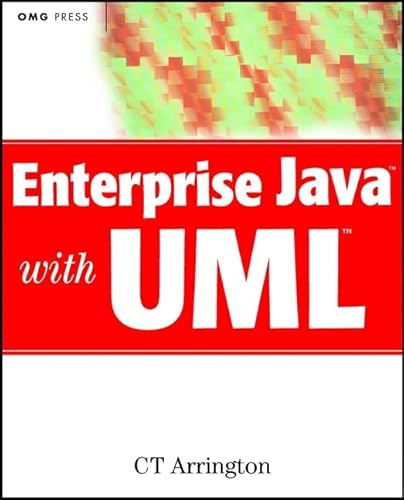
Enterprise Java with UML: How to Use UML to Model Enterprise JavaBeans, Swing Components, CORBA, and Other Popular Technologies - Softcover
Inhaltsangabe
This work is a comprehensive guide to using UML (Unified Modelling Language) in model Java applications. The book presents strategies for developing enterprise systems using Java and related technologies - XML, Servlets, Enterprise JavaBeans, Swing Components, CORBA, RMI, and others. The authors explain how UML is used as a modelling tool for object-oriented computer systems in the real world, break down common situations that development teams encounter, and discuss the tradeoffs of using different technologies in different combinations. They also explore different products, looking closely at their strengths and weaknesses. Four in-depth studies complete the presentation, showing readers how to make the right decision for their project through examples of both successes and failures.
Die Inhaltsangabe kann sich auf eine andere Ausgabe dieses Titels beziehen.
Über die Autorin bzw. den Autor
CT ARRINGTON is an architect and development manager with Capital One in Northern Virginia, where he specializes in architecting and developing N-tier systems in Java. He is also a former Rational Software certified instructor and a Sun certified Java Programmer, Developer, and Architect.
Von der hinteren Coverseite
Use UML to dramatically improve your J2EE applications
This book shows you how to harness the enormous power of enterprise Java technology using the Unified Modeling Language (UML). Writing for Java developers who are interested in modeling software before they build it, Arrington takes you step-by-step through the process of developing enterprise systems using J2EE and UML to devise elegant solutions, share ideas, and track decisions throughout the entire development cycle. Using a Timecard application, you'll start with Requirements Gathering and use case diagrams to understand the system from the user's perspective and create class diagrams, sequence diagrams, and collaboration diagrams to further analyze the problem. During the technology selection process, Arrington evaluates different Java technologies and takes a detailed look at the strengths and weaknesses of EJB, XML, Servlets, Swing, RMI, and JDBC to help you determine their suitability for your project. Next, you'll describe the system at a more granular architectural level with class and package diagrams. In the design stage, you'll apply all of the results from the previous steps to create an intricate model of the system's functionality and prepare a valuable foundation for implementation. The result is a single, coherent model that describes a software system from several perspectives.
With this book, you'll:
* Gain a better understanding of object-oriented analysis and design
* Learn how to use only the parts of the UML that you need for Java development
* Examine a wide variety of UML software models and learn how to select the best one to meet your needs
* Learn how to use UML to describe other technologies and class libraries, such as Servlets, XML, and Swing
The CD-ROM contains:
* All the design documents and source code for the sample Timecard application built in the book
* Instructions for installing and running the sample Timecard application using Sun's J2EE reference implementation
Auszug. © Genehmigter Nachdruck. Alle Rechte vorbehalten.
Excerpt from Enterprise Java with UML By Arrington, C. T.
Chapter 1: Introduction to Modeling Java with the UML
As Java completes its move from a novelty language to the language of choice for Web-enabled enterprise computing, Java developers are faced with many opportunities as well as many challenges. We must produce systems that scale as the underlying business grows and evolves at Web speed. Our customers' appetite for functionality, scalability, usability, extensibility, and reliability rises each year.
Fortunately, Java provides a lot of support as we struggle to meet these demands. First and perhaps foremost, Java is a small, tightly written object-oriented language with excellent support for exception handling and concurrency built in. Of course, this language runs on a platform-independent virtual machine that allows Java systems to run on everything from a PalmPilot to a Web browser to an AS400, with about a dozen operating systems in between. From this solid foundation, Sun built and evolved one of the most impressive class libraries you could ever ask for, including support for internationalization, calendar management, database access, image manipulation, networking, user interfaces, 2D and 3D graphics, and more. Finally, Enterprise JavaBeans and Java 2 Enterprise Edition provide specifications for true cross-platform enterprise computing. Many of the problems that have plagued enterprise developers for decades, such as object-to-relational persistence, object caching, data integrity, and resource management are being addressed with newfound vigor. These specifications, and the application servers that implement them, allow us to leverage a wealth of academic research and practical experience. We are better equipped to develop enterprise systems than ever before.
However, powerful tools do not guarantee success. Before developers can harness the enormous power of enterprise Java technology, they need a clear understanding of the problem and a clear plan for the solution. In order to develop this understanding, they need a way to visualize the system and communicate their decisions and creations to a wide audience. Fortunately, the last few decades have also seen dramatic progress in our ability to understand and model object-oriented systems. The Unified Modeling Language (UML) is an open standard notation that allows developers to build visual representations of software systems. These models enable developers to devise elegant solutions, share ideas, and track decisions throughout the entire development cycle. Also, tools for creating, reverse-engineering, and distributing software models in UML have matured greatly over the past two years, to the point where modeling can be a seamless part of a development lifecycle. This book describes software modeling with the UML, and demonstrates how developers can use UML throughout the software development process to create better enterprise Java systems and more livable enterprise Java projects. The remainder of this chapter discusses software modeling in more detail and presents some object-oriented terminology and UML notation as a foundation for the rest of the book.
When you finish this book, you will be able to:
* Communicate an understanding of 00 modeling theory and practice to others. Communicate an understanding of UML notation to others.
* Critically review a wide variety of UML software models.
* Use UML to create a detailed understanding of the problem from the user's perspective.
* Use UML to visualize and document a balanced solution using the full suite of Java technologies.
* Use UML to describe other technologies and class libraries.
What Is Modeling?
A model is a simplification with a purpose. It uses a precisely defined notation to describe and simplify a complex and interesting structure, phenomenon, or relationship. We create models to avoid drowning in complexity and so that we can understand and control the world around us. Consider a few examples from the real world. Mathematical models of our solar system allow mere mortals to calculate the positions of the planets. Engineers use sophisticated modeling techniques to design everything from aircraft carriers to circuit boards. Meteorologists use mathematical models to predict the weather.
Models of software systems help developers visualize, communicate, and validate a system before significant amounts of money are spent. Software models also help structure and coordinate the efforts of a software development team. The following sections describe some characteristics of models and how they contribute to software development.
Simplification
A model of a system is far less complex, and therefore far more accessible, than the actual code and components that make up the final system. It is much easier for a developer to build, extend, and evaluate a visual model than to work directly in the code. Think of all the decisions that you make while coding. Every time you code, you must decide which parameters to pass, what type of return value to use, where to put certain functionality, and a host of other questions. Once these decisions are made in code, they tend to stay made. With modeling, and especially with a visual modeling tool, these decisions can be made and revised quickly and efficiently. The software model serves the same purpose as an artist's rough sketch. It is a quick and relatively cheap way to get a feel for the actual solution.
The inherent simplicity of models also makes them the perfect mechanism for collaboration and review. It is very difficult to involve more than one other developer during the coding process. Committing to regular code reviews requires a great deal of discipline in the face of ubiquitous schedule pressure. A particular piece of a software model can be reviewed for quality, understandability, and consistency with the rest of the model. Preparation time for reviews of a model is dramatically lower than for a comparable code walkthrough. An experienced developer can assimilate a detailed model of an entire subsystem in a day. Assimilating the actual code for the same subsystem can easily take weeks. This allows more developers to collaborate and review more of the whole model. In general, collaboration and review of software models leads to lower defect rates and fewer difficulties during integration. Also, software models dramatically decrease the time required to assimilate and review code......
„Über diesen Titel“ kann sich auf eine andere Ausgabe dieses Titels beziehen.
Suchergebnisse für Enterprise Java with UML: How to Use UML to Model Enterprise...

Beispielbild für diese ISBN
Enterprise Java with UML: How to Use UML to Model Enterprise JavaBeans, Swing Components, CORBA, and Other Popular Technologies (OMG)
Anbieter: AwesomeBooks, Wallingford, Vereinigtes Königreich
Verkäuferbewertung 5 von 5 Sternen

Paperback. Zustand: Very Good. Enterprise Java with UML: How to Use UML to Model Enterprise JavaBeans, Swing Components, CORBA, and Other Popular Technologies (OMG) This book is in very good condition and will be shipped within 24 hours of ordering. The cover may have some limited signs of wear but the pages are clean, intact and the spine remains undamaged. This book has clearly been well maintained and looked after thus far. Money back guarantee if you are not satisfied. See all our books here, order more than 1 book and get discounted shipping. Artikel-Nr. 7719-9780471386803
Gebraucht kaufen
EUR 6,99
EUR 4,81 Versand
Versand von Vereinigtes Königreich nach USA
Versand von Vereinigtes Königreich nach USA
Anzahl: 2 verfügbar
Beispielbild für diese ISBN
Enterprise Java with UML: How to Use UML to Model Enterprise JavaBeans, Swing Components, CORBA, and Other Popular Technologies (OMG)
Anbieter: Bahamut Media, Reading, Vereinigtes Königreich
Verkäuferbewertung 4 von 5 Sternen

Paperback. Zustand: Very Good. This book is in very good condition and will be shipped within 24 hours of ordering. The cover may have some limited signs of wear but the pages are clean, intact and the spine remains undamaged. This book has clearly been well maintained and looked after thus far. Money back guarantee if you are not satisfied. See all our books here, order more than 1 book and get discounted shipping. Artikel-Nr. 6545-9780471386803
Gebraucht kaufen
EUR 7,03
EUR 8,14 Versand
Versand von Vereinigtes Königreich nach USA
Versand von Vereinigtes Königreich nach USA
Anzahl: 2 verfügbar
Foto des Verkäufers
Enterprise JavaTM with UMLTM: How to Use UML to Model Enterprise JavaBeans, Swing Components, CORBA, and Other Popular Technologies (OMG)
Anbieter: WeBuyBooks, Rossendale, LANCS, Vereinigtes Königreich
Verkäuferbewertung 5 von 5 Sternen
paperback. Zustand: Good. Most items will be dispatched the same or the next working day. A copy that has been read but remains in clean condition. All of the pages are intact and the cover is intact and the spine may show signs of wear. The book may have minor markings which are not specifically mentioned. Artikel-Nr. rev8355171925
Gebraucht kaufen
EUR 5,46
EUR 11,65 Versand
Versand von Vereinigtes Königreich nach USA
Versand von Vereinigtes Königreich nach USA
Anzahl: 1 verfügbar
Foto des Verkäufers
Enterprise Java with UML: How to Use UML to Model Enterprise JavaBeans, Swing Components, CORBA, and Other Popular Technologies
Verlag:
John Wiley & Sons 01.2001., 2001
ISBN 10: 0471386804
ISBN 13: 9780471386803
Gebraucht
paperback
Anbieter: Vulkaneifel Bücher, Birgel, Deutschland
Verkäuferbewertung 5 von 5 Sternen
paperback. Zustand: Sehr gut. 452 Seiten ganz leichte Druckstelle am Cover, kleine Lagerspuren am Buch, Inhalt einwandfrei und ungelesen, CD unbenutzt Sprache: Englisch Gewicht in Gramm: 910. Artikel-Nr. 217423
Gebraucht kaufen
EUR 14,95
EUR 124,40 Versand
Versand von Deutschland nach USA
Versand von Deutschland nach USA
Anzahl: 2 verfügbar