
Verwandte Artikel zu Divorce and New Beginnings: A Complete Guide to Recovery,...
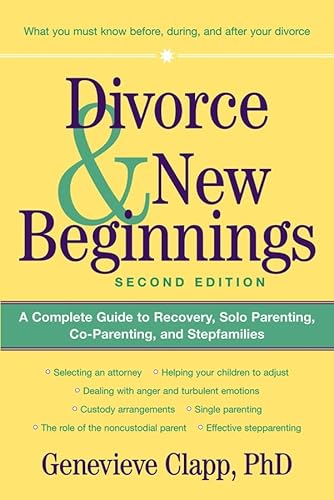
Divorce and New Beginnings: A Complete Guide to Recovery, Solo Parenting, Co-Parenting, and Stepfamilies - Softcover
Inhaltsangabe
A timely revision of a compassionate guide to the practical andemotional aspects of divorce
The first edition of Divorce and New Beginnings helped countlessmen and women emerge from ruptured relationships and build newlives. Enriched with new insights uncovered by researchers and inthe author's work with over 2,000 families, this sensitiveguidebook provides a wealth of proven coping skills to help youweather the difficult times and eventually build newbeginnings--for yourself and, if you have them, yourchildren.
Genevieve Clapp is with you every step of the way as you deal withand recover from your divorce, addressing your daily problems andlong-term concerns with a real-world practicality. Utilizingnumerous case studies and coping tools, Clapp provides you with aroad map of what lies ahead, including tips on navigatingproblematic situations such as choosing a lawyer and dealing withanger and anxiety. Geared directly to your specific needs, Divorceand New Beginnings will help you nurture healthy, committedrelationships and successful stepfamilies, protect your children,and build a rewarding new life.
* Includes updated information on co-parenting and new romanticrelationships
* Offers hundreds of practical suggestions and effective copingstrategies based on the findings and collective insights ofexperts
* Features a strong focus on children and divorce, with astep-by-step guide on fostering their long-term adjustment
Die Inhaltsangabe kann sich auf eine andere Ausgabe dieses Titels beziehen.
Über die Autorin bzw. den Autor
GENEVIEVE CLAPP, PhD, is a counselor with the Superior Court of California, County of San Diego, and works exclusively with separated and divorced parents with child custody disputes, co-parenting problems, or stepfamily problems. She has worked as a divorce mediator and has taught both graduate seminars and undergraduate courses at California State University and Arizona State University.
Von der hinteren Coverseite
A timely revision of a compassionate guide to the practical and emotional aspects of divorce
The first edition of Divorce and New Beginnings helped countless men and women emerge from ruptured relationships and build new lives. Enriched with new insights uncovered by researchers and in the author′s work with over 2,000 families, this sensitive guidebook provides a wealth of proven coping skills to help you weather the difficult times and eventually build new beginnings for yourself and, if you have them, your children.
Genevieve Clapp is with you every step of the way as you deal with and recover from your divorce, addressing your daily problems and long–term concerns with a real–world practicality. Utilizing numerous case studies and coping tools, Clapp provides you with a road map of what lies ahead, including tips on navigating problematic situations such as choosing a lawyer and dealing with anger and anxiety. Geared directly to your specific needs, Divorce and New Beginnings will help you nurture healthy, committed relationships and successful stepfamilies, protect your children, and build a rewarding new life.
- Includes updated information on co–parenting and new romantic relationships
- Offers hundreds of practical suggestions and effective coping strategies based on the findings and collective insights of experts
- Features a strong focus on children and divorce, with a step–by–step guide on fostering their long–term adjustment
Auszug. © Genehmigter Nachdruck. Alle Rechte vorbehalten.
The Aftermath of Marriage
Barbara, an attractive 40-year-old brunette, sat mesmerised at a divorce workshop. It was the first time she had heard about the feelings and problems that people encounter as they go through divorce. "My God," she blurted out, "you're describing my life for the past five months. I didn't know everyone felt like that." There was an immediate restlessness in the room--some nervous laughter, some mumbled comments, one or two heads nodding. "God," Barbara's voice seemed to boom, "what a relief, it's not just me!"
Over the past two decades, there has been an explosion of studies on divorce and its aftermath, providing us access to the experience of thousands who have weathered the rupture of their marriages and families. Thanks to those who have gone before you, the course of divorce is no longer unmapped, and you can be prepared for what lies ahead. If you understand the psychological process of divorce and know what to expect, the upcoming months and years will be considerably less stressful.
This book is more than a road map of the coming years. It is a survival guide, replete with the information and coping tools you need to successfully navigate the years ahead and to successfully guide your children through them. Armed with a road map and a repertoire of good coping skills, you can more easily clear the hurdles of divorce and avoid many of the difficulties that complicate the lives of so many divorcing couples and their children. Your divorce will likely remain a significant event in your life, but it does not have to remain the dominant one.
THE IMPACT OF SEPARATION AND DIVORCE
In the 1970s, two northern California researchers, Judith Wallerstein and Joan Kelly, began an intensive year-long study of divorcing couples and their children. The researchers wished to learn how families are affected by divorce and how they resolve the disruptions to their lives. Wallerstein and Kelly had fully expected families to have recovered by the end of the study, since parents would have been separated 18 months by that time. But the researchers had been mistaken: The majority of adults and children had not yet resolved their divorce-generated difficulties. Wallerstein and Kelly were stunned to find that most families were still in crisis and had not got their lives back together yet. More disturbing, a large number of children were doing worse rather than better.
Were the findings of this groundbreaking study a fluke? Since that time, many other studies have been published that confirm that adjustment to divorce is neither quick nor easy. On the average, people need two years before they regain their equilibrium. They usually need additional time to become emotionally detached from an ex-spouse and to establish a stable and satisfying new lifestyle.
You are probably wondering why divorce adjustment should take so long. After all, divorce is the solution to so many problems, isn't it? It may be easy to see why divorce is difficult for someone who had fought against it or for someone whose partner suddenly walked out. But is divorce also difficult for the person who leaves? Is it also difficult for couples who bitterly argue for years and finally call it quits? Usually, yes. It appears that relatively few people escape the effects of divorce easily. In general, divorce is difficult for both the "leaver" and the "left," for men and for women, for those who have bickered and fought and for those who have lived in indifferent silence, for those married 25 years and for those married 5 years (although break-ups of short-lived marriages tend to be less distressing). Of course, divorce is more difficult for some people than for others. For some the adjustment period is shorter, for some longer. Two years is only an average.
Once you learn more about divorce, you will see why it has such an impact on each member of the family and why such a long adjustment period is commonly needed. Undoubtedly, the best way to understand the nature of divorce is to look at the experiences that most people encounter.
Loss and Turbulent Emotions
Divorcing men and women are often astounded by the extent of their losses. The marriage that had been an important part of life at one time is now gone. So is a lifestyle, future plans, a chunk of one's identity, and perhaps a home, financial security, free access to children, and shared friendships. The list goes on. For many, the massive losses create a feeling of rootlessness--a need to feel connected. For many, the feelings of loss and unconnectedness are entangled with a gnawing sense of failure and dwindling feelings of self-worth.
Lives are further complicated by turbulent and conflicting emotions. Men and women who are filled with bitterness, resentment, and anger may suddenly feel stunned by surges of love and yearning for their former partners. Their predominant feelings of self-pity, sadness, and depression are suddenly displaced by intoxicating feelings of euphoria, well-being, and freedom. Then, as suddenly as it appeared, the euphoria is snatched away. The pendulum swings back and forth, leading people to feel as if they were on a tiny raft being tossed around in stormy seas or as if they were on an emotional roller coaster.
„Über diesen Titel“ kann sich auf eine andere Ausgabe dieses Titels beziehen.
Suchergebnisse für Divorce and New Beginnings: A Complete Guide to Recovery,...

Beispielbild für diese ISBN
Divorce and New Beginnings: A
Anbieter: World of Books (was SecondSale), Montgomery, IL, USA
Verkäuferbewertung 5 von 5 Sternen

Zustand: Acceptable. Item in acceptable condition! Textbooks may not include supplemental items i.e. CDs, access codes etc. Artikel-Nr. 00103347984
Gebraucht kaufen
EUR 3,09
Versand gratis
Versand innerhalb von USA
Versand innerhalb von USA
Anzahl: 1 verfügbar
Beispielbild für diese ISBN
Divorce and New Beginnings: A
Anbieter: World of Books (was SecondSale), Montgomery, IL, USA
Verkäuferbewertung 5 von 5 Sternen
Zustand: Good. Item in good condition. Textbooks may not include supplemental items i.e. CDs, access codes etc. Artikel-Nr. 00104659350
Gebraucht kaufen
EUR 3,09
Versand gratis
Versand innerhalb von USA
Versand innerhalb von USA
Anzahl: 1 verfügbar
Beispielbild für diese ISBN
Divorce & New Beginnings: A Complete Guide to Recovery, Solo Parenting, Co-Parenting, and Stepfamilies
Anbieter: Wonder Book, Frederick, MD, USA
Verkäuferbewertung 5 von 5 Sternen
Zustand: Good. Good condition. 2nd edition. A copy that has been read but remains intact. May contain markings such as bookplates, stamps, limited notes and highlighting, or a few light stains. Artikel-Nr. L08A-01171
Gebraucht kaufen
EUR 4,75
Versand gratis
Versand innerhalb von USA
Versand innerhalb von USA
Anzahl: 1 verfügbar
Beispielbild für diese ISBN
Divorce and New Beginnings: A Complete Guide to Recovery, Solo Parenting, Co-Parenting, and Stepfamilies
Anbieter: BooksRun, Philadelphia, PA, USA
Verkäuferbewertung 5 von 5 Sternen
Paperback. Zustand: Very Good. 2. It's a well-cared-for item that has seen limited use. The item may show minor signs of wear. All the text is legible, with all pages included. It may have slight markings and/or highlighting. Artikel-Nr. 0471326488-11-1
Gebraucht kaufen
EUR 5,14
Versand gratis
Versand innerhalb von USA
Versand innerhalb von USA
Anzahl: 1 verfügbar
Beispielbild für diese ISBN
Divorce and New Beginnings: A Complete Guide to Recovery, Solo Parenting, Co-Parenting, and Stepfamilies
Anbieter: ThriftBooks-Dallas, Dallas, TX, USA
Verkäuferbewertung 5 von 5 Sternen
Paperback. Zustand: As New. No Jacket. Pages are clean and are not marred by notes or folds of any kind. ~ ThriftBooks: Read More, Spend Less. Artikel-Nr. G0471326488I2N00
Gebraucht kaufen
EUR 5,83
Versand gratis
Versand innerhalb von USA
Versand innerhalb von USA
Anzahl: 1 verfügbar
Beispielbild für diese ISBN
Divorce and New Beginnings: A Complete Guide to Recovery, Solo Parenting, Co-Parenting, and Stepfamilies
Anbieter: ThriftBooks-Atlanta, AUSTELL, GA, USA
Verkäuferbewertung 5 von 5 Sternen
Paperback. Zustand: As New. No Jacket. Pages are clean and are not marred by notes or folds of any kind. ~ ThriftBooks: Read More, Spend Less. Artikel-Nr. G0471326488I2N00
Gebraucht kaufen
EUR 5,83
Versand gratis
Versand innerhalb von USA
Versand innerhalb von USA
Anzahl: 1 verfügbar
Beispielbild für diese ISBN
Divorce and New Beginnings : A Complete Guide to Recovery, Solo Parenting, Co-Parenting, and Stepfamilies
Verlag:
Wiley & Sons, Incorporated, John, 2000
ISBN 10: 0471326488
ISBN 13: 9780471326489
Gebraucht
Softcover
Anbieter: Better World Books, Mishawaka, IN, USA
Verkäuferbewertung 5 von 5 Sternen
Zustand: Good. 2nd. Pages intact with minimal writing/highlighting. The binding may be loose and creased. Dust jackets/supplements are not included. Stock photo provided. Product includes identifying sticker. Better World Books: Buy Books. Do Good. Artikel-Nr. 3301346-6
Gebraucht kaufen
EUR 6,48
Versand gratis
Versand innerhalb von USA
Versand innerhalb von USA
Anzahl: 1 verfügbar
Beispielbild für diese ISBN
Divorce and New Beginnings : A Complete Guide to Recovery, Solo Parenting, Co-Parenting, and Stepfamilies
Verlag:
Wiley & Sons, Incorporated, John, 2000
ISBN 10: 0471326488
ISBN 13: 9780471326489
Gebraucht
Softcover
Anbieter: Better World Books, Mishawaka, IN, USA
Verkäuferbewertung 5 von 5 Sternen
Zustand: Good. 2nd. Former library copy. Pages intact with minimal writing/highlighting. The binding may be loose and creased. Dust jackets/supplements are not included. Includes library markings. Stock photo provided. Product includes identifying sticker. Better World Books: Buy Books. Do Good. Artikel-Nr. 3301347-6
Gebraucht kaufen
EUR 6,48
Versand gratis
Versand innerhalb von USA
Versand innerhalb von USA
Anzahl: 1 verfügbar
Beispielbild für diese ISBN
Divorce and New Beginnings : A Complete Guide to Recovery, Solo Parenting, Co-Parenting, and Stepfamilies
Verlag:
Wiley & Sons, Incorporated, John, 2000
ISBN 10: 0471326488
ISBN 13: 9780471326489
Gebraucht
Softcover
Anbieter: Better World Books: West, Reno, NV, USA
Verkäuferbewertung 5 von 5 Sternen
Zustand: Very Good. 2nd. Former library copy. Pages intact with possible writing/highlighting. Binding strong with minor wear. Dust jackets/supplements may not be included. Includes library markings. Stock photo provided. Product includes identifying sticker. Better World Books: Buy Books. Do Good. Artikel-Nr. GRP82408362
Gebraucht kaufen
EUR 6,48
Versand gratis
Versand innerhalb von USA
Versand innerhalb von USA
Anzahl: 1 verfügbar
Beispielbild für diese ISBN
Divorce & New Beginnings: A Complete Guide to Recovery, Solo Parenting, Co-Parenting, and Stepfamilies
Anbieter: Night Heron Books, Laramie, WY, USA
Verkäuferbewertung 5 von 5 Sternen
Paperback. Zustand: Fair. Binding tight.Cover clean.Minor wear to page edges and corners. Minor marking to text.Paperback. Artikel-Nr. 739980
Gebraucht kaufen
EUR 7,06
EUR 3,64 Versand
Versand innerhalb von USA
Versand innerhalb von USA
Anzahl: 1 verfügbar