
Verwandte Artikel zu All the Shah's Men: An American Coup and the Roots...
Inhaltsangabe
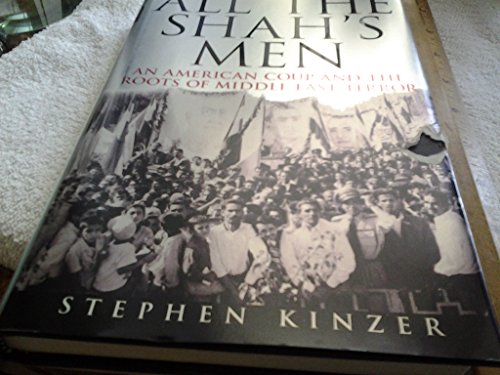
This is the first full-length account of the CIA's coup d'etat in Iran in 1953 - a covert operation whose consequences are still with us today. Written by a noted "New York Times" journalist, this book is based on documents about the coup (including some lengthy internal CIA reports) that have now been declassified. Stephen Kinzer's compelling narrative is at once a vital piece of history, a cautionary tale, and a real-life espionage thriller.
Die Inhaltsangabe kann sich auf eine andere Ausgabe dieses Titels beziehen.
Über die Autorin bzw. den Autor
STEPHEN KINZER is a veteran New York Times correspondent who has reported from more than fifty countries on four continents. During the 1980s he covered revolution and social upheaval in Central America. In 1990 he was named chief of the Times bureau in Berlin, and spent the next six years covering the emergence of post-Communist Europe. Later Kinzer became the first Times bureau chief in Istanbul. He is coauthor of Bitter Fruit: The Story of the American Coup in Guatemala and author of Blood of Brothers: Life and War in Nicaragua and Crescent and Star: Turkey Between Two Worlds. Kinzer is currently a New York Times correspondent based in Chicago.
Von der hinteren Coverseite
Praise for All the Shah?s Men
"Stephen Kinzer?s brilliant reconstruction of the Iranian coup is made even more fascinating by the fact that it is true. It is as gripping as a thriller, and also tells much about why the United States is involved today in places like Afghanistan and Iraq."
?Gore Vidal, author of Lincoln, Burr, and 1876.
"Remarkable, readable, and relevant . . . All the Shah?s Men not only reads like an exciting, page–turning spy novel, it deals with the hard issues of today."
?Senator Richard Lugar, Chairman, Senate Foreign Relations Committee
"A well–researched object lesson in the dismal folly of so–called nation–building. British and American readers of today should blush with shame."
?John le Carré, author of The Spy Who Came In from the Cold
and The Tailor of Panama
Aus dem Klappentext
Half a century ago, the United States overthrew a Middle Eastern government for the first time. The victim was Mohammad Mossadegh, the democratically elected prime minister of Iran. Although the coup seemed a success at first, today it serves as a chilling lesson about the dangers of foreign intervention.
In this book, veteran New York Times correspondent Stephen Kinzer gives the first full account of this fateful operation. His account is centered around an hour–by–hour reconstruction of the events of August 1953, and concludes with an assessment of the coup’s "haunting and terrible legacy."
Operation Ajax, as the plot was code–named, reshaped the history of Iran, the Middle East, and the world. It restored Mohammad Reza Shah to the Peacock Throne, allowing him to impose a tyranny that ultimately sparked the Islamic Revolution of 1979. The Islamic Revolution, in turn, inspired fundamentalists throughout the Muslim world, including the Taliban and terrorists who thrived under its protection.
"It is not far–fetched," Kinzer asserts in this book, "to draw a line from Operation Ajax through the Shah’s repressive regime and the Islamic Revolution to the fireballs that engulfed the World Trade Center in New York."
Drawing on research in the United States and Iran, and using material from a long–secret CIA report, Kinzer explains the background of the coup and tells how it was carried out. It is a cloak–and–dagger story of spies, saboteurs, and secret agents. There are accounts of bribes, staged riots, suitcases full of cash, and midnight meetings between the Shah and CIA agent Kermit Roosevelt, who was smuggled in and out of the royal palace under a blanket in the back seat of a car. Roosevelt, the grandson of President Theodore Roosevelt, was a real–life James Bond in an era when CIA agents operated mainly by their wits. After his first coup attempt failed, he organized a second attempt that succeeded three days later.
The colorful cast of characters includes the terrified young Shah, who fled his country at the first sign of trouble; General H. Norman Schwarzkopf, father of the Gulf War commander and the radio voice of "Gang Busters," who flew to Tehran on a secret mission that helped set the coup in motion; and the fiery Prime Minister Mossadegh, who outraged the West by nationalizing the immensely profitable Anglo–Iranian Oil Company. The British, outraged by the seizure of their oil company, persuaded President Dwight Eisenhower that Mossadegh was leading Iran toward Communism. Eisenhower and Prime Minister Winston Churchill of Great Britain became the coup’s main sponsors.
Brimming with insights into Middle Eastern history and American foreign policy, this book is an eye–opening look at an event whose unintended consequences Islamic revolution and violent anti–Americanism have shaped the modern world. As the United States assumes an ever–widening role in the Middle East, it is essential reading.
„Über diesen Titel“ kann sich auf eine andere Ausgabe dieses Titels beziehen.
Suchergebnisse für All the Shah's Men: An American Coup and the Roots...

Foto des Verkäufers
All the Shah's Men: An American Coup and the Roots of Middle East Terror
Anbieter: Dream Books Co., Denver, CO, USA
Verkäuferbewertung 5 von 5 Sternen

Zustand: good. Gently used with minimal wear on the corners and cover. A few pages may contain light highlighting or writing, but the text remains fully legible. Dust jacket may be missing, and supplemental materials like CDs or codes may not be included. May be ex-library with library markings. Ships promptly! Artikel-Nr. DBV.0471265179.G
Gebraucht kaufen
EUR 6,06
Versand gratis
Versand innerhalb von USA
Versand innerhalb von USA
Anzahl: 1 verfügbar
Beispielbild für diese ISBN
All the Shah's Men: An American Coup and the Roots of Middle East Terror
Verlag:
John Wiley and Sons Ltd, 2003
ISBN 10: 0471265179
ISBN 13: 9780471265177
Gebraucht
Hardcover
Anbieter: World of Books (was SecondSale), Montgomery, IL, USA
Verkäuferbewertung 5 von 5 Sternen
Hardback. Zustand: Good. This is the first full-length account of the CIA's coup d'etat in Iran in 1953 - a covert operation whose consequences are still with us today. Written by a noted "New York Times" journalist, this book is based on documents about the coup (including some lengthy internal CIA reports) that have now been declassified. Stephen Kinzer's compelling narrative is at once a vital piece of history, a cautionary tale, and a real-life espionage thriller. Artikel-Nr. 00109498331
Gebraucht kaufen
EUR 7,63
Versand gratis
Versand innerhalb von USA
Versand innerhalb von USA
Anzahl: 4 verfügbar
Beispielbild für diese ISBN
All the Shah's Men: An American Coup and the Roots of Middle East Terror
Verlag:
Wiley (edition First Edition), 2003
ISBN 10: 0471265179
ISBN 13: 9780471265177
Gebraucht
Hardcover
Erstausgabe
Anbieter: BooksRun, Philadelphia, PA, USA
Verkäuferbewertung 5 von 5 Sternen
Hardcover. Zustand: Very Good. First Edition. With dust jacket. It's a well-cared-for item that has seen limited use. The item may show minor signs of wear. All the text is legible, with all pages included. It may have slight markings and/or highlighting. Artikel-Nr. 0471265179-11-1-29
Gebraucht kaufen
EUR 7,76
Versand gratis
Versand innerhalb von USA
Versand innerhalb von USA
Anzahl: 2 verfügbar
Beispielbild für diese ISBN
All the Shah's Men : An American Coup and the Roots of Middle East Terror
Verlag:
Wiley & Sons, Incorporated, John, 2003
ISBN 10: 0471265179
ISBN 13: 9780471265177
Gebraucht
Hardcover
Erstausgabe
Anbieter: Better World Books, Mishawaka, IN, USA
Verkäuferbewertung 5 von 5 Sternen
Zustand: Good. 1st. Pages intact with minimal writing/highlighting. The binding may be loose and creased. Dust jackets/supplements are not included. Stock photo provided. Product includes identifying sticker. Better World Books: Buy Books. Do Good. Artikel-Nr. 3300046-6
Gebraucht kaufen
EUR 9,54
Versand gratis
Versand innerhalb von USA
Versand innerhalb von USA
Anzahl: 1 verfügbar
Beispielbild für diese ISBN
All the Shah's Men: An American Coup and the Roots of Middle East Terror
Anbieter: WorldofBooks, Goring-By-Sea, WS, Vereinigtes Königreich
Verkäuferbewertung 5 von 5 Sternen
Hardback. Zustand: Very Good. The book has been read, but is in excellent condition. Pages are intact and not marred by notes or highlighting. The spine remains undamaged. Artikel-Nr. GOR002072456
Gebraucht kaufen
EUR 51,65
EUR 6,69 Versand
Versand von Vereinigtes Königreich nach USA
Versand von Vereinigtes Königreich nach USA
Anzahl: 3 verfügbar