
Verwandte Artikel zu CliffsNotes Chemistry Quick Review, 2nd Edition (Cliffsnotes...
CliffsNotes Chemistry Quick Review, 2nd Edition (Cliffsnotes Quick Review) - Softcover
Buch 22 von 39: CliffsNotes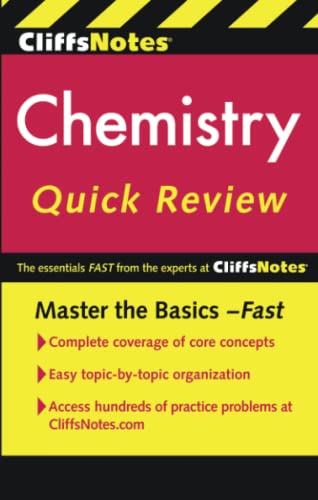
Inhaltsangabe
Inside the Book:
Elements
Atoms
Atomic Structure
Electron Configurations
Chemical Bonding
Organic Compounds
States of Matter
Gases
Solutions
Acids and Bases
Oxidation-Reduction Reactions
Electrochemistry
Equilibrium
Thermodynamics
Review Questions
Resource Center
Glossary
Why CliffsNotes?
Go with the name you know and trust
Get the information you need-fast!
CliffsNotes Quick Review guides give you a clear, concise, easy-to-use review of the basics. Introducing each topic, defining key terms, and carefully walking you through sample problems, this guide helps you grasp and understand the important concepts needed to succeed.
Access 500 additional practice questions at www.cliffsnotes.com/go/quiz/chemistry
Master the Basics –Fast
Complete coverage of core concepts
Easy topic-by-topic organization
Access hundreds of practice problems at www.cliffsnotes.com/go/quiz/chemistry
Die Inhaltsangabe kann sich auf eine andere Ausgabe dieses Titels beziehen.
Von der hinteren Coverseite
Inside the Book:
* Elements
* Atoms
* Atomic Structure
* Electron Configurations
* Chemical Bonding
* Organic Compounds
* States of Matter
* Gases
* Solutions
* Acids and Bases
* Oxidation-Reduction Reactions
* Electrochemistry
* Equilibrium
* Thermodynamics
* Review Questions
* Resource Center
* Glossary
Why CliffsNotes?
* Go with the name you know and trust
* Get the information you need-fast!
CliffsNotes Quick Review guides give you a clear, concise, easy-to-use review of the basics. Introducing each topic, defining key terms, and carefully walking you through sample problems, this guide helps you grasp and understand the important concepts needed to succeed.
Access 500 additional practice questions at www.cliffsnotes.com/go/quiz/chemistry
Master the Basics -Fast
* Complete coverage of core concepts
* Easy topic-by-topic organization
* Access hundreds of practice problems at www.cliffsnotes.com/go/quiz/chemistry
Auszug. © Genehmigter Nachdruck. Alle Rechte vorbehalten.
CliffsNotes Chemistry Quick Review
By Harold D. Nathan Charles HenricksonJohn Wiley & Sons
Copyright © 2011 John Wiley & Sons, LtdAll right reserved.
ISBN: 978-0-470-90543-2
Chapter One
ELEMENTS
Chapter Check-In
Discovering the building blocks of all substances
Understanding the arrangement of the periodic table
Learning about atomic number and atomic weight
With all the different substances that exist, you may be surprised to learn that they are formed from a relatively small number of elements. For example, carbon is one of 112 known elements. Yet carbon can combine with other elements (like hydrogen and oxygen) to form thousands of substances (like sugar, alcohol, and plastics). Although some elements have been known from the earliest times, most were discovered during the last 300 years.
Each element is unique with its own characteristics. Each element is represented conveniently by a symbol. For example: H is for hydrogen, O for oxygen, and Cl for chlorine. In addition, each element has its own atomic number and atomic weight. The symbols of the elements, along with their respective atomic numbers and atomic weights, are displayed in a special arrangement called the periodic table. Although the elements are arranged in order of increasing atomic number, the elements with similar chemical characteristics appear in columns. This organization is useful for studying chemistry.
Discovery and Similarity
The modern science of chemistry began during the eighteenth century, when several brilliant natural philosophers classified the products of decomposition into a small number of fundamental substances. For example, in 1774, the Englishman Joseph Priestley discovered that when the red powder mercuric oxide was heated, it decomposed to liquid metal mercury and to a colorless gas capable of supporting combustion. (This gas was later named oxygen.) Most substances similarly can be decomposed into several simpler substances by heat or by an electrical current; however, the most fundamental substances cannot be broken down further, even with extraordinary temperature or electric voltage. These basic building blocks of all other substances are known as the chemical elements.
When the French chemist Antoine Lavoisier published his famous list of elements in 1789, there were only 33 elements, several of which were erroneous. By 1930, the diligent labors of thousands of chemists had increased the tally of naturally occurring chemical elements to 90. More recently, physicists in high-energy laboratories have been able to create about 20 highly radioactive, unstable elements that do not exist naturally on Earth, although they are probably produced in the hot cores of some stars.
The number of chemical elements has now reached 112, and the list is growing. Fortunately for students, only about 40 are relevant to basic chemistry. Please take a glance at the periodic table of chemical elements (found at the end of this chapter) and find calcium, element number 20. You need to be acquainted with the symbol and general properties of the 20 simplest elements up to calcium, plus another 20 of chemical significance that you will encounter in this book.
Notice that the key concepts of chemistry are set in boldface on their first appearance in the text to alert you to their importance. These terms are used repeatedly in this book, and you cannot master chemistry without understanding them. You can find the definitions of these key concepts in the glossary at the end of this book.
Groups of elements in nature have similar chemical properties. Helium, neon, argon, krypton, and xenon are all colorless gases, only two of which combine with other elements under very special conditions; their lack of reactivity leads to the name inert gases (or noble gases) for this group of similar elements. By contrast, fluorine and chlorine are corrosive greenish gases that form salts when they readily combine with metals, hence the name halogens (salt formers) for fluorine, chlorine, bromine, and iodine.
As a final example of a group of elements with similar properties, the metallic elements lithium, sodium, and potassium have such low densities that they float on water and are so highly reactive that they spontaneously burn by extracting oxygen from the water itself. These light metals form strong alkalis and appropriately are called the alkali metals. You should locate each of these columns of similar elements, as shown in Figure 1-1, on the periodic table.
Similar elements also occur in the same natural environment. For instance, the halogens are markedly concentrated in seawater. (The major salt in ocean brines is sodium chloride.) The other halogens are extracted from seawater that has been further concentrated—bromine from salt beds formed by evaporation and iodine from kelp, which grows in oceans.
The first indispensable key to making sense out of the extensive system of facts and principles called chemistry is the rule that the behavior of an element or compound can be predicted from similar substances.
Atomic Masses
By the early nineteenth century, chemists were striving to organize their rudimentary knowledge of the chemical elements. It was known that differing masses of elements reacted to form compounds. For example, they found that 3 grams of magnesium metal reacted with precisely 2 grams of oxygen to form magnesium oxide with no residual magnesium or oxygen. The same mass of oxygen, however, required 5 grams of calcium metal to react completely to form calcium oxide. Table 1-1 summarizes these relative combining masses.
Chemists gradually discovered that such relative masses in chemical reactions were fundamental characteristics of the elements. The English chemist John Dalton realized that all the known combining masses were nearly whole-number multiples of the combining mass of the lightest element—hydrogen. In 1803, he proposed an atomic theory in which all other elements would be built from multiple hydrogen atoms. Consequently, he based his scale of atomic masses on hydrogen being equal to 1.
Although Dalton's theory was found to be unrealistically simple, he did compel chemists to adopt a standard scale of atomic weights. Because the combining mass of oxygen is approximately 16 times that of hydrogen, the preceding chart can be revised, as shown in Table 1-2.
The modern masses for calcium, magnesium, and oxygen are still nearly in the 5:3:2 ratios of the original masses. Notice especially that the atomic mass of hydrogen is not precisely equal to 1, because the atomic mass scale is now based on the most common variety of carbon being exactly 12 atomic mass units. Dalton's bold conjecture that all the heavier elements have masses that are integral multiples of hydrogen is not strictly valid, but his theory was a good approximation that eventually led to the discovery of the particles composing the atoms.
The Periodic Table
In 1869, the Russian chemist Dmitri Mendeleyev published his great systematization called the periodic table. He arranged all known chemical elements in order of their atomic masses and found that similar physical and chemical properties recurred every 7 elements for the lighter elements and every 17 elements for the heavier ones. (The inert gases had not been discovered at that time; the correct values for similar properties are 8 and 18.) The periodic table is based on atomic masses and similar properties. In each row, the atomic masses...
„Über diesen Titel“ kann sich auf eine andere Ausgabe dieses Titels beziehen.
Suchergebnisse für CliffsNotes Chemistry Quick Review, 2nd Edition (Cliffsnotes...

Beispielbild für diese ISBN
CliffsNotes Chemistry Quick Review, 2nd Edition (Cliffsquickreview)
Anbieter: World of Books (was SecondSale), Montgomery, IL, USA
Verkäuferbewertung 5 von 5 Sternen

Zustand: Acceptable. Item in acceptable condition! Textbooks may not include supplemental items i.e. CDs, access codes etc. Artikel-Nr. 00107585493
Gebraucht kaufen
EUR 3,71
Versand gratis
Versand innerhalb von USA
Versand innerhalb von USA
Anzahl: 1 verfügbar
Beispielbild für diese ISBN
CliffsNotes Chemistry Quick Review, 2nd Edition (Cliffsquickreview)
Anbieter: World of Books (was SecondSale), Montgomery, IL, USA
Verkäuferbewertung 5 von 5 Sternen
Zustand: Good. Item in good condition. Textbooks may not include supplemental items i.e. CDs, access codes etc. Artikel-Nr. 00084327189
Gebraucht kaufen
EUR 3,71
Versand gratis
Versand innerhalb von USA
Versand innerhalb von USA
Anzahl: 11 verfügbar
Beispielbild für diese ISBN
CliffsNotes Chemistry Quick Review: 2nd Edition
Verlag:
Houghton Mifflin Harcourt Publishing Company, 2011
ISBN 10: 0470905433
ISBN 13: 9780470905432
Gebraucht
Paperback
Anbieter: World of Books (was SecondSale), Montgomery, IL, USA
Verkäuferbewertung 5 von 5 Sternen
Paperback. Zustand: Very Good. CliffsNotes Quick Review gives you a clear, concise, easy-to-use review of the basics. Introducing each topic, defining key terms, and carefully walking you through sample problems, this guide helps you grasp and understand the important concepts needed to succeed. Access 500 additional practice questions at www. cliffsnotes. Artikel-Nr. 00098085867
Gebraucht kaufen
EUR 3,71
Versand gratis
Versand innerhalb von USA
Versand innerhalb von USA
Anzahl: 4 verfügbar
Beispielbild für diese ISBN
CliffsNotes Chemistry Quick Review: 2nd Edition
Verlag:
CliffsNotes (edition 2), 2011
ISBN 10: 0470905433
ISBN 13: 9780470905432
Gebraucht
Paperback
Anbieter: BooksRun, Philadelphia, PA, USA
Verkäuferbewertung 5 von 5 Sternen
Paperback. Zustand: Very Good. 2. It's a well-cared-for item that has seen limited use. The item may show minor signs of wear. All the text is legible, with all pages included. It may have slight markings and/or highlighting. Artikel-Nr. 0470905433-11-1
Gebraucht kaufen
EUR 4,72
Versand gratis
Versand innerhalb von USA
Versand innerhalb von USA
Anzahl: 1 verfügbar
Beispielbild für diese ISBN
Cliffsnotes Chemistry Quick Review, 2nd Edition
Anbieter: ThriftBooks-Dallas, Dallas, TX, USA
Verkäuferbewertung 5 von 5 Sternen
Paperback. Zustand: Very Good. No Jacket. May have limited writing in cover pages. Pages are unmarked. ~ ThriftBooks: Read More, Spend Less. Artikel-Nr. G0470905433I4N00
Gebraucht kaufen
EUR 5,94
Versand gratis
Versand innerhalb von USA
Versand innerhalb von USA
Anzahl: 1 verfügbar
Beispielbild für diese ISBN
Cliffsnotes Chemistry Quick Review, 2nd Edition
Anbieter: ThriftBooks-Dallas, Dallas, TX, USA
Verkäuferbewertung 5 von 5 Sternen
Paperback. Zustand: Very Good. No Jacket. Former library book; May have limited writing in cover pages. Pages are unmarked. ~ ThriftBooks: Read More, Spend Less. Artikel-Nr. G0470905433I4N10
Gebraucht kaufen
EUR 5,94
Versand gratis
Versand innerhalb von USA
Versand innerhalb von USA
Anzahl: 1 verfügbar
Beispielbild für diese ISBN
Chemistry : Quick Review
Verlag:
Houghton Mifflin Harcourt Publishing Company, 2011
ISBN 10: 0470905433
ISBN 13: 9780470905432
Gebraucht
Softcover
Anbieter: Better World Books, Mishawaka, IN, USA
Verkäuferbewertung 5 von 5 Sternen
Zustand: Good. 2 Edition. Pages intact with minimal writing/highlighting. The binding may be loose and creased. Dust jackets/supplements are not included. Stock photo provided. Product includes identifying sticker. Better World Books: Buy Books. Do Good. Artikel-Nr. 5230284-6
Gebraucht kaufen
EUR 6,16
Versand gratis
Versand innerhalb von USA
Versand innerhalb von USA
Anzahl: 2 verfügbar
Beispielbild für diese ISBN
CliffsNotes Chemistry Quick Review, 2nd Edition (Cliffs Quick Review)
Anbieter: Wonder Book, Frederick, MD, USA
Verkäuferbewertung 5 von 5 Sternen
Zustand: Very Good. Very Good condition. 2nd edition. A copy that may have a few cosmetic defects. May also contain light spine creasing or a few markings such as an owner's name, short gifter's inscription or light stamp. Artikel-Nr. O07A-02586
Gebraucht kaufen
EUR 6,40
Versand gratis
Versand innerhalb von USA
Versand innerhalb von USA
Anzahl: 3 verfügbar
Beispielbild für diese ISBN
CliffsNotes Chemistry Quick Review: 2nd Edition
Verlag:
CliffsNotes, United States, 2011
ISBN 10: 0470905433
ISBN 13: 9780470905432
Gebraucht
Paperback
Anbieter: The Yard Sale Store, Narrowsburg, NY, USA
Verkäuferbewertung 5 von 5 Sternen
Paperback. Zustand: Good. CLIFFS NOTES is a book designed to help you understand and study some of the great topics of our time. Each aspect is analyzed and explained in clear language. Reliable CLIFFS NOTES edition with some shelf wear to the covers. Enjoy this USEFUL edition. Artikel-Nr. 262014077052279
Gebraucht kaufen
EUR 9,11
EUR 5,31 Versand
Versand innerhalb von USA
Versand innerhalb von USA
Anzahl: 1 verfügbar
Beispielbild für diese ISBN
Cliffs Notes Chemistry: Quick Review
Anbieter: Revaluation Books, Exeter, Vereinigtes Königreich
Verkäuferbewertung 5 von 5 Sternen
Paperback. Zustand: Brand New. 2nd edition. 224 pages. 8.50x4.75x0.50 inches. In Stock. Artikel-Nr. 0470905433
Neu kaufen
EUR 23,98
EUR 11,79 Versand
Versand von Vereinigtes Königreich nach USA
Versand von Vereinigtes Königreich nach USA
Anzahl: 1 verfügbar