
Verwandte Artikel zu CliffsNotes Statistics Quick Review: 2nd Edition: Library...
CliffsNotes Statistics Quick Review: 2nd Edition: Library Edition - Softcover
Buch 3 von 8: Cliffsnotes Quick Review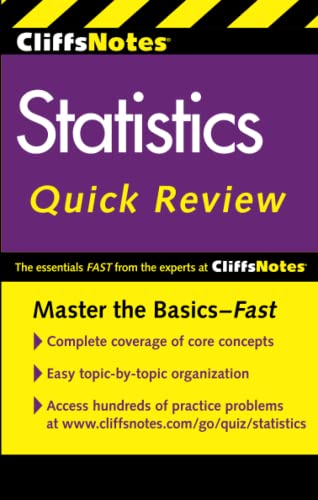
Inhaltsangabe
Inside the Book:
Graphic displays
Numerical measures
Probability
Sampling
Principles of testing
Univariate inferential tests
Bivariate relationships
Review questions
Resource center
Glossary
Common mistakes
Tables
Why CliffsNotes?
Go with the name you know and trust
Get the information you need-fast!
CliffsNotes Quick Review guides give you a clear, concise, easy-to-use review of the basics. Introducing each topic, defining key terms, and carefully walking you through sample problems, this guide helps you grasp and understand the important concepts needed to succeed.
Access 500 additional practice questions at www.cliffsnotes.com/go/quiz/statistics
Master the Basics–Fast
Complete coverage of core concepts
Easy topic-by-topic organization
Access hundreds of practice problems at www.cliffsnotes.com/go/quiz/statistics
Die Inhaltsangabe kann sich auf eine andere Ausgabe dieses Titels beziehen.
Von der hinteren Coverseite
Inside the Book:
* Graphic displays
* Numerical measures
* Probability
* Sampling
* Principles of testing
* Univariate inferential tests
* Bivariate relationships
* Review questions
* Resource center
* Glossary
* Common mistakes
* Tables
Why CliffsNotes?
* Go with the name you know and trust
* Get the information you need-fast!
CliffsNotes Quick Review guides give you a clear, concise, easy-to-use review of the basics. Introducing each topic, defining key terms, and carefully walking you through sample problems, this guide helps you grasp and understand the important concepts needed to succeed.
Access 500 additional practice questions at www.cliffsnotes.com/go/quiz/statistics
Master the Basics-Fast
* Complete coverage of core concepts
* Easy topic-by-topic organization
* Access hundreds of practice problems at www.cliffsnotes.com/go/quiz/statistics
Auszug. © Genehmigter Nachdruck. Alle Rechte vorbehalten.
CliffsNotes Statistics Quick Review
By David H. Voelker Peter Z. Orton Scott AdamsJohn Wiley & Sons
Copyright © 2011 John Wiley & Sons, LtdAll right reserved.
ISBN: 978-0-470-90260-8
Chapter One
OVERVIEW
Chapter Check-In
Learning about the different kinds of statistics
Learning about variables
Understanding the steps in statistical reasoning
Learning several uses for statistical reasoning
For many people, statistics means numbers—numerical facts, figures, or information. Statistics is about data. Data consists of information about statistical variables. There are two types of variables: Quantitative variables are variables that can be measured or described by values, such as height. Categorical variables have values that are categories, such as type of pet. The data for these variables are usually counts or frequencies of the numbers for each category.
Reports of industry production, baseball batting averages, government deficits, and so forth, are often called statistics. To be precise, these numbers are descriptive statistics because they are numerical data that describe phenomena. Descriptive statistics are as simple as the number of children in each family along a city block or as complex as the annual report released from the U.S. Department of the Treasury.
Types of Statistics
In these pages, we are concerned with two ways of representing descriptive statistics: numerical and pictorial.
Numerical statistics
Numerical statistics are numbers, but clearly, some numbers are more meaningful than others. For example, if you are offered a purchase price of $1 for an automobile on the condition that you also buy a second automobile, the price of the second automobile would be a major consideration (its price could be $1,000,000 or $1,000); thus, the average—or mean—of the two prices would be the important statistic. (The different meaningful numerical statistics are discussed in Chapter 3.)
Pictorial statistics
Taking numerical data and presenting it in pictures or graphs is known as pictorial statistics. Showing data in the form of a graphic can make complex and confusing information appear more simple and straightforward. Different types of graphs are used for quantitative and categorical variables. (The more commonly used graphics in statistics are discussed in Chapter 2.)
Method of Statistical Inference
Statistics is also a method, a way of working with numbers to answer puzzling questions about both human and nonhuman phenomena. Questions answerable by using the "method" of statistics are many and varied: Which of several techniques is best for teaching reading to third-graders? Will a new medicine be more effective than the old one? Can you expect it to rain tomorrow? What is the probable outcome of the next presidential election? Which assembly-line process produces fewer faulty carburetors? How can a polling organization make an accurate prediction of a national election by questioning only a few thousand voters? And so on.
For our purposes, statistics is both a collection of numbers and/or pictures and a process: the art and science of making accurate guesses about outcomes involving numbers.
So, fundamentally, the goals of statistics are
* To describe variables and data
* To make accurate inferences about groups based upon incomplete information
Steps in the Process
Making accurate guesses requires groundwork. The statistician must do the following in order to make an educated, better-than-chance hunch:
1. Gather data (numerical information).
2. Organize the data (sometimes in a pictorial).
3. Analyze the data (using tests of significance and so forth). This book shows you how to do precisely these procedures and how to use your analysis to draw an inference—an educated statistical guess—to solve a particular problem. While these steps may appear simple (and indeed some of them are), sound statistical method requires that you perform them in certain prescribed ways. Those ways are the heart and soul of statistics.
Making Predictions
Suppose that you decide to sell commemorative T-shirts at your town's centennial picnic. You know that you can make a tidy profit, but only if you can sell most of your supply of shirts because your supplier will not buy any of them back. How many shirts can you reasonably plan on selling?
Your first question, of course, is this: How many people will be attending the picnic? Suppose you know that 100,000 tickets to the event have been sold. How many T-shirts should you purchase from your supplier to sell on the day of the event? 10,000? 50,000? 100,000? 150,000? How many of each size—small, medium, large, extra-large? And the important question: How many T-shirts must you sell in order to make some profit for your time and effort and not be left with an inventory of thousands of unsold shirts?
Ideally, before you buy your inventory of T-shirts, you need to have an accurate idea of just how many ticket holders will want to purchase centennial T-shirts and which sizes they will want. But, obviously, you have neither the time nor the resources to ask all 100,000 people whether they plan to purchase commemorative T-shirts. If, however, you could locate a small number of those ticket holders—for example, 100—and get an accurate count of how many of those 100 would purchase a T-shirt, you would have a better idea of how many of the 100,000 ticket holders would be willing to buy one.
That is, of course, if the 100 ticket holders that you asked (called the sample) are not too different in their intentions to purchase T-shirts from the total 100,000 ticket holders (called the population). If the sample is indeed representative (typical) of the population, you could expect about the same percentage of T-shirt sales (and sizes) for the population as for the sample, all things being equal. So, if 50 of your sample of 100 people say they cannot wait to plunk down $10 for a centennial T-shirt, it would be reasonable to expect that you would sell about 50,000 T-shirts to your population of 100,000. (At just $1 profit per T-shirt, that is $50,000!)
But before you start shopping to buy a yacht with your profits, remember that this prediction of total T-shirt sales relies heavily upon the sample being representative (similar to the population), which may not necessarily be the case with your sample. You may have inadvertently selected a sample that has more expendable income or is a greater proportion of souvenir T-shirt enthusiasts or who knows what else. Are you reasonably certain that the intentions of the sample of 100 ticket holders reflect the intentions of the 100,000 ticket holders? If not, you may quite possibly be stuck with tens of thousands of centennial T-shirts and no profit to splurge on a yacht.
You can see why choosing a random sample is a critical part of the process of statistics and why this book includes a chapter on sampling (Chapter 5). Even with careful sampling methods, our conclusions are still educated guesses. This is because one sample does not perfectly represent the population, and different samples may give different results.
Comparing Results
Making predictions is only one use of statistics. Suppose you have recently developed a new headache/pain remedy that you call Ache-Away. Should you produce Ache-Away in quantity and make it available to the public?...
„Über diesen Titel“ kann sich auf eine andere Ausgabe dieses Titels beziehen.
Suchergebnisse für CliffsNotes Statistics Quick Review: 2nd Edition: Library...

Foto des Verkäufers
CliffsNotes Statistics Quick Review, 2nd Edition (Cliffsquickreview)
Anbieter: Dream Books Co., Denver, CO, USA
Verkäuferbewertung 5 von 5 Sternen

Zustand: good. Gently used with minimal wear on the corners and cover. A few pages may contain light highlighting or writing, but the text remains fully legible. Dust jacket may be missing, and supplemental materials like CDs or codes may not be included. May be ex-library with library markings. Ships promptly! Artikel-Nr. DBV.0470902604.G
Gebraucht kaufen
EUR 6,10
Versand gratis
Versand innerhalb von USA
Versand innerhalb von USA
Anzahl: 1 verfügbar
Beispielbild für diese ISBN
CliffsNotes Statistics Quick Review, 2nd Edition (Cliffs Quick Review)
Anbieter: Wonder Book, Frederick, MD, USA
Verkäuferbewertung 5 von 5 Sternen
Zustand: Very Good. Very Good condition. 2nd edition. A copy that may have a few cosmetic defects. May also contain light spine creasing or a few markings such as an owner's name, short gifter's inscription or light stamp. Artikel-Nr. J08Q-01330
Gebraucht kaufen
EUR 6,36
Versand gratis
Versand innerhalb von USA
Versand innerhalb von USA
Anzahl: 1 verfügbar
Beispielbild für diese ISBN
Cliffsnotes Statistics Quick Review, 2nd Edition
Anbieter: ThriftBooks-Atlanta, AUSTELL, GA, USA
Verkäuferbewertung 5 von 5 Sternen
Paperback. Zustand: Fair. No Jacket. Readable copy. Pages may have considerable notes/highlighting. ~ ThriftBooks: Read More, Spend Less. Artikel-Nr. G0470902604I5N00
Gebraucht kaufen
EUR 7,07
Versand gratis
Versand innerhalb von USA
Versand innerhalb von USA
Anzahl: 1 verfügbar
Beispielbild für diese ISBN
Cliffsnotes Statistics Quick Review, 2nd Edition
Anbieter: ThriftBooks-Dallas, Dallas, TX, USA
Verkäuferbewertung 5 von 5 Sternen
Paperback. Zustand: Good. No Jacket. Pages can have notes/highlighting. Spine may show signs of wear. ~ ThriftBooks: Read More, Spend Less. Artikel-Nr. G0470902604I3N00
Gebraucht kaufen
EUR 7,07
Versand gratis
Versand innerhalb von USA
Versand innerhalb von USA
Anzahl: 1 verfügbar
Beispielbild für diese ISBN
Statistics Quick Review
Verlag:
Houghton Mifflin Harcourt Publishing Company, 2011
ISBN 10: 0470902604
ISBN 13: 9780470902608
Gebraucht
Softcover
Anbieter: Better World Books, Mishawaka, IN, USA
Verkäuferbewertung 5 von 5 Sternen
Zustand: Good. 2nd Edition. Former library copy. Pages intact with minimal writing/highlighting. The binding may be loose and creased. Dust jackets/supplements are not included. Includes library markings. Stock photo provided. Product includes identifying sticker. Better World Books: Buy Books. Do Good. Artikel-Nr. 5914297-6
Gebraucht kaufen
EUR 8,25
Versand gratis
Versand innerhalb von USA
Versand innerhalb von USA
Anzahl: 1 verfügbar
Beispielbild für diese ISBN
Statistics Quick Review
Verlag:
Houghton Mifflin Harcourt Publishing Company, 2011
ISBN 10: 0470902604
ISBN 13: 9780470902608
Gebraucht
Softcover
Anbieter: Better World Books, Mishawaka, IN, USA
Verkäuferbewertung 5 von 5 Sternen
Zustand: Very Good. 2nd Edition. Pages intact with possible writing/highlighting. Binding strong with minor wear. Dust jackets/supplements may not be included. Stock photo provided. Product includes identifying sticker. Better World Books: Buy Books. Do Good. Artikel-Nr. 11935069-6
Gebraucht kaufen
EUR 8,25
Versand gratis
Versand innerhalb von USA
Versand innerhalb von USA
Anzahl: 1 verfügbar
Beispielbild für diese ISBN
Statistics Quick Review
Verlag:
Houghton Mifflin Harcourt Publishing Company, 2011
ISBN 10: 0470902604
ISBN 13: 9780470902608
Gebraucht
Softcover
Anbieter: Better World Books, Mishawaka, IN, USA
Verkäuferbewertung 5 von 5 Sternen
Zustand: Good. 2nd Edition. Pages intact with minimal writing/highlighting. The binding may be loose and creased. Dust jackets/supplements are not included. Stock photo provided. Product includes identifying sticker. Better World Books: Buy Books. Do Good. Artikel-Nr. 4627657-6
Gebraucht kaufen
EUR 8,25
Versand gratis
Versand innerhalb von USA
Versand innerhalb von USA
Anzahl: 1 verfügbar
Beispielbild für diese ISBN
CliffsNotes Statistics Quick Review: 2nd Edition: Library Edition
Anbieter: WorldofBooks, Goring-By-Sea, WS, Vereinigtes Königreich
Verkäuferbewertung 5 von 5 Sternen
Paperback. Zustand: Very Good. The book has been read, but is in excellent condition. Pages are intact and not marred by notes or highlighting. The spine remains undamaged. Artikel-Nr. GOR012999142
Gebraucht kaufen
EUR 3,62
EUR 6,56 Versand
Versand von Vereinigtes Königreich nach USA
Versand von Vereinigtes Königreich nach USA
Anzahl: 2 verfügbar
Beispielbild für diese ISBN
CliffsNotes Statistics Quick Review: Library Edition
Anbieter: Revaluation Books, Exeter, Vereinigtes Königreich
Verkäuferbewertung 5 von 5 Sternen
Paperback. Zustand: Brand New. 2nd edition. 192 pages. 8.30x5.30x0.40 inches. In Stock. Artikel-Nr. zk0470902604
Neu kaufen
EUR 20,20
EUR 14,64 Versand
Versand von Vereinigtes Königreich nach USA
Versand von Vereinigtes Königreich nach USA
Anzahl: 1 verfügbar