
Verwandte Artikel zu The Investment Checklist: The Art of In-Depth Research
Inhaltsangabe
A practical guide to making more informed investment decisions
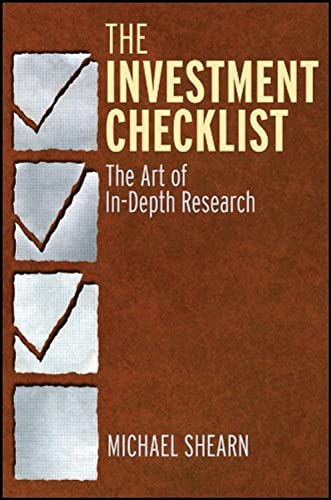
Investors often buy or sell stocks too quickly. When you base your purchase decisions on isolated facts and don't take the time to thoroughly understand the businesses you are buying, stock-price swings and third-party opinion can lead to costly investment mistakes. Your decision making at this point becomes dangerous because it is dominated by emotions. The Investment Checklist has been designed to help you develop an in-depth research process, from generating and researching investment ideas to assessing the quality of a business and its management team.
The purpose of The Investment Checklist is to help you implement a principled investing strategy through a series of checklists. In it, a thorough and comprehensive research process is made simpler through the use of straightforward checklists that will allow you to identify quality investment opportunities. Each chapter contains detailed demonstrations of how and where to find the information necessary to answer fundamental questions about investment opportunities. Real-world examples of how investment managers and CEOs apply these universal principles are also included and help bring the concepts to life. These checklists will help you consider a fuller range of possibilities in your investment strategy, enhance your ability to value your investments by giving you a holistic view of the business and each of its moving parts, identify the risks you are taking, and much more.
- Offers valuable insights into one of the most important aspects of successful investing, in-depth research
- Written in an accessible style that allows aspiring investors to easily understand and apply the concepts covered
- Discusses how to think through your investment decisions more carefully
With The Investment Checklist, you'll quickly be able to ascertain how well you understand your investments by the questions you are able to answer, or not answer, without making the costly mistakes that usually hinder other investors.
Die Inhaltsangabe kann sich auf eine andere Ausgabe dieses Titels beziehen.
Über die Autorin bzw. den Autor
Michael Shearn founded Time Value of Money, LP, a private investment firm, in 1996, to devote his attention to selecting and researching stocks and private investments. He launched the Compound Money Fund, LP, a concentrated value fund, in 2007. Shearn serves on the Investment Committee of Southwestern University, which oversees the school's $250 million endowment. He is also a member of the Advisory Board for the University of Texas MBA Investment Fund. Shearn graduated magna cum laude from Southwestern University, a small liberal arts college in Georgetown, Texas, with a BA in business, with an emphasis in accounting and finance. He lives with his wife and two daughters in Austin, Texas.
Von der hinteren Coverseite
Praise for THE INVESTMENT CHECKLIST
"Every wise investor will keep The Investment Checklist next to their financial instrument panel and consult it whenever they make a decision to buy or sell a stock."
―Robert P. Miles, author, The Warren Buffett CEO
"Michael Shearn has written an indispensable book. It will raise the game of every investor who reads it. Fortunately, not all of them will."
―Judd Kahn, co-author, Competition Demystified and Value Investing: From Graham to Buffett and Beyond
When you base your stock purchase decisions on isolated facts and don't take the time to thoroughly understand the businesses you're buying, costly investment mistakes are usually made. Instead, your investment purchases should be based on understanding the value of a business through in-depth research.
That's why Michael Shearn―founder of Time Value of Money, LP and the Compound Money Fund, LP―has created The Investment Checklist. In it, he shares the successful approach he's used over the past decade to generate and research investment ideas, assess the quality of a business and its management team, and ultimately improve his overall investment performance.
Along the way, you'll be introduced to specific "checklists" that will enhance your ability to understand the dynamics of the business you're interested in and the people operating it, value the potential investment, and make the most informed buy or sell decision possible. Each chapter also contains countless examples that show you exactly how the author's checklist has helped him make the right investment moves over the course of his successful professional career.
Whether you're just starting out and thinking about what you want to invest in, or already have a portfolio that you want to manage more effectively, The Investment Checklist has the tools and insights you need to improve your investment endeavors.
Aus dem Klappentext
All too often, investors buy stocks based on either recommendations from other investors, hunches, or isolated facts about a business they've heard or read about. In doing this, your decision-making process becomes dangerous because you haven't taken the time to thoroughly understand the businesses you are buying and you're relying on the information, or misinformation, being provided to you about a particular stock. Instead, your investment purchases should be based on understanding the value of a business through in-depth research. If you truly understand the value of a business, then you will be in a position to recognize investment opportunities and can more easily make the right buy or sell decisions.
The Investment Checklist has been designed to help you develop an in-depth research process, through a series of checklists, that will allow you to effectively generate and research investment ideas, assess the quality of a business and its management team, and ultimately improve the performance of your portfolio. In it, author Michael Shearn―founder of Time Value of Money, LP, and the Compound Money Fund, LP―outlines the systematic process he has used over the past decade to carefully think through potential investments and avoid common investment mistakes. Along the way, he puts this approach in perspective by addressing:
- A search strategy that will improve your odds of finding investment ideas worth researching further
- The importance of evaluating a business's strengths and weaknesses, measuring its operational and financial health, and understanding a business from the customers' perspective rather than your own
- Why assessing the quality of management― from how they handle daily operations and long-term strategy to the type of managers they are and how they rose to lead the business―are essential to achieving better investment results
- How to gauge the potential future growth opportunities of a business by looking at whether it's growing organically or through merger and acquisitions, and whether historical growth has been profitable
- And much more
Each chapter of The Investment Checklist also offers countless examples of companies the author has researched, considered investing in, and actually invested in or decided not to invest in. These examples show you exactly how his checklist helped him make investment decisions, and they'll show you how to do the same. In addition, each chapter ends with "Key Points to Keep in Mind," so you can zero in on the critical factors in each set of questions.
If you want to lower your investment risk you need to increase your knowledge of the businesses you buy stock in. The Investment Checklist will show you how to do this, and much more, by helping you follow a concise and easy-to-use framework that will guide your investment decisions.
Auszug. © Genehmigter Nachdruck. Alle Rechte vorbehalten.
The Investment Checklist
The Art of In-Depth ResearchBy Michael ShearnJohn Wiley & Sons
Copyright © 2012 John Wiley & Sons, LtdAll right reserved.
ISBN: 978-0-470-89185-8
Chapter One
How to Generate Investment Ideas
There are many ways you can generate investment ideas, some qualitative, some quantitative. Quantitative methods include looking at specific financial or operating metrics, whereas qualitative methods rely on more subjective characteristics, such as management strength, corporate culture, or competitive advantages. Whether you are running a complicated stock screen or simply getting ideas from other investors, all methods have their own advantages, limitations, and risks. Ultimately, the best method of generating ideas for you is the one that gives you the largest number of opportunities.
This chapter explores why stocks become undervalued, how to generate investment ideas, how to filter these ideas, and how to keep track of them. These steps are critical to creating a pool of stock ideas.
How Investment Opportunities Are Created
You can't manufacture investment opportunities. Instead, you need to be patient, and you have to be ready for the right opportunities. It is important to understand that good investment ideas are rare, and consistent success in the stock market is elusive. Those investors who believe that they can make money year after year in the stock market are setting themselves up for disappointment. Most investors are far too optimistic: They often think they've found great ideas when they haven't.
In contrast, investors with the best long-term track records have made most of their money with just a handful of investment ideas. For example, Warren Buffett states that his investment success is due to fewer than 20 ideas, such as the Washington Post newspaper, Coca-Cola, and GEICO. In short, you need to mentally prepare yourself in advance with the idea that you will not have many outstanding investments in your lifetime. Most investments you make will produce mediocre results, but a few can provide outstanding results.
The best investment opportunities usually come in big waves, such as when entire markets decline. There have been several recent examples: the Asian financial crisis of 1997 to 1998, the Internet bubble ending in 2000, and the recession starting in 2007. There were many buying opportunities in 2008 when the S&P 500 dropped 36 percent. This was caused by forced selling. The market sell-off was exacerbated by the indiscriminate selling of stocks by money managers who were forced to sell stocks to fund client redemptions. Even if these money managers knew these stocks were undervalued, they had no choice but to sell. This forced selling created artificially low prices—which created a rare opportunity for investors.
Other kinds of forced selling include situations when stocks are thrown out of an index because they no longer meet the minimum standards to remain in an index. Many investment managers who exclusively invest in stocks found in a particular index (such as the S&P 500) are forced to sell when the stock moves out of the index. Spin-offs (where a business divests a subsidiary) create a similar situation when the business that is spun off does not fit the investing criteria of an investment manager. Forced selling decreases prices—which creates opportunities.
Besides broad market sell-offs that create forced selling, the stock market has a way of magnifying different types of business and industry-wide risk that cause the stock prices of businesses to drop. To learn which area of the stock market is in greatest distress, look for those areas where capital is scarce. Scarcity of capital creates less competition for assets, which decreases prices. Ask yourself, what areas of the stock market are investors fleeing, and why?
You may want to begin by looking at the percentage change in prices of certain industries found in common indices such as the materials, energy, or financials subset of the S&P Composite 1500. For example, the price performance for components of the S&P Composite 1500 from April 23, 2010 to June 7, 2010 showed that:
• Materials were down 18 percent
• Energy was down 17 percent
• Utilities were down 9 percent
With that information, you might start researching the materials industry, looking for stocks that have significantly dropped in price. Ideally, you want to identify those stocks where the baby has been thrown out with the bathwater—and then rescue that baby!
Most stock price drops are due to some type of uncertainty about the business, and there are many possible reasons:
• Litigation fears
• Accounting irregularities
• Accusations of fraud
• Health concerns (such as swine flu)
• Execution problems due to a flawed strategy
• Management concerns
• Executive departures
• Government intervention or regulation
• Loss of a customer
• Technological changes
• Credit rating downgrades
• Competitor announcements
• Or a myriad of other reasons
In most of these cases, investors automatically assume the worst-case scenario and tend to sell stocks first and ask questions later. Once the reality starts to set in that the ultimate outcome will not be as bad as expected, then stock prices adjust and typically rise. Ideally, you want to identify those areas where the outlook is most pessimistic and identify whether the sources of pessimism are temporary or permanent. Let's look at an example.
Case Study: Investors' Pessimism about Heartland Payment Systems Proved Unfounded
In 2009, Heartland Payment Systems found itself in what appeared to be a disastrous scenario. Heartland helps small and mid-sized merchants with credit-card transactions, providing the physical card machine and payment-processing services that enable customers to use credit and debit cards in retail stores. In 2008, computer hackers installed spyware on Heartland's network and had gained access to the systems that process Visa, MasterCard, Discover, and American Express transactions.
After discovering the problem, Heartland announced details concerning the breach, including the number of months the spyware might have gathered card numbers and the number of transactions that the company usually processed. Framing it as potentially the largest data breach in history, the New York Times noted that 600 million or more card accounts were vulnerable, and quoted a data security analyst who said that there could be as much as $500 million in losses and other expenses if you added it all up. Early estimates were that Heartland would have to pay $2 per card for MC/Visa to reissue each affected card. The result? Investors quickly sold the stock. The price plummeted from $18 per share before the breach was announced (on January 6, 2009) to as low as $3.78 per share on March 9, 2009.
However, other investors with a solid base of research on the company and industry knew several things that helped them take advantage of this situation:
• First, they focused on Heartland's transaction count of 100 million transactions per month, and they recognized that not all of those would be from unique accounts. People tend to go the same places more than once. Later, more conservative estimates of stolen cards emerged at...
„Über diesen Titel“ kann sich auf eine andere Ausgabe dieses Titels beziehen.
Suchergebnisse für The Investment Checklist: The Art of In-Depth Research

Beispielbild für diese ISBN
The Investment Checklist: The Art of In-Depth Research
Anbieter: ThriftBooks-Dallas, Dallas, TX, USA
Verkäuferbewertung 5 von 5 Sternen

Hardcover. Zustand: Good. No Jacket. Pages can have notes/highlighting. Spine may show signs of wear. ~ ThriftBooks: Read More, Spend Less. Artikel-Nr. G0470891858I3N00
Gebraucht kaufen
EUR 27,58
Versand gratis
Versand innerhalb von USA
Versand innerhalb von USA
Anzahl: 1 verfügbar
Beispielbild für diese ISBN
The Investment Checklist: The Art of In-Depth Research
Anbieter: ThriftBooks-Dallas, Dallas, TX, USA
Verkäuferbewertung 5 von 5 Sternen
Hardcover. Zustand: Very Good. No Jacket. May have limited writing in cover pages. Pages are unmarked. ~ ThriftBooks: Read More, Spend Less. Artikel-Nr. G0470891858I4N00
Gebraucht kaufen
EUR 27,58
Versand gratis
Versand innerhalb von USA
Versand innerhalb von USA
Anzahl: 1 verfügbar
Beispielbild für diese ISBN
The Investment Checklist : The Art of in-Depth Research
Verlag:
Wiley & Sons, Incorporated, John, 2011
ISBN 10: 0470891858
ISBN 13: 9780470891858
Gebraucht
Hardcover
Anbieter: Better World Books, Mishawaka, IN, USA
Verkäuferbewertung 5 von 5 Sternen
Zustand: Fine. Used book that is in almost brand-new condition. May contain a remainder mark. Better World Books: Buy Books. Do Good. Artikel-Nr. 40302612-6
Gebraucht kaufen
EUR 33,98
Versand gratis
Versand innerhalb von USA
Versand innerhalb von USA
Anzahl: 1 verfügbar
Beispielbild für diese ISBN
The Investment Checklist: The Art of In-Depth Research
Anbieter: WorldofBooks, Goring-By-Sea, WS, Vereinigtes Königreich
Verkäuferbewertung 5 von 5 Sternen
Paperback. Zustand: Very Good. The book has been read, but is in excellent condition. Pages are intact and not marred by notes or highlighting. The spine remains undamaged. Artikel-Nr. GOR006572457
Gebraucht kaufen
EUR 32,04
EUR 6,62 Versand
Versand von Vereinigtes Königreich nach USA
Versand von Vereinigtes Königreich nach USA
Anzahl: 1 verfügbar
Beispielbild für diese ISBN
The Investment Checklist
Anbieter: PBShop.store UK, Fairford, GLOS, Vereinigtes Königreich
Verkäuferbewertung 5 von 5 Sternen
HRD. Zustand: New. New Book. Shipped from UK. Established seller since 2000. Artikel-Nr. FW-9780470891858
Neu kaufen
EUR 33,94
EUR 5,93 Versand
Versand von Vereinigtes Königreich nach USA
Versand von Vereinigtes Königreich nach USA
Anzahl: 11 verfügbar
Beispielbild für diese ISBN
The Investment Checklist
Anbieter: Majestic Books, Hounslow, Vereinigtes Königreich
Verkäuferbewertung 4 von 5 Sternen

Zustand: New. pp. 363. Artikel-Nr. 4308697
Neu kaufen
EUR 44,07
EUR 7,68 Versand
Versand von Vereinigtes Königreich nach USA
Versand von Vereinigtes Königreich nach USA
Anzahl: 3 verfügbar
Beispielbild für diese ISBN
The Investment Checklist: The Art of In-Depth Research
Anbieter: Ria Christie Collections, Uxbridge, Vereinigtes Königreich
Verkäuferbewertung 5 von 5 Sternen
Zustand: New. In English. Artikel-Nr. ria9780470891858_new
Neu kaufen
EUR 46,42
EUR 13,34 Versand
Versand von Vereinigtes Königreich nach USA
Versand von Vereinigtes Königreich nach USA
Anzahl: 11 verfügbar
Beispielbild für diese ISBN
The Investment Checklist The Art of InDepth Research
Anbieter: Revaluation Books, Exeter, Vereinigtes Königreich
Verkäuferbewertung 5 von 5 Sternen
Hardcover. Zustand: Brand New. 1st edition. 363 pages. 9.50x6.50x1.25 inches. In Stock. Artikel-Nr. __0470891858
Neu kaufen
EUR 47,93
EUR 14,77 Versand
Versand von Vereinigtes Königreich nach USA
Versand von Vereinigtes Königreich nach USA
Anzahl: 1 verfügbar
Beispielbild für diese ISBN
The Investment Checklist: The Art of In-Depth Research
Anbieter: Kennys Bookstore, Olney, MD, USA
Verkäuferbewertung 5 von 5 Sternen
Zustand: New. A practical guide to making more informed investment decisions Investors often buy or sell stocks too quickly. When you base your purchase decisions on isolated facts and don't take the time to thoroughly understand the businesses you are buying, stock-price swings and third-party opinion can lead to costly investment mistakes. Num Pages: 384 pages. BIC Classification: KFFM. Category: (P) Professional & Vocational. Dimension: 234 x 157 x 31. Weight in Grams: 604. . 2011. 1st Edition. Hardcover. . . . . Books ship from the US and Ireland. Artikel-Nr. V9780470891858
Neu kaufen
EUR 56,21
EUR 9,38 Versand
Versand innerhalb von USA
Versand innerhalb von USA
Anzahl: 11 verfügbar
Foto des Verkäufers
The Investment Checklist
Anbieter: moluna, Greven, Deutschland
Verkäuferbewertung 5 von 5 Sternen
Gebunden. Zustand: New. Michael Shearn founded Time Value of Money, LP, a private investment firm, in 1996, to devote his attention to selecting and researching stocks and private investments. He launched the Compound Money Fund, LP, a concentrated value fund, in 2007. Shearn serv. Artikel-Nr. 442935947
Neu kaufen
EUR 40,34
EUR 48,99 Versand
Versand von Deutschland nach USA
Versand von Deutschland nach USA
Anzahl: Mehr als 20 verfügbar