
Verwandte Artikel zu CliffsNotes GRE General Test Cram Plan 2nd Edition
Inhaltsangabe
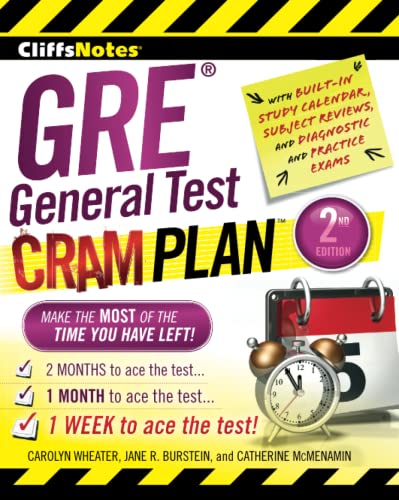
Get a plan to ace the exam—and make the most of the time you have left.
Whether you have two months, one month, or even just a week left before the exam, you can turn to the experts at CliffsNotes for a trusted and achievable cram plan to ace the GRE General Test—without ever breaking a sweat!
First, you'll determine exactly how much time you have left to prepare for the exam. Then, you'll turn to the two-month, one-month, or one-week cram plan for week-by-week and day-by-day schedules of the best way to focus your study according to your unique timeline.
Each stand-alone plan includes:
Diagnostic test—helps you pinpoint your strengths and weaknesses so you can focus your review on the topics in which you need the most help
Subject reviews—cover everything you can expect on the actual exam: text completions, sentence equivalences, vocabulary, reading comprehension, analytical writing, arithmetic, algebra, geometry, and applications
Full-length practice test with answers and detailed explanations—a simulated GRE exam gives you an authentic test-taking experience
Test-prep essentials from the experts at CliffsNotes
Reflects changes to the latest GRE General Test
Make the most of the time you have left!
2 months to ace the test...
1 month to ace the test...
1 week to ace the test!
Die Inhaltsangabe kann sich auf eine andere Ausgabe dieses Titels beziehen.
Über die Autorin bzw. den Autor
Carolyn Wheater teaches math at The Nightingale-Bamford School in New York,New York.
Jane R. Burstein is a private test-prep tutor.
Catherine McMenamin teaches English at The Nightingale-Bamford School.
Auszug. © Genehmigter Nachdruck. Alle Rechte vorbehalten.
CliffsNotes GRE General Test Cram Plan
By Carolyn Wheater Catherine McMenamin Jane R. BursteinJohn Wiley & Sons
Copyright © 2011 John Wiley & Sons, LtdAll right reserved.
ISBN: 978-0-470-87873-6
Chapter One
Diagnostic Test
Section 1: Verbal Reasoning
Time: 30 minutes
20 questions
Directions (1–6): For each blank, select the word or phrase that best completes the text. (Your answer will consist of one, two, or three letters, depending on the number of blanks in each question.)
1. With a __________ common among those to whom short-term fixes are expedient, Senator Noah Julian refused to consider a complete overhaul of the election funding issue.
A. aestheticism
B. myopia
C. skepticism
D. inventiveness
E. paranoia
2. Settling into what he thought would be cosmopolitan suburban community, Seth was confounded by the __________ of his neighbors.
A. erudition
B. urbanity
C. insularity
D. gentility
E. affluence
3. In his interesting preface, Mr. Shorthouse alludes to William Smith's philosophical novel, Thorndale. As a picture of thought developments in the early Victorian period, the work has special historical interest for the (1) __________ and theological student; in this respect, it may be (2) __________ to Pater's Marius the Epicurean, which also vividly reproduces the intellectual ferment of an earlier age.
Blank 1 Blank 2
philosophical abstracted secular adapted antithetical likened
4. Indeed, it is a source of common (1) __________ among engineers, who smirk that the average layman cannot differentiate between the man who runs a locomotive and the man who designs a locomotive. In ordinary (2) __________, both are called engineers.
Blank 1 Blank 2
irritation parlance wrath colloquialism amusement hyperbole
5. The Sheaf Gleaned in French Fields is certainly the most imperfect of Toru Dutt's writings, but it is not the least interesting. It is a wonderful mixture of strength and weakness, of genius (1) __________ great obstacles and of talent succumbing to ignorance and inexperience. That it should have been performed at all is so extraordinary that we forget to be surprised at its (2) __________. The English verse is sometimes (3) __________; at other times the rules of our prosody are absolutely ignored, and it is obvious that the Hindu poetess was chanting to herself a music that is discord in an English ear.
Blank 1 Blank 2 Blank 3
performing constancy exquisite overriding propinquity gauche recapitulating unevenness unintelligible
Directions (7–12): Questions follow each of the passages. Using only the stated or implied information in each passage, answer the questions.
Questions 7–9 are based on the following passage.
The Vietnam War began in 1956 and ended in 1975. It had dire consequences for millions of Americans. The American military pushed forward to South Vietnam to assist its government against the communist regime, who were supported by North Vietnam. By the late 1960s, the United States entered this war in which almost 60,000 Americans would die. Two million Vietnamese lives may have been lost, including those of many thousands of civilians, due to intensive bombing by the opponents. Also, a highly toxic chemical caused defoliation, the elimination of vegetation. The Vietnam War is estimated to have cost approximately $200 billion.
Returning Vietnam veterans, approximately 2.7 million in all, did not receive a positive welcome from American civilians. Instead, they returned to widespread public opposition. Their moral opposition to the war made it difficult for many Americans to show support for these veterans.
6. One step in social order leads to another, and thus is furnished a means of utilizing without waste all of the individual and social forces. Yet how irregular and (1) __________ are the first steps of human progress. A step forward, followed by a long period of readjustment of the conditions of life; a movement forward here and a (2) __________ force there. Within this irregular movement we discover the true course of human progress. One tribe, on account of peculiar advantages, makes a special discovery, which places it in the (3) __________ and gives it power over others.
Blank 1 Blank 2 Blank 3
catastrophic retarding echelon dramatic dominating nadir faltering impulsive ascendancy
A few years after the Vietnam War, veterans started a fund for construction of a memorial to those who had died; they raised nearly $9 million. A competition was held for the proper design, with the proviso that the memorial should not express any political view of the war.
In a funerary design course at Yale University, 21-year-old architecture student Maya Lin submitted a proposal for the design competition for the memorial. The popular conception of a war memorial recalled the heroic equestrian statues of Civil War generals, but in Lin's opinion, such representations were too simplified. Her design consisted of two walls of polished black granite built into the earth, set in the shape of a shallow V. Carved into the stone are the names of all the men and women killed in the war or still missing, in chronological order by the date of their death or disappearance. Rising up 10 feet high, the names begin and continue to that wall's end, resuming at the point of the opposite wall and ending at the place where the names began. Visitors can easily access the wall and touch the names, an integral part of Lin's design.
After the judges evaluated thousands of entries for this competition in the spring of 1981, Maya Lin won. The public's reaction to this particular design was sharply divided, reflecting their opposing feelings about this war. Yet more than one million visitors view the memorial each year.
7. What is the author's primary purpose of the passage?
A. To propose ideas about Maya Lin's submission from Yale University
B. To dissect the Vietnam Memorial's proposition
C. To discuss the history of the design of the Vietnam Memorial and the response to it
D. To critique the judges reviewing Lin's sculptural proposal
E. To discuss the history of the Vietnam War and its aftermath
8. Select the sentence that presents Lin's reasons for not creating a conventional war memorial.
9. What details in the narrative suggest that it was possible to fulfill the requirement that the monument express no political view of the war?
A. Those opposing it said it degraded the memory of those who had given their lives to this cause.
B. The United States government wanted a memorial that would honor the dead.
C. Carved into the stone are the names of all the men and women killed in the war or still missing, in chronological order by the date of their death or disappearance.
D. One wall points toward the Washington Monument and the other wall points toward the Lincoln Memorial, bringing the Vietnam Memorial into proper historical reference.
E. Many Americans were unwilling to confront the...
„Über diesen Titel“ kann sich auf eine andere Ausgabe dieses Titels beziehen.
Suchergebnisse für CliffsNotes GRE General Test Cram Plan 2nd Edition

Beispielbild für diese ISBN
CliffsNotes GRE General Test C
Anbieter: World of Books (was SecondSale), Montgomery, IL, USA
Verkäuferbewertung 5 von 5 Sternen

Zustand: Very Good. Item in very good condition! Textbooks may not include supplemental items i.e. CDs, access codes etc. Artikel-Nr. 00093875240
Gebraucht kaufen
EUR 5,68
Versand gratis
Versand innerhalb von USA
Versand innerhalb von USA
Anzahl: 1 verfügbar
Beispielbild für diese ISBN
CliffsNotes GRE General Test C
Anbieter: World of Books (was SecondSale), Montgomery, IL, USA
Verkäuferbewertung 5 von 5 Sternen
Zustand: Good. Item in good condition. Textbooks may not include supplemental items i.e. CDs, access codes etc. Artikel-Nr. 00101778711
Gebraucht kaufen
EUR 5,68
Versand gratis
Versand innerhalb von USA
Versand innerhalb von USA
Anzahl: 2 verfügbar
Beispielbild für diese ISBN
CliffsNotes GRE General Test Cram Plan: 2nd Edition (CliffsNotes Cram Plan)
Verlag:
CliffsNotes (edition 2), 2011
ISBN 10: 0470878738
ISBN 13: 9780470878736
Gebraucht
Paperback
Anbieter: BooksRun, Philadelphia, PA, USA
Verkäuferbewertung 5 von 5 Sternen
Paperback. Zustand: Very Good. 2. It's a well-cared-for item that has seen limited use. The item may show minor signs of wear. All the text is legible, with all pages included. It may have slight markings and/or highlighting. Artikel-Nr. 0470878738-11-1
Gebraucht kaufen
EUR 5,69
Versand gratis
Versand innerhalb von USA
Versand innerhalb von USA
Anzahl: 1 verfügbar
Beispielbild für diese ISBN
Cliffsnotes GRE General Test Cram Plan 2nd Edition
Anbieter: ThriftBooks-Dallas, Dallas, TX, USA
Verkäuferbewertung 5 von 5 Sternen
Paperback. Zustand: Fair. No Jacket. Readable copy. Pages may have considerable notes/highlighting. ~ ThriftBooks: Read More, Spend Less. Artikel-Nr. G0470878738I5N00
Gebraucht kaufen
EUR 5,98
Versand gratis
Versand innerhalb von USA
Versand innerhalb von USA
Anzahl: 1 verfügbar
Beispielbild für diese ISBN
GRE General Test Cram Plan
Verlag:
Houghton Mifflin Harcourt Publishing Company, 2011
ISBN 10: 0470878738
ISBN 13: 9780470878736
Gebraucht
Softcover
Anbieter: Better World Books, Mishawaka, IN, USA
Verkäuferbewertung 5 von 5 Sternen
Zustand: Good. 2nd Edition. Pages intact with minimal writing/highlighting. The binding may be loose and creased. Dust jackets/supplements are not included. Stock photo provided. Product includes identifying sticker. Better World Books: Buy Books. Do Good. Artikel-Nr. 578428-75
Gebraucht kaufen
EUR 9,95
Versand gratis
Versand innerhalb von USA
Versand innerhalb von USA
Anzahl: 1 verfügbar