
Verwandte Artikel zu The SABR/LIBOR Market Model: Pricing, Calibration and...
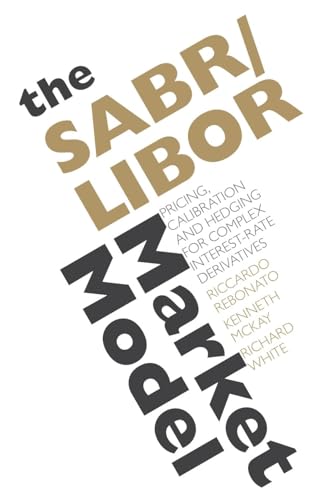
The SABR/LIBOR Market Model: Pricing, Calibration and Hedging for Complex Interest-Rate Derivatives - Hardcover
Inhaltsangabe
This book presents a major innovation in the interest rate space. It explains a financially motivated extension of the LIBOR Market model which accurately reproduces the prices for plain vanilla hedging instruments (swaptions and caplets) of all strikes and maturities produced by the SABR model. The authors show how to accurately recover the whole of the SABR smile surface using their extension of the LIBOR market model. This is not just a new model, this is a new way of option pricing that takes into account the need to calibrate as accurately as possible to the plain vanilla reference hedging instruments and the need to obtain prices and hedges in reasonable time whilst reproducing a realistic future evolution of the smile surface. It removes the hard choice between accuracy and time because the framework that the authors provide reproduces today's market prices of plain vanilla options almost exactly and simultaneously gives a reasonable future evolution for the smile surface.
The authors take the SABR model as the starting point for their extension of the LMM because it is a good model for European options. The problem, however with SABR is that it treats each European option in isolation and the processes for the various underlyings (forward and swap rates) do not talk to each other so it isn't obvious how to relate these processes into the dynamics of the whole yield curve. With this new model, the authors bring the dynamics of the various forward rates and stochastic volatilities under a single umbrella. To ensure the absence of arbitrage they derive drift adjustments to be applied to both the forward rates and their volatilities. When this is completed, complex derivatives that depend on the joint realisation of all relevant forward rates can now be priced.
Contents
THE THEORETICAL SET-UP
The Libor Market model
The SABR Model
The LMM-SABR Model
IMPLEMENTATION AND CALIBRATION
Calibrating the LMM-SABR model to Market Caplet prices
Calibrating the LMM/SABR model to Market Swaption Prices
Calibrating the Correlation Structure
EMPIRICAL EVIDENCE
The Empirical problem
Estimating the volatility of the forward rates
Estimating the correlation structure
Estimating the volatility of the volatility
HEDGING
Hedging the Volatility Structure
Hedging the Correlation Structure
Hedging in conditions of market stress
Die Inhaltsangabe kann sich auf eine andere Ausgabe dieses Titels beziehen.
Über die Autorin bzw. den Autor
RICCARDO REBONATO is Global Head of Market Risk and Global Head of the Quantitative Research Team at RBS. He is a visiting lecturer at Oxford University (Mathematical Finance) and adjunct professor at Imperial College (Tanaka Business School). He sits on the Board of Directors of ISDA and on the Board of Trustees for GARP. He is an editor for the International Journal of Theoretical and Applied Finance, for Applied Mathematical Finance, for the Journal of Risk and for the Journal of Risk Management in Financial Institutions. He holds doctorates in Nuclear Engineering and in Science of Materials/Solid State Physics. He was a research fellow in Physics at Corpus Christi College, Oxford, UK.
KENNETH MCKAY is a PhD student at the London School of Economics following a first class honours degree in Mathematics and Economics from the LSE and an MPhil in Finance from Cambridge University. He has been working on interest rate derivative-related research with Riccardo Rebonato for the past year.
RICHARD WHITE holds a doctorate in Particle Physics from Imperial College London, and a first class honours degree in Physics from Oxford University. He held a Research Associate position at Imperial College before joining RBS in 2004 as a Quantitative Analyst. His research interests include option pricing with Levy Processes, Genetic Algorithms for portfolio optimisation, and Libor Market Models with stochastic volatility. He is currently taking a fortuitously timed sabbatical to pursue his joint passion for travel and scuba diving.
Von der hinteren Coverseite
the SABR/LIBOR Market Model
PRICING, CALIBRATION AND HEDGING FOR COMPLEX INTEREST-RATE DERIVATIVES
"This is the best of Rebonato's books. The conversational spirit of the previous manuscripts is here pleasantly retained. But, the value added is the mathematical rigor that permeates the description of the proposed model. Definitely a must."
"Fabio Mercurio, Senior Quantitative Analyst, Bloomberg New York
"A book that has all the hallmarks of Riccardo Rebonato: rigorous theory, up-to-date market knowledge, practical application, and empirical testing to destruction. This time, with co-authors, he applies himself to the most central banking market: LIBOR-related contracts."
"Ian Cooper, Professor of Finance, London Business School
"In this concise book Riccardo Rebonato and his co-authors introduce a new financially motivated model combining the best features of the Libor Market and SABR models. The authors provide a useful roadmap to pricing, calibrating, and hedging interest rate derivatives in the new framework. The book will be of interest to practitioners and academics alike."
"Alexander Lipton, Managing Director, Merrill Lynch and Visiting Professor, Imperial College
Aus dem Klappentext
the SABR/LIBOR Market Model
PRICING, CALIBRATION AND HEDGING FOR COMPLEX INTEREST-RATE DERIVATIVES
"This is the best of Rebonato's books. The conversational spirit of the previous manuscripts is here pleasantly retained. But, the value added is the mathematical rigor that permeates the description of the proposed model. Definitely a must."
"Fabio Mercurio, Senior Quantitative Analyst, Bloomberg New York
"A book that has all the hallmarks of Riccardo Rebonato: rigorous theory, up-to-date market knowledge, practical application, and empirical testing to destruction. This time, with co-authors, he applies himself to the most central banking market: LIBOR-related contracts."
"Ian Cooper, Professor of Finance, London Business School
"In this concise book Riccardo Rebonato and his co-authors introduce a new financially motivated model combining the best features of the Libor Market and SABR models. The authors provide a useful roadmap to pricing, calibrating, and hedging interest rate derivatives in the new framework. The book will be of interest to practitioners and academics alike."
"Alexander Lipton, Managing Director, Merrill Lynch and Visiting Professor, Imperial College
Auszug. © Genehmigter Nachdruck. Alle Rechte vorbehalten.
The SABRI/LIBOR Market Model
Pricing, Calibration and Hedging for Complex Interest-Rate DerivatesBy Riccardo Rebonato Kenneth McKay Richard WhiteJohn Wiley & Sons
Copyright © 2009 Riccardo Rebonato, Kenneth McKay and Richard WhiteAll right reserved.
ISBN: 978-0-470-74005-7
Chapter One
Introduction
All models are wrong, but some models are useful
We present in this book a financially motivated extension of the LIBOR market model that reproduces for all strikes and maturities the prices of the plain-vanilla hedging instruments (swaptions and caplets) produced by the SABR model. In other words, our extension of the LIBOR market model accurately recovers in a financially motivated manner the whole of the SABR smile surface.
As the SABR model has become the 'market standard' for European options, just the recovery of the smile surface by a dynamic model could be regarded as a useful achievement in itself. However, we have tried to do more. As we have stressed in the opening sentences, we have tried to accomplish this task in a way that we consider financially justifiable.
Our reason for insisting on financial reasonableness is not (just) an aesthetic one. We believe that the quality of a derivatives model should be judged not just on the basis of its ability to price today's hedging instruments, but also on the basis of the quality of the hedges it suggests. We believe that these hedges can be good only if the model is rooted in empirical financial reality. The 'empirical financial reality' of relevance for the pricing and hedging of complex derivatives is the dynamics of the smile surface. We explain below why we believe that this is the case.
We are therefore not just offering yet another model. We present a 'philosophy' of option pricing that takes into account the realities of the industry needs (e.g., the need to calibrate as accurately as possible to the plain-vanilla reference hedging instruments, the need to obtain prices and hedges in reasonable time) while reproducing a realistic future evolution of the smile surface (our 'financial reality').
Until recently choosing between fitting today's prices very accurately and being respectful of 'financial reality' (given our meaning of the term) entailed making hard choices. For instance, some approaches, such as local-volatility modelling (see, e.g., Dupire (1994), Derman and Kani (1994)), fulfilled (by construction) very well the first set of requirements (perfect fitting of today's smile). This made local volatility models very popular with some traders. Yet, the dynamics of the smile these models implied were completely wrong. Indeed, the SABR model, which constitutes the starting point for our extension, was introduced to remedy the wrong dynamics imposed by the local-volatility framework.
On the other hand, financially much more palatable models, such as the Variance Gamma model (see, e.g., Madan and Seneta (1990)) and its 'stochastic volatility' extensions (see, e.g., Madan and Carr (1998)), have failed to gain acceptance in the trading rooms because of their computational cost and, above all, the difficulties in achieving a quick and stable calibration to current market prices. These prices may be 'wrong' and the Variance Gamma models 'right', but this is not a discussion the complex derivatives trader is interested in entering into - and probably wisely so.
We believe that these hard choices no longer have to be made. The framework we present recovers almost exactly today's market prices of plain-vanilla options, and at the same time implies a reasonable future evolution for the smile surface. We say 'reasonable' and not 'optimal'. The evolution our model implies is not the 'best' from an econometric point of view. Two of us (RR and RW), for instance, believe that a two-state Markov-chain model for the instantaneous volatility does a much better job at describing how smile surfaces evolve, especially in times of market turmoil. We have published extensively in this area (see, e.g., Rebonato and Kainth (2004) and White and Rebonato (2008)), and our ideas have been well received in academic circles. Yet we are aware that the approach, even after all the numerical tricks we have discovered, remains too awkward for daily use on the trading floor. It is destined to remain 'another interesting model'. This is where the need for realism comes into play. We believe that the extension of the LMM that we present provides a plausible description of our financial reality while retaining tractability, computational speed and ease of calibration.
As we said, we take the SABR model (Hagan et al.) as the starting point for our extension of the LMM. This is not just because the SABR model has become the market standard to reproduce the price of European options. It is also because it is a good model for European options. Again, pragmatism certainly played a part in its specification as well. A log-normal choice for the volatility process is not ideal, both from a theoretical and (sometimes) from a computational point of view. However, the great advantages afforded by the ability to have an analytic approximation to the true prices, the ease of calibration and the stability of the fitted parameters have more than offset these drawbacks. The main strength of the SABR model, however, is that it is financially justifiable, not just a fitting exercise: the dynamics it implies for the smile evolution when the underlying changes are fundamentally correct - unlike the dynamics suggested by the even-better-fitting local-volatility model.
If the SABR model is so good, why do we need to tinker with it? The problem with the SABR model is that it treats each European option (caplet, swaption) in isolation - in its own measure. The processes for the various underlyings (the forward rates and swap rates) do not 'talk to each other'. It is not obvious how to link these processes together in a coherent dynamics for the whole yield curve. The situation is strongly reminiscent of the pre-LMM days. In those days market practitioners were using the Black (1976) formula for different caplets and swaptions (each with its own 'implied volatility'), but did not know how to link the processes together for the various forward rates to a coherent, arbitrage-free evolution for the whole yield curve. This is what the LMM achieved: it brought all the forward rates under a single measure, and specified dynamics that, thanks to the no-arbitrage 'drift adjustments', were simultaneously valid for all the underlyings. Complex instruments could then be priced (with a deterministic volatility).
We are trying to do something very similar. With our model we bring the dynamics of the various forward rates and stochastic volatilities under a single measure. To ensure absence of arbitrage we also derive 'drift adjustments'. Not surprisingly, these have to be applied both to the forward rates and to their volatilities. When this is done, complex derivatives, which depend on the joint realization of all the relevant forward rates, can now be priced.
All of this is not without a price: when the volatilities become stochastic, there is a whole new set of functions to specify (the volatilities of the volatilities). There is also a whole correlation structure to assign: forward-rate/forward-rate correlations, as in the LMM; but also the forward-rate/volatility and volatility/volatility correlations. For, say, a 10-year, quarterly deal, this could provide a fitting junky with hundreds of parameters to play with. Since implying process parameters from...
„Über diesen Titel“ kann sich auf eine andere Ausgabe dieses Titels beziehen.
Suchergebnisse für The SABR/LIBOR Market Model: Pricing, Calibration and...

Beispielbild für diese ISBN
The SABR/LIBOR Market Model: Pricing, Calibration and Hedging for Complex Interest-Rate Derivatives
Anbieter: World of Books (was SecondSale), Montgomery, IL, USA
Verkäuferbewertung 5 von 5 Sternen

Hardback. Zustand: Good. This book presents a major innovation in the interest rate space. It explains a financially motivated extension of the LIBOR Market model which accurately reproduces the prices for plain vanilla hedging instruments (swaptions and caplets) of all strikes and maturities produced by the SABR model. Artikel-Nr. CIN0470740051G
Gebraucht kaufen
EUR 11,88
Versand gratis
Versand innerhalb von USA
Versand innerhalb von USA
Anzahl: 1 verfügbar
Beispielbild für diese ISBN
The SABR/LIBOR Market Model : Pricing, Calibration and Hedging for Complex Interest-Rate Derivatives
Verlag:
Wiley & Sons, Incorporated, John, 2009
ISBN 10: 0470740051
ISBN 13: 9780470740057
Gebraucht
Hardcover
Anbieter: Better World Books, Mishawaka, IN, USA
Verkäuferbewertung 5 von 5 Sternen
Zustand: Very Good. Pages intact with possible writing/highlighting. Binding strong with minor wear. Dust jackets/supplements may not be included. Stock photo provided. Product includes identifying sticker. Better World Books: Buy Books. Do Good. Artikel-Nr. 48897062-20
Gebraucht kaufen
EUR 14,12
Versand gratis
Versand innerhalb von USA
Versand innerhalb von USA
Anzahl: 1 verfügbar
Beispielbild für diese ISBN
The SABR/LIBOR Market Model : Pricing, Calibration and Hedging for Complex Interest-Rate Derivatives
Verlag:
Wiley & Sons, Incorporated, John, 2009
ISBN 10: 0470740051
ISBN 13: 9780470740057
Gebraucht
Hardcover
Anbieter: Better World Books Ltd, Dunfermline, Vereinigtes Königreich
Verkäuferbewertung 5 von 5 Sternen
Zustand: Good. Pages intact with minimal writing/highlighting. The binding may be loose and creased. Dust jackets/supplements are not included. Stock photo provided. Product includes identifying sticker. Better World Books: Buy Books. Do Good. Artikel-Nr. 67481831-20
Gebraucht kaufen
EUR 15,51
EUR 5,96 Versand
Versand von Vereinigtes Königreich nach USA
Versand von Vereinigtes Königreich nach USA
Anzahl: 1 verfügbar
Beispielbild für diese ISBN
The SABR/LIBOR Market Model: Pricing, Calibration and Hedging for Complex Interest-Rate Derivatives
Anbieter: Phatpocket Limited, Waltham Abbey, HERTS, Vereinigtes Königreich
Verkäuferbewertung 5 von 5 Sternen
Zustand: Good. Your purchase helps support Sri Lankan Children's Charity 'The Rainbow Centre'. Shows some signs of wear but in good overall condition. Our donations to The Rainbow Centre have helped provide an education and a safe haven to hundreds of children who live in appalling conditions. Artikel-Nr. Z1-R-040-02473
Gebraucht kaufen
EUR 52,55
EUR 12,69 Versand
Versand von Vereinigtes Königreich nach USA
Versand von Vereinigtes Königreich nach USA
Anzahl: 1 verfügbar
Beispielbild für diese ISBN
The SABR/LIBOR Market Model: Pricing, Calibration and Hedging for Complex Interest Rate Derivatives
Anbieter: WorldofBooks, Goring-By-Sea, WS, Vereinigtes Königreich
Verkäuferbewertung 5 von 5 Sternen
Hardback. Zustand: Very Good. The book has been read, but is in excellent condition. Pages are intact and not marred by notes or highlighting. The spine remains undamaged. Artikel-Nr. GOR005753924
Gebraucht kaufen
EUR 59,22
EUR 6,68 Versand
Versand von Vereinigtes Königreich nach USA
Versand von Vereinigtes Königreich nach USA
Anzahl: 2 verfügbar
Beispielbild für diese ISBN
The SABR/LIBOR Market Model
Anbieter: PBShop.store UK, Fairford, GLOS, Vereinigtes Königreich
Verkäuferbewertung 5 von 5 Sternen
HRD. Zustand: New. New Book. Shipped from UK. Established seller since 2000. Artikel-Nr. FW-9780470740057
Neu kaufen
EUR 78,87
EUR 5,99 Versand
Versand von Vereinigtes Königreich nach USA
Versand von Vereinigtes Königreich nach USA
Anzahl: 15 verfügbar
Beispielbild für diese ISBN
The SABR/LIBOR Market Model: Pricing, Calibration and Hedging for Complex Interest-Rate Derivatives
Anbieter: Ria Christie Collections, Uxbridge, Vereinigtes Königreich
Verkäuferbewertung 5 von 5 Sternen
Zustand: New. In English. Artikel-Nr. ria9780470740057_new
Neu kaufen
EUR 88,82
EUR 13,46 Versand
Versand von Vereinigtes Königreich nach USA
Versand von Vereinigtes Königreich nach USA
Anzahl: Mehr als 20 verfügbar
Beispielbild für diese ISBN
The Sabr/Libor Market Model
Anbieter: Majestic Books, Hounslow, Vereinigtes Königreich
Verkäuferbewertung 4 von 5 Sternen

Zustand: New. pp. 296. Artikel-Nr. 7397215
Neu kaufen
EUR 102,83
EUR 7,75 Versand
Versand von Vereinigtes Königreich nach USA
Versand von Vereinigtes Königreich nach USA
Anzahl: 3 verfügbar
Beispielbild für diese ISBN
The SABR/LIBOR Market Model pricing, calibration and hedging for complex interest-rate derivatives
Verlag:
John Wiley & Sons Limited, Chichester, 2009
ISBN 10: 0470740051
ISBN 13: 9780470740057
Neu
Hardcover
Anbieter: MARCIAL PONS LIBRERO, MADRID, M, Spanien
Verkäuferbewertung 4 von 5 Sternen
TAPA DURA. Zustand: New. Artikel-Nr. 100842077
Neu kaufen
EUR 97,34
EUR 21,00 Versand
Versand von Spanien nach USA
Versand von Spanien nach USA
Anzahl: 1 verfügbar
Beispielbild für diese ISBN
The SABR/LIBOR Market Model: Pricing, Calibration and Hedging for Complex Interest-Rate Derivatives
Anbieter: Kennys Bookstore, Olney, MD, USA
Verkäuferbewertung 5 von 5 Sternen
Zustand: New. 2009. 1st Edition. Hardcover. This book presents a major innovation in the interest rate space. It explains a financially motivated extension of the LIBOR Market model which accurately reproduces the prices for plain vanilla hedging instruments (swaptions and caplets) of all strikes and maturities produced by the SABR model. Num Pages: 296 pages, black & white tables, figures. BIC Classification: KFFM. Category: (P) Professional & Vocational. Dimension: 252 x 177 x 22. Weight in Grams: 660. . . . . . Books ship from the US and Ireland. Artikel-Nr. V9780470740057
Neu kaufen
EUR 125,87
EUR 9,35 Versand
Versand innerhalb von USA
Versand innerhalb von USA
Anzahl: Mehr als 20 verfügbar