
Verwandte Artikel zu Metal Amide Chemistry
Inhaltsangabe
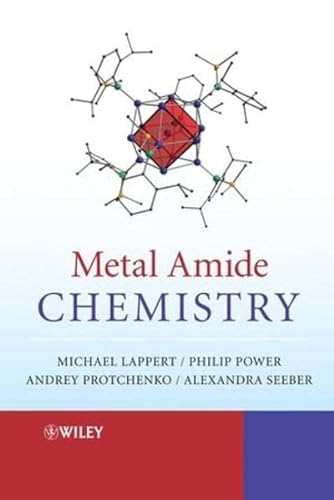
Written by internationally recognised leaders in the field, Metal Amide Chemistry is the authoritative survey of this important class of compounds, the first since Lappert and Power's 1980 book "Metal and Metalloid Amides."
An introduction to the topic is followed by in-depth discussions of the amide compounds of:
* alkali metals
* alkaline earth metals
* zinc, cadmium and mercury
* the transition metals
* group 3 and lanthanide metals
* group 13 metals
* silicon and the group 14 metals
* group 15 metals
* the actinide metals
Accompanied by a substantial bibliography, this is an essential guide for researchers and advanced students in academia and research working in synthetic organometallic, organic and inorganic chemistry, materials chemistry and catalysis.
Die Inhaltsangabe kann sich auf eine andere Ausgabe dieses Titels beziehen.
Über die Autorin bzw. den Autor
Michael Lappert is Emeritus Research Professor of Chemistry at the University of Sussex. A graduate of Northern Polytechnic, his B.S.c. was followed by a Ph.D. (with W. Gerard to which in 1960 he added a D.Sc. (University of London). He has been at Sussex since 1964, having previously been at UMIST (1959-1964). He was the recipient of the first chemical Society Award for Main Group Metal chemistry (1970) and then of the chemistry (1976); with the RSC (he was its Dalton Division President, 1989-1991), he has been a Tilden (1972), Nyholm (1994), and Sir Edward Frankland (1998) Medallist and Lecturer. In 2008, he was awarded the GDCh Alfred-Stock Prize. he was elected FRS in 1979 and was award an honorary doctorate from Ludwig-Maximilians-Universitat (Munchen, 1989). With co-workers he has published 2 books, edited 4 others, and more than 780 papers and reviews and a few patents on various aspects of inorganic and organometallic chemistry.
Philip Power received a b.A. from trinity college Dublin in 1974 and a D. Phil, under M. F. Lappert from the University of Sussex in 1977. After postdoctoral studies with R.H. Holm at Stanford University, he joined the faculty at the department of Chemistry at the University of California at Davis in 1981, where he is a Distinguished Professor of chemistry. His main interests lie in the exploratory synthesis of new main-group and transition-metal complexes. A major theme of his work has been the use of sterically crowded ligands to stabilize species with new types of bonding, low coordination numbers, and high reactivity. He has been the recipient of several awards including the A. P. Sloan Foundation Fellow (1985), Alexander von Humboldt Fellowship for Senior U. S. Scientist (1992), Ludwig Mond Medal of the Royal Society of Chemistry (2005), F.A. Cotton Award in Synthetic Inorganic Chemistry of the American Chemical Society (2005) and was elected Fellow of the Royal Society of London (FRS) (2005).
Andrey Protchenko was born in 1961 in Rostov-on-Don, Russia. A graduate of the Moscow State University (Russia) in 1983, he carried out his doctoral work at the Karpov Institute of physical Chemistry (Moscow) and completed his Ph.D. in chemistry (1997) at the Razuvaev Institute of Organometallic Chemistry (Nizhny Novgorod) under the supervision of Prof. M. N. Bochkarev studying naphthalene complexes of the lanthanides. In 1998 he joined the group of Prof. M. F. Lappert at the University of Sussex (England) working on a series of projects (Royal Society, EPSRC and Leverhulme trust grants) involving lanthanide redox chemistry based on cyclopentadienyl, N- and N, N' -centred ligands.
Alexandra Seeber, nee Pickering, was born in 1979 in Lichfield, UK. After graduating in chemistry at Keele University in 2001 and completing a Ph.D. in Inorganic Chemistry into the design and synthesis of ligands for the controlled self-assembly of tr5ansition metal complexes at the University of Glasgow (Scotland) in 2004, she carried out postdoctoral research into nanoparticle synthesis at the University of California, Davis with Prof. Philip Power under a Department of energy grant for the Design of high surface area materials as hydrogen storage vessels. Alexandra Seeber has worked since 2006 in Research and development in the catalysis department at BASF in Ludwigshafen (Germany).
Von der hinteren Coverseite
Metal amides are amongst the most important classes of chemical compounds. These molecules have an extensive chemistry, with considerable and versatile applications as synthetic intermediates, reagents, catalysts and sources of valuable materials, including in nanotechnology.
Metal Amide Chemistry is a comprehensive overview of these important compounds, written by leading experts in the field. An introduction to the chemistry of these molecules is followed by in-depth discussions of the amide compounds of:
- alkali metals
- alkaline earth metals
- group 3 and lanthanide metals
- the actinide metals
- the transition metals
- zinc, cadmium and mercury
- group 13 metals
- silicon and the group 14 metals (subvalent compounds)
- group 15 metals
Metal Amide Chemistry is an essential guide to this important class of compounds for researchers and advanced students in academia and industry working in synthetic organometallic, organic and inorganic chemistry, materials chemistry and catalysis.
Aus dem Klappentext
Metal amides are amongst the most important classes of chemical compounds. These molecules have an extensive chemistry, with considerable and versatile applications as synthetic intermediates, reagents, catalysts and sources of valuable materials, including in nanotechnology.
Metal Amide Chemistry is a comprehensive overview of these important compounds, written by leading experts in the field. An introduction to the chemistry of these molecules is followed by in-depth discussions of the amide compounds of:
- alkali metals
- alkaline earth metals
- group 3 and lanthanide metals
- the actinide metals
- the transition metals
- zinc, cadmium and mercury
- group 13 metals
- silicon and the group 14 metals (subvalent compounds)
- group 15 metals
Metal Amide Chemistry is an essential guide to this important class of compounds for researchers and advanced students in academia and industry working in synthetic organometallic, organic and inorganic chemistry, materials chemistry and catalysis.
Auszug. © Genehmigter Nachdruck. Alle Rechte vorbehalten.
Metal Amide Chemistry
By Michael Lappert Andrey Protchenko Philip Power Alexandra SeeberJohn Wiley & Sons
Copyright © 2009 John Wiley & Sons, LtdAll right reserved.
ISBN: 978-0-470-72184-1
Chapter One
Introduction
1.1 Scope and Organisation of Subject Matter
Our principal focus is to describe the synthesis, structure, reactions and applications of metal amides and related compounds which are stable at ambient temperatures, and particularly those which are mono-, di- or oligonuclear. Thus, the main thrust is on compounds having one or more [bar.N]](R)R' ligands attached to a metal M. Such species are now known for all the natural elements (and Np and Pu), except for the lighter rare gases. In the present treatise, M is restricted to an element of Groups 1, 2, 3 and a 4f metal, a lighter 5f metal, and a metal of Groups 4 to 11, 12, 13 (except B), 14 (excluding [M.sup.IV] compounds as reagents), and 15 (excluding P); these are described in Chapters 2 to 10, respectively.
The amido ligand may be [bar.N][H.sub.2], [bar.N]](H)R, and [bar.N]](R)R', in which R and R' are the same or different, and each is an alkyl, aryl, or silyl (particularly Si[Me.sub.3]) group; selected N[H.sub.2]-metal compounds feature mainly in Chapters 2, 3, 6, 7 and 8. The amido ligand may be bound to the metal in a terminal or bridging (double or single) fashion; examples of the latter are [[Sn(N[Me.sub.2])(-N[Me.sub.2])].sub.2] and [[Cu(-N[Me.sub.2])].sub.4]. Within our scope for main group and f-elements are bi- and tri-dentate ligands, including not only N,N'- and N,N',N"-centred species such as 1; 2-[C.sub.6][H.sub.4][([bar.N]C[H.sub.2][Bu.sup.t]).sub.2] and MeC[{Si[(Me).sub.2][bar.N][Bu.sup.t]}.sub.3] but also others with a single amido site such as 1. Tetradentate encapsulating ligands are excluded; their more natural home is to be found for the most part in textbooks of organic and biological chemistry and, more recently, materials chemistry. Amide-free metal complexes containing some N,N'-bidentate ligands which are neutral (e.g. bipy) or monoanionic (e.g. amidinates, guanidinates, or -diketiminates) are also outside our scope.
Imides are usually included for main group elements because bi- and oligonuclear metal imides are ubiquitous and were often developed in parallel with the amides. They generally feature trivalent nitrogen, as in [[As(Cl)( -N[bu.sup.t])].sub.2]. Imido derivatives of the transition metals are not widely covered, as their chemistry is quite extensive and distinct from that of the amides. In general mononuclear metal imides are more frequent in d- and f-block chemistry; examples are [Ti(=N[C.sub.6][H.sub.3][Pr.sup.i.sub.2]-2,6) (N[Me.sub.2])[(NH[Me.sub.2]).sub.3]][B[([C.sub.6][F.sub.5]).sub.4]] or [U{[(N(Si[Me.sub.2][Bu.sup.t])C[H.sub.2]C[H.sub.2]).sub.3]N}(=Nsi[Me.sub.3])], but rare examples are also found in main group metal compounds having bulky ligands, as in [In{[C.sub.6][H.sub.3][([C.sub.6][H.sub.3] [Pr.sup.i.sub.2]-2',6').sub.2]-2,6}-{=N[C.sub.6][H.sub.3][([C.sub.6][H.sub.3] [Me.sub.2]-2',6').sub.2]-2,6}]. The majority of metal amides and related compounds are neutral, but cationic and anionic complexes have featured; examples are [MATHEMATICAL EXPRESSION NOT REPRODUCIBLE IN ASCII]. Compounds considered are mainly homometallic, but several are heterometallic such as the inverse crown complex [MATHEMATICAL EXPRESSION NOT REPRODUCIBLE IN ASCII].
1.2 Developments and Perspectives
In 1980, metal and metalloid amides were already known for 57 elements, but then excluded were amides of the following elements: Sr, Ba, Tb, Dy, Er, Tm, Ru, Os, Rh, Ir and Pd (for several others, the first publications were post-1970: Sc, Y, La, Ce, Pr, Nd, Sm, Eu, Gd, Ho, Yb, Lu, Re, In and Tl). Since then, these lacunae have been filled. The variety of metal oxidation states for metal amides has also greatly expanded since 1980. The literature on metal amides has likewise burgeoned. For example, in the 1980 book there were 119 and 317 bibliographic citations for Group 1 and a conglomerate of Group 3 and 4f/5f and d-metal amides, respectively, whereas there are now 263 and 1110 for these two sections, respectively. Our aim has been to provide a comprehensive, but not exhaustive, coverage of the field of metal amides, with emphasis on the post-1980 developments through to the end of 2007. The total number of references for the succeeding Chapters 2 to 10 is in excess of 2500, while for these topics there were 923 citations in 1980.
Tables 1.1 and 1.2, laid out in the form of a Periodic Table, provide (i) a list of the elements, (ii) in brackets after each entry, the metal oxidation states for its amides, and (iii) the number of literature citations for each group of metals. Highlighted in bold are those metals for which amides were reported in the post-1979 period, while in italics are those metal oxidation states which likewise are of more recent date.
The variety of amido ligands now in use is very large. Many are bulky and often are free of -hydrogen atoms. Among the newer monodentate amides are [bar.N][Cy.sub.2] (Cy = cyclohexyl), [bar.N][(SiH[Me.sub.2]).sub.2], [bar.N][(Si[Me.sub.2][Bu.sup.t]).sub.2], [bar.N][(Si[Me.sub.3])[C.sub.6][H.sub.3][Pr.sup.i.sub.2]-2,6], [bar.N][(Si[Me.sub.3]){[C.sub.6][H.sub.3][([C.sub.6][H.sub.2] [Me.sub.3]-2',4',6').sub.2]-2,6}], and [bar.N][Ad[C.sub.6][H.sub.3] [Me.sub.2]-3,5)]. Bi- and tridentate amides include not only those which are solely N-centred such as [bar.N](R)CH=CH[bar.N]R or X[{C[H.sub.2]C[H.sub.2] [bar.N][Bu.sup.t]}.sub.3] (X = Si[Bu.sup.t] or N), but others in which the ligating atoms are not exclusively nitrogen: for illustrations of such ligands see 6-12 and 26-54 in Chapter 4.
Numerous amidometallates (several as cluster compounds) and, more rarely, cationic complexes, are well established. Representative examples of such salts are [[KMg[(N[Pr.sup.i.sub.2]).sub.3]].sub.[infinity]], [Ti[(N[Me.sub.2]).sub.3] [(py).sub.2]][B[Ph.sub.4]], [[Pt(-Cl){SnCl[(N[R.sub.2]).sub.2]} (P[Et.sub.3])].sub.2] (R = Si[Me.sub.3]), [Li[(thf).sub.4]] [Ni[(N[Ph.sub.2]).sub.3]], [U[(N[Et.sub.2]).sub.2][(py).sub.2]] [[B[Ph.sub.4]].sub.2], [As([C.sub.5][Me.sub.5])(N[Me.sub.2])][Al[Cl.sub.4]] and Li[[Sb.sub.3][(-NCy).sub.4][(N[Me.sub.2]).sub.2]].
A feature of the post-1980 literature on mononuclear metal amides has been the discovery of numerous low-coordinate metal complexes. Significant examples among neutral compounds are the crystalline unicoordinate Group 13 metal and the dicoordinate [Si.sup.II] and Group 15 metal amides [Ga{N(Si[Me.sub.3])[C.sub.6][H.sub.3] [Mes.sub.2]-2,6}], [MATHEMATICAL EXPRESSION NOT REPRODUCIBLE IN ASCII] and [As{N(H)Mes*}(=NMes*)] (Mes = [C.sub.6][H.sub.2][Me.sub.3]-2,4,6; Mes* = [C.sub.6][H.sub.2][Bu.sup.t.sub.3]-2,4,6). The highest metal coordination number recorded for a homo- or heteroleptic metal amide containing only monodentate ligands is six, in [M[(N[Me.sub.2]).sub.6]] (M = Mo or W), or seven, in [U[(N[Et.sub.2]).sub.2][(py).sub.5]][[B[Ph.sub.4]].sub.2], respectively. The highest metal oxidation state of +6 is found not only in the Mo and W hexa(dimethylamides) but also for U, originally in trans-[U[(O).sub.2]- [{N[(Si[Me.sub.3]).sub.2]}.sub.2][(thf).sub.2]]; U[(N[Me.sub.2]).sub.6] was found to be thermally labile.
Bi-, tri- and oligonuclear compounds have ring, fused ring, or cluster core geometries, which feature [bar.N](R)R' as bridging ligands. For oligonuclear aggregates, the fused rings...
„Über diesen Titel“ kann sich auf eine andere Ausgabe dieses Titels beziehen.
Suchergebnisse für Metal Amide Chemistry

Foto des Verkäufers
Metal Amide Chemistry
Anbieter: WeBuyBooks, Rossendale, LANCS, Vereinigtes Königreich
Verkäuferbewertung 5 von 5 Sternen

Zustand: Good. Most items will be dispatched the same or the next working day. A copy that has been read but remains in clean condition. All of the pages are intact and the cover is intact and the spine may show signs of wear. The book may have minor markings which are not specifically mentioned. Artikel-Nr. rev7433909604
Gebraucht kaufen
EUR 80,36
EUR 10,01 Versand
Versand von Vereinigtes Königreich nach USA
Versand von Vereinigtes Königreich nach USA
Anzahl: 1 verfügbar
Foto des Verkäufers
Metal Amide Chemistry
Anbieter: moluna, Greven, Deutschland
Verkäuferbewertung 5 von 5 Sternen
Gebunden. Zustand: New. Professor Michael LappertDepartment of Chemistry and Biochemistry, University of Sussex, UKProfessor Lappert is a Fellow of the Royal Society, and Emeritus Research Professor at the University of Sussex.Professor Philip PowerDepartment of Chemistry, Univers. Artikel-Nr. 556557857
Neu kaufen
EUR 177,07
EUR 48,99 Versand
Versand von Deutschland nach USA
Versand von Deutschland nach USA
Anzahl: Mehr als 20 verfügbar
Beispielbild für diese ISBN
Metal Amide Chemistry
Anbieter: Kennys Bookstore, Olney, MD, USA
Verkäuferbewertung 5 von 5 Sternen
Zustand: New. Written by internationally recognised leaders in the field, Metal Amide Chemistry is the authoritative survey of this important class of compounds, the first since Lappert and Power's 1980 book "Metal and Metalloid Amides. Num Pages: 370 pages, Illustrations. BIC Classification: PNN. Category: (P) Professional & Vocational; (UP) Postgraduate, Research & Scholarly. Dimension: 252 x 176 x 25. Weight in Grams: 772. . 2008. . . . . Books ship from the US and Ireland. Artikel-Nr. V9780470721841
Neu kaufen
EUR 221,48
EUR 9,07 Versand
Versand innerhalb von USA
Versand innerhalb von USA
Anzahl: 15 verfügbar