
Verwandte Artikel zu How to be a Quantitative Ecologist: The 'A to R'...
Inhaltsangabe
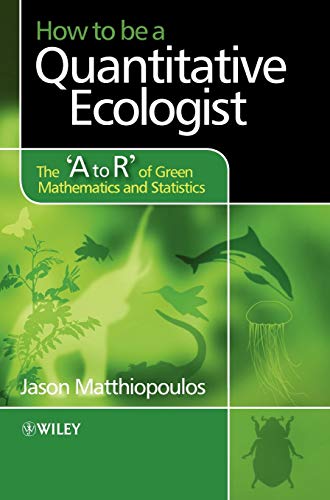
How to be a Quantitative Ecologist: The 'A to R' of Green Mathematics and Statistics
Ecological research is becoming increasingly quantitative, yet students often opt out of courses in mathematics and statistics, unwittingly limiting their ability to carry out research in the future. This textbook provides a practical introduction to quantitative ecology for students and practitioners who have realised that they need this opportunity.
The text is addressed to readers who haven't used mathematics since school, who were perhaps more confused than enlightened by their undergraduate lectures in statistics and who have never used a computer for much more than word processing and data entry. From this starting point, it slowly but surely instils an understanding of mathematics, statistics and programming, sufficient for initiating research in ecology. The book's practical value is enhanced by extensive use of biological examples and the computer language R for graphics, programming and data analysis.
Key Features:
- Provides a complete introduction to mathematics statistics and computing for ecologists.
- Presents a wealth of ecological examples demonstrating the applied relevance of abstract mathematical concepts, showing how a little technique can go a long way in answering interesting ecological questions.
- Covers elementary topics, including the rules of algebra, logarithms, geometry, calculus, descriptive statistics, probability, hypothesis testing and linear regression.
- Explores more advanced topics including fractals, non-linear dynamical systems, likelihood and Bayesian estimation, generalised linear, mixed and additive models, and multivariate statistics.
- R boxes provide step-by-step recipes for implementing the graphical and numerical techniques outlined in each section.
How to be a Quantitative Ecologist provides a comprehensive introduction to mathematics, statistics and computing and is the ideal textbook for late undergraduate and postgraduate courses in environmental biology.
"With a book like this, there is no excuse for people to be afraid of maths, and to be ignorant of what it can do."
―Professor Tim Benton, Faculty of Biological Sciences, University of Leeds, UK
Die Inhaltsangabe kann sich auf eine andere Ausgabe dieses Titels beziehen.
Über die Autorin bzw. den Autor
Jason Matthiopoulos, Lecturer in biology (University of St Andrews). He is a senior researcher in the Sea Mammal Research Unit and member of the Centre for Ecological and Environmental Modelling.
Von der hinteren Coverseite
Ecological research is becoming increasingly quantitative, yet students often opt out of courses in mathematics and statistics, unwittingly limiting their ability to carry out research in the future. This textbook provides a practical introduction to quantitative ecology for students and practitioners who have realised that they need this opportunity.
The text is addressed to readers who haven't used mathematics since school, who were perhaps more confused than enlightened by their undergraduate lectures in statistics and who have never used a computer for much more than word processing and data entry. From this starting point, it slowly but surely instils an understanding of mathematics, statistics and programming, sufficient for initiating research in ecology. The book's practical value is enhanced by extensive use of biological examples and the computer language R for graphics, programming and data analysis.
Key Features:
- Provides a complete introduction to mathematics statistics and computing for ecologists.
- Presents a wealth of ecological examples demonstrating the applied relevance of abstract mathematical concepts, showing how a little technique can go a long way in answering interesting ecological questions.
- Covers elementary topics, including the rules of algebra, logarithms, geometry, calculus, descriptive statistics, probability, hypothesis testing and linear regression.
- Explores more advanced topics including fractals, non-linear dynamical systems, likelihood and Bayesian estimation, generalised linear, mixed and additive models, and multivariate statistics.
- R boxes provide step-by-step recipes for implementing the graphical and numerical techniques outlined in each section.
- A companion website www.wiley.com/go/quantitative_ecologist is specifically designed for independent study.
How to be a Quantitative Ecologist provides a comprehensive introduction to mathematics, statistics and computing and is the ideal textbook for late undergraduate and postgraduate courses in environmental biology.
'With a book like this, there is no excuse for people to be afraid of maths, and to be ignorant of what it can do.’ – Professor Tim Benton, Faculty of Biological Sciences, University of Leeds, UK
Companion Website
www.wiley.com/go/quantitative_ecologist
Aus dem Klappentext
"With a book like this, there is no excuse for people to be afraid of maths, and to be ignorant of what it can do."
―Professor Tim Benton, Faculty of Biological Sciences, University of Leeds, UK
„Über diesen Titel“ kann sich auf eine andere Ausgabe dieses Titels beziehen.
Suchergebnisse für How to be a Quantitative Ecologist: The 'A to R'...

Beispielbild für diese ISBN
How to Be a Quantitative Ecologist
Anbieter: PBShop.store UK, Fairford, GLOS, Vereinigtes Königreich
Verkäuferbewertung 5 von 5 Sternen

HRD. Zustand: New. New Book. Shipped from UK. Established seller since 2000. Artikel-Nr. FW-9780470699782
Neu kaufen
EUR 130,39
EUR 7,87 Versand
Versand von Vereinigtes Königreich nach USA
Versand von Vereinigtes Königreich nach USA
Anzahl: 15 verfügbar
Beispielbild für diese ISBN
How to be a Quantitative Ecologist: The 'A to R' of Green Mathematics and Statistics (Aerospace Series (Pep))
Anbieter: Ria Christie Collections, Uxbridge, Vereinigtes Königreich
Verkäuferbewertung 5 von 5 Sternen
Zustand: New. In English. Artikel-Nr. ria9780470699782_new
Neu kaufen
EUR 133,45
EUR 17,39 Versand
Versand von Vereinigtes Königreich nach USA
Versand von Vereinigtes Königreich nach USA
Anzahl: Mehr als 20 verfügbar
Beispielbild für diese ISBN
How to be a Quantitative Ecologist
Anbieter: Majestic Books, Hounslow, Vereinigtes Königreich
Verkäuferbewertung 4 von 5 Sternen

Zustand: New. pp. 490. Artikel-Nr. 5530631
Neu kaufen
EUR 172,61
EUR 7,57 Versand
Versand von Vereinigtes Königreich nach USA
Versand von Vereinigtes Königreich nach USA
Anzahl: 3 verfügbar
Foto des Verkäufers
How to be a Quantitative Ecologist
Anbieter: moluna, Greven, Deutschland
Verkäuferbewertung 5 von 5 Sternen
Gebunden. Zustand: New. Ecological research is becoming increasingly quantitative, yet students often opt out of courses in mathematics and statistics, unwittingly limiting their ability to carry out research in the future. This textbook provides a practical introduction to quanti. Artikel-Nr. 446913417
Neu kaufen
EUR 146,80
EUR 48,99 Versand
Versand von Deutschland nach USA
Versand von Deutschland nach USA
Anzahl: Mehr als 20 verfügbar
Beispielbild für diese ISBN
How to be a Quantitative Ecologist The 'A to R' of Green Mathematics and Statistics
Anbieter: Revaluation Books, Exeter, Vereinigtes Königreich
Verkäuferbewertung 5 von 5 Sternen
Hardcover. Zustand: Brand New. 1st edition. 496 pages. 10.00x7.00x1.00 inches. In Stock. Artikel-Nr. x-0470699787
Neu kaufen
EUR 200,51
EUR 14,55 Versand
Versand von Vereinigtes Königreich nach USA
Versand von Vereinigtes Königreich nach USA
Anzahl: 2 verfügbar
Beispielbild für diese ISBN
How to be a Quantitative Ecologist: The A to R of Green Mathematics and Statistics
Anbieter: Kennys Bookstore, Olney, MD, USA
Verkäuferbewertung 5 von 5 Sternen
Zustand: New. How to Be a Quantitative Ecologist is comprised of two equal parts on mathematics and statistics with emphasis on quantitative skills. A major component of this guide is computer implementation techniques, accompanied by computer practicals using the language R. Num Pages: 490 pages, Illustrations. BIC Classification: PBT; PBW; PSAF; RB. Category: (P) Professional & Vocational. Dimension: 244 x 179 x 35. Weight in Grams: 946. . 2011. 1st Edition. Hardcover. . . . . Books ship from the US and Ireland. Artikel-Nr. V9780470699782
Neu kaufen
EUR 211,46
EUR 9,15 Versand
Versand innerhalb von USA
Versand innerhalb von USA
Anzahl: Mehr als 20 verfügbar
Foto des Verkäufers
How to be a Quantitative Ecologist
Anbieter: AHA-BUCH GmbH, Einbeck, Deutschland
Verkäuferbewertung 5 von 5 Sternen
Buch. Zustand: Neu. Neuware - Ecological research is becoming increasingly quantitative, yet students often opt out of courses in mathematics and statistics, unwittingly limiting their ability to carry out research in the future. This textbook provides a practical introduction to quantitative ecology for students and practitioners who have realised that they need this opportunity.The text is addressed to readers who haven't used mathematics since school, who were perhaps more confused than enlightened by their undergraduate lectures in statistics and who have never used a computer for much more than word processing and data entry. From this starting point, it slowly but surely instils an understanding of mathematics, statistics and programming, sufficient for initiating research in ecology. The book's practical value is enhanced by extensive use of biological examples and the computer language R for graphics, programming and data analysis.Key Features:\* Provides a complete introduction to mathematics statistics and computing for ecologists.\* Presents a wealth of ecological examples demonstrating the applied relevance of abstract mathematical concepts, showing how a little technique can go a long way in answering interesting ecological questions.\* Covers elementary topics, including the rules of algebra, logarithms, geometry, calculus, descriptive statistics, probability, hypothesis testing and linear regression.\* Explores more advanced topics including fractals, non-linear dynamical systems, likelihood and Bayesian estimation, generalised linear, mixed and additive models, and multivariate statistics.\* R boxes provide step-by-step recipes for implementing the graphical and numerical techniques outlined in each section.How to be a Quantitative Ecologist provides a comprehensive introduction to mathematics, statistics and computing and is the ideal textbook for late undergraduate and postgraduate courses in environmental biology.'With a book like this, there is no excuse for people to be afraid of maths, and to be ignorant of what it can do.'--Professor Tim Benton, Faculty of Biological Sciences, University of Leeds, UK. Artikel-Nr. 9780470699782
Neu kaufen
EUR 189,21
EUR 37,63 Versand
Versand von Deutschland nach USA
Versand von Deutschland nach USA
Anzahl: 2 verfügbar