
Verwandte Artikel zu Collider: The Search for the World's Smallest Particles
Inhaltsangabe
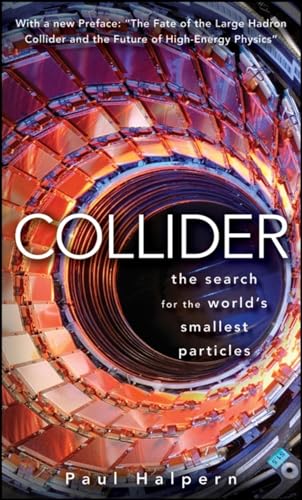
An accessible look at the hottest topic in physics and the experiments that will transform our understanding of the universe
The biggest news in science today is the Large Hadron Collider, the world's largest and most powerful particle-smasher, and the anticipation of finally discovering the Higgs boson particle. But what is the Higgs boson and why is it often referred to as the God Particle? Why are the Higgs and the LHC so important? Getting a handle on the science behind the LHC can be difficult for anyone without an advanced degree in particle physics, but you don't need to go back to school to learn about it. In Collider, award-winning physicist Paul Halpern provides you with the tools you need to understand what the LHC is and what it hopes to discover.
* Comprehensive, accessible guide to the theory, history, and science behind experimental high-energy physics
* Explains why particle physics could well be on the verge of some of its greatest breakthroughs, changing what we think we know about quarks, string theory, dark matter, dark energy, and the fundamentals of modern physics
* Tells you why the theoretical Higgs boson is often referred to as the God particle and how its discovery could change our understanding of the universe
* Clearly explains why fears that the LHC could create a miniature black hole that could swallow up the Earth amount to a tempest in a very tiny teapot
* "Best of 2009 Sci-Tech Books (Physics)"-Library Journal
* "Halpern makes the search for mysterious particles pertinent and exciting by explaining clearly what we don't know about the universe, and offering a hopeful outlook for future research."-Publishers Weekly
* Includes a new author preface, "The Fate of the Large Hadron Collider and the Future of High-Energy Physics"
The world will not come to an end any time soon, but we may learn a lot more about it in the blink of an eye. Read Collider and find out what, when, and how.
Die Inhaltsangabe kann sich auf eine andere Ausgabe dieses Titels beziehen.
Über die Autorin bzw. den Autor
PAUL HALPERN, PhD, is Professor of Physics at the University of the Sciences in Philadelphia. He is the author of numerous books, including The Great Beyond and What's Science Ever Done For Us?, both available from Wiley.
Von der hinteren Coverseite
"Paul Halpern makes the search for mysterious particles pertinent and exciting by explaining clearly what we don't know about the universe, and offering a hopeful outlook for future research."
--Publishers Weekly
"Paul Halpern is a gifted writer who brings science and scientists alive. This is a wonderful introduction to the world of high-energy physics, where gigantic machines and tiny particles meet."
--Kenneth Ford, retired director of the American Institute of Physics and author of The Quantum World: Quantum Physics for Everyone
"Professor Paul Halpern takes the reader on a stimulating odyssey on topics ranging from particle physics and dark matter to unexplored dimensions of space. . . . Buy this book and feed your mind!"
--Dr. Cliff Pickover, author of Archimedes to Hawking and The Math Book
"With clarity and a Sagan-esque gift for explanation, Paul Halpern traces the story of how physicists use immensely powerful machines to probe the deepest mysteries of existence. Halpern also conclusively debunks the ludicrous claims that the Large Hadron Collider and other high-energy physics experiments threaten to destroy anything--except our residual ignorance about the nature and workings of our wondrous universe."
--Mark Wolverton, author of The Science of Superman and A Life in Twilight: The Final Years of J. Robert Oppenheimer
The biggest news in science today is the world's largest and most powerful particle-smasher, the Large Hadron Collider, and the anticipation of finally discovering the Higgs boson particle. But what is the Higgs boson and why is it often referred to as the God particle? Why are the Higgs and the LHC so important? Getting a handle on the science behind the LHC can be difficult for anyone without an advanced degree in particle physics, but you don't need to go back to school to learn about it. In Collider, award-winning physicist Paul Halpern provides you with the tools you need to understand what the LHC is and what it hopes to discover.
Auszug. © Genehmigter Nachdruck. Alle Rechte vorbehalten.
Collider
The Search for the World's Smallest ParticlesBy Paul HalpernJohn Wiley & Sons
Copyright © 2010 John Wiley & Sons, LtdAll right reserved.
ISBN: 978-0-470-64391-4
Chapter One
The Secrets of Creation
When in the height heaven was not named, And the earth beneath did not yet bear a name, And the primeval Apsu, who begat them, And chaos, Tiamut, the mother of them both Their waters were mingled together, And no field was formed, no marsh was to be seen; When of the gods none had been called into being, And none bore a name, and no destinies were ordained ... —ENUMA ELISH, THE BABYLONIAN EPIC OF CREATION, TRANSLATED BY L. W. KING
Hidden among the haze of cosmic dust and radiation, buried in the very soil we walk upon, locked away in the deep structure of everything we see, feel, or touch, lie the secrets of our universal origins. Like the gleaming faces of a beautiful but impenetrable diamond, each facet of creation offers a glimpse of a wonderful, yet inscrutable, unity. With probing intellect, humankind longs to cut through the layers and reach the core of truth that underlies all things. What is the universe made of? What are the forces that affect our universe? How was the universe created?
Ancient Greek philosophers offered competing explanations of what constitutes the tiniest things. In the fifth century BCE, Leucippus and Democritus, the founders of atomism, argued that materials could be broken down only so far before their basic constituents would be reached. They imagined these smallest, unbreakable pieces, or "atoms," as possessing a variety of shapes and sizes, like an exotic assortment of pebbles and shells. Another view, proposed by Empedocles, is that everything is a mixture of four elements: fire, water, air, and earth. Aristotle supplemented these with a fifth essence, the void. For two millennia these classical elements were the assumed building blocks of creation until scientific experimentation prodded Europe toward an empirical view of nature.
In his influential book The Sceptical Chymist, Robert Boyle (16271–691) demonstrated that fire, air, earth, and water couldn't realistically be combined to create the extraordinary range of materials on Earth. He argued for a new definition of the term "element" based on the simplest ingredients comprising any substance. Chemists could identify these, he argued, by breaking things down into their most basic parts, rather than through relying on philosophical speculation. Boyle's clever insight challenged experimenters to discover, through a variety of methods, the true chemical elements—familiar to us (in no particular order) as hydrogen, oxygen, carbon, nitrogen, sulphur, and so forth. Whenever children today combine assorted liquids and powders in their chemistry sets, set off bubbling reactions, and concoct colorful, smelly, gooey by-products, they owe a debt to Boyle.
Boyle was an ardent atomist and a meticulous experimenter. Refusing to accept the hypothesis on faith alone, he developed a clever experiment designed to test the concept that materials are made of small particles—which he called corpuscles—with empty space between them. He started with a curved glass tube, exposed to the air on one end and closed on the other. Filling the open end with mercury, he trapped some of the air in the tube and pressed it into a smaller and smaller volume. Then, by slowly removing the mercury, he noted that the trapped air expanded in inverse proportion to its pressure (a relationship now called Boyle's law). He reasoned that this could happen only if the air was made of tiny components separated by gaps.
Manchester chemist John Dalton was an earnest young Quaker whose research about how different substances react with one another and combine led him to the spectacular insight that each chemical element is composed of atoms with distinct characteristics. Dalton was the first, in fact, to use the word "atom" in the modern sense: the smallest component of a chemical element that conveys its properties.
Dalton developed a clever visual shorthand for showing how different atoms combine. He depicted each type of element as a circle with a distinctive mark in the center—for example, hydrogen with a dot, sodium (which he called "soda") with two vertical lines, and silver with the letter "s." Dalton counted twenty elements; today we know of ninety-two natural elements and at least twenty-five more that can be produced artificially. By arranging his circular symbols into various patterns, he showed how compounds such as water and carbon dioxide could be assembled from the "Lego blocks" of elements such as hydrogen, oxygen, and carbon. In what he called the law of multiple proportions, he demonstrated that the elements forming particular substances always combined in the same fixed ratios.
Dalton also attempted to characterize atoms by their relative weights. Although many of his estimates were off, his efforts led to simple arithmetical ways of understanding chemistry. In 1808, Scottish chemist Thomas Thomson combined oxalic acid (a compound of hydrogen, carbon, and oxygen) with several different elements, including strontium and potassium, and produced a variety of salts. Weighing these salts, he found proportionalities corresponding to differences in the elements he used. Thomson's results, published in his book A System of Chemistry, helped Dalton's theories gain wide acceptance in the scientific community.
One thing that Dalton's theories couldn't do was predict new elements. Arranging atoms in order of their relative weights didn't offer enough information or impetus for scientists to infer that others existed. It's as if a mother brought three of her sons to a new school to register them and reported only their names and ages. Without saying more about her family, the teachers there would have no reason to believe she had other kids that were older, younger, or in between.
Indeed the family of elements was much larger than Dalton surmised. By the mid-nineteenth century the number of known elements had tripled to about sixty. Curiously, some of these had shared properties—even ones associated with much different atomic weights. For example, sodium and potassium, though separated in terms of weight, seemed to react with other substances in similar ways.
In the late 1860s, Russian chemist Dmitry Mendeleyev decided to write a state-of-the-art chemistry textbook. To illustrate the great progress in atomic theory, he included a chart depicting all of the then-known elements in order of weight. In a bold innovation, he listed the elements in table form with each row representing elements with similar properties. By doing so, he illustrated that elements fall into patterns. Some of the spaces in what became known as the periodic table he left blank, pointing to elements he predicted would later be discovered. He was absolutely right; like a solved Sudoku puzzle, all of the gaps in his table were eventually filled.
Science didn't realize the full significance of Mendeleyev's discovery until the birth of quantum mechanics decades later. The periodic table's patterns reveal that the Democritean term "atom" is really a misnomer; atoms are indeed "breakable." Each atom is a world unto itself governed by laws that supersede Newtonian mechanics. These laws mandate a...
„Über diesen Titel“ kann sich auf eine andere Ausgabe dieses Titels beziehen.
Suchergebnisse für Collider: The Search for the World's Smallest Particles

Beispielbild für diese ISBN
Collider The Search for the Wo
Anbieter: World of Books (was SecondSale), Montgomery, IL, USA
Verkäuferbewertung 5 von 5 Sternen

Zustand: Good. Item in good condition. Textbooks may not include supplemental items i.e. CDs, access codes etc. Artikel-Nr. 00110875315
Gebraucht kaufen
EUR 5,42
Versand gratis
Versand innerhalb von USA
Versand innerhalb von USA
Anzahl: 1 verfügbar
Beispielbild für diese ISBN
Collider: The Search for the World's Smallest Particles
Anbieter: ThriftBooks-Dallas, Dallas, TX, USA
Verkäuferbewertung 5 von 5 Sternen
Paperback. Zustand: Very Good. No Jacket. May have limited writing in cover pages. Pages are unmarked. ~ ThriftBooks: Read More, Spend Less. Artikel-Nr. G0470643919I4N00
Gebraucht kaufen
EUR 6,03
Versand gratis
Versand innerhalb von USA
Versand innerhalb von USA
Anzahl: 1 verfügbar
Beispielbild für diese ISBN
Collider: The Search for the World's Smallest Particles
Anbieter: ThriftBooks-Dallas, Dallas, TX, USA
Verkäuferbewertung 5 von 5 Sternen
Paperback. Zustand: Good. No Jacket. Pages can have notes/highlighting. Spine may show signs of wear. ~ ThriftBooks: Read More, Spend Less. Artikel-Nr. G0470643919I3N00
Gebraucht kaufen
EUR 6,03
Versand gratis
Versand innerhalb von USA
Versand innerhalb von USA
Anzahl: 1 verfügbar
Beispielbild für diese ISBN
Collider: The Search for the World's Smallest Particles
Anbieter: ThriftBooks-Atlanta, AUSTELL, GA, USA
Verkäuferbewertung 5 von 5 Sternen
Paperback. Zustand: Very Good. No Jacket. May have limited writing in cover pages. Pages are unmarked. ~ ThriftBooks: Read More, Spend Less. Artikel-Nr. G0470643919I4N00
Gebraucht kaufen
EUR 6,03
Versand gratis
Versand innerhalb von USA
Versand innerhalb von USA
Anzahl: 1 verfügbar
Beispielbild für diese ISBN
Collider: The Search for the World's Smallest Particles
Anbieter: ThriftBooks-Atlanta, AUSTELL, GA, USA
Verkäuferbewertung 5 von 5 Sternen
Paperback. Zustand: Good. No Jacket. Pages can have notes/highlighting. Spine may show signs of wear. ~ ThriftBooks: Read More, Spend Less. Artikel-Nr. G0470643919I3N00
Gebraucht kaufen
EUR 6,03
Versand gratis
Versand innerhalb von USA
Versand innerhalb von USA
Anzahl: 1 verfügbar
Beispielbild für diese ISBN
Collider: The Search for the World's Smallest Particles
Anbieter: Wonder Book, Frederick, MD, USA
Verkäuferbewertung 5 von 5 Sternen
Zustand: Good. Good condition. A copy that has been read but remains intact. May contain markings such as bookplates, stamps, limited notes and highlighting, or a few light stains. Artikel-Nr. R04C-03029
Gebraucht kaufen
EUR 6,32
Versand gratis
Versand innerhalb von USA
Versand innerhalb von USA
Anzahl: 1 verfügbar
Beispielbild für diese ISBN
Collider : The Search for the World's Smallest Particles
Verlag:
Wiley & Sons Canada, Limited, John, 2010
ISBN 10: 0470643919
ISBN 13: 9780470643914
Gebraucht
Softcover
Anbieter: Better World Books, Mishawaka, IN, USA
Verkäuferbewertung 5 von 5 Sternen
Zustand: Very Good. Pages intact with possible writing/highlighting. Binding strong with minor wear. Dust jackets/supplements may not be included. Stock photo provided. Product includes identifying sticker. Better World Books: Buy Books. Do Good. Artikel-Nr. 6472538-6
Gebraucht kaufen
EUR 6,46
Versand gratis
Versand innerhalb von USA
Versand innerhalb von USA
Anzahl: 2 verfügbar
Beispielbild für diese ISBN
Collider : The Search for the World's Smallest Particles
Verlag:
Wiley & Sons Canada, Limited, John, 2010
ISBN 10: 0470643919
ISBN 13: 9780470643914
Gebraucht
Softcover
Anbieter: Better World Books, Mishawaka, IN, USA
Verkäuferbewertung 5 von 5 Sternen
Zustand: Good. Former library copy. Pages intact with minimal writing/highlighting. The binding may be loose and creased. Dust jackets/supplements are not included. Includes library markings. Stock photo provided. Product includes identifying sticker. Better World Books: Buy Books. Do Good. Artikel-Nr. GRP74151549
Gebraucht kaufen
EUR 6,46
Versand gratis
Versand innerhalb von USA
Versand innerhalb von USA
Anzahl: 1 verfügbar
Beispielbild für diese ISBN
Collider: The Search for the World's Smallest Particles
Anbieter: WorldofBooks, Goring-By-Sea, WS, Vereinigtes Königreich
Verkäuferbewertung 5 von 5 Sternen
Paperback. Zustand: Very Good. The book has been read, but is in excellent condition. Pages are intact and not marred by notes or highlighting. The spine remains undamaged. Artikel-Nr. GOR003265215
Gebraucht kaufen
EUR 2,28
EUR 6,51 Versand
Versand von Vereinigtes Königreich nach USA
Versand von Vereinigtes Königreich nach USA
Anzahl: 1 verfügbar
Beispielbild für diese ISBN
Collider : The Search for the World's Smallest Particles
Verlag:
Wiley & Sons Canada, Limited, John, 2010
ISBN 10: 0470643919
ISBN 13: 9780470643914
Gebraucht
Softcover
Anbieter: Better World Books Ltd, Dunfermline, Vereinigtes Königreich
Verkäuferbewertung 5 von 5 Sternen
Zustand: Very Good. Former library copy. Pages intact with possible writing/highlighting. Binding strong with minor wear. Dust jackets/supplements may not be included. Includes library markings. Stock photo provided. Product includes identifying sticker. Better World Books: Buy Books. Do Good. Artikel-Nr. 54959081-20
Gebraucht kaufen
EUR 5,66
EUR 5,81 Versand
Versand von Vereinigtes Königreich nach USA
Versand von Vereinigtes Königreich nach USA
Anzahl: 1 verfügbar