
Verwandte Artikel zu Arrested Development and Philosophy: They've Made...
Arrested Development and Philosophy: They've Made a Huge Mistake (The Blackwell Philosophy and Pop Culture Series) - Softcover
Buch 18 von 26: The Blackwell Philosophy and Pop Culture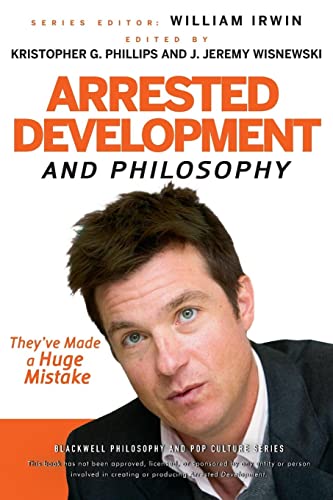
Inhaltsangabe
ARRESTED DEVELOPMENT AND PHILOSOPHY
Is George Michael’s crush on his cousin unnatural?
Is it immoral for Lindsay to lie about stealing clothes to hide her job?
Is Gob better off living his life in bad faith?
What inferences can we draw from Tobias’s double-entendres?
Are the pictures really of bunkers or balls?
The Bluth family’s faults, foibles, and character flaws are so excruciatingly familiar that we squirm in painful recognition of the outrageous impulses that we all have but would never act on. The Bluths seem utterly unaware of the gaping distance between their behavior and accepted social norms. Lurking behind this craziness are large moral and philosophical issues to be explored. From Plato to Aristotle, from Descartes to Marx, Arrested Development and Philosophy draws from great philosophical minds to shed new light on the show’s key questions and captivating themes, including the nature of self-knowledge and happiness, business ethics and capitalist alienation, social class, the role of error in character development, and much more.
Die Inhaltsangabe kann sich auf eine andere Ausgabe dieses Titels beziehen.
Über die Autorin bzw. den Autor
KRISTOPHER G. PHILLIPS is a PhD candidate (ABD) in the Department of Philosophy at the University of Iowa.
J. JEREMY WISNEWSKI is an associate professor of philosophy at Hartwick College. He is the editor of Family Guy and Philosophy, The Office and Philosophy, and 30 Rock and Philosophy, and coeditor of X-Men and Philosophy and Twilight and Philosophy.
WILLIAM IRWIN is a professor of philosophy at King’s College. He originated the philosophy and popular culture genre of books as coeditor of the bestselling The Simpsons and Philosophy and has overseen recent titles including House and Philosophy, Alice in Wonderland and Philosophy, and Mad Men and Philosophy.
To learn more about the Blackwell Philosophy and Pop Culture series, visit www.andphilosophy.com
Von der hinteren Coverseite
Is George Michael’s crush on his cousin unnatural?
Is it immoral for Lindsay to lie about stealing clothes to hide her job?
Is Gob better off living his life in bad faith?
What inferences can we draw from Tobias’s double-entendres?
Are the pictures really of bunkers or balls?
The Bluth family’s faults, foibles, and character flaws are so excruciatingly familiar that we squirm in painful recognition of the outrageous impulses that we all have but would never act on. The Bluths seem utterly unaware of the gaping distance between their behavior and accepted social norms. Lurking behind this craziness are large moral and philosophical issues to be explored. From Plato to Aristotle, from Descartes to Marx, Arrested Development and Philosophy draws from great philosophical minds to shed new light on the show’s key questions and captivating themes, including the nature of self-knowledge and happiness, business ethics and capitalist alienation, social class, the role of error in character development, and much more.
Aus dem Klappentext
Is George Michael's crush on his cousin unnatural?
Is it immoral for Lindsay to lie about stealing clothes to hide her job?
Is Gob better off living his life in bad faith?
What inferences can we draw from Tobias's double-entendres?
Are the pictures really of bunkers or balls?
The Bluth family's faults, foibles, and character flaws are so excruciatingly familiar that we squirm in painful recognition of the outrageous impulses that we all have but would never act on. The Bluths seem utterly unaware of the gaping distance between their behavior and accepted social norms. Lurking behind this craziness are large moral and philosophical issues to be explored. From Plato to Aristotle, from Descartes to Marx, Arrested Development and Philosophy draws from great philosophical minds to shed new light on the show's key questions and captivating themes, including the nature of self-knowledge and happiness, business ethics and capitalist alienation, social class, the role of error in character development, and much more.
To learn more about the Blackwell Philosophy and Pop Culture series, visit www.andphilosophy.com
Auszug. © Genehmigter Nachdruck. Alle Rechte vorbehalten.
Arrested Development and Philosophy
They've Made a Huge MistakeBy William Irwin Kristopher G. Phillips J. Jeremy WisnewskiJohn Wiley & Sons
Copyright © 2012 John Wiley & Sons, LtdAll right reserved.
ISBN: 978-0-470-57559-8
Chapter One
IS THE EXAMINED LIFE A HUGE MISTAKE?Happiness, Self-Knowledge, and the Bluths
Jason Southworth and Ruth Tallman
Ignorance is bliss—or is it? While you hear that little nugget of folk wisdom fairly often, some people desire the truth regardless of the repercussions. On the side of ignorance, George Michael decides not to tell Maeby that she's adopted (she's really not) because he thinks she is happier believing she is her parents' biological child. Michael chooses not to tell George Michael that he slept with his ethics teacher (after George Michael professed his love for Ms. Barely), because George Michael is happier not knowing. Yet, on the side of truth, George Sr. escapes from a Mexican prison only to go home to verify his wife's relationship with his brother. So what makes us happier, ignorance or knowledge?
For centuries, analrapists and philosophers have come down on the side of knowledge. I mean, we philosophers really need to know the truth (about everything!); we need to know so badly that we even need you to need to know. If you don't, we're unhappy. On the other side of the debate is ... basically everyone else. Sure, when we're feeling uncharitable we'll point to the MR. Fs and "moron jocks" (Steve Holt (!)) who prefer ignorance, but when we're being fair, philosophers will admit that there are plenty of smart people who seem to think we're wrong about self-knowledge being the key to happiness. Since there are no smart people on television, let's take the Bluths as our guides in reconsidering whether ignorance really is bliss.
The Life of Arrested Development Is Not Worth Living
Plato (428/427 BCE-348/347 BCE) is the most famous proponent of the view that self-awareness is the hallmark of a happy person. In his account of the trial and death of his mentor, Socrates (c. 469 BCE-399 BCE), Plato depicts a man who thought pursuing the truth about himself, others, and the world was the most important thing anybody could ever do—indeed, that it was worth dying for (would any member of the Bluth family do that?). Socrates spent his life trying to convince those around him to reflect on their lives and on their values, and to think critically about the kinds of people they were. This comes through clearly in his rebuke of the accusers at his trial: "Are you not ashamed that you give your attention to acquiring as much money as possible, and similarly with reputation and honour, and give no attention or thought to truth and understanding and the perfection of your soul?"
Socrates's actions made him an enemy of many in Athens (no one likes to be told they're behaving badly). Despite the lack of support, and outright hostility of many, Socrates continued to reflect on his own life and urged others to do the same, saying, "Examining both myself and others is really the very best thing that a man can do, and that life without this sort of examination is not worth living." Eventually, the people of Athens had enough and gave Socrates a choice—stop with the philosophy or face the death penalty. If this seems like an awfully strict punishment, you might not realize just how obnoxious Socrates could be.
Facing death, he had this to say: "You are mistaken, my friend, if you think that a man who is worth anything ought to spend his time weighing up the prospects of life and death. He has only one thing to consider in performing any action; that is, whether he is acting justly or unjustly, like a good man or a bad one." Socrates would say that Gob's worries about the next illusion, Lindsay's worries about finding a suitable partner in adultery, and Tobias's fears of being nude all fail to consider what is really important. Our crucial concern should always come down to one question: Am I being moral?
Socrates not only believed that self-reflection was essential—he thought it was desirable. Thinking critically and pursuing truth, he believed, leads to the greatest happiness. He often conveyed his teachings through stories, and one of his most famous is called the Myth of the Cave. In this story, Socrates describes the human condition as analogous to people who are imprisoned—chained in a dark cave, where they never see anything real, but rather, only see shadows of real people and objects as they are reflected by firelight on the walls of the cave. As far as the prisoners know, the limited existence they experience in the cave is the whole of reality. If one of those prisoners were to get free and emerge from the cave into the light, he would be temporarily blinded, much like George Sr. probably was when he emerged from his underground hiding place. In the myth, though, things are even worse for those who see the light outside the cave. They're seeing it for the first time. After a period of adjustment, the escaped prisoners will finally see the world as it really is, rather than as shadowy reflections. They will, in fact, find that reality is far more fulfilling than cave life ever could be.
The story doesn't end there, however. If one of the freed prisoners were to return to the cave and explain to those still chained what he'd witnessed in the world above, they would laugh at him. They would scoff because, after being in the sunlight, his sight in the darkness of the cave would be far less keen than theirs. Like Buster Bluth, the freed prisoner would be inept in the everyday world of the cave dwellers. Unlike Buster Bluth, though, this ineptitude would be the result of seeing the truth. The former prisoner of the cave would claim to be happier than those chained below, but the cave dwellers would have no interest in leaving the warm complacency of cave life.
What does this strange story mean? Socrates thinks that most of us spend our lives shrouded in illusion. We think we're great magicians, or awesome actors, or brilliant businessmen. Our understanding of the world is clouded and inaccurate, just like the people in the cave. Unlike the prisoners in the story, however, our chains are of our own making. We can break free anytime we like, just by opening our eyes, looking around, thinking critically, and refusing to let our minds be lulled and soothed by false but comforting beliefs. Shaking off our familiar misconceptions will be uncomfortable at first, just as it was uncomfortable for the prisoner when he first emerged into the light. But once we adjust to the sharpness and purity of reality, we'll achieve a happiness that is equally sharp and pure, and we'll never again be content to live a life of self-delusion. This is what Socrates called "happiness." Happy people are those who have seen illusion and reality and are in a position to choose between them. And every person in that situation will embrace truth, even when it's difficult or painful. Socrates says that this happiness is so compelling, he will not deviate from his pursuit of truth, no, "... not even if I have to die a hundred deaths."
The Myth of the Cave shares some things in common with the pilot of Arrested Development. Think back to the first morning we met the Bluths. Michael was excited, because he believed he would be made partner that day. Michael was living in the cave with his family. He was not seeing reality for what it really was. Though he had worked at the company faithfully every day, he was totally unaware of what...
„Über diesen Titel“ kann sich auf eine andere Ausgabe dieses Titels beziehen.
Suchergebnisse für Arrested Development and Philosophy: They've Made...

Beispielbild für diese ISBN
Arrested Development and Philosophy: They've Made a Huge Mistake
Anbieter: World of Books (was SecondSale), Montgomery, IL, USA
Verkäuferbewertung 5 von 5 Sternen

Paperback. Zustand: Very Good. A smart philosophical look at the cult hit television show, Arrested Development Arrested Development earned six Emmy awards, a Golden Globe award, critical acclaim, and a loyal cult following and then it was canceled. Artikel-Nr. 00109136005
Gebraucht kaufen
EUR 4,23
Versand gratis
Versand innerhalb von USA
Versand innerhalb von USA
Anzahl: 1 verfügbar
Beispielbild für diese ISBN
Arrested Development and Philosophy: They've Made a Huge Mistake
Anbieter: World of Books (was SecondSale), Montgomery, IL, USA
Verkäuferbewertung 5 von 5 Sternen
Paperback. Zustand: Good. A smart philosophical look at the cult hit television show, Arrested Development Arrested Development earned six Emmy awards, a Golden Globe award, critical acclaim, and a loyal cult following and then it was canceled. Artikel-Nr. 00109596743
Gebraucht kaufen
EUR 4,23
Versand gratis
Versand innerhalb von USA
Versand innerhalb von USA
Anzahl: 2 verfügbar
Beispielbild für diese ISBN
Arrested Development and Philosophy: They've Made a Huge Mistake (The Blackwell Philosophy and Pop Culture Series)
Anbieter: BooksRun, Philadelphia, PA, USA
Verkäuferbewertung 5 von 5 Sternen
Paperback. Zustand: Very Good. 1. It's a well-cared-for item that has seen limited use. The item may show minor signs of wear. All the text is legible, with all pages included. It may have slight markings and/or highlighting. Artikel-Nr. 047057559X-8-1
Gebraucht kaufen
EUR 5,06
Versand gratis
Versand innerhalb von USA
Versand innerhalb von USA
Anzahl: 1 verfügbar
Beispielbild für diese ISBN
Arrested Development and Philosophy
Anbieter: ThriftBooks-Atlanta, AUSTELL, GA, USA
Verkäuferbewertung 5 von 5 Sternen
Paperback. Zustand: Very Good. No Jacket. May have limited writing in cover pages. Pages are unmarked. ~ ThriftBooks: Read More, Spend Less. Artikel-Nr. G047057559XI4N00
Gebraucht kaufen
EUR 6,06
Versand gratis
Versand innerhalb von USA
Versand innerhalb von USA
Anzahl: 1 verfügbar
Beispielbild für diese ISBN
Arrested Development and Philosophy
Anbieter: ThriftBooks-Atlanta, AUSTELL, GA, USA
Verkäuferbewertung 5 von 5 Sternen
Paperback. Zustand: Very Good. No Jacket. Former library book; May have limited writing in cover pages. Pages are unmarked. ~ ThriftBooks: Read More, Spend Less. Artikel-Nr. G047057559XI4N10
Gebraucht kaufen
EUR 6,06
Versand gratis
Versand innerhalb von USA
Versand innerhalb von USA
Anzahl: 1 verfügbar
Beispielbild für diese ISBN
Arrested Development and Philosophy
Anbieter: ThriftBooks-Atlanta, AUSTELL, GA, USA
Verkäuferbewertung 5 von 5 Sternen
Paperback. Zustand: Good. No Jacket. Pages can have notes/highlighting. Spine may show signs of wear. ~ ThriftBooks: Read More, Spend Less. Artikel-Nr. G047057559XI3N00
Gebraucht kaufen
EUR 6,06
Versand gratis
Versand innerhalb von USA
Versand innerhalb von USA
Anzahl: 1 verfügbar
Beispielbild für diese ISBN
Arrested Development and Philosophy : They've Made a Huge Mistake
Verlag:
Wiley & Sons, Incorporated, John, 2011
ISBN 10: 047057559X
ISBN 13: 9780470575598
Gebraucht
Softcover
Erstausgabe
Anbieter: Better World Books, Mishawaka, IN, USA
Verkäuferbewertung 5 von 5 Sternen
Zustand: Good. 1st Edition. Pages intact with minimal writing/highlighting. The binding may be loose and creased. Dust jackets/supplements are not included. Stock photo provided. Product includes identifying sticker. Better World Books: Buy Books. Do Good. Artikel-Nr. 7913565-6
Gebraucht kaufen
EUR 10,07
Versand gratis
Versand innerhalb von USA
Versand innerhalb von USA
Anzahl: 2 verfügbar
Beispielbild für diese ISBN
Arrested Development and Philosophy: They've Made a Huge Mistake: 18 (The Blackwell Philosophy and Pop Culture Series)
Anbieter: WorldofBooks, Goring-By-Sea, WS, Vereinigtes Königreich
Verkäuferbewertung 5 von 5 Sternen
Paperback. Zustand: Very Good. The book has been read, but is in excellent condition. Pages are intact and not marred by notes or highlighting. The spine remains undamaged. Artikel-Nr. GOR004962816
Gebraucht kaufen
EUR 4,51
EUR 6,59 Versand
Versand von Vereinigtes Königreich nach USA
Versand von Vereinigtes Königreich nach USA
Anzahl: 1 verfügbar
Beispielbild für diese ISBN
Arrested Development and Philosophy: They've Made a Huge Mistake (The Blackwell Philosophy and Pop Culture Series)
Anbieter: MusicMagpie, Stockport, Vereinigtes Königreich
Verkäuferbewertung 5 von 5 Sternen
Zustand: Very Good. 1774616552. 3/27/2026 1:02:32 PM. Artikel-Nr. U9780470575598
Gebraucht kaufen
EUR 6,74
EUR 6,46 Versand
Versand von Vereinigtes Königreich nach USA
Versand von Vereinigtes Königreich nach USA
Anzahl: 1 verfügbar
Beispielbild für diese ISBN
Arrested Development and Philosophy
Anbieter: PBShop.store UK, Fairford, GLOS, Vereinigtes Königreich
Verkäuferbewertung 5 von 5 Sternen
PAP. Zustand: New. New Book. Shipped from UK. Established seller since 2000. Artikel-Nr. FW-9780470575598
Neu kaufen
EUR 21,71
EUR 4,89 Versand
Versand von Vereinigtes Königreich nach USA
Versand von Vereinigtes Königreich nach USA
Anzahl: 15 verfügbar