
Verwandte Artikel zu Creating Interdisciplinary Campus Cultures: A Model...
Inhaltsangabe
Praise for Creating Interdisciplinary Campus Cultures
"Klein's analysis shows convincingly that from research in the sciences to new graduate-level programs and departments, to new designs for general education, interdisciplinarity is now prevalent throughout American colleges and universities. . . . Klein documents trends, traces historical patterns and precedents, and provides practical advice. Going directly to the heart of our institutional realities, she focuses attention on some of the more challenging aspects of bringing together ambitious goals for interdisciplinary vitality with institutional, budgetary, and governance systems. A singular strength of this book, then, is the practical advice it provides about such nitty-gritty issues as program review, faculty development, tenure and promotion, hiring, and the political economy of interdisciplinarity. . . . We know that readers everywhere will find [this book] simultaneously richly illuminating and intensively useful."
—from the foreword by Carol Geary Schneider, president, Association of American Colleges and Universities
"Klein reveals how universities can move beyond glib rhetoric about being interdisciplinary toward pervasive full interdisciplinarity. Institutions that heed her call for restructured intellectual environments are most likely to thrive in the new millennium."
—William H. Newell, professor, Interdisciplinary Studies, Miami University, and executive director, Association for Integrative Studies
"In true interdisciplinary fashion, Julie Klein integrates a tremendous amount of material into this book to tell the story of interdisciplinarity across the sciences, social sciences, and humanities. And she does so both from the theoretical perspective of 'understanding' interdisciplinarity and from the practical vantage of 'doing' interdisciplinarity. This book is a must-read for faculty and administrators thinking about how to maximize the opportunities and minimize the challenges of interdisciplinary programming on their campuses."
—Diana Rhoten, director, Knowledge Institutions Program, and director, Digital Media and Learning Project, Social Science Research Counsel
Die Inhaltsangabe kann sich auf eine andere Ausgabe dieses Titels beziehen.
Über die Autorin bzw. den Autor
Julie Thompson Klein is a professor of humanities in English and interdisciplinary studies at Wayne State University in Detroit, Michigan. She is past president of the Association for Integrative Studies (AIS) and former editor of the AIS journal, Issues in Integrative Studies. Klein consults widely both nationally and internationally and is the author and editor of many books, including Interdisciplinarity: History, Theory, and Practice; Crossing Boundaries; and Humanities, Culture, and Interdisciplinarity. She is also associate editor of the forthcoming Oxford Handbook on Interdisciplinarity.
The Association of American Colleges and Universities (AAC&U), headquartered in Washington, D.C., is the leading national association concerned with the quality, vitality, and public standing of undergraduate liberal education. Founded in 1915 by college presidents, AAC&U now represents the entire spectrum of American colleges and universities―large and small, public and private, two-year and four-year. AAC&U comprises more than 1,200 accredited colleges and universities that collectively educate more than seven million students every year.
Von der hinteren Coverseite
Praise for Creating Interdisciplinary Campus Cultures
"Klein's analysis shows convincingly that from research in the sciences to new graduate-level programs and departments, to new designs for general education, interdisciplinarity is now prevalent throughout American colleges and universities. . . . Klein documents trends, traces historical patterns and precedents, and provides practical advice. Going directly to the heart of our institutional realities, she focuses attention on some of the more challenging aspects of bringing together ambitious goals for interdisciplinary vitality with institutional, budgetary, and governance systems. A singular strength of this book, then, is the practical advice it provides about such nitty-gritty issues as program review, faculty development, tenure and promotion, hiring, and the political economy of interdisciplinarity. . . . We know that readers everywhere will find [this book] simultaneously richly illuminating and intensively useful."
from the foreword by Carol Geary Schneider, president, Association of American Colleges and Universities
"Klein reveals how universities can move beyond glib rhetoric about being interdisciplinary toward pervasive full interdisciplinarity. Institutions that heed her call for restructured intellectual environments are most likely to thrive in the new millennium."
William H. Newell, professor, Interdisciplinary Studies, Miami University, and executive director, Association for Integrative Studies
"In true interdisciplinary fashion, Julie Klein integrates a tremendous amount of material into this book to tell the story of interdisciplinarity across the sciences, social sciences, and humanities. And she does so both from the theoretical perspective of 'understanding' interdisciplinarity and from the practical vantage of 'doing' interdisciplinarity. This book is a must-read for faculty and administrators thinking about how to maximize the opportunities and minimize the challenges of interdisciplinary programming on their campuses."
Diana Rhoten, director, Knowledge Institutions Program, and director, Digital Media and Learning Project, Social Science Research Counsel
Aus dem Klappentext
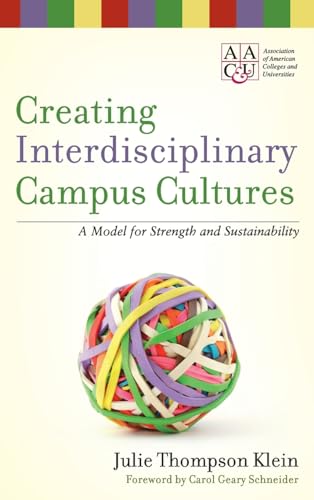
Creating Interdisciplinary Campus Cultures
"Interdisciplinarity" has become a mantra for change in higher education and is embodied in a rich variety of forms and practices that challenge how we think about knowledge, research, and education. Yet, despite widespread desire for change on campuses, proponents are often uncertain about how to go about planning, implementing, and sustaining interdisciplinary programs and projects.
Creating Interdisciplinary Campus Cultures offers administrators, faculty, and planning groups a primer for interdisciplinary change with a portfolio of practical, concrete strategies for actualizing this change. These proven techniques are anchored in a conceptual framework that unites insights from organizational theory, higher education studies, and the literature on interdisciplinarity.
Creating campus cultures that enable rather than impede interdisciplinary work and thought requires a systematic approach to identifying current activities and interests, leveraging existing resources, benchmarking best practices, building capacity and critical mass, targeting strategic initiatives alongside generally loosening barriers, and creating a platform for higher levels of strength and sustainability. Topics also include criteria of program review, the interdisciplinary career lifecycle, and endowment building. These strategies are not meant as one-size-fits-all prescriptions for every campus or as universal formulas or sets of rules, but rather provide informed awareness of nationwide developments and lessons of theory and practice that will improve local decision making and implementation.
Sponsored by the Association of American Colleges and Universities, Creating Interdisciplinary Campus Cultures is an essential resource aimed at developing and maintaining institutional support for interdisciplinary work and giving campuses the tools needed to ensure that their work is successful and sustainable.
Auszug. © Genehmigter Nachdruck. Alle Rechte vorbehalten.
Creating Interdisciplinary Campus Cultures
A Model for Strength and SustainabilityBy Julie Thompson Klein Carol Geary SchneiderJohn Wiley & Sons
Copyright © 2010 John Wiley & Sons, LtdAll right reserved.
ISBN: 978-0-470-55089-2
Chapter One
Mapping National Drivers of Interdisciplinary Change
Preparing for interdisciplinary change requires two mappings-the first national and the second local. Skipping to the second map shortchanges the answers to two of the three questions that are uppermost in the minds of faculty and administrators: What changes are occurring? and What is happening on other campuses? Shared awareness of the national picture will enable individuals to locate themselves within the larger landscape of higher education, reduce their sense of isolation, lessen ignorance and skepticism about activities in other areas, heighten awareness of the plurality of local activities, and foster a common commitment to easing barriers. This chapter presents an overview of major developments associated with interdisciplinarity today in science and technology, social sciences, and humanities.
The book adopts a root meaning of interdisciplinarity based on two authoritative definitions from the National Academy of Sciences (NAS) report, Facilitating Interdisciplinary Research (2004), and Klein and Newell (1997) in Handbook of the Undergraduate Curriculum. Interdisciplinary research (IDR) and interdisciplinary studies (IDS) integrate content, data, methods, tools, concepts, and theories from two or more disciplines or bodies of specialized knowledge in order to advance fundamental understanding, answer questions, address complex issues and broad themes, and solve problems that are too broad for a single approach (Facilitating Interdisciplinary Research, 2004; Klein and Newell, 1997).
The consensus meaning, though, is only a literal definition. The root term has many connotations, distinguishing a variety of goals and contexts that will become clear in this chapter. The differences are dramatically evident in disputes over what constitutes real or genuine interdisciplinarity. Awareness of the multiple connotations is not an idle exercise in etymology or history. Differences surface in local arguments for and against certain forms of interdisciplinarity. To help readers navigate the debate on meaning, this chapter also introduces a core vocabulary that can be used on campuses and ends with a summary statement of the conceptual vocabulary of the book.
Science and Technology
When scientists hear the word interdisciplinary some mention historical precedents ranging from the Greek philosopher Anaximander to Charles Darwin. By and large, though, scientists are inclined to cite modern developments in defense-related research during the 1930s and 1940s, especially the Manhattan Project to build an atomic bomb. It was the first large government-funded example of IDR. In subsequent decades, IDR became part of the profiles of the Department of Defense, the National Science Foundation, the National Institutes of Health, and the National Aeronautics and Space Administration. Scientists also tend to cite major discoveries and initiatives, such as x-ray crystallography and the human genome project. The current momentum is documented in a 2004 report from NAS. Facilitating Interdisciplinary Research identifies four primary drivers of IDR today (pp. 2, 40):
1. the inherent complexity of nature and society
2. the desire to explore problems and questions that are not confined to a single discipline
3. the need to solve societal problems
4. the power of new technologies
Drivers 2 and 3 are not new. However, they gained momentum in the closing decades of the twentieth century. The heightened profile of driver 3 was signaled in 1982, when the Organization for Economic Cooperation and Development declared in The University and the Community (1982) that interdisciplinarity exogenous to the university now takes priority over endogenous university interdisciplinarity based on the production of new knowledge. The exogenous originates in real problems of the community and the demand that universities perform their pragmatic social mission. International economic competition in science-based fields of high technology propelled increased activity and investment from the late 1970s forward in areas such as engineering and manufacturing, computers, biotechnology, and biomedicine. Complex problems of practice in professional and vocational education have also fostered interdisciplinary approaches in law, medicine, social work, education, and business.
The National Research Council (NRC) tracked changes in a series of reports. In 1986, the authors of Scientific Interfaces and Technological Applications announced that almost all significant growth in knowledge production in recent decades was occurring at the interdisciplinary borderlands between established fields. The five prominent areas in fundamental research were biological physics, materials science, the physics-chemistry interface, geophysics, and mathematical physics and computational physics. The six outstanding areas of technical applications were microelectronics, optical technology, new instrumentation, the fields of energy and environment, national security, and medical applications. Four years later a new NRC report, Interdisciplinary Research (1990), tracked developments that were promoting increased collaborations between life sciences and medicine and between physical sciences and engineering. New intellectual understandings of biological systems, problem complexity, the costs of instrumentation and facilities, and the desire to transfer knowledge rapidly from laboratory to hospital practice have been strong catalysts for change.
These developments signaled a double form of boundary crossing between disciplines and commercial sectors, leading Rustum Roy to suggest that the more accurate term is not interdisciplinary but interactive research (2000). The escalation of boundary crossing between academic science and commercial sectors, in combination with recent discoveries in molecular and cell biology, prompted the National Institutes of Health to issue a new road map for research and funding in 2002. Collaborative teams, new combinations of skills and disciplines, a better toolbox, and new technologies are all needed to understand the combination of molecular events that lead to disease. The NIH has accelerated this trend with the aim of creating a new discipline of clinical and translational research capable of catalyzing new knowledge and techniques for patient care (http://nihroadmap.nih.gov/overview.asp; http://nihroadmap.nih.gov/clinicalresearch/overviewtranslational. asp).
Driver 4 is apparent in new technologies of molecular imaging, nanomedicine, and bioinformatics. In addition, new tools of quantitative and computer-assisted mathematical analysis also facilitate the sharing of large quantities of data across disciplinary boundaries in areas as diverse as medicine and the geosciences, the latter of which already experienced an interdisciplinary transformation in the mid-twentieth century fueled by the theory of plate tectonics. Driven by Web 2.0 technologies, information sharing across the infrastructure of distributed information is also enabling individuals and networks in dispersed locations to collaborate. The implications are not merely technical. In the journal Science, Alan Leshner (2004) observed that "new technologies are...
„Über diesen Titel“ kann sich auf eine andere Ausgabe dieses Titels beziehen.
Suchergebnisse für Creating Interdisciplinary Campus Cultures: A Model...

Beispielbild für diese ISBN
Creating Interdisciplinary Campus Cultures: A Model for Strength and Sustainability
Anbieter: World of Books (was SecondSale), Montgomery, IL, USA
Verkäuferbewertung 5 von 5 Sternen

Hardback. Zustand: Good. With the increased support from funding agencies and in literature, an interdisciplinary culture is of growing significance. Creating Interdisciplinary Campus Cultures provides an introduction to interdisciplinary change through pragmatic strategies. Artikel-Nr. 00109463001
Gebraucht kaufen
EUR 6,30
Versand gratis
Versand innerhalb von USA
Versand innerhalb von USA
Anzahl: 1 verfügbar
Beispielbild für diese ISBN
Creating Interdisciplinary Campus Cultures : A Model for Strength and Sustainability
Verlag:
Wiley & Sons, Incorporated, John, 2010
ISBN 10: 0470550899
ISBN 13: 9780470550892
Gebraucht
Hardcover
Anbieter: Better World Books, Mishawaka, IN, USA
Verkäuferbewertung 5 von 5 Sternen
Zustand: Good. Pages intact with minimal writing/highlighting. The binding may be loose and creased. Dust jackets/supplements are not included. Stock photo provided. Product includes identifying sticker. Better World Books: Buy Books. Do Good. Artikel-Nr. 11596898-6
Gebraucht kaufen
EUR 6,54
Versand gratis
Versand innerhalb von USA
Versand innerhalb von USA
Anzahl: 1 verfügbar
Beispielbild für diese ISBN
Creating Interdisciplinary Campus Cultures: A Model for Strength and Sustainability
Verlag:
Jossey-Bass (edition 1), 2010
ISBN 10: 0470550899
ISBN 13: 9780470550892
Gebraucht
Hardcover
Anbieter: BooksRun, Philadelphia, PA, USA
Verkäuferbewertung 5 von 5 Sternen
Hardcover. Zustand: Very Good. 1. With dust jacket. It's a well-cared-for item that has seen limited use. The item may show minor signs of wear. All the text is legible, with all pages included. It may have slight markings and/or highlighting. Artikel-Nr. 0470550899-11-1-29
Gebraucht kaufen
EUR 7,93
Versand gratis
Versand innerhalb von USA
Versand innerhalb von USA
Anzahl: 3 verfügbar
Beispielbild für diese ISBN
Creating Interdisciplinary Campus Cultures: A Model for Strength and Sustainability
Anbieter: WorldofBooks, Goring-By-Sea, WS, Vereinigtes Königreich
Verkäuferbewertung 5 von 5 Sternen
Hardback. Zustand: Very Good. The book has been read, but is in excellent condition. Pages are intact and not marred by notes or highlighting. The spine remains undamaged. Artikel-Nr. GOR014945100
Gebraucht kaufen
EUR 5,58
EUR 6,57 Versand
Versand von Vereinigtes Königreich nach USA
Versand von Vereinigtes Königreich nach USA
Anzahl: 1 verfügbar
Beispielbild für diese ISBN
Creating Interdisciplinary Campus Cultures : A Model for Strength and Sustainability
Verlag:
Wiley & Sons, Incorporated, John, 2010
ISBN 10: 0470550899
ISBN 13: 9780470550892
Gebraucht
Hardcover
Anbieter: Better World Books Ltd, Dunfermline, Vereinigtes Königreich
Verkäuferbewertung 5 von 5 Sternen
Zustand: Good. Pages intact with minimal writing/highlighting. The binding may be loose and creased. Dust jackets/supplements are not included. Stock photo provided. Product includes identifying sticker. Better World Books: Buy Books. Do Good. Artikel-Nr. 11596898-6
Gebraucht kaufen
EUR 9,35
EUR 5,87 Versand
Versand von Vereinigtes Königreich nach USA
Versand von Vereinigtes Königreich nach USA
Anzahl: 1 verfügbar
Beispielbild für diese ISBN
Creating Interdisciplinary Campus Cultures. A Model for Strength and Sustainability.
Verlag:
San Francisco, Jossey-Bass, 2010
ISBN 10: 0470550899
ISBN 13: 9780470550892
Gebraucht
Hardcover
Anbieter: Antiquariat Thomas Haker GmbH & Co. KG, Berlin, Deutschland
Verkäuferbewertung 5 von 5 Sternen
Hardcover/Pappeinband. Zustand: Gut. 208 S. Good condition. Ex library with stamps and back label. Pages clean. Sprache: Englisch Gewicht in Gramm: 500. Artikel-Nr. 884073
Gebraucht kaufen
EUR 7,70
EUR 15,00 Versand
Versand von Deutschland nach USA
Versand von Deutschland nach USA
Anzahl: 1 verfügbar
Beispielbild für diese ISBN
Creating Interdisciplinary Campus Cultures
Anbieter: PBShop.store UK, Fairford, GLOS, Vereinigtes Königreich
Verkäuferbewertung 5 von 5 Sternen
HRD. Zustand: New. New Book. Shipped from UK. Established seller since 2000. Artikel-Nr. FW-9780470550892
Neu kaufen
EUR 42,23
EUR 5,89 Versand
Versand von Vereinigtes Königreich nach USA
Versand von Vereinigtes Königreich nach USA
Anzahl: 15 verfügbar
Beispielbild für diese ISBN
Creating Interdisciplinary Campus Cultures
Anbieter: Majestic Books, Hounslow, Vereinigtes Königreich
Verkäuferbewertung 4 von 5 Sternen

Zustand: New. pp. xxii + 208 Illus. Artikel-Nr. 8150882
Neu kaufen
EUR 53,32
EUR 7,63 Versand
Versand von Vereinigtes Königreich nach USA
Versand von Vereinigtes Königreich nach USA
Anzahl: 3 verfügbar
Beispielbild für diese ISBN
Creating Interdisciplinary Campus Cultures: A Model for Strength and Sustainability
Anbieter: Ria Christie Collections, Uxbridge, Vereinigtes Königreich
Verkäuferbewertung 5 von 5 Sternen
Zustand: New. In English. Artikel-Nr. ria9780470550892_new
Neu kaufen
EUR 49,22
EUR 13,25 Versand
Versand von Vereinigtes Königreich nach USA
Versand von Vereinigtes Königreich nach USA
Anzahl: Mehr als 20 verfügbar
Beispielbild für diese ISBN
Creating Interdisciplinary Campus Cultures A Model for Strength and Sustainability
Anbieter: Revaluation Books, Exeter, Vereinigtes Königreich
Verkäuferbewertung 5 von 5 Sternen
Hardcover. Zustand: Brand New. 1st edition. 240 pages. 9.00x6.10x1.10 inches. In Stock. Artikel-Nr. x-0470550899
Neu kaufen
EUR 62,70
EUR 11,73 Versand
Versand von Vereinigtes Königreich nach USA
Versand von Vereinigtes Königreich nach USA
Anzahl: 2 verfügbar