
Verwandte Artikel zu Web Application Architecture: Principles, Protocols...
Inhaltsangabe
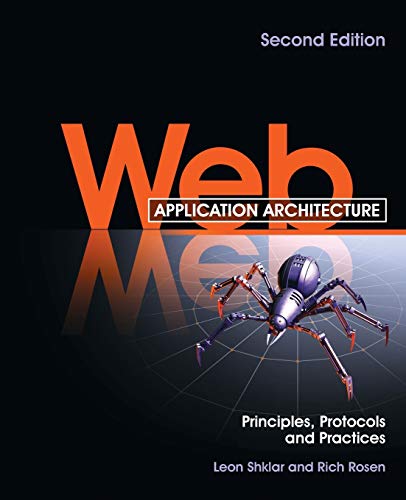
The book provides an in-depth examination of the core concepts and general principles of web application development, using examples from specific technologies. This conceptual knowledge is critical when designing, developing and debugging complex systems, and makes it easier to learn the new application programming interfaces (APIs) that arise in the rapidly changing Internet environment.
The companion web site for the book is located at www.webappbuilders.com.
The text is organized into the following sections:
- Core Internet protocols
- The HTTP protocol as a foundation for web applications
- Discussion of markup languages such as HTML, CSS, and XML
- Server and browser architecture
- Application design case studies using JavaEE/Struts and Ruby on Rails
- Survey of emerging technologies
The second edition of the book has been updated with enhanced coverage of:
- XML applications including XSLT, XSL-FO, and XPath
- XML-compliant HTML including XHTML and XHTML MP
- Web Services protocols including SOAP and REST
- Platform for Privacy Preferences (P3P)
- Security and encryption
- XML and RDF query languages
- Cloud computing, collaborative online services, and Web 2.0
and new chapters on:
- JavaScript, Dynamic HTML (DHTML), and AJAX
- Rapid application development using Ruby on Rails
- Search technology including Search Engine Optimization
Die Inhaltsangabe kann sich auf eine andere Ausgabe dieses Titels beziehen.
Über die Autorin bzw. den Autor
Leon Shklar currently works for Thomson Reuters where he is the head of technology for Reuters Media. Previously, Leon headed up the development team for the online edition of the Wall Street Journal at Dow Jones. Prior to joining Dow Jones, he spent six years at Bell Communications Research and almost as long in the world of dot-coms and Internet software. Leon holds a Ph.D. in Computer Science from Rutgers University.
Rich Rosen is a senior developer in the Fixed Income Systems Group at Interactive Data Corporation. Previously, he was an Application Architect at Dow Jones. Rich began his career at Bell Labs, where his work with relational databases and the Internet prepared him the world of Web application development. He is a co-author of Mac OS X for Unix Geeks, 4th Edition (O'Reilly). Rich holds an M.S. in Computer Science from Stevens Institute of Technology.
Von der hinteren Coverseite
It is not enough for Web application developers to be proficient in just one platform. As platforms grow and evolve, and as new ones arise, developers must be able to transfer their proficiency across platforms in order to build complex Web applications effectively. This book helps developers understand the underlying core technologies so that they can learn new APIs and application frameworks more quickly.
Web Application Architecture provides an in-depth examination of the basic concepts and general principles associated with Web application development, using examples that illustrate specific technologies. This conceptual knowledge is critical when building and deploying complex systems that are scaleable, extensible, maintainable and reusable. The book explains the underlying protocols and languages that support Web application development, and delineates the best practices associated with building robust applications. It describes mechanisms for providing Web access to heterogeneous data sources including relational databases and multimedia.
The new edition includes brand new and fully updated chapters on:
- Internet protocols - from TCP/IP to HTTP and beyond
- software components - servers, browsers, proxies and agents
- the dynamic web - how web applications present dynamic data
- markup languages – HTML, XML and CSS
- tools, libraries and frameworks - AJAX, Struts, and Ruby on Rails
- search technologies – underlying principles, application design, and SEO
- future directions and emerging technologies – XML Query, RDF, and the Semantic Web
Ideally suited for course usage and self-study, this practical, engaging textbook is essential reading for students, programmers and system architects and designers alike. It provides a comprehensive, timely overview of modern web technology.
Visit the supplementary website at www.wileyeurope.com/college/shklar
Aus dem Klappentext
It is not enough for Web application developers to be proficient in just one platform. As platforms grow and evolve, and as new ones arise, developers must be able to transfer their proficiency across platforms in order to build complex Web applications effectively. This book helps developers understand the underlying core technologies so that they can learn new APIs and application frameworks more quickly.
Web Application Architecture provides an in-depth examination of the basic concepts and general principles associated with Web application development, using examples that illustrate specific technologies. This conceptual knowledge is critical when building and deploying complex systems that are scaleable, extensible, maintainable and reusable. The book explains the underlying protocols and languages that support Web application development, and delineates the best practices associated with building robust applications. It describes mechanisms for providing Web access to heterogeneous data sources including relational databases and multimedia.
The new edition includes brand new and fully updated chapters on:
- Internet protocols - from TCP/IP to HTTP and beyond
- software components - servers, browsers, proxies and agents
- the dynamic web - how web applications present dynamic data
- markup languages – HTML, XML and CSS
- tools, libraries and frameworks - AJAX, Struts, and Ruby on Rails
- search technologies – underlying principles, application design, and SEO
- future directions and emerging technologies – XML Query, RDF, and the Semantic Web
Ideally suited for course usage and self-study, this practical, engaging textbook is essential reading for students, programmers and system architects and designers alike. It provides a comprehensive, timely overview of modern web technology.
Visit the supplementary website at www.wileyeurope.com/college/shklar
Auszug. © Genehmigter Nachdruck. Alle Rechte vorbehalten.
Web Application Architecture
Principles, Protocols and PracticesBy Leon Shklar Rich RosenJohn Wiley & Sons
Copyright © 2009 Leon ShklarAll right reserved.
ISBN: 978-0-470-51860-1
Chapter One
Introduction
IN THIS CHAPTER
History and pre-history of the web
From web pages to web sites to web applications
Web 2.0 and AJAX
Summary of what is covered in the book
OBJECTIVES
Offer a historical overview of web technology.
Introduce the concept of "web applications."
Explain the focus and purpose of the book.
Provide a chapter-by-chapter outline.
1.1 History and Pre-History of the Web
Back in 1989, at CERN (the scientific research laboratory near Geneva, Switzerland), Tim Berners-Lee presented a proposal for an information management system that would enable the sharing of knowledge and resources over a computer network. We now know this system as the worldwide web (the web). Building on the foundation of existing Internet protocols and services, it lives up to its name as a ubiquitous network providing information and communication services to hundreds of millions of people around the world.
From the very beginnings of Internet technology, many people shared the dream of using the Internet as a universal medium for exchanging information over computer networks. Internet file-sharing services (such as FTP and Gopher) and message forum services (such as Netnews) provided increasingly powerful mechanisms for information exchange and brought us closer to fulfilling those goals.
Ted Nelson's Xanadu project aspired to make that dream a reality, but the goals were lofty and never fully realized. Nelson coined the term "hypertext" as a way of describing "non-sequential writing - text that branches and allows choice to the reader." Unlike the static text of print media, hypertext was intended for use with an interactive computer screen. It is open, fluid and mutable, and can be connected to other pieces of hypertext by "links".
It took Tim Berners-Lee to "marry together" (in his words) the notion of hypertext with the power of the Internet, bringing those initial dreams to fruition in a way that the earliest developers of both hypertext and Internet technology might never have imagined. His vision was to connect literally everything, in a uniform and universal way. Berners-Lee originally promoted the web as a virtual library, a document control system for sharing information resources among researchers. On-line documents could be accessed via a unique document address, a universal resource locator (URL). These documents could be cross-referenced via hypertext links.
From its humble beginnings, the web has expanded exponentially to serve a wide variety of purposes for a wide variety of people:
Given its origins, it seems natural that educational institutions and research laboratories were among the very first users of the web, employing it to share documents and other resources across the Internet.
Popular adoption of the web by individuals followed gradually, originally through on-line services, such as America On-line (now AOL) that slowly but surely integrated with the web and the Internet. Initially, personal usage of the web was limited to e-mail and web surfing. Eventually, people began building their own web sites where they posted everything from on-line photo albums to personal journals that would become known as "blogs."
Over time, businesses saw the potential of the web and began to employ it for e-commerce, providing an on-line medium for buying and selling goods interactively. As more and more people were connected to the web, the draw of a new source of revenue and the fear that competitors would get there first and undercut traditional revenue streams made e-commerce increasingly important to business. E-commerce applications are now being used for everything - from displaying catalogs of available merchandise to providing the means for customers to purchase goods and services securely on-line.
As the impact of e-commerce grew, the back-end applications supporting e-commerce became increasingly important to the companies using it. The front-end, customer-facing web sites needed to be up to date, synchronized with inventory systems so that customers would know what items were or weren't immediately available. Automated fulfillment systems connected to the on-line ordering mechanisms became commonplace. With that, secure login and registration, including collection of credit card information and payment processing, became an absolute requirement for viable e-commerce sites.
With the maturing of the web, a tug of war arose between sites offering free and paid content. Google was successful in tilting the balance in favor of free content supported by ads. Even the Wall Street Journal, which pioneered the notion of paid subscriptions for on-line content, has been opening up more and more of its content to non-subscribers. Critical technological challenges for free sites include tracking visitor behavior, providing adaptive personalization, and offering advanced community-building tools.
The web did not come into existence in a vacuum. It was built on top of core Internet protocols that had been in existence for many years prior to the inception of the web. Understanding the relationship between web technology and the underlying Internet protocols is fundamental to the design and implementation of true web applications. In fact, it is the exploitation of that relationship that distinguishes a web page or web site from a web application.
1.2 From Web Pages to Web Sites
The explosive growth of the web at least partially can be attributed to its grass-roots proliferation as a tool for personal publishing. The fundamental technology behind the web is relatively simple. A computer connected to the Internet running a web server was all that was necessary to serve documents. Both CERN and the National Center for Supercomputer Applications (NCSA) at the University of Illinois had developed freely available web server software. A small amount of HTML knowledge (and the proper computing resources) got you something that could be called a web site. Early web sites were just loosely connected sets of pages, branching hierarchically from a home page; now, a web site is much more than just a conglomeration of web pages.
When the web was in its infancy, academic institutions and technology companies owned the only computers that were connected to the Internet and could run server software. In those days, personal computers sitting on people's desks were still a rarity. If you wanted access to any sort of computing power, you used a terminal that let you "log in" to a large server or mainframe over a direct connection or dial-up phone line.
Still, creating and posting web pages quickly became popular among people that had access to scarce computing power. The original HTML language was simple enough that, even without the more sophisticated tools we have at our disposal today, it was an easy task for someone to create a web page. (Some would say too easy.) In the end, all that was needed to create first generation web pages was a simple text editor.
There is a big difference between a bunch of web pages and a web site. A web site is more than just a group of web pages that happen to be connected to each other through hypertext links:...
„Über diesen Titel“ kann sich auf eine andere Ausgabe dieses Titels beziehen.
Suchergebnisse für Web Application Architecture: Principles, Protocols...

Beispielbild für diese ISBN
Web Application Architecture: Principles, Protocols and Practices
Anbieter: BooksRun, Philadelphia, PA, USA
Verkäuferbewertung 5 von 5 Sternen

Paperback. Zustand: Very Good. 2. It's a well-cared-for item that has seen limited use. The item may show minor signs of wear. All the text is legible, with all pages included. It may have slight markings and/or highlighting. Artikel-Nr. 047051860X-11-1
Gebraucht kaufen
EUR 5,46
Versand gratis
Versand innerhalb von USA
Versand innerhalb von USA
Anzahl: 1 verfügbar
Beispielbild für diese ISBN
Web Application Architecture: Principles, Protocols and Practices
Anbieter: ThriftBooks-Dallas, Dallas, TX, USA
Verkäuferbewertung 5 von 5 Sternen
Paperback. Zustand: Fair. No Jacket. Readable copy. Pages may have considerable notes/highlighting. ~ ThriftBooks: Read More, Spend Less. Artikel-Nr. G047051860XI5N00
Gebraucht kaufen
EUR 6,42
Versand gratis
Versand innerhalb von USA
Versand innerhalb von USA
Anzahl: 1 verfügbar
Beispielbild für diese ISBN
Web Application Architecture: Principles, Protocols and Practices
Anbieter: ThriftBooks-Dallas, Dallas, TX, USA
Verkäuferbewertung 5 von 5 Sternen
Paperback. Zustand: Good. No Jacket. Pages can have notes/highlighting. Spine may show signs of wear. ~ ThriftBooks: Read More, Spend Less. Artikel-Nr. G047051860XI3N00
Gebraucht kaufen
EUR 6,42
Versand gratis
Versand innerhalb von USA
Versand innerhalb von USA
Anzahl: 1 verfügbar
Beispielbild für diese ISBN
Web Application Architecture: Principles, Protocols and Practices
Anbieter: ThriftBooks-Atlanta, AUSTELL, GA, USA
Verkäuferbewertung 5 von 5 Sternen
Paperback. Zustand: Fair. No Jacket. Readable copy. Pages may have considerable notes/highlighting. ~ ThriftBooks: Read More, Spend Less. Artikel-Nr. G047051860XI5N00
Gebraucht kaufen
EUR 6,42
Versand gratis
Versand innerhalb von USA
Versand innerhalb von USA
Anzahl: 1 verfügbar
Beispielbild für diese ISBN
Web Application Architecture: Principles, Protocols and Practices, 2nd Edition
Anbieter: AwesomeBooks, Wallingford, Vereinigtes Königreich
Verkäuferbewertung 5 von 5 Sternen
Paperback. Zustand: Very Good. Web Application Architecture: Principles, Protocols and Practices, 2nd Edition This book is in very good condition and will be shipped within 24 hours of ordering. The cover may have some limited signs of wear but the pages are clean, intact and the spine remains undamaged. This book has clearly been well maintained and looked after thus far. Money back guarantee if you are not satisfied. See all our books here, order more than 1 book and get discounted shipping. Artikel-Nr. 7719-9780470518601
Gebraucht kaufen
EUR 3,75
EUR 4,86 Versand
Versand von Vereinigtes Königreich nach USA
Versand von Vereinigtes Königreich nach USA
Anzahl: 2 verfügbar
Beispielbild für diese ISBN
Web Application Architecture: Principles, Protocols and Practices, 2nd Edition
Anbieter: WorldofBooks, Goring-By-Sea, WS, Vereinigtes Königreich
Verkäuferbewertung 5 von 5 Sternen
Paperback. Zustand: Very Good. The book has been read, but is in excellent condition. Pages are intact and not marred by notes or highlighting. The spine remains undamaged. Artikel-Nr. GOR004218135
Gebraucht kaufen
EUR 2,31
EUR 6,61 Versand
Versand von Vereinigtes Königreich nach USA
Versand von Vereinigtes Königreich nach USA
Anzahl: 2 verfügbar
Beispielbild für diese ISBN
Web Application Architecture : Principles, Protocols and Practices
Verlag:
Wiley & Sons, Incorporated, John, 2009
ISBN 10: 047051860X
ISBN 13: 9780470518601
Gebraucht
Softcover
Anbieter: Better World Books Ltd, Dunfermline, Vereinigtes Königreich
Verkäuferbewertung 5 von 5 Sternen
Zustand: Very Good. Former library copy. Pages intact with possible writing/highlighting. Binding strong with minor wear. Dust jackets/supplements may not be included. Includes library markings. Stock photo provided. Product includes identifying sticker. Better World Books: Buy Books. Do Good. Artikel-Nr. 9131585-6
Gebraucht kaufen
EUR 5,72
EUR 5,90 Versand
Versand von Vereinigtes Königreich nach USA
Versand von Vereinigtes Königreich nach USA
Anzahl: 1 verfügbar
Beispielbild für diese ISBN
Web Application Architecture : Principles, Protocols and Practices
Verlag:
Wiley & Sons, Incorporated, John, 2009
ISBN 10: 047051860X
ISBN 13: 9780470518601
Gebraucht
Softcover
Anbieter: Better World Books Ltd, Dunfermline, Vereinigtes Königreich
Verkäuferbewertung 5 von 5 Sternen
Zustand: Good. Former library copy. Pages intact with minimal writing/highlighting. The binding may be loose and creased. Dust jackets/supplements are not included. Includes library markings. Stock photo provided. Product includes identifying sticker. Better World Books: Buy Books. Do Good. Artikel-Nr. 17937506-20
Gebraucht kaufen
EUR 5,72
EUR 5,90 Versand
Versand von Vereinigtes Königreich nach USA
Versand von Vereinigtes Königreich nach USA
Anzahl: 1 verfügbar
Beispielbild für diese ISBN
Web Application Architecture: Principles, Protocols and Practices, 2nd Edition
Anbieter: Bahamut Media, Reading, Vereinigtes Königreich
Verkäuferbewertung 4 von 5 Sternen

Paperback. Zustand: Very Good. This book is in very good condition and will be shipped within 24 hours of ordering. The cover may have some limited signs of wear but the pages are clean, intact and the spine remains undamaged. This book has clearly been well maintained and looked after thus far. Money back guarantee if you are not satisfied. See all our books here, order more than 1 book and get discounted shipping. Artikel-Nr. 6545-9780470518601
Gebraucht kaufen
EUR 4,13
EUR 8,23 Versand
Versand von Vereinigtes Königreich nach USA
Versand von Vereinigtes Königreich nach USA
Anzahl: 2 verfügbar
Beispielbild für diese ISBN
Web Application Architecture
Anbieter: PBShop.store UK, Fairford, GLOS, Vereinigtes Königreich
Verkäuferbewertung 5 von 5 Sternen
PAP. Zustand: New. New Book. Shipped from UK. Established seller since 2000. Artikel-Nr. FW-9780470518601
Neu kaufen
EUR 66,64
EUR 6,93 Versand
Versand von Vereinigtes Königreich nach USA
Versand von Vereinigtes Königreich nach USA
Anzahl: 15 verfügbar