
Inhaltsangabe
A value-packed guide to speaking, reading, and writing in Spanish
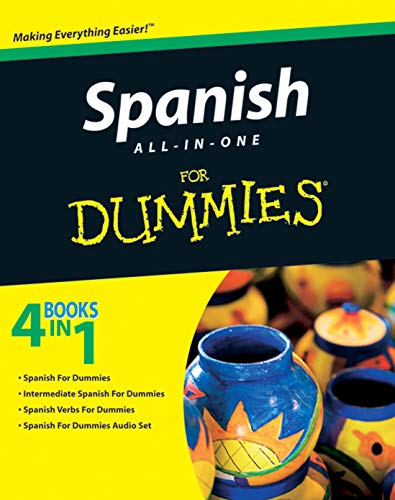
Spanish All-in-One For Dummies is the first Dummies All-in-One title in the foreign language category–nearly 800 pages of expert instruction to help people master Spanish basics and beyond. This comprehensive volume features content from all For Dummies Spanish language instruction titles, including Spanish For Dummies, Intermediate Spanish For Dummies, Spanish Verbs For Dummies, and Spanish For Dummies Audio Set. The book's audio CD provides readers with an effective tool to help them start speaking Spanish from day one. Plus, the practical exercises give readers greater confidence in communicating in Spanish, whether traveling or in business.
Die Inhaltsangabe kann sich auf eine andere Ausgabe dieses Titels beziehen.
Über die Autorin bzw. den Autor
The Experts at Dummies are smart, friendly people who make learning easy by taking a not-so-serious approach to serious stuff.
Von der hinteren Coverseite
Your comprehensive guide to speaking, reading, and writing in Spanish!
Want to speak Spanish? Looking to improve your Spanish skills? Now you can start today with these minibooks, which give you the expert instruction you need to master Spanish basics and beyond. From numbers and vocabulary to common phrases, conversations, and much more, you'll see how to communicate effectively in Spanish and use it in real-life situations. The practical exercises will give you greater confidence ― and the bonus CD helps you start speaking Spanish from day one!
- Warm up with the basics ― handle greetings and small talk and review pronunciation rules, letters, numbers, and dates
-
Speak in everyday settings ― handle greetings and small talk, order food and purchase goods, talk on the phone, ask for directions, and deal with emergencies
-
Grasp grammar essentials ― learn to identify and use the various parts of speech while you conjugate verbs in the simple past, present, and future tense
-
Stretch your skills ― issue commands with the imperative mood, take action on object pronouns, talk about yourself with the reflexive, and wish and hope with the subjunctive
-
Take Spanish to work ― communicate with colleagues or customers at the office, tailor phrases to your line of work, and review example workplace scenarios for common professions
Open the book and find:
- Basic and advanced Spanish grammar
-
Pronunciation tips and vocabulary charts
-
Verb conjugations for regular and irregular verbs
-
Masculine and feminine nouns
-
Tips for using adjectives, adverbs, and prepositional phrases
-
Proper ways to ask questions
-
The inside scoop on the key verb haber
-
Key phrases for numerous work environments
-
Spanish-to-English and English-to-Spanish dictionaries
Bonus CD Includes
- Features dialogues by native Spanish speakers
-
Allows you to hear Spanish as it's really spoken
-
Please see the CD appendix for details and complete system requirements.
Note: CD-ROM/DVD and other supplementary materials are not included as part of eBook file.
Aus dem Klappentext
Your comprehensive guide to speaking, reading, and writing in Spanish!
Want to speak Spanish? Looking to improve your Spanish skills? Now you can start today with these minibooks, which give you the expert instruction you need to master Spanish basics and beyond. From numbers and vocabulary to common phrases, conversations, and much more, you'll see how to communicate effectively in Spanish and use it in real-life situations. The practical exercises will give you greater confidence — and the bonus CD helps you start speaking Spanish from day one!
- Warm up with the basics — handle greetings and small talk and review pronunciation rules, letters, numbers, and dates
-
Speak in everyday settings — handle greetings and small talk, order food and purchase goods, talk on the phone, ask for directions, and deal with emergencies
-
Grasp grammar essentials — learn to identify and use the various parts of speech while you conjugate verbs in the simple past, present, and future tense
-
Stretch your skills — issue commands with the imperative mood, take action on object pronouns, talk about yourself with the reflexive, and wish and hope with the subjunctive
-
Take Spanish to work — communicate with colleagues or customers at the office, tailor phrases to your line of work, and review example workplace scenarios for common professions
Open the book and find:
- Basic and advanced Spanish grammar
-
Pronunciation tips and vocabulary charts
-
Verb conjugations for regular and irregular verbs
-
Masculine and feminine nouns
-
Tips for using adjectives, adverbs, and prepositional phrases
-
Proper ways to ask questions
-
The inside scoop on the key verb haber
-
Key phrases for numerous work environments
-
Spanish-to-English and English-to-Spanish dictionaries
Bonus CD Includes
- Features dialogues by native Spanish speakers
-
Allows you to hear Spanish as it's really spoken
-
Please see the CD appendix for details and complete system requirements.
Note: CD-ROM/DVD and other supplementary materials are not included as part of eBook file.
Auszug. © Genehmigter Nachdruck. Alle Rechte vorbehalten.
Spanish All-in-One For Dummies
John Wiley & Sons
Copyright © 2009 John Wiley & Sons, LtdAll right reserved.
ISBN: 978-0-470-46244-7
Chapter One
Spanish for Healthcare Workers
In This Chapter
As a healthcare professional, you're dedicated to providing all your patients with the best treatment available, whatever language they happen to speak. Providing effective care, however, requires not only a thorough medical background but also an ability to clearly communicate with your patients. You need to be able to take your patients through the entire process - from meeting and greeting them to filling out paperwork, and from asking them questions to delivering your diagnosis, treatment plan, and instructions.
In the course of a single chapter, we can't possibly tell you everything you need to know to fully understand what your Spanish-speaking patients tell you or what you need to tell them, but we can bring you up to speed on the basics and show you how to communicate in the most common scenarios. Here, we cover the basics of gathering information from patients and explaining to patients the diagnosis and treatment.
REMEMBER
Refer to the early chapters in Book I for basic coverage of conversational Spanish, including a pronunciation guide in Chapter 1. Book I, Chapter 3 leads you through the basics of meeting and greeting people, while Chapter 4 shows you how to engage in small talk - for when you're just getting to know your patients.
First Things First: Key Words and Emergency Lingo
Whatever your role is in serving patients - whether you're a receptionist meeting the patient for the first time or the doctor who ultimately provides diagnosis and treatment - you need to know some basic doctor's office vocabulary and how to communicate with patients in emergency situations. In the following sections, we introduce you to some general terminology along with Spanish names for body parts and internal organs. We also provide key phrases for dealing with accidents and emergencies.
Doctor-speak: Using basic terminology
When you're in a healthcare situation, whether in a doctor's office, pharmacy, or emergency room, you're likely to use many of the terms in Table 1-1.
Naming body parts
Fortunately, you and your patient can probably refer to body parts simply by pointing to them - although this method can get a bit tricky when it comes to internal organs. A more efficient way to communicate with your Spanish-speaking patients is to brush up your Spanish anatomy terminology. Table 1-2 brings you up to speed and acts as a quick reference.
Dealing with emergencies
In emergency situations, you have very little time to establish rapport with the patient. You need to find out what's going on in a hurry and then issue whatever commands necessary to get the patient to cooperate. Here's a list of questions that can help you quickly ascertain what happened and evaluate the patient's condition:
When you encounter an emergency situation, you need to take control and tell the patient exactly what you need her to do. These short commands are often all you need:
Admitting New Patients
The first encounter with a new patient is likely to be one of the most important, and it usually occurs with the receptionist who answers the phone and greets the patient when she arrives. This initial contact is when the patient first explains what's going on and why she needs to see a doctor, sets an appointment, completes the necessary paperwork, and discusses details relating to insurance and payments.
In the following sections, we reveal some basic terminology and phrases you need to know at this point and present you with dialogues of some common scenarios so you can begin to tune in to your Spanish-speaking patients.
REMEMBER
A smile always conveys concern and compassion and makes a patient feel more at ease. This advice may seem trite, but people often forget how important body language can be, especially when they may be struggling with a language barrier.
TIP
One of the most common questions you're going to get is Dnde est el bao? (dohn-deh ehs-tah ehl bvah-nyoh) (Where's the bathroom?) You have two options here: You can escort the person to the nearest bathroom or give the person directions, as discussed in Book I, Chapter 8.
Setting appointments and asking initial questions
When a patient calls into the office, you need to gather some basic information - including the patient's complaint, name, and phone number - and then set up an appointment for the patient to see the doctor. The following dialogue leads you through a typical preliminary phone conversation.
Talkin' the Talk
Mrs. Cruz calls her doctor to set up an appointment. The receptionist, Janice, answers the call, obtains the necessary information from Mrs. Cruz, and then schedules the appointment. Here's how such a conversation is likely to go.
Janice: Bueno. Esta es la oficina de los Doctres Smith, Rowe, y Cline. bvooeh-noh ehs-tah ehs lah oh-fee-see-nah deh lohs dohk-toh-rehs smeeth, roh, ee kline Hello. This is the...
„Über diesen Titel“ kann sich auf eine andere Ausgabe dieses Titels beziehen.
Suchergebnisse für Spanish All-in-One For Dummies (For Dummies Series)

Beispielbild für diese ISBN
Spanish All-in-One For Dummies (For Dummies Series)
Verlag:
For Dummies (edition 1), 2009
ISBN 10: 0470462442
ISBN 13: 9780470462447
Gebraucht
Paperback
Anbieter: BooksRun, Philadelphia, PA, USA
Verkäuferbewertung 5 von 5 Sternen

Paperback. Zustand: Very Good. 1. It's a well-cared-for item that has seen limited use. The item may show minor signs of wear. All the text is legible, with all pages included. It may have slight markings and/or highlighting. Artikel-Nr. 0470462442-11-1
Gebraucht kaufen
EUR 13,90
Versand gratis
Versand innerhalb von USA
Versand innerhalb von USA
Anzahl: 2 verfügbar
Foto des Verkäufers
Spanish All-in-One For Dummies (For Dummies Series)
Anbieter: Dream Books Co., Denver, CO, USA
Verkäuferbewertung 5 von 5 Sternen
Zustand: acceptable. This copy has clearly been enjoyedâ"expect noticeable shelf wear and some minor creases to the cover. Binding is strong, and all pages are legible. May contain previous library markings or stamps. Artikel-Nr. DBV.0470462442.A
Gebraucht kaufen
EUR 18,53
Versand gratis
Versand innerhalb von USA
Versand innerhalb von USA
Anzahl: 2 verfügbar
Foto des Verkäufers
Spanish All-in-One For Dummies (For Dummies Series)
Anbieter: Dream Books Co., Denver, CO, USA
Verkäuferbewertung 5 von 5 Sternen
Zustand: good. Gently used with minimal wear on the corners and cover. A few pages may contain light highlighting or writing, but the text remains fully legible. Dust jacket may be missing, and supplemental materials like CDs or codes may not be included. May be ex-library with library markings. Ships promptly! Artikel-Nr. DBV.0470462442.G
Gebraucht kaufen
EUR 22,25
Versand gratis
Versand innerhalb von USA
Versand innerhalb von USA
Anzahl: 1 verfügbar
Beispielbild für diese ISBN
Spanish AllinOne For Dummies U
Anbieter: World of Books (was SecondSale), Montgomery, IL, USA
Verkäuferbewertung 5 von 5 Sternen
Zustand: Acceptable. Item in acceptable condition! Textbooks may not include supplemental items i.e. CDs, access codes etc. Artikel-Nr. 00104020849
Gebraucht kaufen
EUR 29,32
Versand gratis
Versand innerhalb von USA
Versand innerhalb von USA
Anzahl: 3 verfügbar
Beispielbild für diese ISBN
Spanish AllinOne For Dummies U
Anbieter: World of Books (was SecondSale), Montgomery, IL, USA
Verkäuferbewertung 5 von 5 Sternen
Zustand: Good. Item in good condition. Textbooks may not include supplemental items i.e. CDs, access codes etc. Artikel-Nr. 00104247031
Gebraucht kaufen
EUR 29,32
Versand gratis
Versand innerhalb von USA
Versand innerhalb von USA
Anzahl: 6 verfügbar
Beispielbild für diese ISBN
Spanish AllinOne For Dummies U
Anbieter: World of Books (was SecondSale), Montgomery, IL, USA
Verkäuferbewertung 5 von 5 Sternen
Zustand: Good. Item in good condition and has highlighting/writing on text. Used texts may not contain supplemental items such as CDs, info-trac etc. Artikel-Nr. 00104605049
Gebraucht kaufen
EUR 29,32
Versand gratis
Versand innerhalb von USA
Versand innerhalb von USA
Anzahl: 1 verfügbar
Beispielbild für diese ISBN
Spanish All-in-One For Dummies
Anbieter: PBShop.store UK, Fairford, GLOS, Vereinigtes Königreich
Verkäuferbewertung 5 von 5 Sternen
UNK. Zustand: New. New Book. Shipped from UK. Established seller since 2000. Artikel-Nr. GB-9780470462447
Neu kaufen
EUR 39,93
EUR 7,79 Versand
Versand von Vereinigtes Königreich nach USA
Versand von Vereinigtes Königreich nach USA
Anzahl: 1 verfügbar
Beispielbild für diese ISBN
Spanish All-in-One For Dummies
Anbieter: Kennys Bookstore, Olney, MD, USA
Verkäuferbewertung 5 von 5 Sternen
Zustand: New. 2009. 1st Edition. Paperback. A value-packed guide to speaking, reading, and writing in Spanish Spanish All-in-One For Dummies is the first Dummies All-in-One title in the foreign language category--nearly 800 pages of expert instruction to help people master Spanish basics and beyond. Num Pages: 696 pages, Illustrations. BIC Classification: 2ADS; CJB. Category: (G) General (US: Trade). Dimension: 234 x 186 x 39. Weight in Grams: 964. . . . . . Books ship from the US and Ireland. Artikel-Nr. V9780470462447
Neu kaufen
EUR 53,23
EUR 9,15 Versand
Versand innerhalb von USA
Versand innerhalb von USA
Anzahl: 1 verfügbar
Beispielbild für diese ISBN
Spanish AllinOne For Dummies®
Anbieter: Revaluation Books, Exeter, Vereinigtes Königreich
Verkäuferbewertung 5 von 5 Sternen
Paperback. Zustand: Brand New. paperback/cd-rom edition. 664 pages. 9.00x7.50x1.75 inches. In Stock. Artikel-Nr. zk0470462442
Neu kaufen
EUR 54,82
EUR 14,41 Versand
Versand von Vereinigtes Königreich nach USA
Versand von Vereinigtes Königreich nach USA
Anzahl: 1 verfügbar
Foto des Verkäufers
Spanish All-in-One For Dummies
Anbieter: moluna, Greven, Deutschland
Verkäuferbewertung 5 von 5 Sternen
Zustand: New. Your comprehensive guide to speaking, reading, and writing in Spanish!Want to speak Spanish? Looking to improve your Spanish skills? Now you can start today with these minibooks, which give you the expert instruction you need to master Spanish basics and be. Artikel-Nr. 556555607
Neu kaufen
EUR 42,04
EUR 48,99 Versand
Versand von Deutschland nach USA
Versand von Deutschland nach USA
Anzahl: 1 verfügbar