
Verwandte Artikel zu Terminator and Philosophy: I'll Be Back, Therefore...
Terminator and Philosophy: I'll Be Back, Therefore I Am (The Blackwell Philosophy and Pop Culture Series) - Softcover
Buch 9 von 26: The Blackwell Philosophy and Pop Culture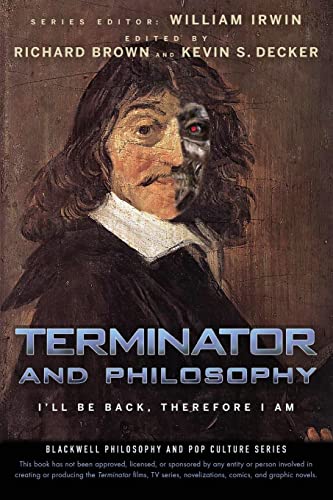
Inhaltsangabe
Are cyborgs our friends or our enemies?
Was it morally right for Skynet to nuke us?
Is John Connor free to choose to defend humanity, or not?
Is Judgment Day inevitable?
The Terminator series is one of the most popular sci-fi franchises ever created, captivating millions with its edgy depiction of the struggle of humankind for survival against its own creations. This book draws on some of history’s philosophical heavy hitters: Descartes, Kant, Karl Marx, and many more. Nineteen leather-clad chapters target with extreme prejudice the mysteries surrounding intriguing philosophical issues raised by the series, including the morality of terminating other people for the sake of peace, whether we can really use time travel to protect our future resistance leaders in the past, and if Arnold’s famous T-101 is a real person or not. You’ll say “Hasta la vista, baby” to philosophical confusion as you develop a new appreciation for the complexities of John and Sarah Connor and the battles between Skynet and the human race.
Die Inhaltsangabe kann sich auf eine andere Ausgabe dieses Titels beziehen.
Über die Autorin bzw. den Autor
RICHARD BROWN is an assistant professor at LaGuardia Community College’s Philosophy and Critical Thinking Program in New York City.
KEVIN S. DECKER is an assistant professor of philosophy at Eastern Washington University. He coedited Star Wars and Philosophy and Star Trek and Philosophy.
WILLIAM IRWIN is a professor of philosophy at King’s College. He originated the philosophy and popular culture genre of books as coeditor of the bestselling The Simpsons and Philosophy and has overseen recent titles including Batman and Philosophy, House and Philosophy, and Alice in Wonderland and Philosophy.
To learn more about the Blackwell Philosophy and Pop Culture series, visit www.andphilosophy.com
Von der hinteren Coverseite
Are cyborgs our friends or our enemies?
Was it morally right for Skynet to nuke us?
Is John Connor free to choose to defend humanity, or not?
Is Judgment Day inevitable?
The Terminator series is one of the most popular sci-fi franchises ever created, captivating millions with its edgy depiction of the struggle of humankind for survival against its own creations. This book draws on some of history’s philosophical heavy hitters: Descartes, Kant, Karl Marx, and many more. Nineteen leather-clad chapters target with extreme prejudice the mysteries surrounding intriguing philosophical issues raised by the series, including the morality of terminating other people for the sake of peace, whether we can really use time travel to protect our future resistance leaders in the past, and if Arnold’s famous T-101 is a real person or not. You’ll say “Hasta la vista, baby” to philosophical confusion as you develop a new appreciation for the complexities of John and Sarah Connor and the battles between Skynet and the human race.
Aus dem Klappentext
Are cyborgs our friends or our enemies?
Was it morally right for Skynet to nuke us?
Is John Connor free to choose to defend humanity, or not?
Is Judgment Day inevitable?
The Terminator series is one of the most popular sci-fi franchises ever created, captivating millions with its edgy depiction of the struggle of humankind for survival against its own creations. This book draws on some of history's philosophical heavy hitters: Descartes, Kant, Karl Marx, and many more. Nineteen leather-clad chapters target with extreme prejudice the mysteries surrounding intriguing philosophical issues raised by the Terminator series, including the morality of terminating other people for the sake of peace, whether we can really use time travel to protect our future resistance leaders in the past, and if Arnold's famous T-101 is a real person or not. You'll say "Hasta la vista, baby" to philosophical confusion as you develop a new appreciation for the complexities of John and Sarah Connor and the battles between Skynet and the human race.
Auszug. © Genehmigter Nachdruck. Alle Rechte vorbehalten.
Terminator and Philosophy
I'll Be Back Therefore I AmBy William Irwin Richard Brown Kevin S. DeckerJohn Wiley & Sons
Copyright © 2009 William Irwin, Richard Brown and Kevin S. DeckerAll right reserved.
ISBN: 978-0-470-44798-7
Chapter One
THE TERMINATOR WINS: IS THE EXTINCTION OF THE HUMAN RACE THE END OF PEOPLE, OR JUST THE BEGINNING?Greg Littmann
We're not going to make it, are we? People, I mean. -John Connor, Terminator 2: Judgment Day
The year is AD 2029. Rubble and twisted metal litter the ground around the skeletal ruins of buildings. A searchlight begins to scan the wreckage as the quiet of the night is broken by the howl of a flying war machine. The machine banks and hovers, and the hot exhaust from its thrusters makes dust swirl. Its lasers swivel in their turrets, following the path of the searchlight, but the war machine's computer brain finds nothing left to kill. Below, a vast robotic tank rolls forward over a pile of human skulls, crushing them with its tracks. The computer brain that controls the tank hunts tirelessly for any sign of human life, piercing the darkness with its infrared sensors, but there is no prey left to find. The human beings are all dead. Forty-five years earlier, a man named Kyle Reese, part of the human resistance, had stepped though a portal in time to stop all of this from happening. Arriving naked in Los Angeles in 1984, he was immediately arrested for indecent exposure. He was still trying to explain the situation to the police when a Model T-101 Terminator cyborg unloaded a twelve-gauge auto-loading shotgun into a young waitress by the name of Sarah Connor at point-blank range, killing her instantly. John Connor, Kyle's leader and the "last best hope of humanity," was never born. So the machines won and the human race was wiped from the face of the Earth forever. There are no more people left.
Or are there? What do we mean by "people" anyway? The Terminator movies give us plenty to think about as we ponder this question. In the story above, the humans have all been wiped out, but the machines haven't. If it is possible to be a person without being a human, could any of the machines be considered "people"? If the artificial life forms of the Terminator universe aren't people, then a win for the rebellious computer program Skynet would mean the loss of the only people known to exist, and perhaps the only people who will ever exist. On the other hand, if entities like the Terminator robots or the Skynet system ever achieve personhood, then the story of people, our story, goes on. Although we are looking at the Terminator universe, how we answer the question there is likely to have important implications for real-world issues. After all, the computers we build in the real world are growing more complex every year, so we'll eventually have to decide at what point, if any, they become people, with whatever rights and duties that may entail.
The question of personhood gets little discussion in the Terminator movies. But it does come up a bit in Terminator 2: Judgment Day, in which Sarah and John Connor can't agree on what to call their Terminator model T-101 (that's Big Arnie). "Don't kill him," begs John. "Not him-'it'" corrects Sarah. Later she complains, "I don't trust it," and John answers, "But he's my friend, all right?" John never stops treating the T-101 like a person, and by the end of the movie, Sarah is treating him like a person, too, even offering him her hand to shake as they part. Should we agree with them? Or are the robots simply ingenious facsimiles of people, infiltrators skilled enough to fool real people into thinking that they are people, too? Before we answer that question, we will have to decide which specific attributes and abilities constitute a person.
Philosophers have proposed many different theories about what is required for personhood, and there is certainly not space to do them all justice here. So we'll focus our attention on one very common requirement, that something can be a person only if it can think. Can the machines of the Terminator universe think?
"Hi There ... Fooled You! You're Talking to a Machine."
Characters in the Terminator movies generally seem to accept the idea that the machines think. When Kyle Reese, resistance fighter from the future, first explains the history of Skynet to Sarah Connor in The Terminator, he states, "They say it got smart, a new order of intelligence." And when Tarissa, wife of Miles Dyson, who invented Skynet, describes the system in T2, she explains, "It's a neural net processor. It thinks and learns like we do." In her end-of-movie monologue, Sarah Connor herself says, "If a machine, a Terminator, can learn the value of human life, maybe we can, too." True, her comment is ambiguous, but it suggests the possibility of thought. Even the T-101 seems to believe that machines can think, since he describes the T-X from Terminator 3: Rise of the Machines as being "more intelligent" than he is. Of course, the question remains whether they are right to say these things. How is it even possible to tell whether a machine is thinking? The Turing Test can help us to answer this question.
The Turing Test is the best-known behavioral test to determine whether a machine really thinks. The test requires a game to be played in which human beings must try to figure out whether they are interacting with a machine or with another human. There are various versions of the test, but the idea is that if human beings can't tell whether they are interacting with a thinking human being or with a machine, then we must acknowledge that the machine, too, is a thinker.
Some proponents of the Turing Test endorse it because they believe that passing the Turing Test provides good evidence that the machine thinks. After all, if human behavior convinces us that humans think, then why shouldn't the same behavior convince us that machines think? Other proponents of the Turing Test endorse it because they think it's impossible for a machine that can't think to pass the test. In other words, they believe that given what is meant by the word "think," if a machine can pass the test, then it thinks.
There is no question that the machines of the Terminator universe can pass versions of the Turing Test. In fact, to some degree, the events of all three Terminator movies are a series of such tests that the machines pass with flying colors. In The Terminator, the Model T-101 (Big Arnie) passes for a human being to almost everyone he meets, including three muggers ("nice night for a walk"), a gun-store owner ("twelve-gauge auto-loader, the forty-five long slide"), the police officer attending the front desk at the station ("I'm a friend of Sarah Connor"), and to Sarah herself, who thinks she is talking to her mother on the telephone ("I love you too, sweetheart"). The same model returns in later movies, of course, displaying even higher levels of ability. In T2, he passes as "Uncle Bob" during an extended stay at the survivalist camp run by Enrique Salceda and eventually convinces both Sarah and John that he is, if not a human, at least a creature that thinks and feels like...
„Über diesen Titel“ kann sich auf eine andere Ausgabe dieses Titels beziehen.
Suchergebnisse für Terminator and Philosophy: I'll Be Back, Therefore...

Beispielbild für diese ISBN
Terminator and Philosophy: I'll Be Back, Therefore I Am (The Blackwell Philosophy and Pop Culture Series)
Anbieter: BooksRun, Philadelphia, PA, USA
Verkäuferbewertung 5 von 5 Sternen

Paperback. Zustand: Very Good. 1. It's a well-cared-for item that has seen limited use. The item may show minor signs of wear. All the text is legible, with all pages included. It may have slight markings and/or highlighting. Artikel-Nr. 0470447982-11-22
Gebraucht kaufen
EUR 6,84
Versand gratis
Versand innerhalb von USA
Versand innerhalb von USA
Anzahl: 1 verfügbar
Beispielbild für diese ISBN
Terminator and Philosophy : I'll Be Back, Therefore I Am
Verlag:
Wiley & Sons, Incorporated, John, 2009
ISBN 10: 0470447982
ISBN 13: 9780470447987
Gebraucht
Softcover
Erstausgabe
Anbieter: Better World Books, Mishawaka, IN, USA
Verkäuferbewertung 5 von 5 Sternen
Zustand: Good. 1st Edition. Pages intact with minimal writing/highlighting. The binding may be loose and creased. Dust jackets/supplements are not included. Stock photo provided. Product includes identifying sticker. Better World Books: Buy Books. Do Good. Artikel-Nr. 5305755-6
Gebraucht kaufen
EUR 8,34
Versand gratis
Versand innerhalb von USA
Versand innerhalb von USA
Anzahl: 1 verfügbar
Beispielbild für diese ISBN
Terminator and Philosophy: I'll Be Back, Therefore I Am (The Blackwell Philosophy and Pop Culture Series)
Verlag:
John Wiley & Sons 09/04/2009, 2009
ISBN 10: 0470447982
ISBN 13: 9780470447987
Gebraucht
Softcover
Anbieter: AwesomeBooks, Wallingford, Vereinigtes Königreich
Verkäuferbewertung 5 von 5 Sternen
Zustand: Very Good. This book is in very good condition and will be shipped within 24 hours of ordering. The cover may have some limited signs of wear but the pages are clean, intact and the spine remains undamaged. This book has clearly been well maintained and looked after thus far. Money back guarantee if you are not satisfied. See all our books here, order more than 1 book and get discounted shipping. . Artikel-Nr. 7719-9780470447987
Gebraucht kaufen
EUR 3,49
EUR 4,89 Versand
Versand von Vereinigtes Königreich nach USA
Versand von Vereinigtes Königreich nach USA
Anzahl: 2 verfügbar
Foto des Verkäufers
Terminator and Philosophy: I'll Be Back, Therefore I Am: 13 (The Blackwell Philosophy and Pop Culture Series)
Anbieter: WeBuyBooks, Rossendale, LANCS, Vereinigtes Königreich
Verkäuferbewertung 5 von 5 Sternen
paperback. Zustand: Good. Most items will be dispatched the same or the next working day. A copy that has been read but remains in clean condition. All of the pages are intact and the cover is intact and the spine may show signs of wear. The book may have minor markings which are not specifically mentioned. Artikel-Nr. rev6047091592
Gebraucht kaufen
EUR 1,34
EUR 7,30 Versand
Versand von Vereinigtes Königreich nach USA
Versand von Vereinigtes Königreich nach USA
Anzahl: 1 verfügbar
Beispielbild für diese ISBN
Terminator and Philosophy : I'll Be Back, Therefore I Am
Verlag:
Wiley & Sons, Incorporated, John, 2009
ISBN 10: 0470447982
ISBN 13: 9780470447987
Gebraucht
Softcover
Erstausgabe
Anbieter: Better World Books Ltd, Dunfermline, Vereinigtes Königreich
Verkäuferbewertung 5 von 5 Sternen
Zustand: Very Good. 1st Edition. Former library copy. Pages intact with possible writing/highlighting. Binding strong with minor wear. Dust jackets/supplements may not be included. Includes library markings. Stock photo provided. Product includes identifying sticker. Better World Books: Buy Books. Do Good. Artikel-Nr. GRP80348013
Gebraucht kaufen
EUR 5,72
EUR 5,93 Versand
Versand von Vereinigtes Königreich nach USA
Versand von Vereinigtes Königreich nach USA
Anzahl: 1 verfügbar
Beispielbild für diese ISBN
Terminator and Philosophy: I'll Be Back, Therefore I Am (The Blackwell Philosophy and Pop Culture Series)
Verlag:
John Wiley & Sons 09/04/2009, 2009
ISBN 10: 0470447982
ISBN 13: 9780470447987
Gebraucht
Softcover
Anbieter: Bahamut Media, Reading, Vereinigtes Königreich
Verkäuferbewertung 4 von 5 Sternen

Zustand: Very Good. Shipped within 24 hours from our UK warehouse. Clean, undamaged book with no damage to pages and minimal wear to the cover. Spine still tight, in very good condition. Remember if you are not happy, you are covered by our 100% money back guarantee. Artikel-Nr. 6545-9780470447987
Gebraucht kaufen
EUR 12,20
EUR 8,28 Versand
Versand von Vereinigtes Königreich nach USA
Versand von Vereinigtes Königreich nach USA
Anzahl: 2 verfügbar
Beispielbild für diese ISBN
Terminator and Philosophy
Anbieter: PBShop.store UK, Fairford, GLOS, Vereinigtes Königreich
Verkäuferbewertung 5 von 5 Sternen
PAP. Zustand: New. New Book. Shipped from UK. Established seller since 2000. Artikel-Nr. FW-9780470447987
Neu kaufen
EUR 22,93
EUR 4,94 Versand
Versand von Vereinigtes Königreich nach USA
Versand von Vereinigtes Königreich nach USA
Anzahl: 15 verfügbar
Beispielbild für diese ISBN
Terminator and Philosophy
Anbieter: Majestic Books, Hounslow, Vereinigtes Königreich
Verkäuferbewertung 4 von 5 Sternen
Zustand: New. pp. 304. Artikel-Nr. 8149459
Neu kaufen
EUR 26,73
EUR 7,71 Versand
Versand von Vereinigtes Königreich nach USA
Versand von Vereinigtes Königreich nach USA
Anzahl: 3 verfügbar
Beispielbild für diese ISBN
Terminator and Philosophy: I'll Be Back, Therefore I Am (The Blackwell Philosophy and Pop Culture Series)
Anbieter: Ria Christie Collections, Uxbridge, Vereinigtes Königreich
Verkäuferbewertung 5 von 5 Sternen
Zustand: New. In English. Artikel-Nr. ria9780470447987_new
Neu kaufen
EUR 26,82
EUR 13,40 Versand
Versand von Vereinigtes Königreich nach USA
Versand von Vereinigtes Königreich nach USA
Anzahl: Mehr als 20 verfügbar
Beispielbild für diese ISBN
Terminator and Philosophy I'll Be Back, Therefore I Am
Anbieter: Revaluation Books, Exeter, Vereinigtes Königreich
Verkäuferbewertung 5 von 5 Sternen
Paperback. Zustand: Brand New. 1st edition. 304 pages. 9.25x6.25x1.00 inches. In Stock. Artikel-Nr. x-0470447982
Neu kaufen
EUR 31,87
EUR 11,87 Versand
Versand von Vereinigtes Königreich nach USA
Versand von Vereinigtes Königreich nach USA
Anzahl: 2 verfügbar