
Verwandte Artikel zu How Math Can Save Your Life: (and Make You Rich, Help...
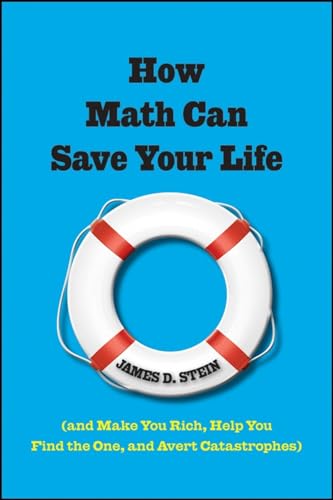
How Math Can Save Your Life: (and Make You Rich, Help You Find the One, and Avert Catastrophes) - Hardcover
Inhaltsangabe
How to make lots of money, keep yourself safe, and even save the world-all by using a little simple math
Forget the dull, boring math you learned in school. This book shows you the powerful things math can do for you, with applications no teacher ever taught you in algebra class. How can you make money off credit card companies? Will driving a hybrid save you money in the long run? How do you know when he or she is ""the one""?
From financial decisions to your education, job, health, and love life, you'll learn how the math you already know can help you get a lot more out of life.
- Gives you fun, practical advice for using math to improve virtually every area of daily life
- Includes straightforward explanations and easy-to-follow examples
- Written by the author of the successful guide, How Math Explains the World
Filled with practical, indispensable guidance you can put to work every day, this book will safeguard your wallet and enrich every aspect of your life. You can count on it!
Die Inhaltsangabe kann sich auf eine andere Ausgabe dieses Titels beziehen.
Über die Autorin bzw. den Autor
James D. Stein is the author of How Math Explains the World: A Guide to the Power of Numbers, From Car Repair to Modern Physics and is a professor of mathematics at California State University, Long Beach. A graduate of Yale University and the University of California, Berkeley, he has taught college math for more than forty years.
Von der hinteren Coverseite
Are service contracts for electronics just a scam?
Should your lottery ticket contain numbers greater than 31?
How do you know when he or she is "the one"?
How Math Can Save Your Life shows you how to use basic arithmetic to answer these and many other questions that come up in everyday life. You'll discover how simple math can make you lots of money, keep you safe, and even save the world. Not bad for something you learned back in grade school.
Filled with practical, indispensable guidance you can put to work every day, this book will safeguard your wallet and enrich every aspect of your life.
"Even if you hated math in school, you'll like this book. Jim Stein presents math the way I wish my teachers had: as a practical tool that can be used to solve everyday problems in the real world. Using down-to-earth langauge and real-life examples, Stein shows how even quick, back-of-the-envelope math can help us avoid costly errors."
—Joseph T. Hallinan, author of Why We Make Mistakes
"Stein pulls off a literary hat trick by writing a book about mathematics that is fun, friendly and factual. It's the definitive answer to the student's question, 'When will I ever need this stuff?'"
—Leonard Wapner, author of The Pea and the Sun: A Mathematical Paradox
Learn how a little math can help:
Avert disasters
Beat the bookies
Boost your grades
Extend your life expectancy
Fix the economy
Improve your love life
Make you rich
Win arguments
And much more!
Aus dem Klappentext
Forget algebra, geometry, trigonometry, and calculus. Even if you've never been a whiz at math, you can save lots of money and make your life better in all kinds of ways simply by using the basic arithmetic you learned when you were in grade school. How Math Can Save Your Life shows you how.
Would refinancing your house actually save you money? Which car insurance policy is the best deal? Is Internet dating worth it? This practical, thought-provoking book does the math to help you answer these and a whole host of other everyday, real-world questions. It also lets you see how to apply math to tackle all kinds of vexing issues, from the quirky (Why are women thought of as fickle while men are regarded as steadfast? What are the chances that extraterrestrials will attack the Earth?) to the philosophical (How much is a human life worth in dollars? When will the world end?).
Along the way, you will learn the crucial concept of expected value, the single most useful idea in mathematics, and one that can be worth hundreds of thousands of dollars to you over your lifetime. You'll be able to spot common mistakes people make when using percentages or constructing a logical argument. You'll also get a fresh take on the purpose and process of addition, subtraction, multiplication, and division that will give you a new respect for these math workhorses and give you a head start if you ever need to teach them to kids.
So, should you spend the money to buy this book? If you let the numbers guide you, you'll do a simple risk/reward calculation and find that the answer is to head straight over to checkout. It will be worth it. You can count on it!
Auszug. © Genehmigter Nachdruck. Alle Rechte vorbehalten.
How Math Can Save Your Life
(And Make You Rich, Help You Find The One, and Avert Catastrophes)By James D. SteinJohn Wiley & Sons
Copyright © 2010 John Wiley & Sons, LtdAll right reserved.
ISBN: 978-0-470-43775-9
Chapter One
The Most Valuable Chapter You Will Ever Read
Are service contracts for electronics and appliances just a scam?
* * *
How likely are you to win at roulette?
* * * Is it worth going to college?
What constitutes value? On a philosophical level, I'm not sure; what's valuable for one person may not be for others. The most philosophically valuable thing I've ever learned is that bad times are always followed by good times and vice versa, but that may simply be a lesson specific to yours truly. On the other hand, if this lesson helps you, that's value added to this chapter. And if this chapter helps you financially, even better-because there is one universal common denominator of value that everyone accepts: money.
That's why this chapter is valuable, because I'm going to discuss a few basic concepts that will be worth tens of thousands-maybe even hundreds of thousands-of dollars to you. So let's get started.
Service Contracts: This Is Worth Thousands of Dollars
A penny saved is still a penny earned, but nowadays you can't even slip a penny into a parking meter-so let me make this book a worthwhile investment by saving you a few thousand dollars. The next time you go to buy an appliance and the salesperson offers you a service contract, don't even consider purchasing it. A simple table and a little sixth-grade math should convince you.
Suppose you are interested in buying a refrigerator. A basic model costs in the vicinity of $400, and you'll be offered the opportunity to buy a service contract for around $100. If anything happens to the refrigerator during the first three years, the store will send a repairman to your apartment to fix it. The salesperson will try to convince you that it's cheap insurance in case anything goes wrong, but it's not. Let's figure out why. Here is a table of how frequently various appliances need to be repaired. I found this table by typing "refrigerator repair rates" into a search engine; it's the 2006 product reliability survey from Consumer Reports National Research Center. It's very easy to read: the top line tells you that 43 percent of laptop computers need to be repaired in the first three years after they are purchased.
Use this chart, do some sixth-grade arithmetic, and you can save thousands of dollars during the course of a lifetime. For instance, with the refrigerator service contract, a refrigerator with a top-and-bottom freezer and no icemaker needs to be repaired in the first three years approximately 12 percent of the time; that's about one time in eight. So if you were to buy eight refrigerators and eight service contracts, the cost of the service contracts would be 8 $100 = $800. Yet you'd need to make only a single repair call, on average, which would cost you $200. So, if you had to buy eight refrigerators, you'd save $800 - $200 = $600 by not buying the service contracts: an average saving of $600/8 = $75 per refrigerator. Admittedly, you're not going to buy eight refrigerators-at least, not all at once. Even if you buy fewer than eight refrigerators over the course of a lifetime, you'll probably buy a hundred or so items listed in the table. Play the averages, and just like the casinos in Las Vegas, you'll show a big profit in the long run.
You can save a considerable amount of money by using the chart. There are basically two ways to do it. The first is to do the computation as I did above, estimating the cost of a service call (I always figure $200-that's $100 to get the repairman to show up and $100 for parts). The other is a highly conservative approach, in which you figure that if something goes wrong, you've bought a lemon, and you'll have to replace the appliance. If the cost of the service contract is more than the average replacement cost, purchasing a service contract is a sucker play.
For instance, suppose you buy a microwave oven for $300. The chart says this appliance breaks down 17 percent of the time-one in six. To compute the average replacement cost, simply multiply $300 by 17/100 (or 1/6 for simplicity)-the answer is about $50. If the service contract costs $50 or more, they're ripping you off big-time. Incidentally, note that a side-by-side refrigerator with icemaker and dispenser will break down three times as often as the basic model. How can you buy something that breaks down 37 percent of the time in a three-year period? I'd save myself the aggravation and do things the old-fashioned way, by pouring water into ice trays.
Finally, notice that TVs almost never break down. I had a 25-inch model I bought in the mid-eighties that lasted seventeen years. Admittedly, I did have to replace the picture tube once. Digital cameras are pretty reliable, too.
The long-term average resulting from a course of action is called the expected value of that action. In my opinion, expected value is the single most bottom-line useful idea in mathematics, and I intend to devote a lot of time to exploring what you can do with it. In deciding whether to purchase the refrigerator service contract, we looked at the expected value of two actions. The first, buying the contract, has an expected value of $100; the minus sign occurs because it is natural to think of expected value in terms of how it affects your bottom line, and in this case your bottom line shows a loss of $100. The second, passing it up, has an expected value of $25; remember, if you bought eight refrigerators, only one would need a repair costing $200, and $200/8 = $25. In many situations, we are confronted with a choice between alternatives that can be resolved by an expected-value calculation. Over the course of a lifetime, such calculations are worth a minimum of tens of thousands of dollars to you-and, as you'll see, they can be worth hundreds of thousands of dollars, or more, to you. This type of cost-effective mathematical projection can be worth millions of dollars to small organizations and billions to large ones, such as nations. It can even be used in preventing catastrophes that threaten all of humanity. That's why this type of math is valuable.
Averages: The Most Important Concept in Mathematics
Now you know my opinion, but I'm not the only math teacher who believes this: averages play a significant role in all of the basic mathematical subjects and in many of the advanced ones. You just saw a simple example of an average regarding service contracts. Averages play a significant role in our everyday use of and exposure to mathematics. Simply scanning through a few sections of today's paper, I found references to the average household income, the average per-screen revenue of current motion pictures, the scoring averages of various basketball players, the average age of individuals when they first became president, and on and on.
So, what is an average? When one has a collection of numbers, such as the income of each household in America, one simply adds up all of those...
„Über diesen Titel“ kann sich auf eine andere Ausgabe dieses Titels beziehen.
Suchergebnisse für How Math Can Save Your Life: (and Make You Rich, Help...

Beispielbild für diese ISBN
How Math Can Save Your Life: (And Make You Rich, Help You Find The One, and Avert Catastrophes)
Anbieter: World of Books (was SecondSale), Montgomery, IL, USA
Verkäuferbewertung 5 von 5 Sternen

Zustand: Good. Good condition ex-library book with usual library markings and stickers. Artikel-Nr. 00105212420
Gebraucht kaufen
EUR 6,45
Versand gratis
Versand innerhalb von USA
Versand innerhalb von USA
Anzahl: 1 verfügbar
Beispielbild für diese ISBN
How Math Can Save Your Life: (And Make You Rich, Help You Find The One, and Avert Catastrophes)
Anbieter: World of Books (was SecondSale), Montgomery, IL, USA
Verkäuferbewertung 5 von 5 Sternen
Zustand: Very Good. Item in very good condition! Textbooks may not include supplemental items i.e. CDs, access codes etc. Artikel-Nr. 00097152436
Gebraucht kaufen
EUR 6,45
Versand gratis
Versand innerhalb von USA
Versand innerhalb von USA
Anzahl: 1 verfügbar
Beispielbild für diese ISBN
How Math Can Save Your Life : (and Make You Rich, Help You Find the One, and Avert Catastrophes)
Verlag:
Wiley & Sons Canada, Limited, John, 2010
ISBN 10: 0470437758
ISBN 13: 9780470437759
Gebraucht
Hardcover
Erstausgabe
Anbieter: Better World Books: West, Reno, NV, USA
Verkäuferbewertung 5 von 5 Sternen
Zustand: Good. 1st Edition. Former library copy. Pages intact with minimal writing/highlighting. The binding may be loose and creased. Dust jackets/supplements are not included. Includes library markings. Stock photo provided. Product includes identifying sticker. Better World Books: Buy Books. Do Good. Artikel-Nr. GRP89148674
Gebraucht kaufen
EUR 6,46
Versand gratis
Versand innerhalb von USA
Versand innerhalb von USA
Anzahl: 1 verfügbar
Beispielbild für diese ISBN
How Math Can Save Your Life : (and Make You Rich, Help You Find the One, and Avert Catastrophes)
Verlag:
Wiley & Sons Canada, Limited, John, 2010
ISBN 10: 0470437758
ISBN 13: 9780470437759
Gebraucht
Hardcover
Erstausgabe
Anbieter: Better World Books, Mishawaka, IN, USA
Verkäuferbewertung 5 von 5 Sternen
Zustand: Very Good. 1st Edition. Former library copy. Pages intact with possible writing/highlighting. Binding strong with minor wear. Dust jackets/supplements may not be included. Includes library markings. Stock photo provided. Product includes identifying sticker. Better World Books: Buy Books. Do Good. Artikel-Nr. GRP102617180
Gebraucht kaufen
EUR 6,46
Versand gratis
Versand innerhalb von USA
Versand innerhalb von USA
Anzahl: 1 verfügbar
Beispielbild für diese ISBN
How Math Can Save Your Life: (And Make You Rich, Help You Find the One, and Avert Catastrophes)
Anbieter: ThriftBooks-Dallas, Dallas, TX, USA
Verkäuferbewertung 5 von 5 Sternen
Hardcover. Zustand: Good. No Jacket. Pages can have notes/highlighting. Spine may show signs of wear. ~ ThriftBooks: Read More, Spend Less. Artikel-Nr. G0470437758I3N00
Gebraucht kaufen
EUR 8,58
Versand gratis
Versand innerhalb von USA
Versand innerhalb von USA
Anzahl: 1 verfügbar
Beispielbild für diese ISBN
How Math Can Save Your Life: (And Make You Rich, Help You Find the One, and Avert Catastrophes)
Anbieter: Revaluation Books, Exeter, Vereinigtes Königreich
Verkäuferbewertung 5 von 5 Sternen
Hardcover. Zustand: Brand New. 1st edition. 256 pages. 9.25x6.00x1.00 inches. In Stock. Artikel-Nr. 0470437758
Neu kaufen
EUR 27,60
EUR 11,63 Versand
Versand von Vereinigtes Königreich nach USA
Versand von Vereinigtes Königreich nach USA
Anzahl: 1 verfügbar